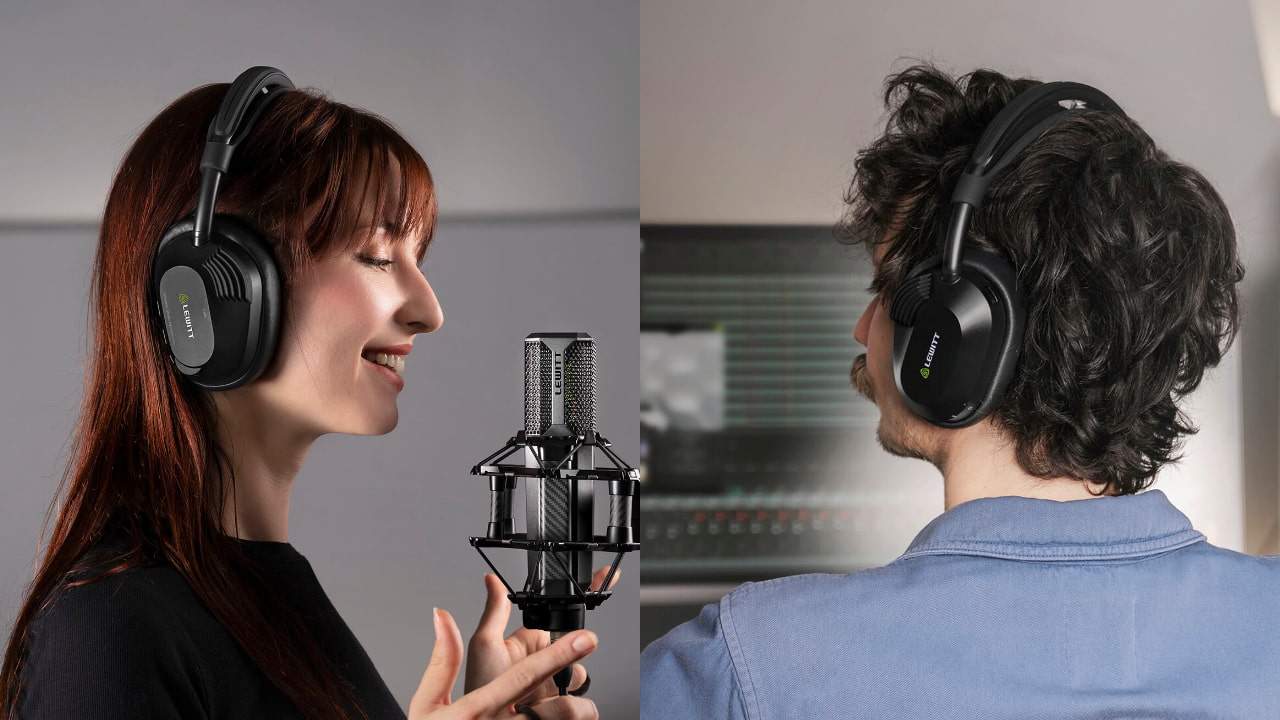
Bluetooth has become very good at convenience. The trouble begins when you ask it to behave like a cable inside a recording studio, where latency, compression, and synchronization are not features engineers are particularly interested in negotiating with.
A vocalist monitoring their own voice or a musician tracking an instrument needs to hear what is happening almost immediately. Nobody in the control room really cares how impressive the codec logo looks when the performance arrives late.
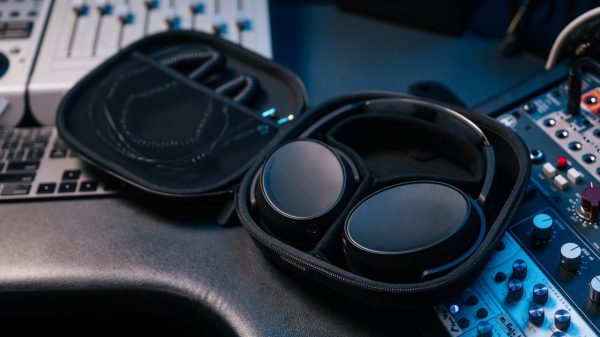
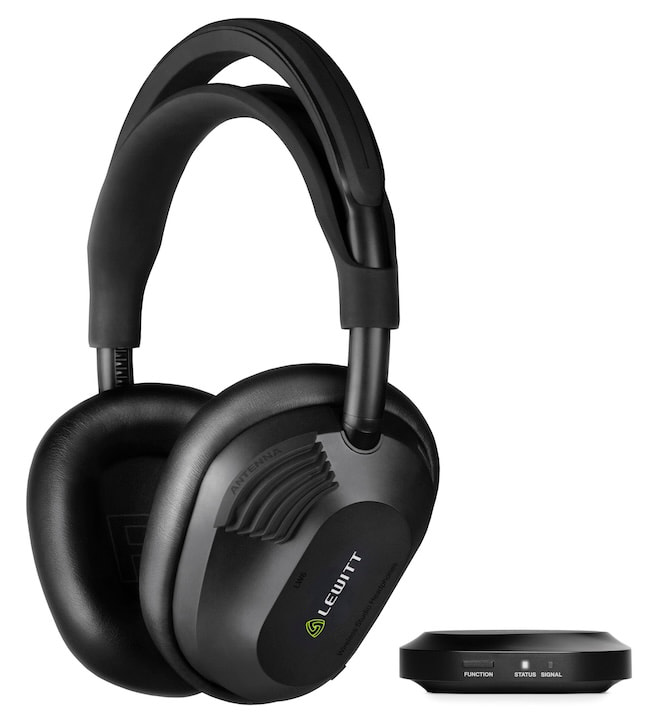
That is the problem LEWITT is attempting to solve with its new LW6 Wireless Studio Headphones, a $699 closed-back design that uses Ultra-Wideband (UWB) wireless technology rather than Bluetooth for its primary professional audio connection.
More specifically, LEWITT’s RealSound wireless system uses LE-UWB technology from SPARK Microsystems to deliver uncompressed PCM audio with 5.8 milliseconds of latency, a 1,728 kbps data rate, 110 dB of dynamic range, and an operating range of up to 5 meters or 16.4 feet. SPARK describes the LW6 as its commercial entry into the professional audio market.
That makes the LW6 considerably more interesting than another wireless headphone with a new Bluetooth codec.
Related Reading:
Bluetooth Is Getting Some New Competition
The timing is rather interesting.
We just examined Qualcomm’s Snapdragon Sound Elite Gen 2, which adds micro-power Wi-Fi 6E and XPAN technology to future wireless headphones and earbuds. Qualcomm’s idea is that Wi-Fi can handle higher-bandwidth lossless audio and other demanding applications while Bluetooth remains available when power efficiency and universal compatibility are more important.
LEWITT and SPARK are approaching the same fundamental problem from a different direction.
Instead of adding Wi-Fi, the LW6 uses LE-UWB, or Low Energy Ultra-Wideband, for its RealSound connection. SPARK’s implementation is based on impulse-radio UWB technology but has been developed as a high-speed short-range data connection rather than primarily for the ranging and positioning applications commonly associated with UWB.
In other words, this is not AirTag technology wearing expensive headphones and hoping nobody notices.
SPARK designed LE-UWB around deterministic low latency, high throughput, and low power consumption for applications where data needs to arrive quickly and predictably. In the LW6, that technology is being used specifically to move uncompressed audio between LEWITT’s included transmitter and the headphones.
We Have Already Seen UWB in High-End Audio
UWB audio itself is not entirely new.
We have already covered its use in the Focal Diva Utopia family, including the $210,000 Diva Alta Utopia, which uses UWB for the wireless connection between its left and right loudspeakers. That system can transmit 24-bit/96kHz audio wirelessly between the speakers without compression.
SPARK also confirmed earlier this year that its LE-UWB technology powers the wireless connection inside the Diva Alta Utopia.
The LW6 moves that concept into headphones, where latency becomes considerably more important. A small delay between two loudspeakers can be managed by the system; hearing your own guitar, drums, or vocals noticeably behind the actual performance is another matter entirely.
LEWITT RealSound
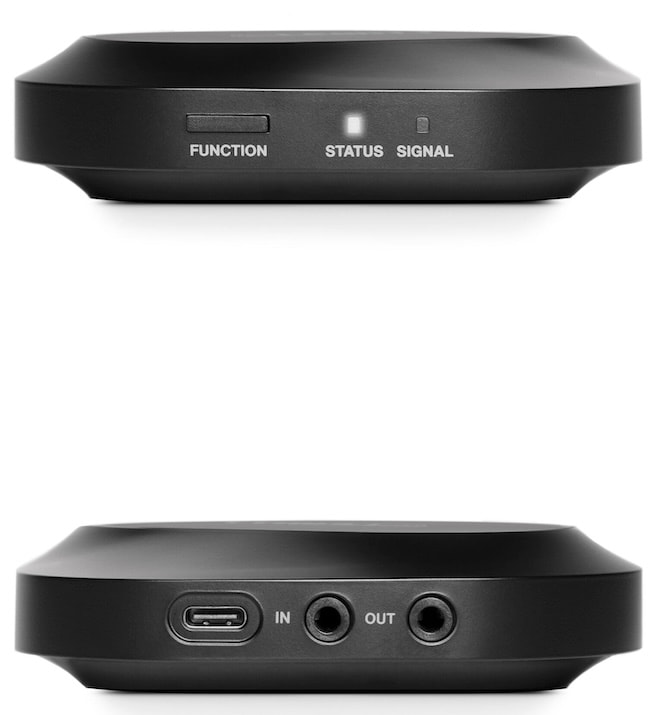
The supplied LW TX RealSound transmitter can connect directly to a computer using USB-C or to the headphone output of an audio interface using its 3.5 mm analog input.
The transmitter itself supports USB audio up to 24-bit/96kHz, while the RealSound wireless link delivers uncompressed PCM audio at 1,728 kbps with the aforementioned 5.8 ms latency. LEWITT also provides a 3.5 mm analog output on the transmitter.
There is one important limitation to understand: RealSound is a short-range dedicated connection, not a universal replacement for Bluetooth. Its specified range is only 5 meters, which makes complete sense inside a studio but somewhat less useful if your recording console happens to be located across the parking lot.
Bluetooth remains onboard for everything else.
The LW6 supports Bluetooth 5.3 with SBC and AAC, with LEWITT claiming a range of approximately 40 meters. There is no aptX Adaptive, aptX Lossless, or LDAC because the higher-performance studio connection is handled separately by RealSound.
That separation may prove to be one of the smarter aspects of the design.
Instead of trying to force Bluetooth to handle professional monitoring, LEWITT uses UWB for the demanding job and leaves Bluetooth available for phones, tablets, and casual listening.
Closed-Back Headphones Designed for Studio Work
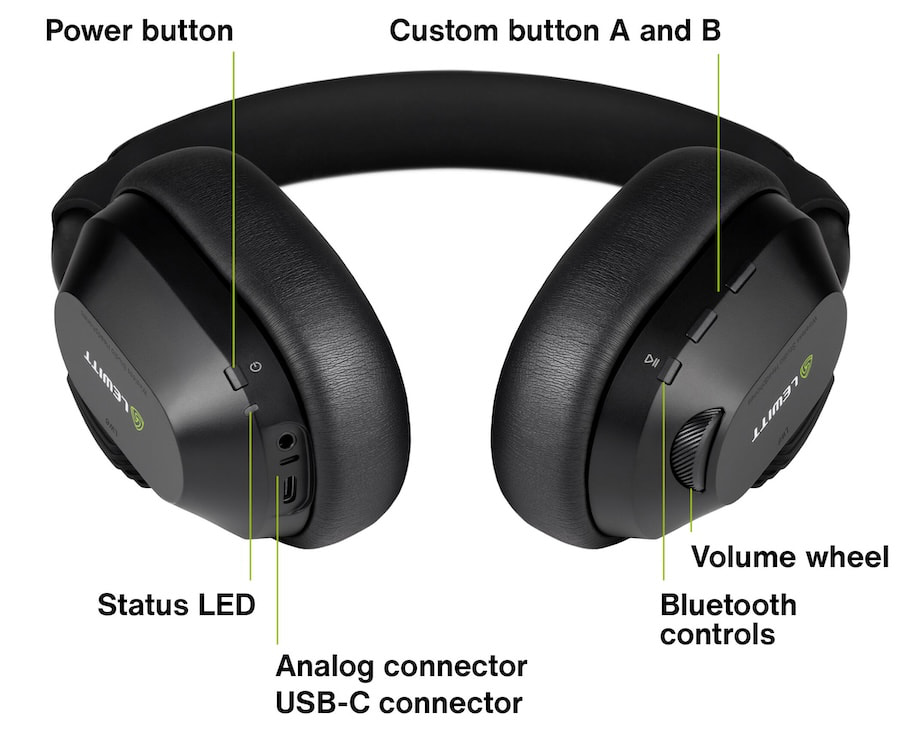
The LW6 uses a 40 mm dynamic driver with a bio-cellulose diaphragm inside a closed-back enclosure. Frequency response is rated from 20Hz to 20kHz, impedance is 32 ohms, sensitivity is 114 dB SPL/V, and maximum output is specified at 121 dB SPL. Weight is 358 grams.
LEWITT also took an interesting approach to tuning.
Rather than relying solely on conventional headphone measurement fixtures, the company used MIRE measurements, which place small microphones inside the ear canals of actual listeners. LEWITT says this allowed its engineers to account for differences in ear anatomy, head shape, hair, glasses, and headphone seal while developing the LW6’s target response.
The goal is to provide the isolation required for tracking and recording while maintaining the tonal characteristics engineers often prefer from open-back headphones.
We will reserve judgment on whether LEWITT achieved that until someone actually puts them on our head. We have all met enough products that were “reference” right up until the first cymbal crash.
DSP and Studio Tools
The LW6 is not relying solely on its wireless connection to justify the $699 asking price.
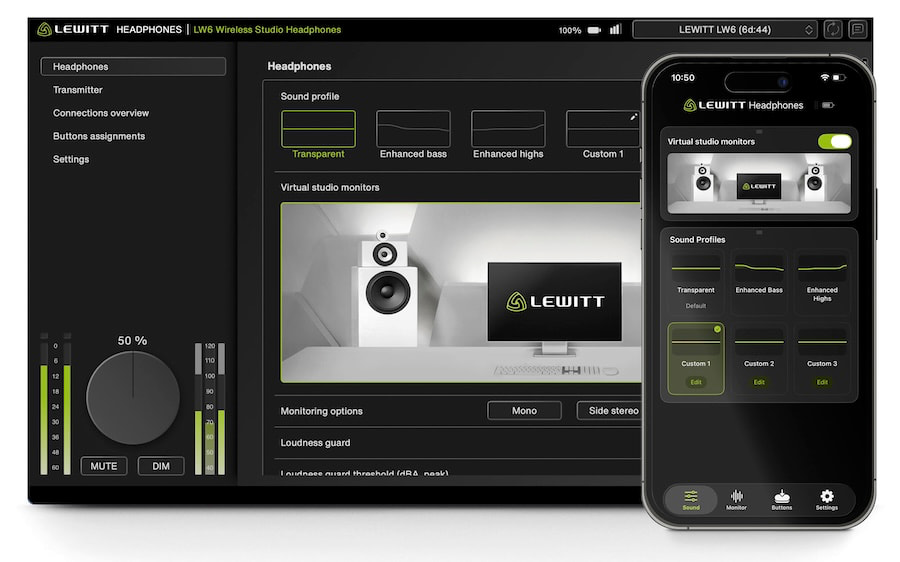
LEWITT includes a substantial collection of onboard DSP features controlled through its HEADPHONES desktop software and mobile app:
- 5-band customizable EQ
- Three user EQ profiles stored directly on the headphones
- Virtual studio monitor processing
- Loudness Guard
- Mono, side stereo, side mono, and left/right monitoring checks
- Three programmable target volume levels
- Two customizable hardware buttons
- K-metering support for mastering and broadcast
The LW6 also includes a license for LEWITT Space Replicator Essential, which provides virtual studio environments and additional mix translation tools.
Battery life is rated at 21 hours using RealSound, with a full recharge taking approximately 80 minutes. A 15-minute charge can provide around three additional hours of playback.
USB-C audio is also supported directly through the headphones at up to 24-bit/96kHz, along with a conventional 3.5 mm analog input.
Specifications:
- Type: Closed-back wireless studio headphones
- Driver: 40 mm bio-cellulose dynamic
- Frequency Response: 20Hz–20kHz
- Impedance: 32 ohms
- Sensitivity: 114 dB SPL/V
- Max SPL: 121 dB
- Weight: 358 g / 12.6 oz
- RealSound Wireless: LE-UWB, uncompressed PCM
- Latency: 5.8 ms
- Data Rate: 1,728 kbps
- Dynamic Range: 110 dB(A)
- RealSound Range: 5 m / 16.4 ft
- Bluetooth: 5.3 with SBC and AAC
- Bluetooth Range: Approx. 40 m / 130 ft
- USB-C Audio: Up to 24-bit/96kHz
- Analog Input: 3.5 mm
- Battery Life: Up to 21 hours with RealSound
- Charging: 80 minutes; 15-minute charge provides approx. 3 hours
The Bottom Line
The LW6 is not evidence that Bluetooth is about to disappear.
It is evidence that audio manufacturers are becoming less willing to pretend Bluetooth needs to handle every wireless application.
Our recent look at whether wireless headphones really need 24-bit/192kHz audio raised precisely this issue. Better drivers, amplification, DSP, and DAC stages have pushed wireless headphones forward considerably, but the connection between the source and headphone remains an important part of the equation.
HiFiMAN has already explored another route with the HE1000 WiFi, which moves high-resolution playback onto Wi-Fi rather than relying exclusively on Bluetooth. We found genuine sonic advantages there, although battery life and usability demonstrated that changing the wireless transport does not magically erase every engineering compromise.
LEWITT’s approach is narrower but arguably more practical for its intended audience.
It does not need RealSound to work everywhere. It needs it to deliver stable, uncompressed, nearly real-time audio across a recording room, while Bluetooth handles ordinary listening outside of that environment.
Qualcomm is betting that Wi-Fi will become a second wireless pipeline for premium consumer headphones. LEWITT and SPARK are demonstrating that UWB can perform a similar role where latency matters even more.
Bluetooth isn’t dead. Far from it.
But 2026 is starting to look like the year the audio industry finally stopped asking it to do every job in the building.
Price & Availability
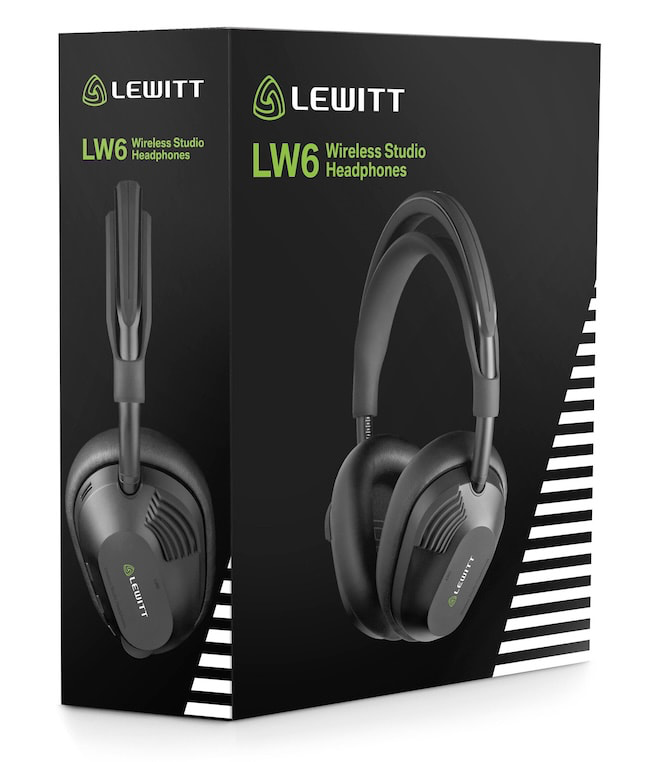
The LEWITT LW6 Wireless Studio Headphones are priced at $699 USD and include LW TX RealSound UWB transmitter, cables, adapters, transport pouch, and Space Replicator Essential software..
Related Reading:
- Do Wireless Headphones Need 24-Bit/192kHz Lossless Audio? Major Brands Disagree
- Sonos Ace “Ultra” Headphones Surface In FCC Filing: Will They Finally Work Like Sonos?
- Sony 1000X THE COLLEXION Headphones Review: A $650 Upgrade Or An Expensive Fashion Statement?
- Video Review: New Beats 360 Wireless Headphones Change Everything!