When Topping, one of the pioneers of the affordable DAC and headphone amplifier category, agreed to send the newly released DX1 II in for review, I was genuinely excited.
I had spent time with the original DX1 and came away impressed. It earned its reputation by doing something straightforward rather well: delivering clean, compact, USB-powered DAC/amp performance for budget-conscious headphone listeners without feeling like an afterthought. At the time, that mattered.
The Topping DX1 II is not a mild facelift. It is a complete redesign with new components, updated technology, balanced headphone output, PEQ, optical connectivity, headset support, line outputs, console compatibility, and considerably broader ambitions than its predecessor. At $119, it looks like a very aggressive value proposition.
Of course, Topping is not alone in this price range. Schiit and FiiO both offer serious competition for desktop listeners looking to improve their headphone or powered-speaker setups without spending silly money. So, how versatile is the DX1 II in actual use, and more importantly, does it sound good enough to make those rivals nervous?
Related Reviews:
- Apos X Community Gremlin Tube Headphone Amplifier Review: The Little Monster That Crawled Out Of The Upside Down
- FiiO Jade Audio LEVEL 1 Desktop Amp Debuts At High End Vienna 2026 With 300 Watts For $139
Technology, Features and Specifications
The DX1 II is built around ESS’s ES9039Q2M DAC chip and an XMOS XU316 USB controller, with PCM support up to 32-bit/384kHz and DSD256 via DoP. Topping also claims a balanced line-output THD+N figure below 0.00007%, a 128dB SNR, and a 3.5mm low-gain noise floor below 0.9µVrms.
All of these numbers represent upgrades over the original DX1, and they reveal exactly what Topping is trying to accomplish here: deliver a measurement-focused desktop DAC/headphone amp at a price that still falls into impulse-buy territory for a lot of headphone listeners.
One of the biggest gains comes in the power department. The 4.4mm balanced headphone output is rated at 1,000mW x2 into 32 ohms, while the 3.5mm single-ended output is rated at 800mW x2 into 16 ohms. That does not make the DX1 II a replacement for a serious high-current desktop amplifier, but it pushes the little Topping well beyond typical dongle territory. It should have enough muscle for efficient planars, most dynamic-driver headphones, and sensitive IEMs used at a desk. We will get into the DX1 II’s real-world drivability later in the review.
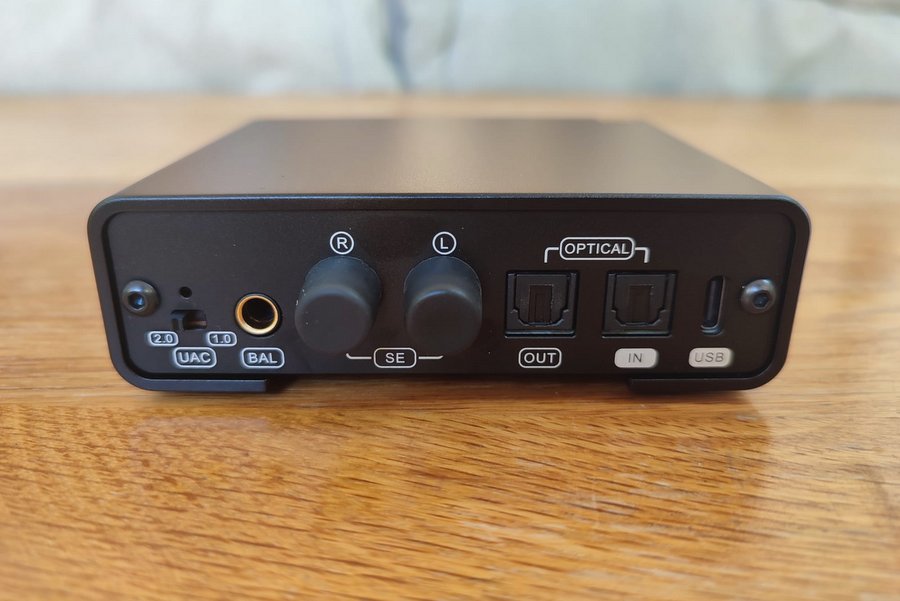
Connectivity is unusually broad for $119. The DX1 II includes USB-C, optical input and output, RCA line output, a 4.4mm balanced line output, a 3.5mm headphone/headset jack, and a 4.4mm balanced headphone output. It also supports both UAC 1.0 and UAC 2.0, allowing it to work with computers, tablets, Nintendo Switch, and PlayStation consoles.
The 10-band PEQ is the feature that most clearly separates the DX1 II from older budget DAC/amps. Topping’s software allows adjustment of frequency, gain, Q, and left/right channels, with up to three profiles saved directly to the device. For headphone listeners, that means the ability to tame a hot treble peak, add sub-bass to a lean planar, or create a gaming-focused profile without relying on system-wide EQ software running in the background.
Design & Build
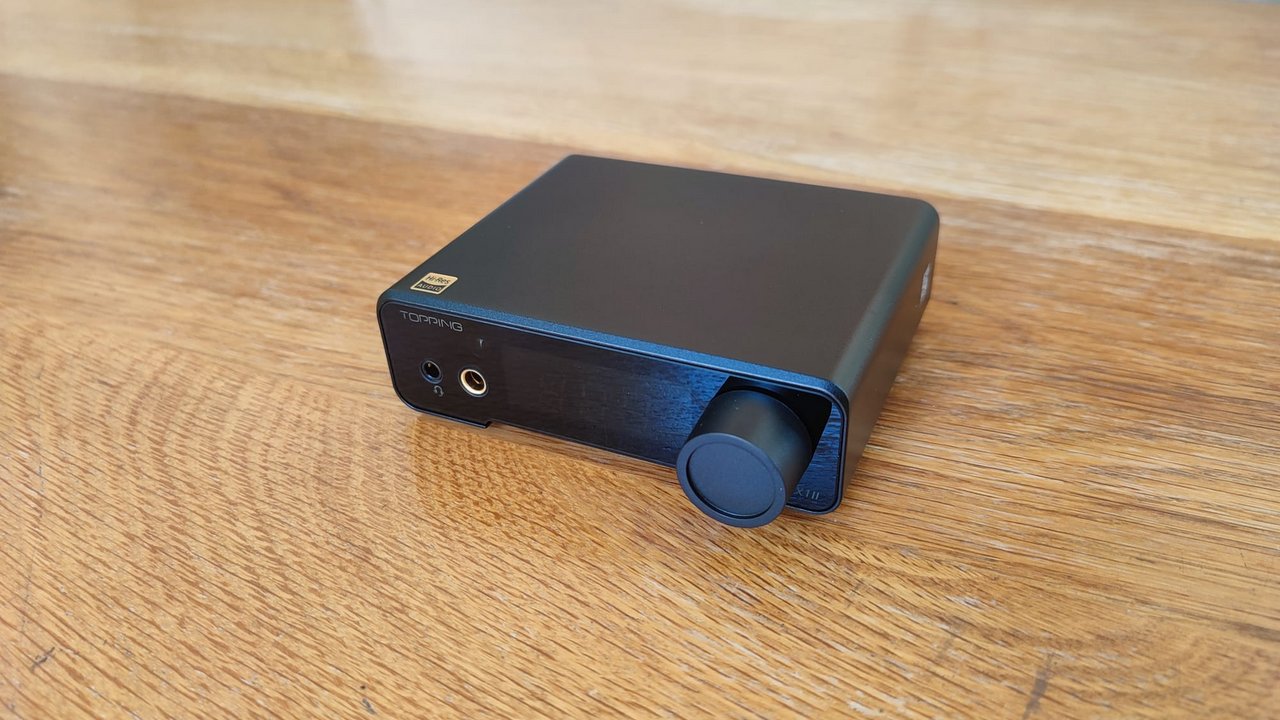
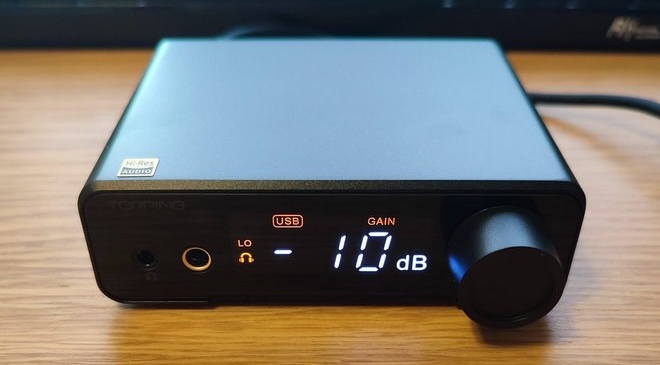
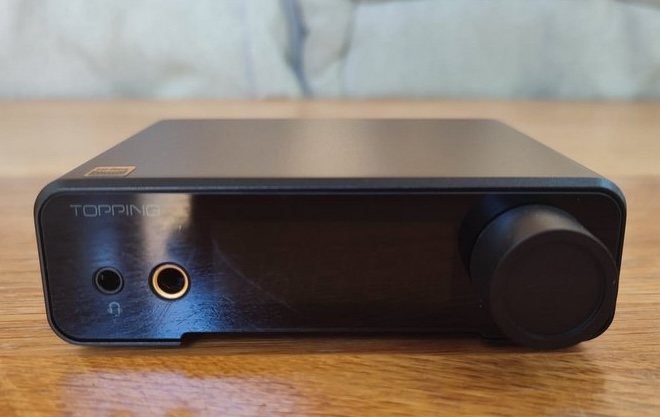
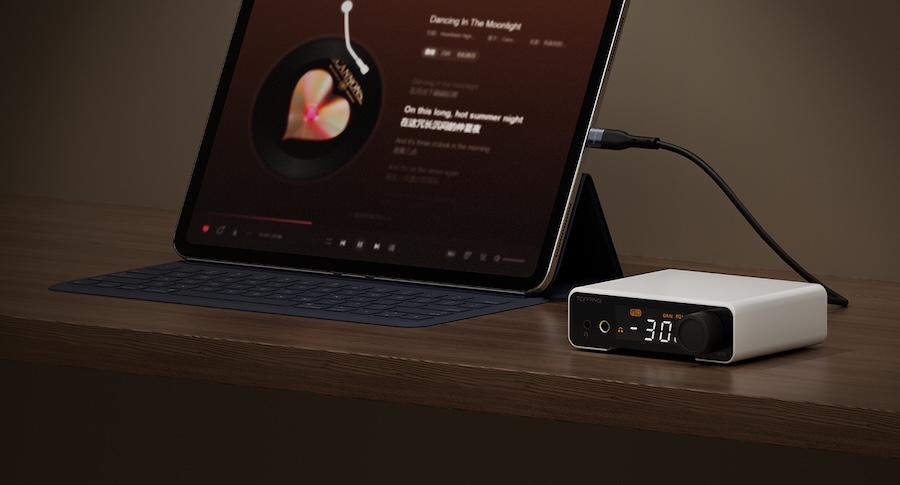
The DX1 II follows Topping’s familiar approach: compact, clean, and functional rather than decorative. Its CNC-machined aluminum chassis feels appropriately solid, and the unit is powered entirely over USB-C, so there is no external power brick to hide behind the monitor. The display shows volume, input, gain, and PEQ status, which matters more than it might seem once a device starts adding multiple modes and saved profiles.
The front-panel layout gives the DX1 II more flexibility than most budget DAC/amps. The 3.5mm jack supports both conventional headphones and TRRS headsets with microphone input, while the 4.4mm balanced jack is the main attraction for listeners who want more output power and balanced headphone connectivity. Around back, optical input/output, RCA output, and a 4.4mm balanced line output allow the DX1 II to function as more than just a headphone box. It can sit between a PC, console, TV, powered speakers, and headphones in a way that makes genuine sense for a compact desktop setup.
Topping also includes a remote control for switching among gain modes, EQ profiles, inputs, and other settings. It is a useful inclusion, although the number of available adjustments can make navigating to one specific setting feel more like working through a small software menu than operating a $119 desktop DAC/amp.
Listening & Headphone Synergy
As with all of our DAC/amp reviews, the Topping DX1 II was tested with a broad mix of full-size headphones, from high-impedance and low-sensitivity planar magnetics such as the HiFiMAN HE6se V2 to low-impedance, high-sensitivity dynamic-driver models like the SIVGA SV021 Pro, with plenty in between. The DAC/amp was connected to my PC, with a mix of Spotify streams and hi-res FLAC files used to give the little Topping every opportunity to show what it could do.
In general, the DX1 II leans more comfortable than clinical. ESS-based DAC chips are often expected to sound crisp, detailed, and occasionally a little etched, but I found the Topping’s presentation to have a very slight upper-treble roll-off.
Cymbals, upper harmonics, and ambient air do not leap forward as aggressively as they do with brighter desktop sources, but that restraint makes the DX1 II easier to listen to for longer stretches.
The trade-off is that its perceived detail retrieval is not quite the best I have heard at, or close to, this price. I noticed this on Fleetwood Mac’s “Dreams,” which features a faint hi-hat and cymbal accent during the choruses. I had to listen rather hard to pick it out through the Topping, whereas the similarly priced, if slightly more expensive, FiiO K11 and iFi Audio ZEN DAC 3 made it easier to hear.
Bass is the more interesting part of the equation. It may not be measurably elevated, but the perceived balance gives kick drums, bass guitar, and electronic low-end hits more weight. With the upper treble slightly relaxed, the ear naturally pays more attention to the lower registers, making the amplifier sound punchier without adding obvious warmth. The result is a compact DAC/amp that feels more grounded than expected. Queen’s “Another One Bites the Dust” was particularly enjoyable through this little unit.
Overall, the DX1 II should be a good match for brighter dynamic-driver headphones, including many Beyerdynamic models and even the Sennheiser HD 800 S. Headphones that already have plenty of treble energy may benefit from its smoother top-end behavior, especially for listeners sensitive to glare. Warmer headphones will also work well, provided they are not unusually difficult loads like the HE6se V2. Some light EQ may be useful to tighten the bass or add a little more life to the upper registers, but the DX1 II gives users enough control to make those adjustments without turning the desk into a small science project.
The Bottom Line
The Topping DX1 II is not a mild refresh of an entry-level DAC/amp. It is a compact desktop hub with balanced headphone output, PEQ, headset support, optical I/O, line outputs, console compatibility, and enough power to handle a wide range of real-world headphones. At $119, the feature set is genuinely aggressive.
There is very little to criticize here, especially at such a low price. Add 10-band parametric EQ to its smooth, unfussy sonic character and the DX1 II becomes a legitimate one-and-done desktop solution for headphone listeners, gamers, and anyone looking to upgrade a small PC or powered-speaker setup without spending much more.
The real question is whether Topping offers more at $119 than similarly priced alternatives from Schiit and FiiO. On features alone, it makes a very persuasive case.
Pros:
- Clean, compact aluminium desktop design
- 4.4mm balanced headphone output rated at 1000mW x2 into 32 ohms
- 10-band PEQ with profile storage
- USB-C powered; no external power brick required
- Mass-appealing sonic signature with zero fatigue
- Strong value for the money
Cons:
- Upper treble may sound slightly softened depending on headphone pairing. Warmer headphones may need PEQ to restore air and clarity
- Controls and gain/profile switching may not be as intuitive as the feature list suggests
- USB-powered design is convenient but not a substitute for larger desktop amplifiers with difficult headphones
Our Ratings
★★★★★★★★★★ Sound Quality
★★★★★★★★★★ Features
★★★★★★★★★★ Usability
★★★★★★★★★★ Build Quality
★★★★★★★★★★ Value
Where to buy:
Related Reading:
- IFi IDSD GR 2 Portable DAC Amp Debuts With New DAC Architecture, K2HD, And Lossless Bluetooth
- LAiV Crescendo VERSE Review: Chapter And Verse On This All-In-One DAC, Preamp, And Headphone Amplifier
- Schiit LYR 5 Lands With Forkbeard And Fusion: Serious Headphone Amp Or More Schiit For Your Rack?
- Best DAC/Amps For Headphones: Editors’ Choice