
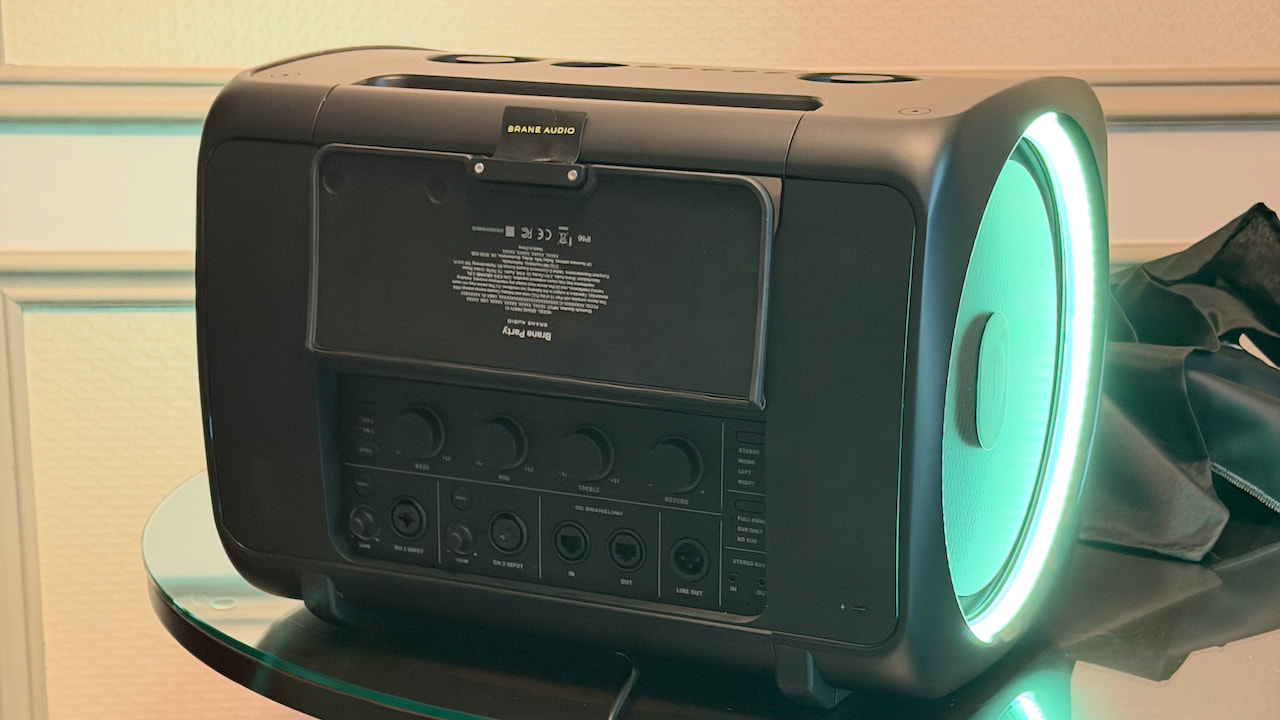
Our search for the best portable Bluetooth speaker didn’t start at CES 2026—it was rooted in our first exposure to Brane Audio at T.H.E. Show SoCal 2024. Brane showed up with a $499 portable speaker—the Brane X—and immediately made a problem for the category’s usual heavy hitters. In a direct demo, it delivered more convincing low-frequency output than the JBL Xtreme 4, Sonos Move 2, and UE Hyperboom, despite being physically smaller. No hype tactics. No “DSP magic” excuses. Just a proprietary down-firing 9-inch by 6-inch oval woofer moving real air and producing bass that actually sounded controlled.
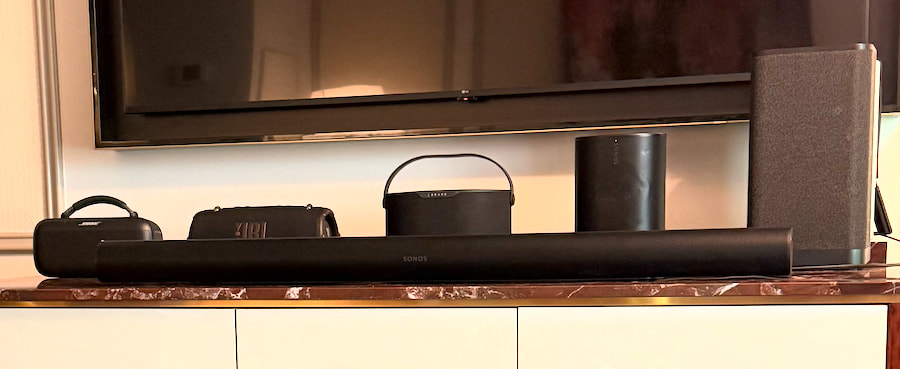
That initial impression carried into a proper shoot-out in December 2024 in Southern California, where we compared the Brane X head-to-head with the Devialet Mania and Soundboks Go. The Brane X didn’t just hang—it made its case decisively and went on to earn one of our Editors’ Choice Awards for Best Portable Speaker. That alone would have been a successful debut story.
But what we experienced on Day One at CES 2026—with Brane’s unveiling of RAD2 driver technology and a first look at the Party Pro prototype—was something else entirely. And yes, shocking is still the right word, even in an industry that’s abused it into irrelevance. This wasn’t incremental tuning or another “more bass, same box” claim. It was a fundamental rethink of how deep bass can be generated efficiently in portable and wireless speakers—and one of the most impressive developments we’ve seen in this category in years.
“This is what disruption sounds like,” said Joe Pinkerton, CEO and co-founder of Brane Audio. “The industry spent decades trying to overcome the limits of producing deep bass. We solved it once, and now we’ve pushed it even further. We’re delivering speaker performance that was once only limited to much larger, expensive systems. It’s truly just the beginning as we see even larger gains in performance over time.”
Repel-Attract Driver 2 (RAD2): Why This Isn’t Just Another “More Bass” Claim
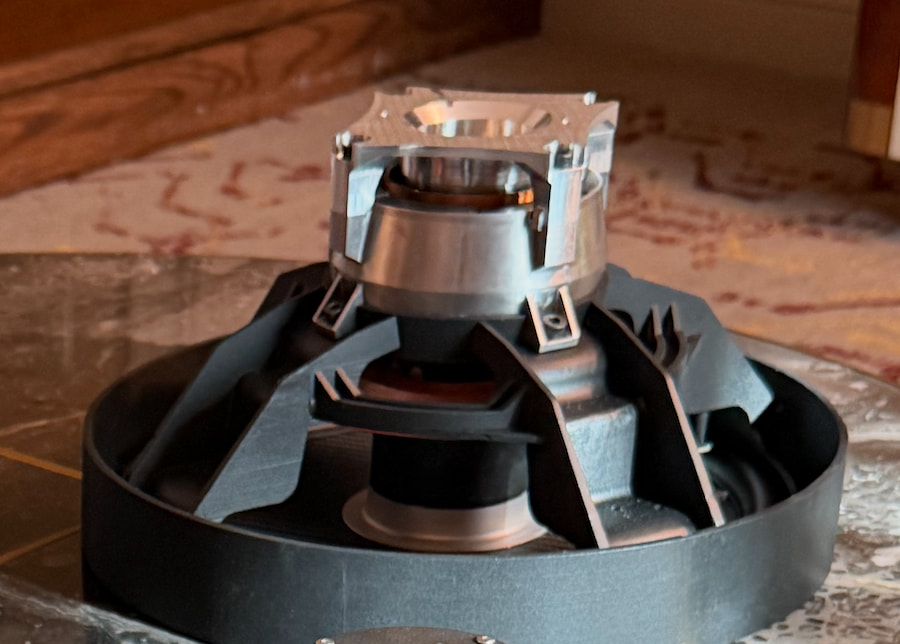
Brane Audio used CES 2026 to pull the curtain back on its most important development yet: Repel-Attract Driver 2 (RAD2). This isn’t a new speaker—it’s the underlying driver technology—and it represents a real engineering leap, not a marketing remix. Brane claims a 30x deep-bass advantage over conventional driver designs, while also reducing enclosure size and power consumption. Big words, yes—but there’s real physics behind them.
The easiest way to understand RAD is to think about what’s been holding bass reproduction back for nearly a century. Traditional dynamic drivers have to fight the air pressure inside their own enclosures. As cabinets get smaller, that pressure skyrockets, forcing designers to choose between deep bass, efficiency, or size. Pick two. High power draw and bulky enclosures became unavoidable side effects, especially in portable systems.
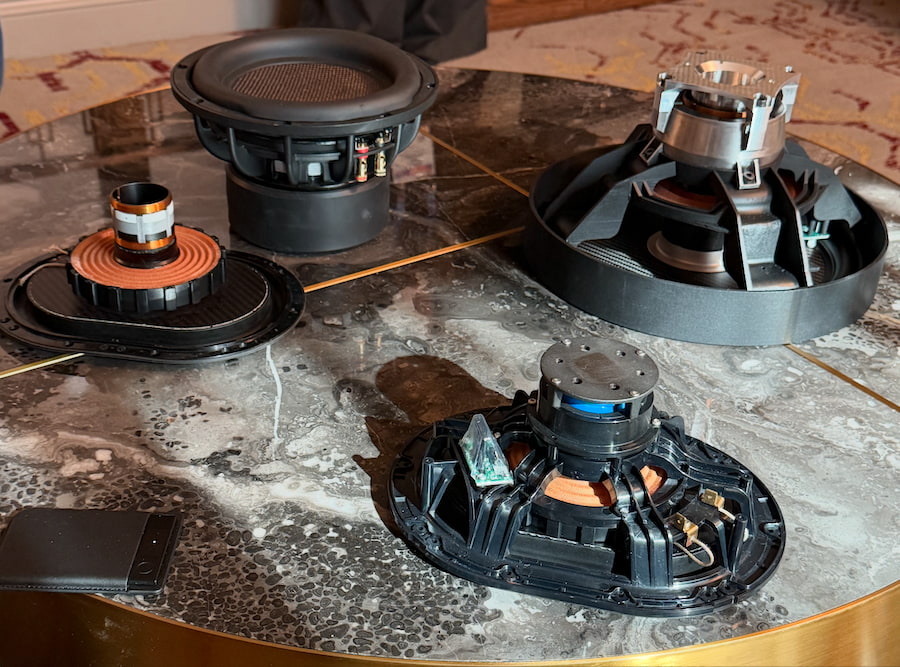
Brane’s original RAD technology tackled that problem directly by canceling internal air pressure using a proprietary magnetic architecture. Instead of the driver wasting energy pushing against trapped air, RAD neutralized that resistance. The result was roughly a 10x improvement in deep-bass efficiency compared to conventional designs—already enough to make the Brane X an outlier in the portable speaker category.
RAD2 pushes that idea much further. The second-generation design introduces a revised magnetic structure, a more efficient launch system, and reduced moving mass. Translation: the driver can move more air with less effort. That efficiency gain scales dramatically, allowing RAD2-based systems to produce substantially higher output while consuming far less power. Brane says the payoff is twofold—bass extension down to 20Hz and a major jump in battery runtime when deployed in portable products.
The technology is inherently scalable, allowing the RAD2 architecture to be applied across a broad range of audio products—from earbuds and compact portable speakers to large-format mobile and professional sound systems—without changing the core physics that make it effective.
The flat-screen TV analogy actually fits here. Just as displays didn’t truly evolve until bulky picture tubes were eliminated, compact speakers have been stuck compensating for air pressure losses. RAD2 doesn’t tweak around that limitation—it removes it. And if the prototype Party Pro shown at CES is any indication, this is technology that scales cleanly from lab theory to real-world products. Whether competitors can follow is another question entirely.
The First RAD2-Powered Product: Brane Party Pro
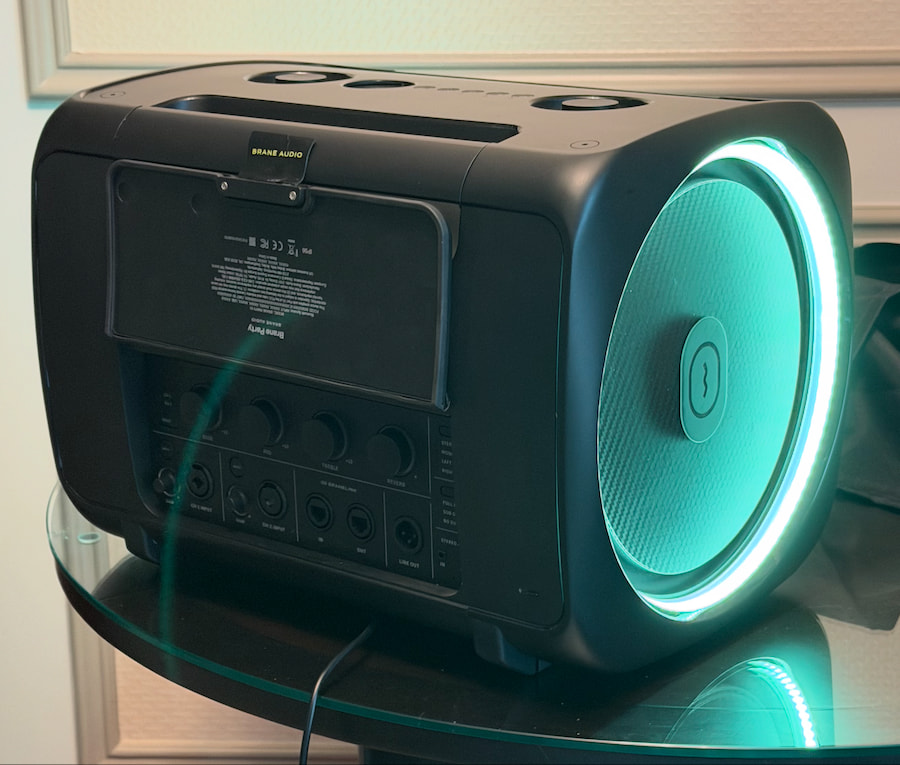
The first commercial product built around RAD2 will be the Brane Party Pro, previewed at CES 2026 in prototype form. It uses two exposed RAD2 drivers that collectively displace 1,000 cc of air, a figure that helps explain why this speaker immediately feels out of scale with its size. Brane’s goal here isn’t subtlety—the Party Pro is designed to be the most powerful speaker in its category, delivering sub-bass output that normally requires far larger enclosures and significantly higher power draw.
What matters is how that output is achieved. Instead of brute force amplification or oversized cabinets, the Party Pro relies on RAD2’s efficiency advantage to generate deep, physical bass while keeping size and energy consumption in check. The result is low-frequency performance that competes with much larger systems, without the usual penalties in portability or battery life.
Initial Impressions: A Prototype That Rewrites What “Portable” Bass Means
Based on early show-floor impressions at CES 2026; and yes, those are never ideal—the Brane Party Pro delivered alarming levels of deep bass for something that’s still clearly a prototype. Brane quoted extension down to 26Hz, with output reaching a claimed 107 dB, and what stood out wasn’t just volume but how effortlessly it filled space. This wasn’t boomy, one-note bass designed to impress for five seconds. It was dense, physical, and immediately disorienting in the best way.
The Party Pro can also be switched into a subwoofer-only mode, allowing it to function as a dedicated low-frequency system within a larger setup, which is an unusual but smart option for a speaker in this category. Flexibility is clearly part of the design brief. Multiple Party Pro units can be configured as a stereo pair, daisy-chained for larger event-style setups, and Brane says Auracast support will allow simultaneous wireless transmission to multiple compatible speakers.
New Brane X Color & USB-C Input
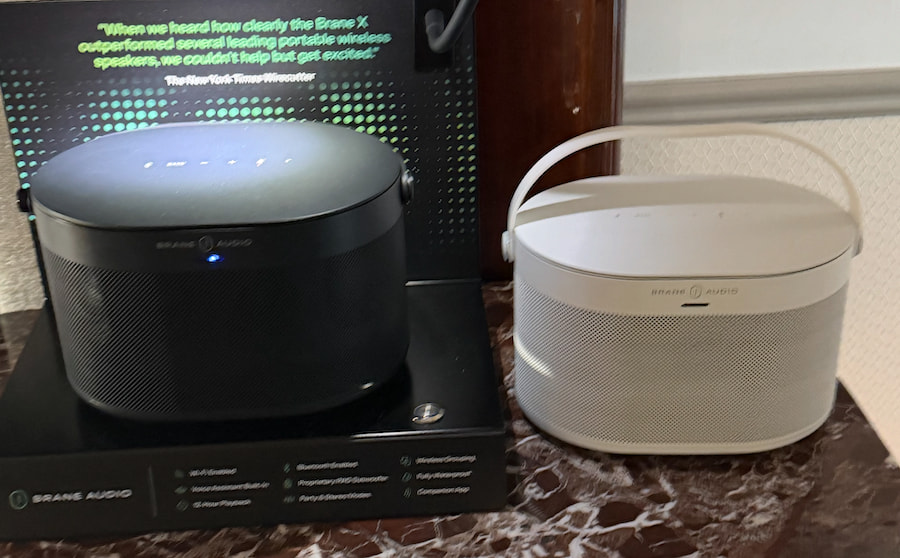
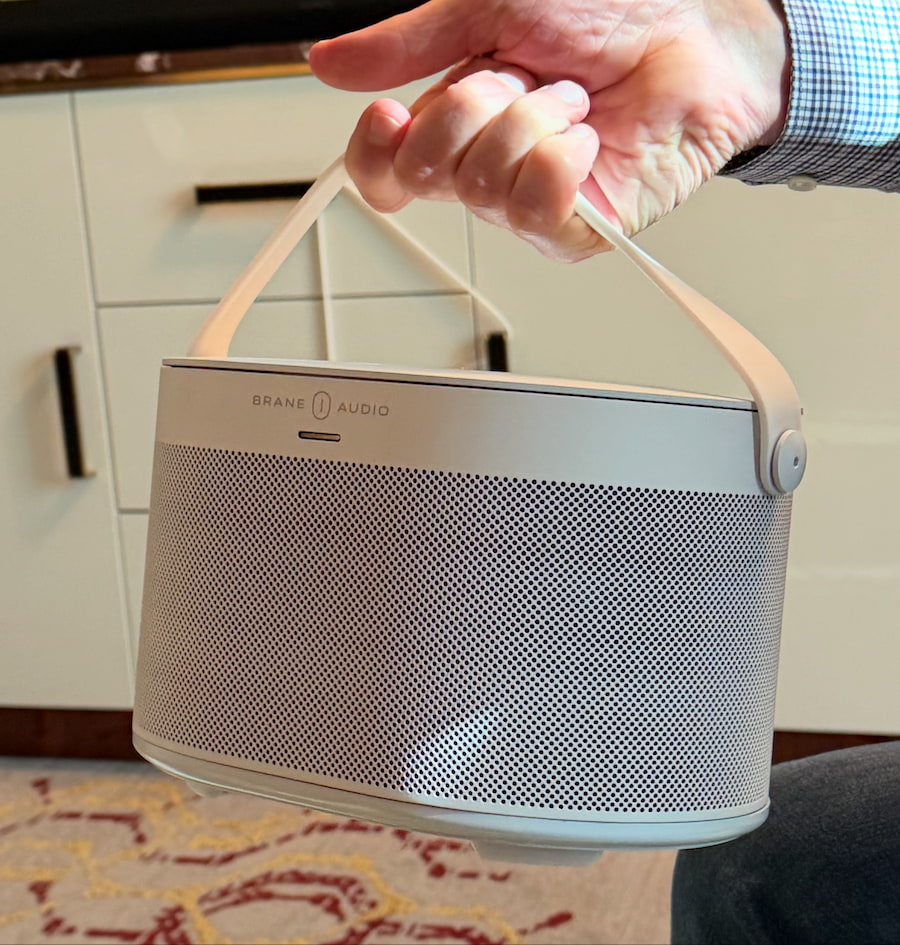
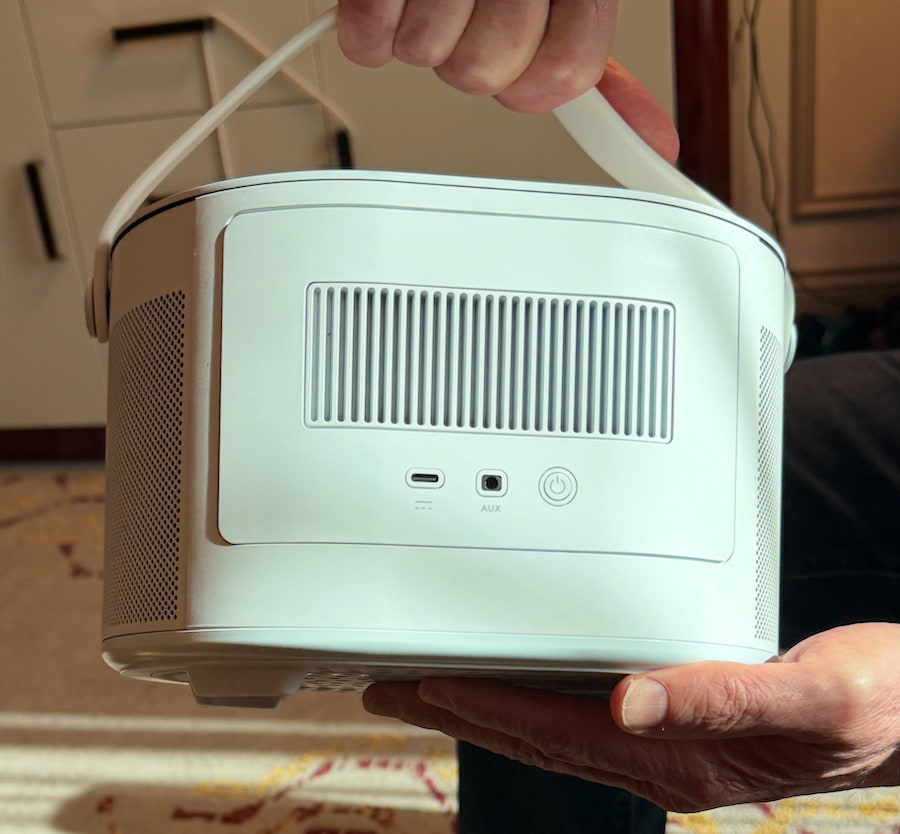
Brane X will get a small, but important update in 2026. A new white color will be available this year for $499, and a more convenient USB-C charging port has been added, which the original Brane X didn’t have. Otherwise the original Brane X and Brane X with USB-C remain the same sonically.
The Bottom Line
Pricing is expected to around $1,199 to $1,399, though Brane was clear that final pricing is not yet locked. That puts the Party Pro well outside impulse-buy territory—but also nowhere near the cost of the larger systems it’s clearly trying to replace.
All of this comes with an important caveat: these impressions are based on CES show conditions, which are about as hostile as it gets for critical listening. We plan to evaluate the Party Pro properly indoors and outdoors once a final review sample is available. If what we heard on the show floor holds up in controlled testing, Brane may have another category disruptor on its hands.
The Brane X remains the company’s flagship product and continues to anchor Brane Audio’s lineup. Looking ahead, Brane confirmed plans for a limited-edition white colorway, along with expanded EU availability beginning in early 2026, starting with France and Germany.
As for the Brane Party Pro, Brane is targeting U.S. availability later this year, with additional product details including final specifications and pricing expected to be announced in the first half of 2026.
Related Reading:






Anton
January 8, 2026 at 6:03 pm
When is this coming out? That looks like something I might need.
20Hz???
Please post a video if you can.
Chris Boylan
January 12, 2026 at 5:33 pm
Alas, the model shown at CES was an unfinished prototype (not functional). We did get a demo of one of the new driver and it shook the hotel room. The final version will include two of these drivers. BOOM BOOM!
jeffrey henning
January 13, 2026 at 12:00 am
Any idea of the estimated weight, size, driver compliment?