Montréal does certain things extremely well: hockey anxiety, construction cones, smoked meat, arguing about bagels, and building audio equipment with absolutely no interest in being inexpensive.
MOON by Simaudio has been doing the latter in Boucherville, just across the river, for more than four decades.
When we first covered the MOON 371 Network Player/Amplifier in October 2025, the interesting part was not that Simaudio had built another expensive streaming amplifier. The category already had plenty of those.
The real story was that the Québec manufacturer had taken engineering developed for its far more expensive North Collection, folded it into a single chassis with streaming, DAC, preamplification, MM/MC phono, headphone output, and 100 watts per channel, and called it the entry point to its new Compass Collection.
At $6,500 USD / $8,800 CAD, “entry level” remains a wonderfully flexible expression in Montréal hi-fi. Then again, anyone who has ordered smoked meat for four at Lester’s or Snowdon Deli lately already understands that quality and restraint do not always arrive on the same plate.
Since then, Compass has expanded to include the 491 Network Player/Preamplifier and 461 Power Amplifier, but the 371 remains the product that explains the collection most clearly. It is aimed at listeners who want a serious high-end system without a rack full of components, six power cords, three shelves of isolation hardware, and the inevitable explanation to a spouse about why one of the boxes apparently exists only to make another box sound better.
And unlike some “all-in-one” products, the 371 does not feel like a streamer that had an amplifier module stuffed inside five minutes before lunch.
Related Reading:
- MOON 491 Network Player/Preamplifier And 461 Amplifier Launch With Canadian Muscle
- MOON 250i V2 Integrated Amplifier: The Audiophile System Builder
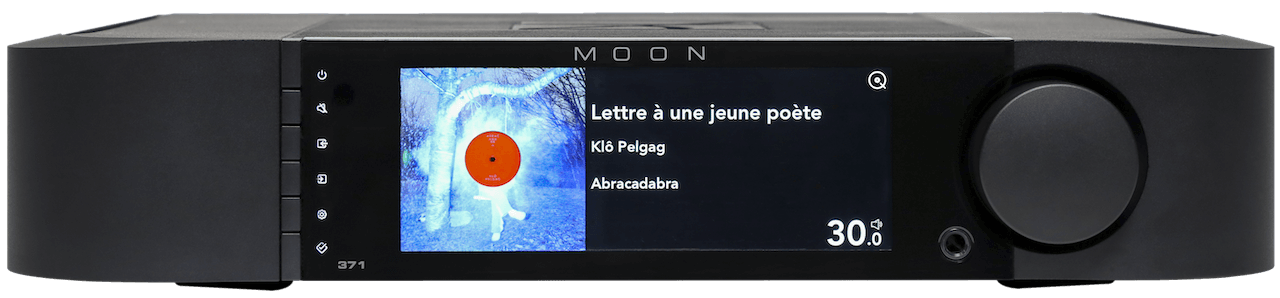
What Makes the MOON 371 Different?
The 371 combines five major functions in one chassis: network player, DAC, preamplifier, integrated amplifier, and MM/MC phono stage. That feature list alone is no longer unusual in 2026. NAD, Naim, Linn, Lyngdorf, and others have been collapsing entire systems into single enclosures for years.
What makes the MOON more interesting is where Simaudio appears to have spent the money.
Its MDCA (MOON Distortion Cancelling Amplifier) and MHP (MOON Hybrid Power) technologies were developed for the North Collection before making their way into Compass. The amplifier delivers 100 watts per channel into 8 ohms and 200 watts into 4 ohms.
Amplification remains Class A/B, which also separates the 371 from the growing number of premium streaming amplifiers built around Class D modules. There is nothing inherently wrong with Class D; some of the best amplifiers we have heard use it but Simaudio has clearly decided that its Compass customer still wants some traditional iron in the equation.
Vinyl Was Not an Afterthought
The 371 also includes a genuine all-analog MM/MC phono stage, which matters because too many otherwise excellent streaming amplifiers treat vinyl playback like something the engineering team remembered after the rear panel had already gone to production.
MM gain is fixed at 40dB with 47k-ohm/100pF loading, while MC provides 60dB with 1k-ohm/0pF loading. Those settings will work with a broad range of cartridges, although owners of particularly low-output moving coils may still prefer an external phono stage or step-up transformer.
Importantly, the phono signal remains in the analog domain rather than being converted to digital before moving through the signal path.
That point will matter deeply to approximately seventeen people on an audiophile forum before breakfast.
I know at least eleven of them. And we’re most certainly not breaking bread.
MiND 2 and Digital Playback
MOON’s MiND 2 platform handles network playback and supports Qobuz Connect, TIDAL Connect, Spotify Connect, AirPlay, Bluetooth, Roon Ready playback, UPnP, internet radio, and MOON multi-room operation.
Wired network playback supports PCM up to 32-bit/384kHz and DSD256, giving anyone with a large local library or NAS plenty of room to indulge.
The rear USB Type-C connection deserves clarification because it is not a conventional USB DAC input for connecting a computer. It functions as a USB host for attached storage, with playback controlled through MiND. Computer-based libraries can instead be accessed over the network.
At $6,500, the absence of a conventional asynchronous USB DAC input is one of the more curious omissions. Someone in Boucherville apparently decided Ethernet was good enough and went to Snowdon for lunch.
The 371 also includes HDMI ARC, allowing PCM audio from a compatible television while supporting CEC power and volume control. It is ARC rather than eARC, so anybody arriving with expectations of multichannel Dolby Atmos should turn around before parking.
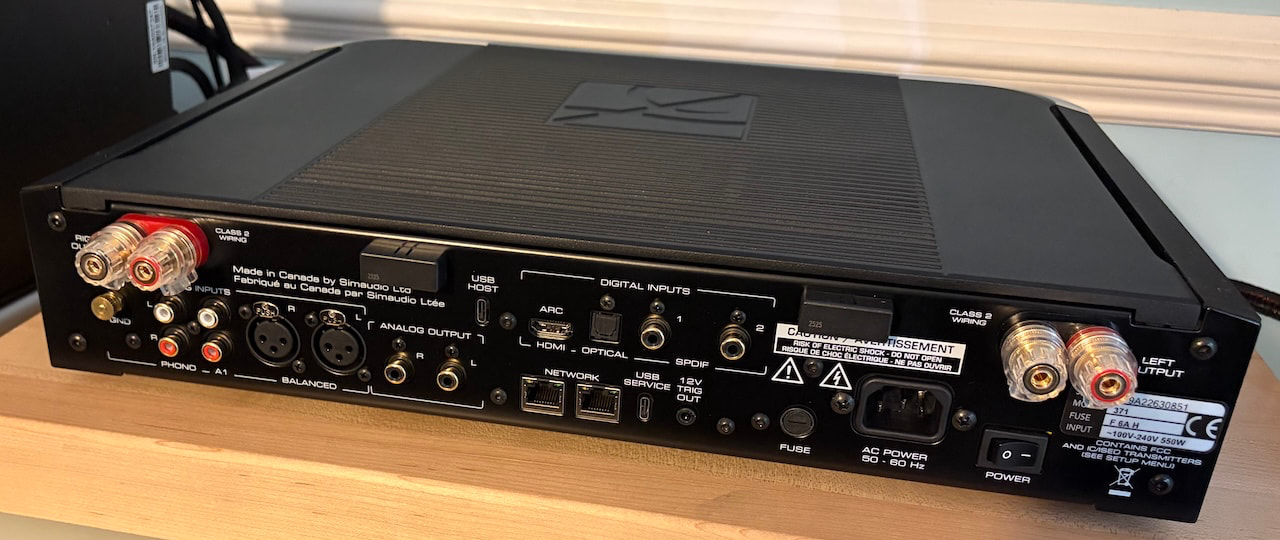
Connectivity
Analog connectivity includes one RCA line input, one balanced XLR input, and the dedicated MM/MC phono input. Digital sources can use HDMI ARC, optical TOSLINK, or coaxial S/PDIF, while two Ethernet ports allow one network connection to be passed through to another device.
A variable RCA analog output can feed an external power amplifier, powered loudspeakers, or subwoofer, and both the RCA and balanced analog inputs can be configured for home-theater bypass.
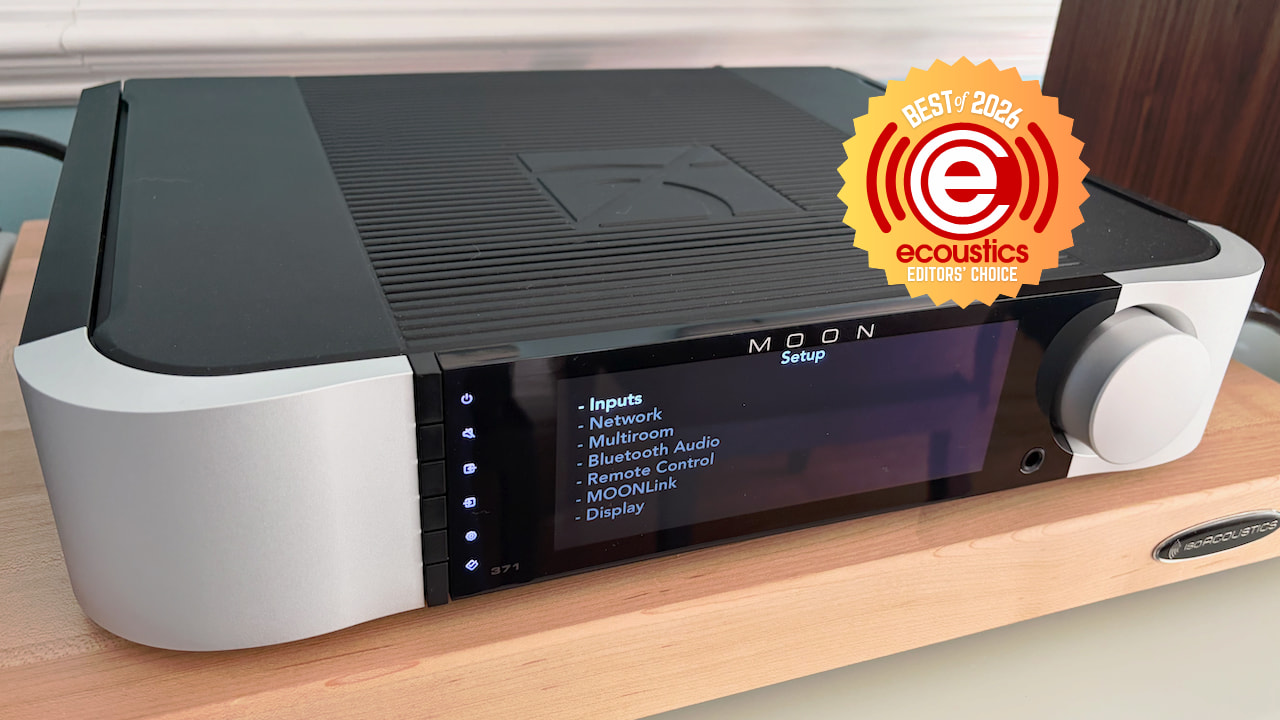
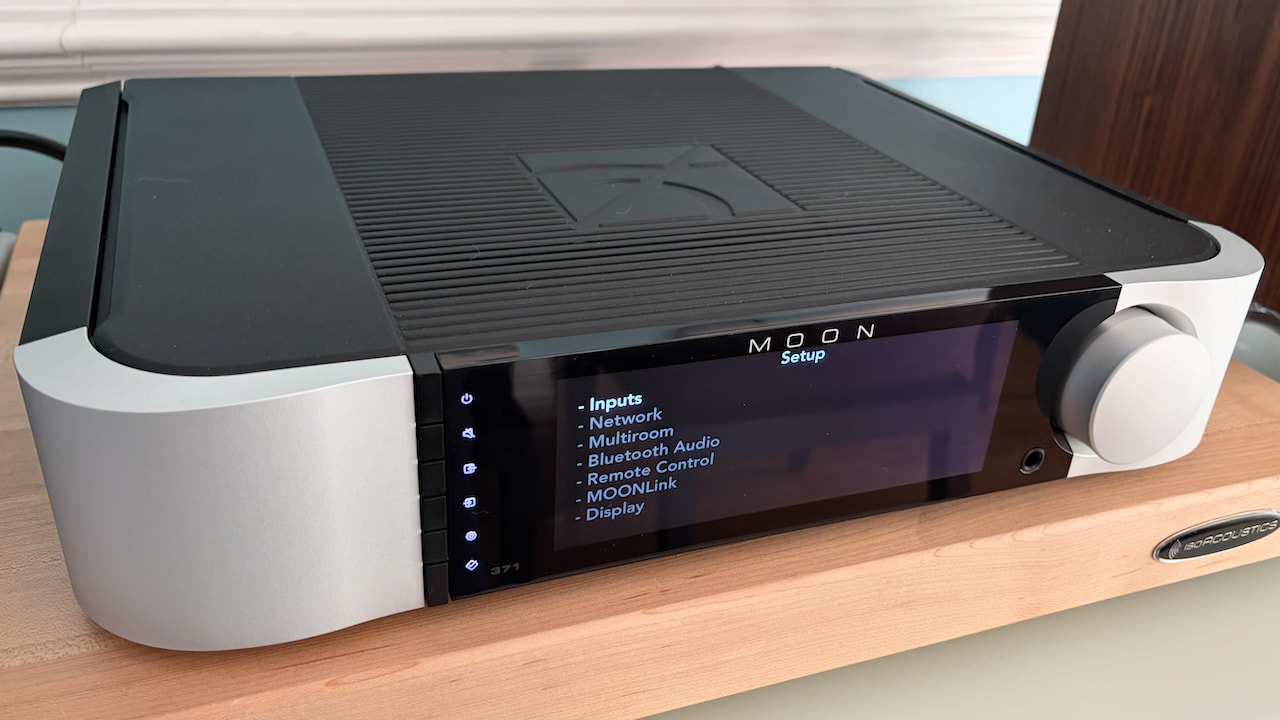
The front panel also includes a ¼-inch headphone output, while the large color display handles album art, input information, DAC sample rate, and configuration duties.
The supplied aluminum CRM-4 remote covers the basics, and MOON’s considerably more elaborate BRM-1 remote from the North Collection can also be paired with the 371 if your remote control needs to feel like something that should come with valet parking.

Heavy Metal, Light Work
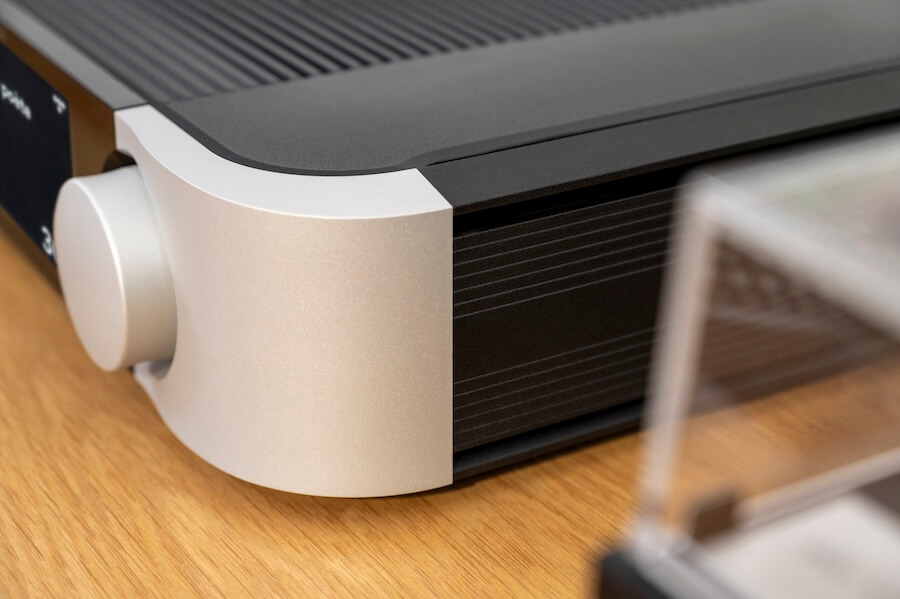
Simaudio deserves high marks for its packaging, which borders on bombproof. The MOON 371 arrives looking like it should require two people and a chiropractor to get it out of the box. In reality, it’s considerably lighter than its appearance suggests, but don’t mistake that for cost-cutting. The weight reflects smart engineering and thoughtful construction rather than an obsession with making everything unnecessarily heavy. This is a robust amplifier that looks and feels like a serious piece of equipment, and it’s built with longevity in mind. I know plenty of audiophiles who are still enjoying their Simaudio components after 20 years. Try getting that kind of mileage out of most consumer electronics.
The display is not a touchscreen, and I’m perfectly fine with that. It’s crisp, easy to read, and clearly visible from 20 feet away, which is no small accomplishment considering the mileage on my eyes. The supplied remote is serviceable rather than spectacular, but I suspect most owners will spend considerably more time using their smartphones to control the 371 anyway.
I do have two complaints. The first is the sheer number of menus you have to navigate on the display. There are more settings than most owners will ever need, and finding the ones you actually want can become a bit tedious. The second is the volume dial. At this price, I would prefer something with more physical heft and a more pronounced, tactile stepped action. The current dial works, but it doesn’t deliver the precise, reassuring feel I expect from an amplifier in this class. It’s a small detail, but one you notice every time you reach for it.
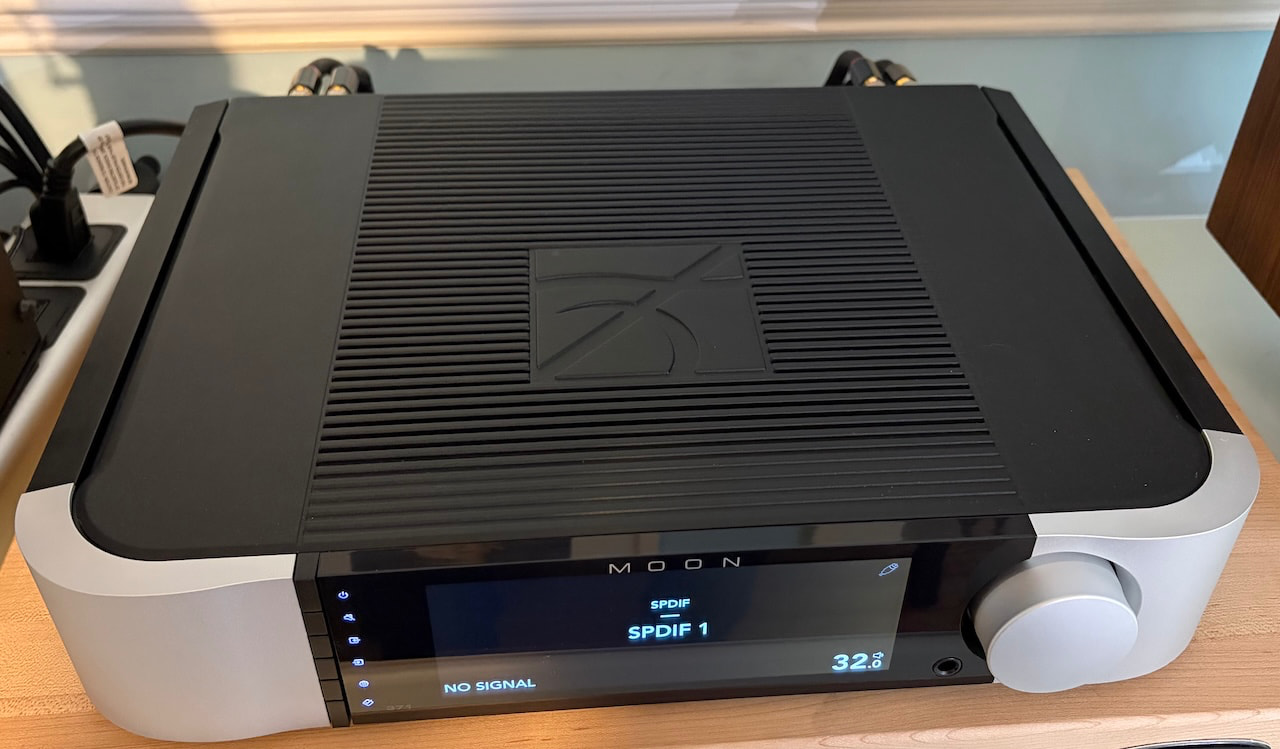
MOON 371 Key Specifications
- Type: Network player / DAC / preamplifier / integrated amplifier / phono stage
- Amplification: Class A/B with MDCA architecture
- Power Output: 100 watts/channel into 8 ohms
- Power Output: 200 watts/channel into 4 ohms
- Frequency Response: 5Hz – 100kHz (+0/-3dB)
- THD+N at 1W: 0.009%
- THD+N at 100W: 0.003%
- Intermodulation Distortion: 0.005%
- Signal-to-Noise Ratio: 108dB
- Crosstalk: -108dB
- Damping Factor: 425
- Phono: MM/MC
- MM Gain: 40dB
- MC Gain: 60dB
- Streaming: MiND 2
- Network Resolution: Up to 32-bit/384kHz PCM and DSD256
- Streaming Services/Platforms: Qobuz Connect, TIDAL Connect, Spotify Connect, AirPlay, Roon Ready
- Analog Inputs: RCA line, balanced XLR, RCA phono
- Digital Inputs: HDMI ARC, optical TOSLINK, coaxial S/PDIF
- USB: USB Type-C host for storage playback
- Networking: Wi-Fi, dual Ethernet
- Headphone Output: ¼-inch TRS
- Analog Output: Variable RCA
- Display: Color display
- Remote: CRM-4 included; BRM-1 optional
- Dimensions: 16.9 x 3.5 x 15.2 inches
- Weight: 20 lbs
- Power Consumption: 30W idle / 28W full-power standby / 6W low-power standby
- Warranty: Up to 10 years with qualifying product registration
- Finish: Black or silver
Listening
My first encounter with the MOON 371 came at AXPONA, where Simaudio paired it with the new Dynaudio Legend. The combination produced one of the best-sounding rooms at the show, earning both components a place on our Best of AXPONA list. In a hotel full of expensive systems, questionable acoustics, and enough audiophile hyperbole to fill Lake Michigan, this was a pairing that actually justified the enthusiasm.
I came away wanting to hear both components in my own listening room. Unfortunately, Dynaudio’s decision to withdraw from the North American market for the time being put an end to my planned Legend review. Disappointing? Absolutely. But it didn’t diminish my interest in the MOON 371. As impressive as the Danish loudspeaker sounded, it wasn’t performing miracles on its own. The Canadian amplifier deserved a fair amount of credit for what I heard that weekend.
With the Legend no longer an option, I needed to rethink the pairing. Fortunately, the answer was already sitting in my listening room.
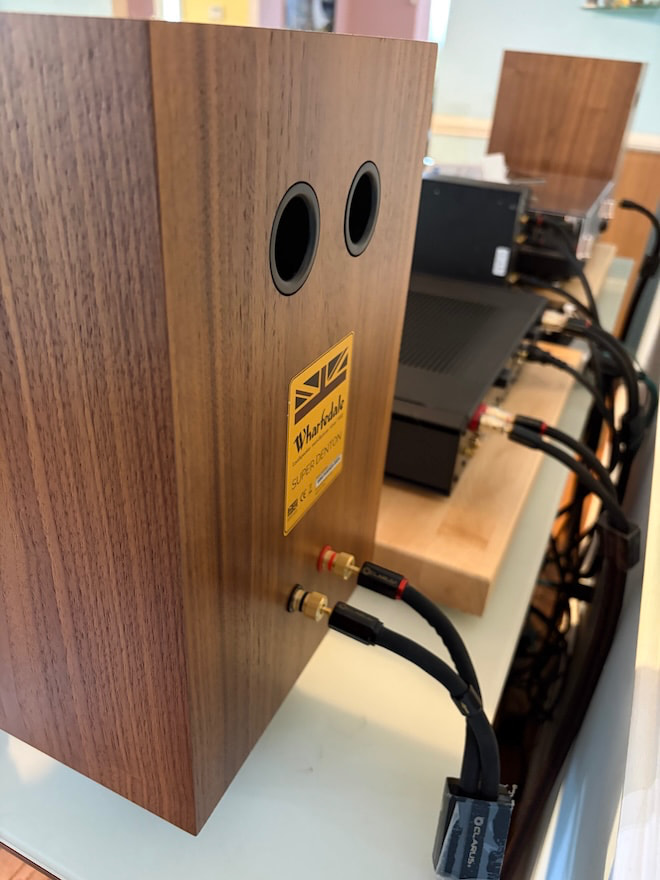
I had recently acquired the Wharfedale Super Denton, and the longer I lived with it, the more I realized that this charming British standmount was considerably more demanding than its modest dimensions and vintage styling suggested. It wasn’t that my existing amplifiers couldn’t drive it. They could. But getting the Super Denton to really open up, especially in the bass and lower midrange, required more authority and control than I had initially expected.
The Super Denton has all the ingredients I enjoy in a loudspeaker: tonal richness, a wonderfully expressive midrange, and enough old-school British personality to make you forgive the occasional eccentricity. But charm only gets you so far. I wanted to hear what happened when it was paired with an amplifier that had substantially more power, control, and confidence behind it.
Enter the MOON 371.
One Canadian with 100 watts per channel and a rather sophisticated approach to amplification. One British loudspeaker that looks like it should be sitting beside a teak sideboard, a bottle of single malt, and a member of the Royal Family whom the public still finds palatable. Preferably Prince George, before Lord Blackadder convinces him to invade Belgium with a wooden spoon and a cunning plan devised by Baldrick.
Streaming and vinyl were the order of the day, with TIDAL and Qobuz handling the digital side of things and two Thorens turntables providing the analog entertainment. My Thorens TD-160 Super was fitted with an Ortofon 2M Black, while the trusty TD-145 was partnered with a Dynavector 10×5. All cabling was supplied by Clarus Audio, giving the MOON 371 and Wharfedale Super Dentons a familiar supporting cast without introducing any unnecessary variables.
And because no proper evaluation of a Montreal amplifier should take place on an empty stomach, smoked meat from Lester’s and Pancer’s was also part of the proceedings. One from Montreal, the other from Toronto. I’ve spent enough time in both cities to know better than to declare a winner in public.
Unlike the equipment, neither sandwich required a lengthy break-in period.
Songs for the Broken, and an Amplifier That Refuses to Let Go
Nick Cave’s rendition of Leonard Cohen’s “Avalanche,” along with pretty much the entirety of Idiot Prayer, became the soundtrack for breaking in the system while I worked at the table. Cave’s interpretation of Cohen’s emotional punch to the gut has become something of a personal anthem for those moments when I want to be left the hell alone and wallow in self-pity over a few questionable life decisions. I’m doing considerably better these days, thank you, but some music is simply too good to abandon just because the clouds have started to lift.
Based on what I heard at AXPONA, I suspected the MOON 371 would grip the Wharfedale Super Dentons like Johnny Cochran holding on to O.J.’s retainer and push Cave’s voice forward into the room without stripping away its gravel, texture, or emotional weight. I wasn’t disappointed. Cave sounded wonderfully present, with the piano retaining its harmonic richness and the darker edges of his voice emerging without any artificial spotlighting.
The best solid-state amplification combines the organic texture and tonal richness of great tube equipment with the clarity, detail, and iron-fisted control that make solid-state designs so compelling. The MOON 371 delivered all four without breaking a sweat. The Super Dentons are inherently warm loudspeakers, although colored might be the more accurate description, and they benefit from an amplifier capable of injecting some violence and authority into the proceedings without turning everything into a clinical exercise.
With the house to myself, Metallica’s “One” from …And Justice for All and “Nothing Else Matters” from Metallica (the Black Album) were logical progressions. With the third anniversary of October 7th approaching, I wasn’t exactly in the mood for Cyndi Lauper or Ed Sheeran. Sometimes you need music that matches your mood rather than tries to improve it, and Metallica seemed considerably more appropriate for the occasion.
The Wharfedale Super Dentons are not bass-light loudspeakers. Far from it. They can deliver a surprisingly convincing wallop for their size, but the low end isn’t always as articulate as I would like. There’s plenty of weight, although things can get a little thick and untidy when the music becomes more demanding. Rather un-British behavior from a loudspeaker with such impeccable manners everywhere else.
The MOON 371 sorted that out in a Montreal minute. I’ve had poutine from Décarie that didn’t solidify as quickly.
The opening guitar notes of “One” had greater definition and bite, while the percussion arrived with considerably more impact. The slightly rounded presentation I’d grown accustomed to with the Super Dentons gave way to sharper transients and better separation between instruments. As the song descended into its more furious passages, the MOON maintained the momentum and intensity without making the Wharfedales sound strained or congested.
“Nothing Else Matters” revealed another side of the pairing. The opening guitar retained its delicacy and natural decay, while Hetfield’s voice had the necessary grit and body. As the arrangement expanded, the soundstage remained open and layered, with the strings adding scale without overwhelming the performance.
The Canadian wasn’t trying to turn the Wharfedales into studio monitors. It was simply reminding them that good manners and a firm right hook are not mutually exclusive.
The MOON 371 Takes Off the Gloves
After Metallica, I moved into my usual electronic rotation of Kraftwerk, deadmau5, The Orb, Aphex Twin, Boards of Canada, and Nine Inch Nails. Not exactly the playlist for demonstrating the delicate sweetness of an expensive amplifier over a glass of Burgundy. I wanted to know whether the MOON 371 had the muscle to make the Super Dentons forget their British manners.
Kraftwerk’s “The Robots” had tremendous rhythmic precision and presence, while deadmau5’s “Strobe” demonstrated just how enormous a soundstage the 371 could create with these relatively compact loudspeakers. The Orb’s “Little Fluffy Clouds” floated well beyond the cabinets, with individual effects occupying their own spaces rather than collapsing into psychedelic soup. Aphex Twin’s “Windowlicker” was a nastier proposition, but its fractured rhythms and abrupt transitions never caused the Canadian to lose its footing.
Boards of Canada’s “Roygbiv” retained its wonderfully hazy, nostalgic warmth, while Nine Inch Nails’ “The Hand That Feeds” demonstrated that the MOON wasn’t remotely afraid of being pushed. The harder I drove it, the more convincing the Wharfedales became. There was genuine scale, impact, and an absence of the congestion I’ve heard from less capable amplifiers when electronic music gets particularly demanding. Sterile? Not remotely.
Is the 371 as warm through the midrange as some competing NAD or Advance Paris integrated amplifiers? Not quite. But it offers a compelling combination of tonal substance, clarity, dynamic authority, and sheer musical energy that its power rating doesn’t fully convey. It doesn’t sugarcoat recordings or dissect them until there’s nothing left worth listening to.
For $6,500, I expect more than an expensive aluminum box with a fancy display, an impressive spec sheet, and enough audiophile marketing nonsense to choke a moose. I want an amplifier that can handle Nick Cave’s emotional wreckage, Kraftwerk’s precision, and Trent Reznor’s industrial therapy without breaking a sweat or requiring a personality transplant. The MOON 371 puts on its big boy pants and gets to work.
The Human Voice, a Little Heartbreak, and the Soul of the MOON 371
Maybe it’s an age thing, but aside from those moments when I need absolute musical chaos (see above), I’ve become increasingly drawn to the human voice. Carole King, Natalie Merchant, Peter Gabriel, Terry Callier, Jason Isbell, Dolly Parton, Orville Peck, Sam Cooke, and Sia have been getting considerably more playing time lately. Throw in some John Coltrane or Jackie McLean when I need a saxophone to cut through the smoke and angst in the room, and I’m generally a happier person. Or at least a slightly less miserable one.
The MOON 371 doesn’t offer the ethereal, deeply seductive sex appeal of the Unison Research Simply 845 or Audio Note OTO SE Silver Signature integrated amplifiers. Those tube designs have a way of making the human voice feel almost indecently intimate, as though the performer has invited themselves into your living room, poured a stiff drink, pushed the Westie out of his favorite seat, and started unbuttoning things that really ought to remain buttoned.
The Canadian is more matter-of-fact, but that doesn’t mean emotionally detached. It connects the dots without turning every singer into the same homogenized audiophile fantasy.
Dolly Parton’s unmistakable quiver remained intact, and hearing her again was a reminder of just how much poorer the world became when we lost her. RIP, Queen Dolly. Orville Peck’s cavernous baritone had enough physical presence to threaten the foundations, while Natalie Merchant’s expressive range and slightly darker vocal character came through beautifully. Carole King’s wonderfully imperfect delivery retained its humanity, Sam Cooke sounded effortlessly soulful, and Jason Isbell’s weary honesty wasn’t polished into something more palatable.
Coltrane and Jackie McLean were equally revealing. Their saxophones had bite, breath, and the occasional rough edge without becoming unpleasantly sharp. The MOON didn’t soften the attack to make things more comfortable, nor did it push every detail forward to demonstrate how revealing it could be. Sometimes a saxophone is supposed to sound a little confrontational. McLean certainly wasn’t interested in asking anyone’s permission.
Could the 371 do justice to larger, more revealing loudspeakers than the Wharfedale Super Dentons? I suspect so, although that will have to wait for another reviewer. What this pairing demonstrated was that solid-state amplification doesn’t have to sacrifice musical intimacy in pursuit of precision. The MOON won’t seduce you quite like those wonderful tube amplifiers, but it doesn’t leave you emotionally stranded either.
It lets these extraordinary voices remain recognizably human, with all their imperfections, vulnerability, and occasional flashes of brilliance. At this stage of my life, that’s worth considerably more than another amplifier determined to impress me with how many details it can extract from a recording.
And sometimes, that’s enough.
The Bottom Line
The MOON by Simaudio 371 Network Player/Amplifier is one of the most convincing integrated audio systems I’ve reviewed, combining exceptional build quality, serious amplification, MiND 2 streaming, and an excellent MM/MC phono stage in one beautifully engineered component. At $6,500, it delivers much of the refinement and performance associated with more expensive separates without demanding an entire equipment rack.
Paired with the Wharfedale Super Denton loudspeakers, the 371 delivered superb control, dynamic authority, impressive bass definition, and an expansive soundstage without sounding clinical or overly analytical. Its transparent presentation may be less appealing to listeners who prefer a warmer, more forgiving midrange, but its ability to reveal musical detail while maintaining composure is exceptional.
The extensive menus, underwhelming remote, and less-than-satisfying tactile feel of the volume control deserve improvement at this price. Those shortcomings are outweighed by its musical performance, versatility, and 10-year warranty, making the 371 an outstanding choice for serious listeners who want a sophisticated vinyl and streaming system without the complexity of separates.
Editors’ Choice? Without question. Simaudio has delivered one of the most compelling integrated amplifiers in its class, and unlike Montreal’s endless orange construction cones, this is something worth going out of your way for.
Pros:
- Exceptional clarity, dynamic authority, and bass control
- Expansive soundstage with precise imaging and natural detail
- Excellent MiND 2 streaming and MM/MC phono stage
- Outstanding build quality and versatile connectivity
- Compelling alternative to separates with a 10-year warranty
Cons:
- Menu navigation could be more intuitive
- Remote control feels underwhelming at $6,500
- Volume control lacks the tactile refinement expected at this price
- Less forgiving of poor recordings than warmer-sounding alternatives
Our Ratings:
★★★★★★★★★★ Sound Quality
★★★★★★★★★★ Build Quality
★★★★★★★★★★ Connectivity
★★★★★★★★★★ Value
Where to Buy:
Related Reading: