FiiO dropped the K11 R2R in late 2024 as a quiet replacement for the original K11—and then promptly buried it under an avalanche of new gear. In 2025 alone, FiiO unleashed more than three dozen components, headphones, speakers, streamers, and IEMs, turning the K11 R2R into the forgotten middle child. The Kevin. Left behind. Suitcase open. Lights on. Cue Home Alone. And yet here it is, still standing, armed with a fully differential 24-bit R2R DAC topology and a $175.99 price tag that looks almost rebellious in a market addicted to feature creep.
This is also the moment we’re living in: desktop DAC/headphone amps under $300 aren’t compromises anymore—they’re the logical landing spot for headphone listeners. Between FiiO, Topping, Apos, SMSL, and Schiit Audio, headphone listeners are spoiled in ways that would’ve sounded like fantasy five years ago. So the question isn’t whether the K11 R2R is good—it’s whether $175.99 buys you enough of the R2R magic, or if sanity says climb the ladder to the $319 K13 R2R instead.
Budget king…or just another forgotten kid with unlimited Uber Eats, mom’s credit card on file, and way too much time to scroll Reddit, swap headphones, and order midnight dumplings until the family gets home?
Inside the FiiO K11 R2R: Design, R2R DAC Architecture, and Build Quality

FiiO designed the K11 R2R around an in house 24-bit resistor to resistor DAC rather than a licensed off the shelf solution. The architecture is fully differential and four channel, using precision thin film resistor arrays. Each channel incorporates two banks of 48 resistors, for a total of 192 resistors matched to 0.1 percent tolerance with low temperature drift rated at 30 ppm. This approach is intended to maintain tight electrical consistency across channels and operating conditions rather than relying on heavy post processing.
Volume control is handled by a four channel electronic volume controller designed to maintain low distortion and low noise while allowing fine level adjustment. Three independent gain levels and three selectable volume curves are provided, allowing the K11 R2R to accommodate a wide range of headphones, from sensitive earphones to higher impedance over ear designs. Gain and volume behavior are predictable, with no reliance on automatic detection or hidden logic.
The internal signal path follows a straightforward digital to analog chain. Incoming audio is transferred via a USB interface processor to a digital audio bridge. An FPGA then manages digital processing before sending the signal to the four channel R2R DAC for decoding. After conversion, the signal passes through a pair of OPA1642 op amps for low pass filtering and single ended analog signal conversion, followed by an NJW1195A electronic volume control chip for precise level adjustment.
The output stage uses two SGM8262 op amps to perform four way phase inversion and amplification, allowing the unit to provide both single ended and balanced output paths. This topology is consistent across the output modes and avoids separate amplification stages for different connectors.
The K11 R2R offers both NOS and oversampling playback modes. NOS mode decodes audio at its original sampling rate, while oversampling mode upsamples incoming audio to 384 kHz. Mode selection is user controlled and does not affect system stability or output configuration.
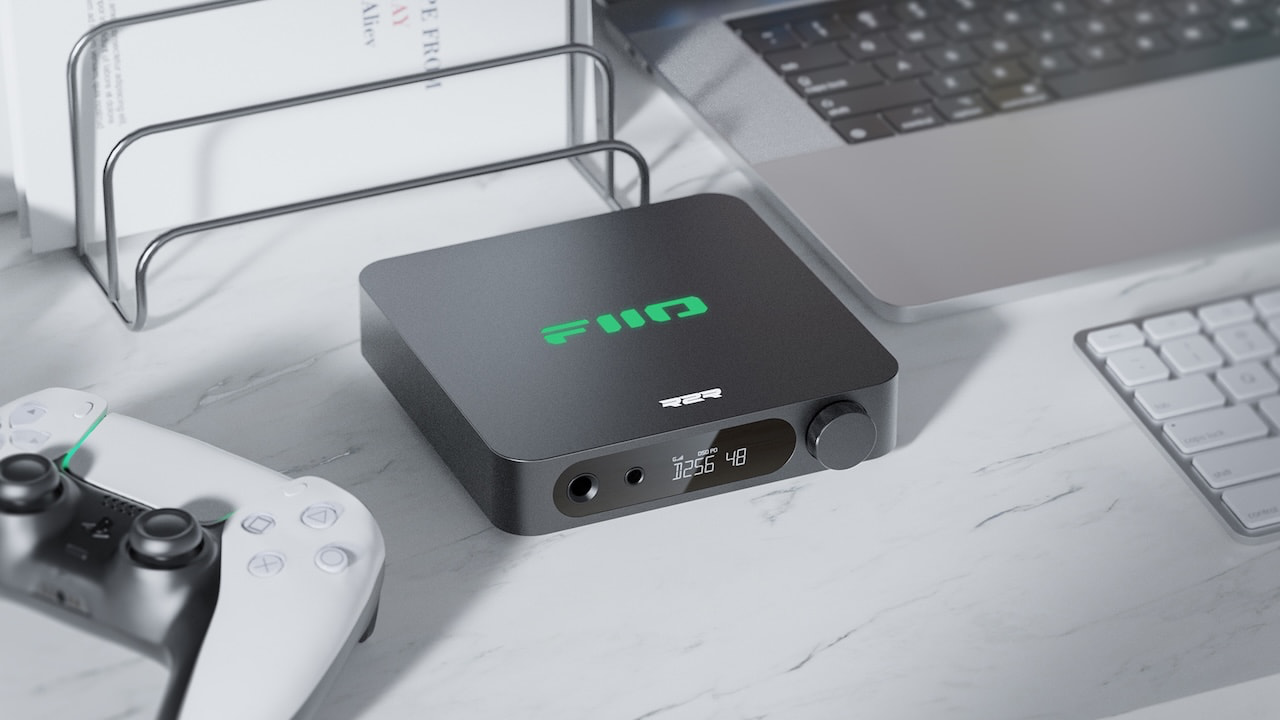
Physical control is handled through a single multifunction volume knob that manages power, menu navigation, and volume adjustment. Output modes including power out, pre out, and line out can be selected via a double press of the knob, allowing the unit to be used as a headphone amplifier, DAC, or preamp depending on system requirements.
The illuminated FiiO logo on the top panel functions as a sampling rate indicator using RGB lighting. Brightness, color, lighting behavior, and on off control are adjustable through the menu system.

Build quality is solid and rattle free. The chassis feels rigid, the rear panel input and output jacks are securely mounted, and both the single ended and balanced headphone outputs are well constructed with no looseness or play.
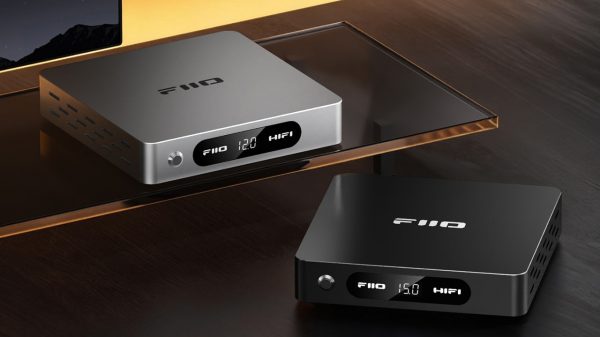
The K11 R2R has a compact, practical footprint. It measures 147 × 133 × 32.3 mm (5.8 × 5.24 × 1.27 inches) and weighs 420 grams, or about 15 ounces. It feels appropriately solid for its size and is easy to place on a desk without demanding extra space. Finish options include Obsidian Black and Midnight Silver.
A 1.1 inch LCD VA segment display with white illumination sits on the front panel. It provides basic operational information including sampling rate and menu status and remains easy to read from a normal listening position without drawing unnecessary attention.
From a value perspective, the K11 R2R offers a feature set comparable to my Topping L30II and E30 amplifier DAC combination while costing roughly $120 less and consolidating everything into a single chassis. The reduced cable clutter and simpler setup are practical advantages rather than headline features.
Compared with my three year old Schiit Audio Magni Unity and Modi 3 stack, the K11 R2R provides a more modern DAC architecture and broader feature support, despite being the less expensive option. That said, the Magni Unity remains a product I have a soft spot for. It addressed shortcomings of earlier Magni designs and is still one of my preferred Schiit Audio components.
Inputs, Outputs, Supported Sampling Rates, and Headphone Power Specifications
On the output side, the K11 R2R provides both single ended and balanced headphone connections. The 6.35 mm single ended output delivers more than 460 mW per channel into 32 ohms and over 50 mW per channel into 300 ohms, with THD+N kept below 1 percent.
The 4.4 mm balanced output offers higher headroom, rated at more than 1300 mW per channel into 32 ohms and over 220 mW per channel into 300 ohms, again with THD+N under 1 percent. These power figures are sufficient for a wide range of headphones, from efficient dynamic designs to higher impedance over ear models, without pushing the amplifier into its limits.

Input options are straightforward and cover the bases for a desktop focused system. Digital inputs include one USB Type-C, one coaxial, and one optical connection. In addition to the headphone outputs, the rear panel includes left and right RCA analog outputs for use as a DAC or preamp, along with a coaxial digital output for passing signal to an external DAC.
Supported sampling rates vary by input. Over USB, the K11 R2R supports PCM up to 384 kHz at 32-bit and DSD up to DSD256. The coaxial input supports PCM up to 192 kHz at 24-bit, while the optical input supports PCM up to 96 kHz at 24-bit. These limits are in line with typical interface constraints and cover the majority of high resolution digital audio content in real world use.
To access DSD256 playback, the DSD output mode must be set to native in the menu system. It’s also worth noting that while DSD256 is accepted as an input format, the signal is internally converted to PCM before R2R processing.

Listening
System setup was deliberately uncomplicated and representative of how most people will actually use the K11 R2R. Digital streaming came via TIDAL and Qobuz running out of an Apple iMac, MacBook Pro, and an iPhone 17. USB was the primary connection throughout, with the K11 R2R functioning as both DAC and headphone amplifier to keep variables to a minimum and the workflow consistent.
FiiO has since released a firmware update that enables 1 bit DSD decoding, which is relevant if you maintain a DSD heavy library. There is a catch. The firmware update is Windows only. Mac users are officially out of luck. Yes, you can install a Windows 11 virtual machine and jump through the hoops that follow, but I chose not to. I’ve had enough bad experiences with virtual machines to know when to walk away. Until there’s a dedicated PC laptop on my desk, the update stays theoretical.
Headphone pairing covered a wide spread of designs and sensitivities, including the Grado SR80x, Meze Audio 99 Classics V2, Meze Audio 109 Pro, Meze Audio Empyrean II, and the Beyerdynamic DT 770 PRO X. This range allowed the K11 R2R to be evaluated across efficient dynamics, higher impedance loads, and more demanding planar designs.
The moment R2R enters the conversation, expectations tend to harden fast. People immediately assume a certain tonal outcome: organic, textured, warm, smooth, maybe even a little romantic. Having spent time with enough R2R DACs, I’ve learned that the topology alone doesn’t guarantee any of that. Implementation matters, and results vary more than the marketing would like to admit. R2R designs do not all share the same tonal balance, presentation, or overall character, and treating them as interchangeable is lazy thinking.
I’ve always leaned toward DACs and amplifiers that prioritize texture and a sense of organic flow. That preference hasn’t gone away. But as the number of headphones and IEMs crossing my desk has increased, so has my appreciation for linearity when it comes to evaluation. A more neutral baseline makes it easier to hear what the transducer is doing rather than what the electronics want it to do. It’s the difference between seasoning and masking.
I’m fine with a little heat. Chili sauce with dim sum, spicy mustard on smoked meat—keeps things interesting. But when the heat takes over, everything tastes the same and the point is lost. Same deal here. Balance matters when you’re listening critically, not chasing a flavor.
Because real restraint is knowing when to stop—even when that little dish of chicken feet or beef tripe is begging for abuse and the waitress is hovering, eyebrow raised, asking just how hot you think you are. That’s when you pause, think, and dip your spoon into the soy sauce.

Turning Up the Heat Without Burning the Dish: When Warmth Helps—and When It Gets You Yelled At
Meze Audio’s re engineered 99 Classics V2 present a noticeably different perspective from the original and felt like the right place to start. The tuning is more linear, the bass tighter, and the presentation wider and more spacious overall. It doesn’t hit with quite the same blunt force impact as before, but it’s the more balanced and ultimately more enjoyable listen.
Using the 99 Classics V2, a stretch of Nick Cave tracks including “Avalanche,” “Frogs,” “Song of the Lake,” and “Red Right Hand” made for an easy test loop during post surgery recovery sessions. The K11 R2R’s character showed itself quickly. Cave’s gritty, low register growl carried a strong sense of depth through the Meze, and the vocal weight felt appropriately grounded. That part worked.
The bass, however, shifts character. Sub bass arrives with more weight, but definition takes a small step back. It’s fuller, less precise. On “Avalanche,” where the focus should remain locked on Cave’s voice while the piano and strings quietly do their damage, the K11 R2R delivered the mass but softened some of the fine edges. Piano notes carried weight, but a bit of detail was shaved off in the process. The presentation wandered slightly outside the lines.
It’s not a bad change. Just a different one. Compared to the Topping stack or some of the Questyle dongle DACs I’ve used with the 99 Classics V2, there’s less micro detail and less grip in the low end. Whether that’s a flaw or a flavor depends on what you’re after. The K11 R2R clearly has an opinion here, and it isn’t pretending otherwise.
Switching gears to Sam Cooke, Jason Isbell, and David Byrne, the balance shifted in a way that played to the K11 R2R’s strengths. I found myself leaning into the added texture and mass. Vocals came across as more human and less etched, which worked well with material that lives and dies by phrasing rather than precision. And since I’ve never been especially committed to coloring inside the lines—audio or otherwise—that aspect landed positively for me.
Some listeners will likely hear the slight loss of focus as a non issue, and there’s a good chance I’m being overly critical here. Context matters. With the re-engineered 99 Classics V2, this pairing makes sense. With the original 99 Classics, I wouldn’t be nearly as enthusiastic. Those older, darker, thicker sounding headphones already lean heavy and don’t need extra weight added to the bar.
Pair those with the K11 R2R and you don’t need warmth—you need Paris Island at 0500. That’s when Gunnery Sergeant Hartman would lean in until you could smell the coffee and bark:
“This rig is soft, unfocused, and hiding behind warmth like it’s a security blanket. I didn’t ask for comfort—I asked for clarity. Now tighten that bass, sharpen those transients, and give me definition before I personally confiscate your hot sauce and your headphone privileges.”
Switching over to the Beyerdynamic DT 770 PRO X and the Meze Audio Empyrean II, there was a clear step up across those same tracks. Between the two, I gravitated toward the more ethereal presentation of the Empyrean II, which simply plays nicer with the K11 R2R’s personality. It’s also worth noting that this pairing really came together once I moved to the balanced output—which explains, yet again, why I keep buying extra cables and connectors and calling them “birthday gifts to myself.” Some people collect watches. I collect terminations.
The DT 770 PRO X, though, deserves special mention. At under $200, they remain a genuine surprise. I traveled with them last summer through Italy, Croatia, Greece, and Spain, paired with a FiiO portable CD player and a small army of dongle DACs, and their closed back design and analytical nature proved consistently useful. That’s saying something, because I’ve never exactly been a card carrying fan of German headphones. We’ve had our differences. Never mention the war.
What the K11 R2R does here is predictable but effective. It adds a layer of texture and warmth, but when paired with more analytical headphones like the DT 770 PRO X, that added weight doesn’t bog things down. Instead, it gives them a shove in the right direction. Less lab coat, more blood flow. The result is a pairing that’s not only listenable, but genuinely enjoyable—without pretending the K11 R2R is staying out of the conversation.

Electronic Stress Test: Aphex Twin, Boards of Canada, Trent Reznor, deadmau5, and Daft Punk on the K11 R2R
I’ve come to accept that electronic music works best for me on headphones. The experience is more intimate. More immersive. The space matters, the pulse matters, and the way synth lines rise and fall in a controlled soundstage is what pulls me in. It’s why listening to Aphex Twin, Boards of Canada, deadmau5, Trent Reznor, Tangerine Dream and Daft Punk sends my brain drifting elsewhere. I start staring through people, thinking about late nights on the “L,” an almost empty train rattling above Chicago streets. Been there. Lived that. File it under stories for another time. Will cost you at least 4 pieces of biltong to really find out.
Electronic music demands a careful mix of precision, pacing, texture, impact, and real depth across width and space. Miss one element and the illusion collapses. The K11 R2R handled that balance better than expected. Through the Beyerdynamic and Meze’s flagship Romanian cans, it was easy to disappear into the music and stay there longer than planned.
I’ve felt this before with some of Alex Cavalli’s earlier designs and with the Linear Tube Audio headphone amplifier, so the reference point is familiar. What’s different here is the price. A DAC and headphone amplifier this affordable shouldn’t be able to make me lose track of time for twenty minutes and miss three phone calls. But it did.
Is it the best I’ve heard under $200? Without hesitation, yes. To get meaningfully better, I’d likely have to spend two to three times more, and even then the improvement wouldn’t be guaranteed—just different.

The Bottom Line
The K11 R2R gets a lot right, especially at its price. It delivers a genuinely engaging presentation that favors texture, flow, and musical momentum over strict studio-style precision. That character works across a wide range of headphones, particularly those that lean analytical or slightly dry, where the K11 R2R adds just enough weight and humanity to make long listening sessions easy. It’s compact, well built, and flexible enough to function as a one-box desktop solution without feeling compromised.
The tradeoff is that it’s not the last word in focus or micro-detail. Bass definition can soften depending on pairing, and listeners who want maximum edge sharpness and absolute neutrality will hear the limits. This is not a scalpel. It’s a well-balanced knife that gives you feel as well as control.
That balance came into sharp focus listening to Víkingur Ólafsson’s recording of J.S. Bach: Goldberg Variations. The way he brings the variations to life is measured, intimate, and emotionally direct. The K11 R2R didn’t render every transient with forensic precision, but it conveyed the weight, and emotional gravity of the performance in a way that felt honest. Almost tear-inducing. Beautiful. Like her blonde, curly hair resting on your chest on a blanket in the rain. You feel it.
Is it perfectly accurate? No. But nothing that meaningful and real ever is.
Pros:
- Fully differential in-house R2R DAC design at a very accessible price
- Engaging, textured presentation that works well with analytical headphones
- Strong feature set including balanced output, NOS/OS modes, and preamp capability
- Compact, solidly built, and genuinely useful as a one-box desktop solution
- Excellent value under $200 with performance that pushes well above its class
Cons:
- Bass definition and fine detail can soften depending on headphone pairing
- Not ideal for listeners who prioritize absolute neutrality and maximum precision
- Windows-only firmware updates limit flexibility for Mac users
- R2R character is always present and not universally compatible with darker headphones
Where to buy:
Related Reading: