
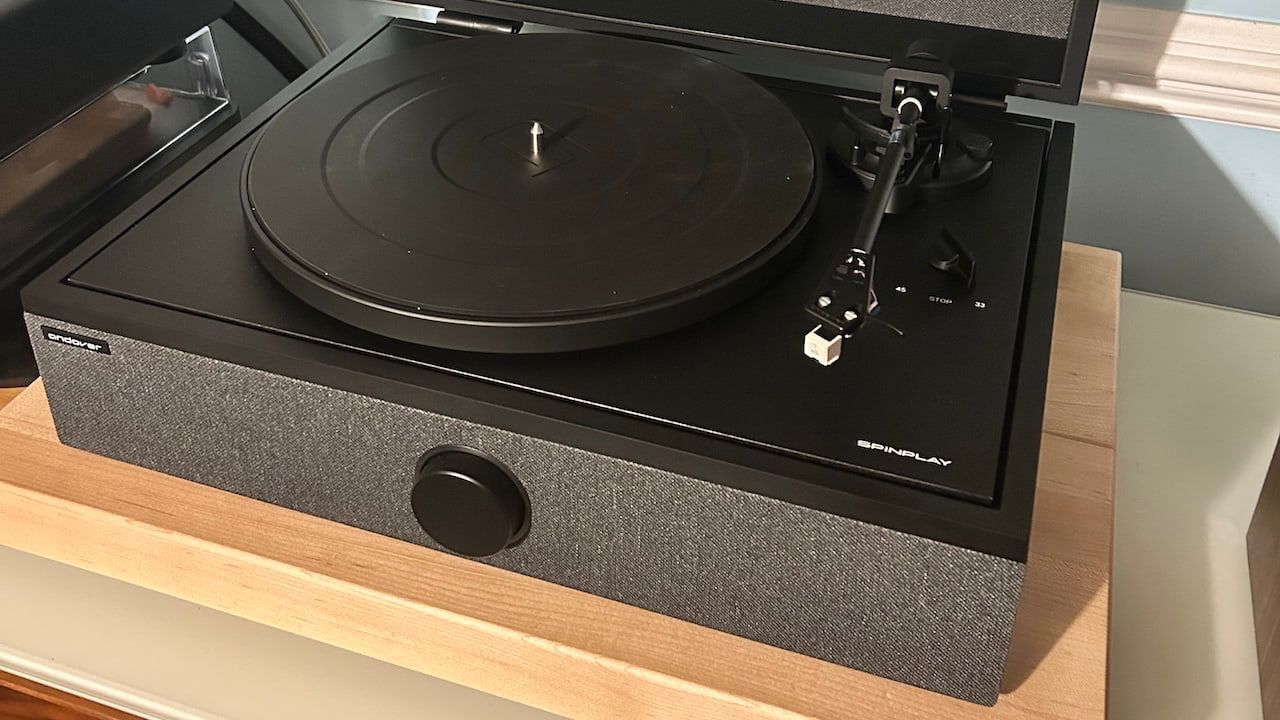
If you’re the type who sees an all-in-one record player and instinctively mutters “Crosley,” “lifestyle,” or “not real hi-fi,”congratulations—you’re thinking exactly what Andover Audio expects you to think. And in the case of the Andover Audio SpinPlay, you’d be wrong on all three counts.
I’ll admit it: I was skeptical too. The category has trained us to be. Too many so-called “vinyl solutions” are plastic toys with delusions of grandeur that are fine for Instagram, but terrible for music. Then the SpinPlay arrived. In a box so heavy it felt less like a lifestyle product and more like a mild liability warning. Timing was…fortunate, considering it showed up before two stomach surgeries last week. This thing is not a toy, not an impulse buy masquerading as hi-fi, and definitely not something you toss under one arm like a dorm-room accessory.
What Andover has done here is quietly subversive. They’ve taken everything people think they know about plug-and-play turntables and flipped it. The SpinPlay is unapologetically simple; pull it out, plug it in, drop the needle, but underneath that ease is real engineering, real mass, and real intent. It looks friendly. Like an Imperial Star Destroyer on approach. And it exists for people who want vinyl to sound right without turning setup into a weekend project or a YouTube rabbit hole.
if you judged this one by the category it lives in, that’s understandable. If you keep judging it after lifting the box—or better yet, lowering the needle—that’s on you.
This isn’t Andover Audio suddenly trying something cute after one lucky hit. Andover Audio has been grinding this lane for years with products like the SpinStage and SpinBase MAX—both proof that the company knows how to solve real-world vinyl problems without turning everything into an engineering thesis or a lifestyle prop. Call it clever, call it pragmatic, but don’t call it accidental.
The SpinPlay leans hard into that same playbook. At its core is Andover’s patented IsoGroove isolation system, borrowed directly from the Andover-One—a far more expensive product that’s already done the long-term proving. IsoGroove isn’t some miracle cure, and it’s not pretending to rewrite the laws of physics. It’s a straightforward mechanical approach—mass, isolation, and sensible engineering—that reduces feedback as volume increases, and it does exactly what it’s supposed to do.
Andover Audio SpinPlay: Why This All-In-One Turntable Isn’t a Crosley in Disguise
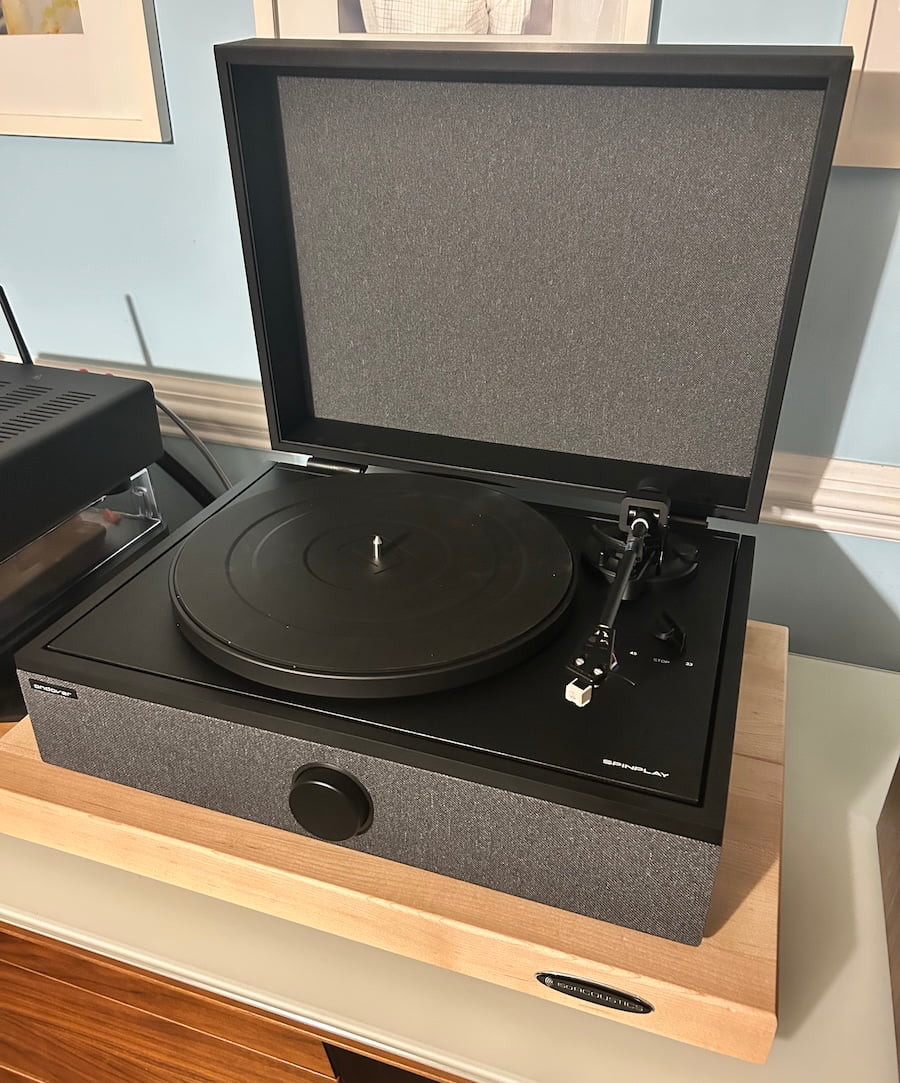
The Andover Audio SpinPlay is a fully integrated record player and speaker system built around a fairly technical premise: reduce feedback mechanically (IsoGroove) and keep the amplification/speaker system properly controlled. The onboard amplification is Class D, using Andover’s Dual Direct Drive (DDD) approach—separate amplifier channels assigned to the drivers rather than one amp section trying to run the whole show.
The speaker system is a four-driver, 270° array: two 1.75″ × 4″ oval woofers handling 40Hz–2.5kHz and two 0.75″ silk-dome tweeters covering 2.5kHz–20kHz. Power is split with 20W allocated to the oval woofers and 15W to the silk-dome tweeters, with a published system response of 60Hz–20kHz. There’s also a selectable 100Hz high-pass filter, which matters if you’re offloading bass to a sub.
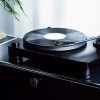
Physically, the SpinPlay doesn’t pretend to be delicate. It’s a braced MDF cabinet measuring 18″ (W) × 6.75″ (H) × 13.5″ (D) and it weighs 20.5 lbs (9.3 kg)—which is why it doesn’t feel like a toy when you pick it up. The dustcover is genuinely substantial (heavier than some entry-level tables I’ve tried), and while the styling is more utilitarian than “showpiece,” the upside is obvious: rigidity, stability, and less cabinet nonsense when the volume goes up. The 12″ cast aluminum platter is also well made and paired with a damped silicone mat, which helps with both stability and resonance control.
The turntable itself is a custom Andover belt-drive design with electronic speed control and an electronically governed DC motor designed to maintain stable speed. It supports 33⅓ and 45 RPM and includes an end-of-record auto-stop function; however, the tonearm does not return to its rest, as this is not an automatic arm.
Andover rates wow & flutter at <0.15% (weighted). Setup is intentionally minimized: the platter and belt come pre-installed, and the tonearm is pre-balanced at the factory, so you’re not spending your Friday night learning tonearm geometry on YouTube.
The tonearm is more capable than this category typically requires, and that’s not accidental. It’s an 8.9″ (9-inch class) aluminum arm riding on precision ball bearings, with viscous-damped cueing, a semi-fixed counterweight, and—crucially—adjustable tracking force and anti-skate. Those last two are the point. They mean Andover isn’t locking you into a sealed, “factory-set forever” design where any thought of adjustment voids the premise.
Will 95% of buyers ever change a cartridge or stylus? Absolutely not and that’s fine. But the option is there, and that’s the difference. After spending time with the SpinPlay, I can see myself taking advantage of it, because this isn’t a decorative box pretending to be hi-fi. It’s capable enough to justify a little experimentation, which is more than can be said for most all-in-one turntables that panic the moment you think about upgrading anything.
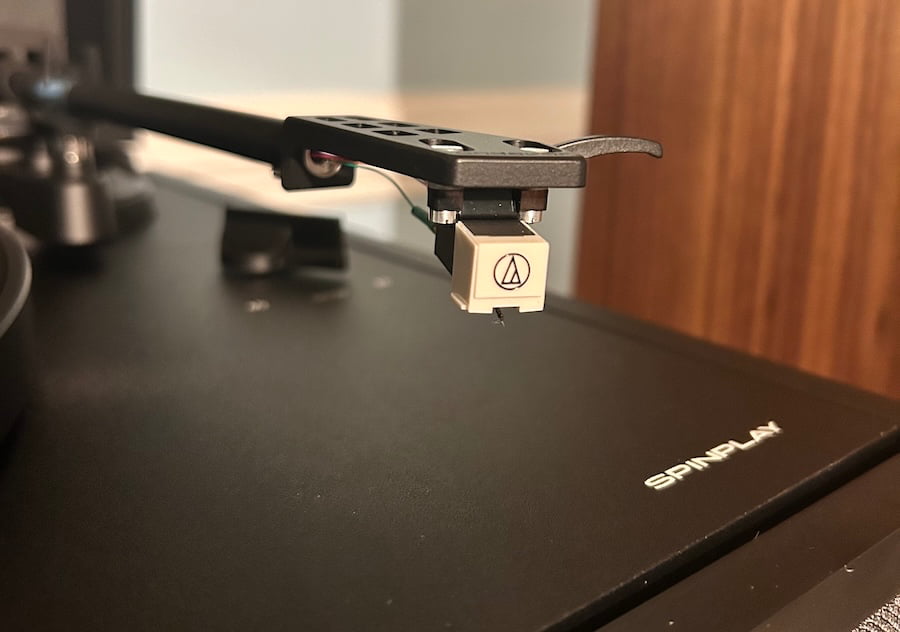
The included cartridge is the Audio-Technica AT3600L, a moving-magnet design that’s widely used for good reason: it’s stable, forgiving, and well matched to plug-and-play turntables like the SpinPlay. Output is rated at 3.5 mV, with a 20Hz–20kHz frequency response, channel balance within 2.0 dB, and channel separation of 20 dB at 1kHz (15 dB at 10kHz)—all squarely in line with what you’d expect from a competent entry-level MM cartridge designed for reliability rather than fireworks.
Tracking force is specified between 2.5 and 3.5 grams, with around 3.5 g commonly used in practice, which favors secure tracking over low-mass finesse. The stylus is a 0.6 mil bonded conical diamond mounted on a carbon fiber–reinforced plastic (CFRP) cantilever, a combination chosen for durability and tolerance rather than surgical precision. Stylus life is typically 300–500 hours, depending on record condition and setup. Total cartridge weight is 5.7 grams.
Importantly, the AT3600L isn’t a dead end. Stylus replacements are readily available, including the ATN3600LC conical and ATN3600LE elliptical, allowing for incremental upgrades without changing the cartridge body. You can also step up to other MM cartridges, but expectations should stay realistic—this is an MM-only platform, not an MC playground.
The stock cartridge does its job cleanly and predictably, and the tuning of the internal phono preamp and powered speakers balances out the analytical nature of the cartridge. You’re not getting a Grado Prestige Gold here with a fluffy midrange.
On the connectivity side, it’s more complete than most “all-in-one” systems. Inputs include line (aux) with 10kΩ input impedance, optical digital in up to 24-bit/96kHz, and USB flash drive playback (MP3/WMA/WAV). Wireless is Bluetooth 5.0 with transmit and receive, which is useful if you want to send audio to headphones or pull audio in from a phone/tablet. There is no support for LDAC, aptX HD or aptX Lossless which is disappointing.
Outputs include line out at 2V RMS, headphone out rated 120mW @ 16Ω, and even a USB power output (5V DC / 300mA). Power supply is 100–250V AC, 50–60Hz, and control is via a full-function infrared remote.
And yes, Andover is pitching portability with the upcoming SpinPlay Go-Bag (Q1 2026), designed to fit under an airline seat or in an overhead bin. I’m not signing off on that yet. 20.5 pounds is a lot of carry-on ambition, especially when you’ve just had abdominal surgery. Back of the SUV for a road trip to Florida? Completely believable. Flying with it? I’ll withhold judgment until the surgeon who just rebuilt my core gives permission—and possibly a waiver.
Setup: Because Not Everyone Enjoys Tonearm Foreplay
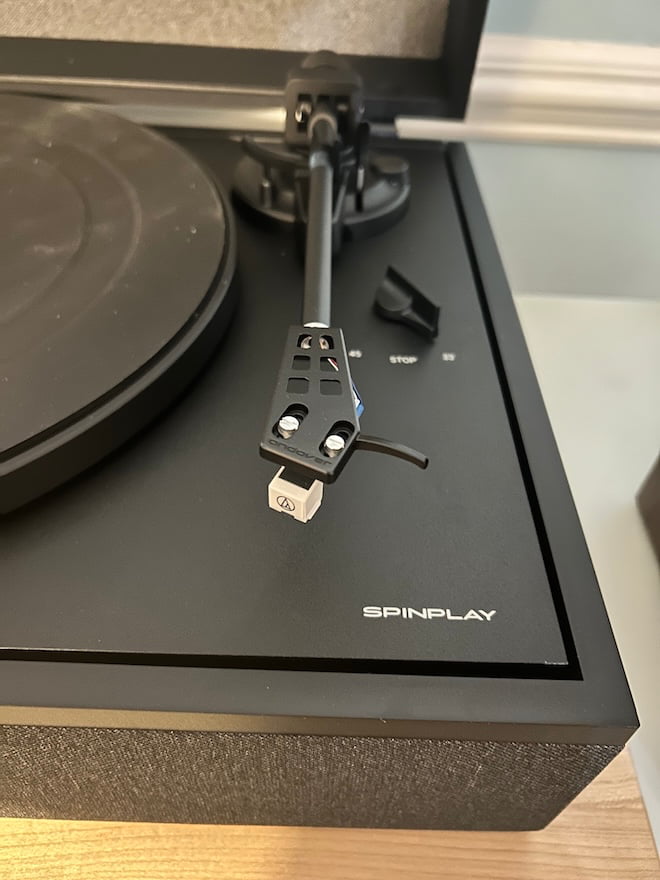
Yes—the SpinPlay really is plug-and-play, and not in the marketing-department sense of the phrase. I had it up and running in under ten minutes, and that includes getting it out of the packaging and remembering to peel off the shipping tape securing the tonearm.
What genuinely caught me off guard was the build, especially the dustcover. It’s substantial. At the risk of repeating myself (the editorial equivalent of making the same bad joke on a date), Andover clearly did not skimp here. The SpinPlay feels solid in a way that suggests longevity, not trend-chasing. It’s the kind of product that feels like it could still be working just fine long after most lifestyle gear has been quietly retired to the garage. For the price, that matters, and it’s something other manufacturers in this space should probably take notes on.
Do I wish it looked a little more elegant? Sure. A bit of wood trim to break up the otherwise neutral, utilitarian finish wouldn’t have hurt. But not everything needs to be precious or performative. The SpinPlay prioritizes function and durability over decorative flair, and I’m okay with that—even if it means accepting that not every product gets to sip Brio, wax poetic about smoked meat, or pretend it’s auditioning for a permanent slot at MoMA.
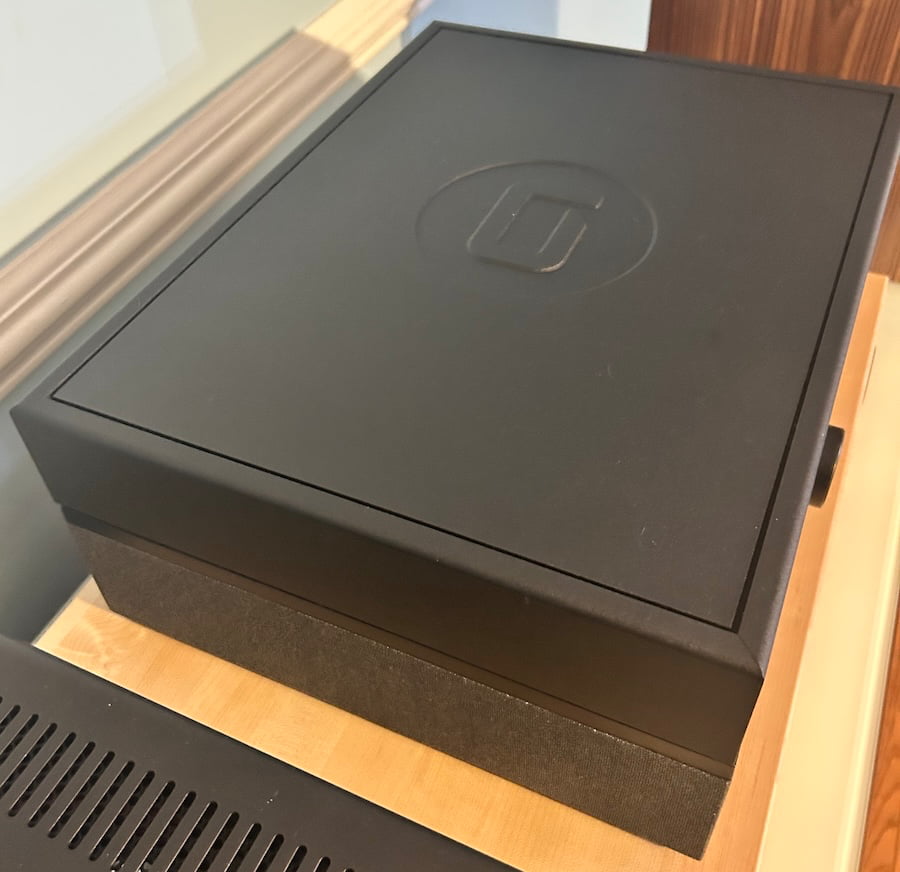
Probably the most important part of the setup has nothing to do with menus or controls—it’s placement. Bookshelves are a poor choice, and anything enclosed is worse. The SpinPlay has built-in speakers, which means it needs open space to work properly. Put it on a solid, stable surface and don’t try to tuck it into furniture that was never meant to host a turntable.
A credenza works well, with one caveat: spacing matters. You want roughly 12 inches (25–30 cm) of open space on each side. That gives the speaker array room to breathe and avoids choking the sound. Some people will say that’s inconvenient. My advice is simple—make it work. The SpinPlay is forgiving, but it can’t overcome bad placement.
I tested it in several real-world spots: a bedroom end table, a dresser, a dining-room credenza, an IKEA EXPEDIT in my home office, and even the kitchen counter. The results were consistent. Solid surface plus open sides equals better balance and cleaner sound. Ignore that guidance and it’ll still function. Follow it, and it performs the way Andover clearly intended.
Andover includes a 45 RPM adapter for singles, which sounds trivial until you remember how many companies still make you buy one separately. The remote is also more useful than expected—and yes, that matters. You can operate most of the SpinPlay from the front panel, but once you start switching sources or tweaking settings, the remote saves time and patience.
The front-panel control scheme is straightforward and mostly well thought out. The single central knob does the heavy lifting: press it to power the unit on or off, at which point the LED display behind the grille lights up and confirms the active input. Pressing the knob again puts the SpinPlay into source-select mode, and rotating it cycles through the available inputs. Turning the knob normally raises or lowers the volume.
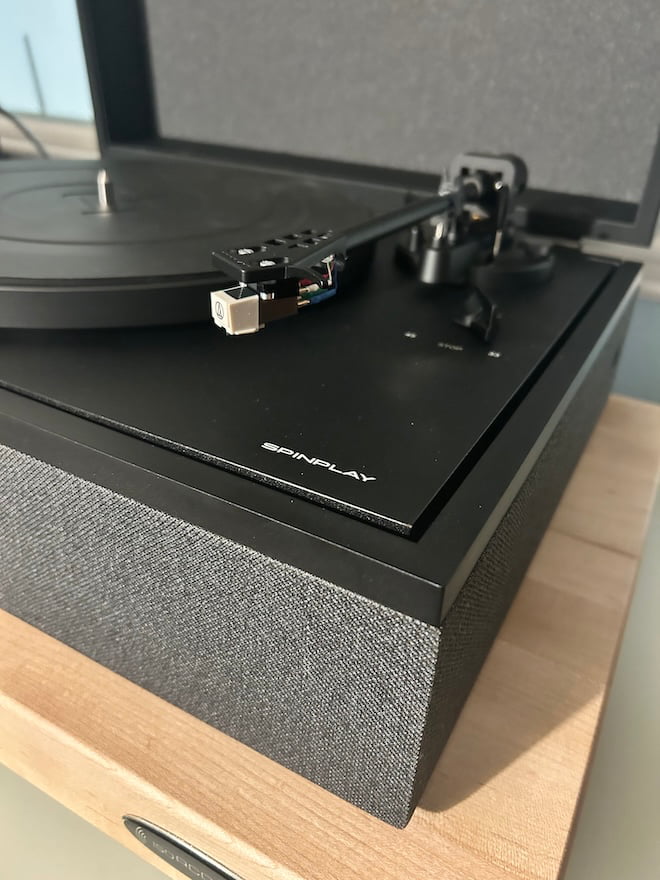
The only function you can’t access from the knob is enabling or disabling the high-pass filter if you’re running a subwoofer—which is a deliberate limitation rather than a design miss.
The remote handles everything else. You get power, volume up/down, source selection, bass and treble adjustment, and a headphone button that lets you switch between the built-in speakers and the headphone output. There are also play/pause and track forward/back controls for digital and Bluetooth sources. Bluetooth pairing is simple: select BT as the input and pair your phone, wireless headphones, earbuds, or speakers.
One note on the phono stage: while it can technically work with some high-output moving-coil cartridges, this system clearly prefers MM cartridges in the 3.5–5.0 mV range, which is exactly where the supplied Audio-Technica lands. Stick there and everything behaves.
During testing, I used an iPhone 15, a WiiM Pro Plus network player, and routed audio to two pairs of wireless speakers via RCA-to-3.5 mm and RCA-to-RCA connections—specifically the KEF LSX II and Triangle Borea BR03 BT.
Listening
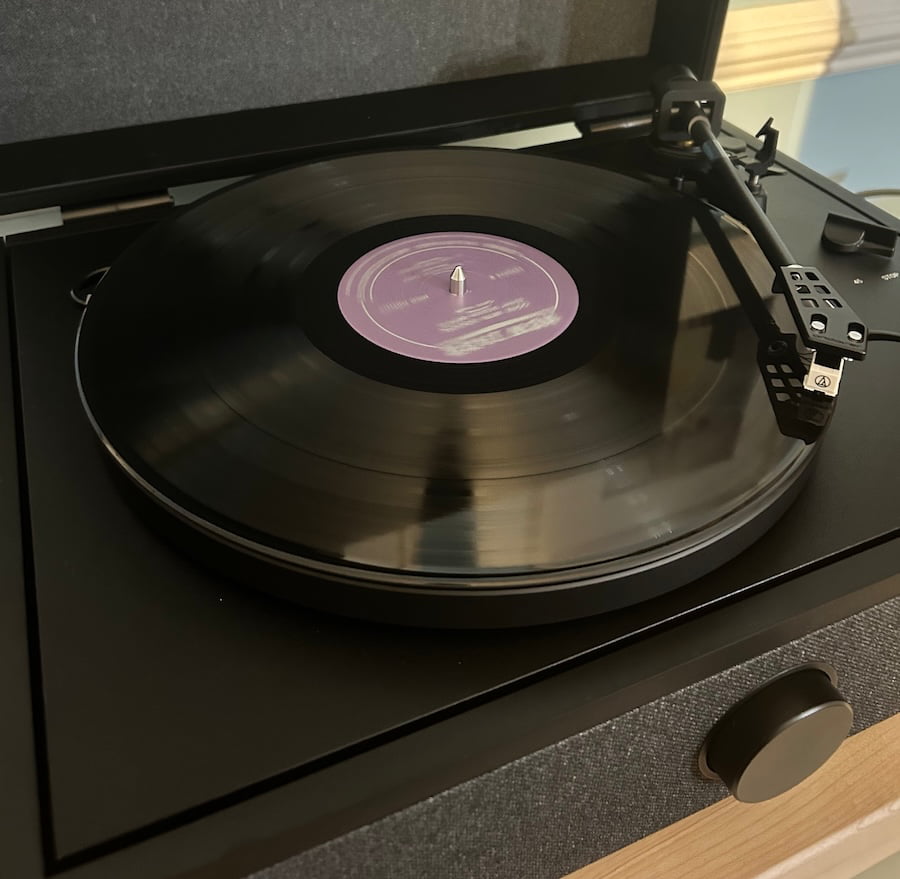
All-in-one turntable systems usually ask you to forgive something—build, sound, longevity, ambition. So expectations stayed low, partly out of self-defense. And that’s exactly why the SpinPlay works. It doesn’t announce itself. It doesn’t lean on tricks. It reveals its strengths slowly, once you stop judging it by appearances and start listening to what it’s actually doing.
Think of it like being set up by someone who means well but clearly doesn’t want to oversell it. You lower your expectations on purpose. You’re half-expecting Allison Reynolds—interesting on paper, probably complicated in practice, and very much a roll of the dice. You brace yourself accordingly.
Instead, what you actually get is Joyce Byers, with a little Nora Charles and Maria Tura quietly baked in. Not flashy. Not trying to impress you. But sharp, capable, and far more together than the first impression suggested. That’s the SpinPlay experience in a nutshell.
Circumstance allowed me to set the SpinPlay up on the kitchen counter, which I’ll admit carries a certain amount of risk. I grew up in a food-industry family and logged well over 10,000 meals in my late teens for paying customers, which means two things: I like to cook, and I don’t tolerate chaos near heat, knives, or sauce. My family appreciates this. Clean counters, clear sinks, and no mystery leftovers for the dog to devour overnight on the kitchen floor.
Fortunately, the layout of our kitchen made this workable. The SpinPlay sat off to the side of the cooktop, with about two feet of clearance—far enough to avoid heat, splatter, or airborne olive oil while still letting me listen properly. That setup mattered, because this wasn’t background noise duty. This was Sunday gravy. The long version. The one you stir slowly and take seriously. Never let the garlic or veal burn.
Craft Recordings was unbelievably good to me in 2025—beyond grateful—and you can find the deep-dive coverage Mark Smotroff and I did elsewhere. When I cook, I focus. It makes for a better meal, and distractions are usually not invited. That said, Gone with Golson happened to be spinning in the next room on my Thorens, so it became the sacrificial first listen on the SpinPlay. If you’re going to break the seal, you could do worse than an understated jazz gem keeping company with shanks, sausage, and a pot of Sunday gravy.
The kitchen had its own soundtrack going—cast iron sizzling, fat rendering, the smell of meat slowly giving up the fight to time and heat. That’s a sensory overload I take seriously. Then the SpinPlay chimed in, and it stopped being background anything. What came out of that box was genuinely unexpected: presence, real top-end bite without glare, pacing that made the groove feel alive, and a spaciousness that didn’t collapse when I moved around the room.
Nobody wants to burn eighty dollars’ worth of meat, but it’s fair to say my attention drifted. I caught myself staring at the Andover instead of the stovetop more than once—not because the food stopped mattering, but because the SpinPlay suddenly did. That’s not a small thing in a room full of smells, heat, and competing noise.
With the gravy doing its thing, I went back into the den, pulled about a dozen records from the In Rotation cube, and brought them into the kitchen. Nick Cave, Sonny Rollins, John Prine, Lana Del Rey, Nils Frahm, Boards of Canada, Lee Morgan, Mississippi John Hurt, Natalie Bergman, The Cure, and Amy Winehouse. Enough range to see where the SpinPlay stays composed and where it shows its limitations.
The SpinPlay is consistent across genres, but not because it’s chasing neutrality or trying to sound “correct.” It’s consistent because it keeps its priorities straight. The top end never gets hard or brittle, but it also doesn’t dig out every last micro detail. That’s a trade-off I’m fine with in a system like this. You can listen for hours without fatigue, and nothing turns sharp or shouty when the volume comes up.
Electronic music has enough pace and drive to stay engaging, but bass lines through the built-in speakers could be tighter and better defined. There’s weight and energy, but not the kind of grip you get from a dedicated speaker setup. Jazz holds together well, with good flow and momentum, and vocals stay forward enough to anchor the mix without sounding hyped or boxed in.
It does not offer the transparency of a Rega Planar 3 or a Pro-Ject Debut PRO B. The presentation is slightly thicker and more rounded, which is likely a combination of the all in one design and the stock cartridge. That cartridge feels like the limiting factor. A Nagaoka or a higher level Audio-Technica would almost certainly improve clarity and separation.
Vocals sit slightly forward and remain centered without collapsing into the cabinet. The sound does extend beyond the physical width of the unit, but stereo separation is not on the level of the KEF LSX II or Triangle Borea BR03 BT I used for comparison. There is still an improvement over most all in one systems, but expectations should remain realistic.
As much as I could live with the SpinPlay exactly as it ships, a cartridge upgrade within reason makes sense. Moving from a roughly $30 cartridge to something in the $100–$150 range feels like the right move. Anything beyond that starts to miss the point. That said, running the SpinPlay into external wireless speakers changed my overall impression more than I expected.
The Triangle has an average MM phono stage, while the KEF doesn’t offer one at all, so the SpinPlay’s internal phono stage stayed in play for both. The Triangle’s voicing leans toward upper bass and lower midrange energy, with a slightly hot top end, and that balance actually worked well with the SpinPlay.
What caught me off guard is that this setup worked better than a few $1,000 turntable and phono preamp combinations I’ve used in similar real-world systems. Not because it was more revealing or more “audiophile,” but because it was better balanced and easier to live with. At that point, the SpinPlay stops feeling like an all-in-one compromise and starts acting like a flexible front end.
I should also note that while I have both the WiiM Ultra and WiiM Pro Plus on hand and consider them solid buys, I doubt most people shopping for the SpinPlay are pairing it with the Ultra. Realistically, many will stream from a smartphone over Bluetooth, and that works fine. That said, the WiiM Pro Plus sounded noticeably better than my iPhone as a source. Cleaner, more stable, and with better stereo separation. It’s also small enough to disappear into a system visually, which makes it an easy recommendation as a longer-term upgrade once you’ve lived with the SpinPlay for a while.
The Bottom Line
The SpinPlay succeeds because it knows exactly what it is and doesn’t pretend to be anything else. It does the fundamentals well: solid timing, an easygoing top end that never turns brittle, and an overall presentation that’s engaging rather than analytical. It sounds far better than most people will expect from an all-in-one system at $729, and it stays listenable across genres without falling apart or calling attention to itself for the wrong reasons.
It also does a few things better than expected. The build quality is genuinely tank-like, the setup is truly plug-and-play, and the system scales surprisingly well when used as a source feeding better speakers. Add a sensible cartridge upgrade or a small streamer down the line and the SpinPlay grows with you, instead of forcing an immediate replacement. That kind of headroom is rare in this category.
Where it’s merely okay is also worth stating. Bass through the built-in speakers has limits, transparency isn’t on the level of a traditional separates-based turntable system, and stereo separation can’t match dedicated speakers. None of that is shocking, and none of it feels like a dealbreaker given the design brief.
The main shortcoming is cosmetic rather than sonic. Had Andover leaned a little harder into finish and visual flair, this could have been the ideal second system or a perfect gateway for a new generation of vinyl listeners. As it stands, it’s a very well-executed design that earns its 2025 Editors’ Choice for sound quality relative to price, scalability, and build integrity. This isn’t a lifestyle toy pretending to be hi-fi. It’s a serious, thoughtfully engineered record player that happens to be easy to live with.
Pros:
- Genuinely plug-and-play setup with no calibration or adjustment required out of the box
- Sound quality is far better than expected for an all-in-one system at this price
- Presence and pacing are consistent across genres
- Top end stays smooth and listenable without turning hard or fatiguing
- Tank-like build quality, including a surprisingly substantial platter and dustcover
- Scales well when used as a source with external speakers or a better streamer
- Flexible connectivity with analog, digital, USB, and Bluetooth inputs
- Sensible upgrade path via MM cartridge swaps and external components
Cons:
- Bass extension and control are limited by the built-in speakers and cabinet size
- Transparency does not match traditional separates-based turntable systems
- Stereo separation cannot equal dedicated speaker setups
- Stock cartridge is competent but holds back ultimate performance
- Industrial, utilitarian design may feel plain to some buyers
- Portability claims feel optimistic given the system’s weight
Where to buy:
Related Reading:
- Andover Audio SpinBase MAX 2: More Power, Deeper Bass—Is This The Turntable Speaker System To Consider Below $550?
- Podcast: Andover Audio Has An Affordable And Unique Solution For Your Hi-Fi Budget Blues
- Best Audiophile Turntables: Editors’ Choice










Mark
January 17, 2026 at 4:02 pm
I have NOT used this product but my 12- year old daughter received a SpinBase 2/ SpinDeck 2 combo as a gift from her grandparents. Andover is legit and as long as you’re ok with all the caveats, it’s a supremely fun system and VERY listenable. She’s already asking about the Ortofon 2m Blue I have laying around, unused. Most importantly, to me, Andover made products that feel like they’re going to last decades.
Ian White
January 17, 2026 at 4:33 pm
Mark,
I own 3 of their products and the SpinPlay is the best by far.
Kid has good taste.
IW
J Husby
February 21, 2026 at 3:27 pm
Understanding that the stock cartridge is a limiting factor, does the aluminum tone arm allow for head shell swap-outs, or must the cartridges be separately installed / uninstalled ? Thanks in advance for any feedback.
Ian White
February 22, 2026 at 11:24 am
Jeff,
Cartridges must be separately installed. It’s a fixed head shell.
IW
Robert
February 25, 2026 at 9:59 pm
Is there any way to get the music played here into my iPhone. I can rip a cd into my computer and transfer music to the iPhone but how to transfer an LP to the iPhone defeats me. I have seen players online that supposedly allow LP music to record on a cd, which might transfer to a iPhone. I have music from the 60’s and 70’s,80’s 90s’Even some 45’s from the 50’s. And would love to have them on my phone for vehicle play.
Ian White
February 25, 2026 at 11:40 pm
Robert,
There are turntables with digital outputs that you can plug into your computer. These plug into your computer like a flash drive and show up as an audio input.
Audio-Technica AT-LP120XUSB / AT-LP60XUSB – Classic USB turntables that work with most Mac/Windows recording software (Audacity, GarageBand, etc.).
Denon DP-300USB – Belt-drive with USB and good sound for the price.
Pro-Ject T1 USB / Debut Carbon EVO USB – Higher-end sound and digital output; Pro-Ject’s USB interface is solid.
Rega Planar 2 with optional USB – Some bundles include a USB interface box for digital output.
IW