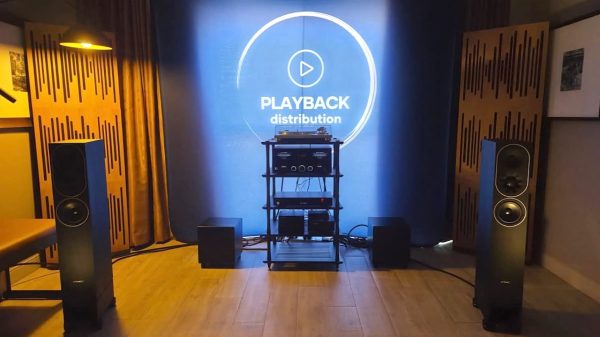
Gryphon Audio Designs has arrived at High End Vienna 2026 with the kind of system that makes “cost no object” feel like a clerical understatement. Inside The Gryphon Room, Level 2, Room 2.31, the Danish ultra-high-end manufacturer is introducing two major new components: the Helios preamplifier and the Hyperion Pure Class A power amplifier, successors to the long-running Pandora preamplifier and Mephisto power amplifier, both of which debuted back in 2012 and somehow managed to avoid becoming yesterday’s pastry for 14 years.
The new Gryphon Helios preamplifier is shipping immediately, priced at $29,800 USD, with the optional PSU 5 external power supply adding another $20,800 USD. The Gryphon Hyperion Stereo power amplifier is scheduled to ship in late summer 2026 at $80,200 USD, while the Hyperion Mono pair lands at $160,400 USD. Cheap? Not unless your accountant wears black and speaks in runes. But Gryphon has never pretended to build audio jewelry for the timid, and at High End Vienna 2026, Helios and Hyperion are being positioned as the new core of one of the most ambitious Gryphon systems ever assembled for a public show.
Gryphon’s Mega-System: Enough Danish Hardware to Make Your Banker Move to Greenland
In The Gryphon Room at High End Vienna 2026, Gryphon is not showing Helios and Hyperion in isolation. The new Helios preamplifier will be fitted with both the PS3 balanced phono module and DAC 3 module, while the new Hyperion power amplifier will drive the Trident II semi-active loudspeakers. Add the Apollo turntable, Black Diamond DLC cartridge, PowerZone 3.20, Vanta cabling, and StandArt furniture, and you have a full Gryphon ecosystem rather than a “demo system.” Denmark apparently looked at restraint and filed a formal complaint.
For pricing context, the Helios preamplifier is listed at $29,800 USD, with the PSU 5 power supply at $20,800 USD. The Hyperion Stereo is listed in Gryphon’s supplied High End Vienna 2026 materials at $80,200 USD, with the Hyperion Mono pair at $160,400 USD.
The Apollo turntable was announced at $149,800 USD, while the Black Diamond DLC cartridge has been reported at $20,000 USD. The Trident II loudspeakers have been listed around $139,000 to $139,500 USD per pair by dealers/show reports, with older European launch pricing at €97,000 plus local taxes, so current regional pricing should be confirmed with Gryphon or the distributor.
The PowerZone 3 has been reported at $17,500 USD, while Gryphon’s Vanta cable pricing varies by type and length; one reported example listed Vanta power cords at $5,150 for 1.5 meters and digital cables at $4,000 for 1 meter. The StandArt rack system is modular, with published pricing varying by configuration, from smaller amp stands to multi-shelf racks.
Gryphon Helios Preamplifier
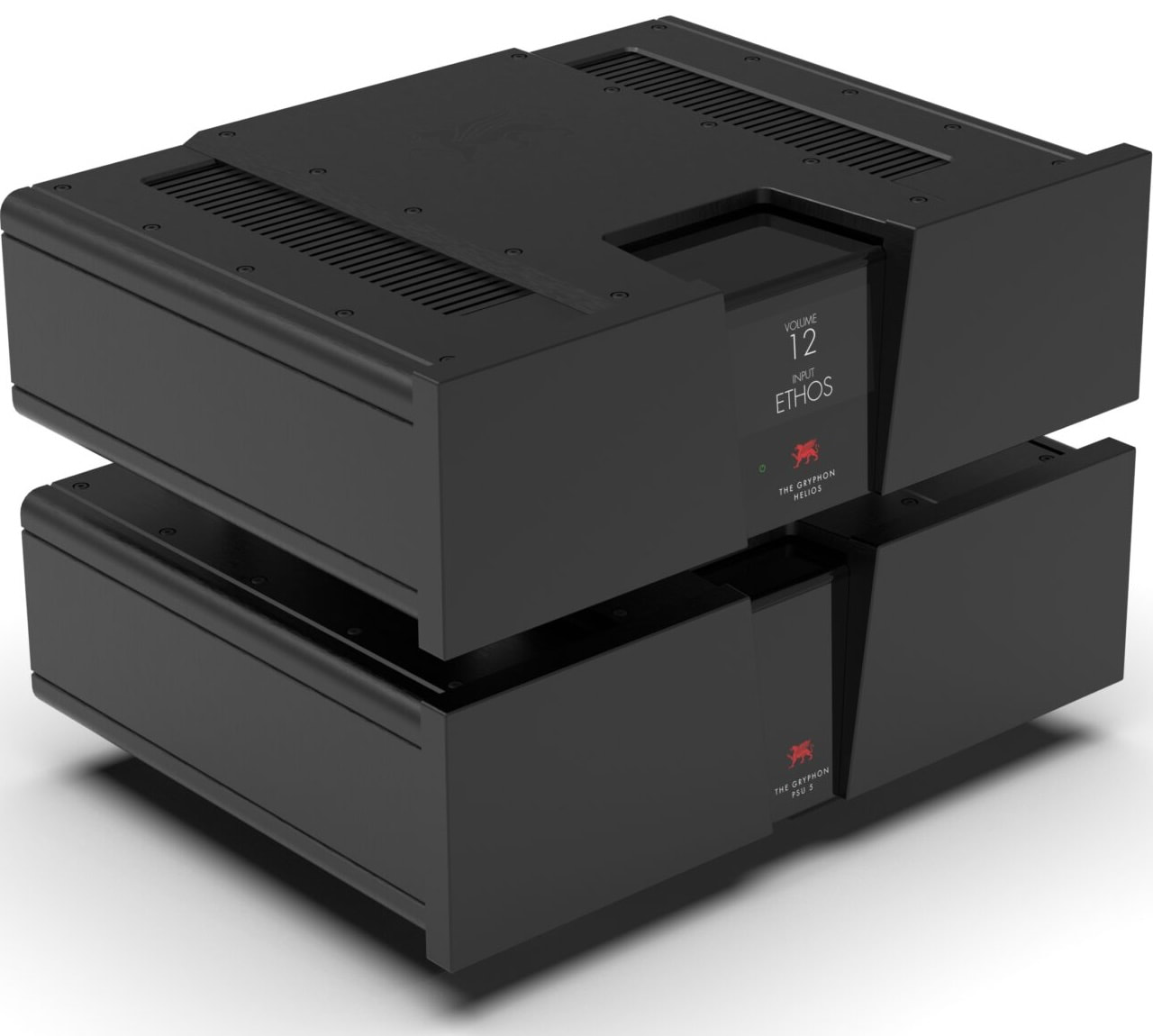
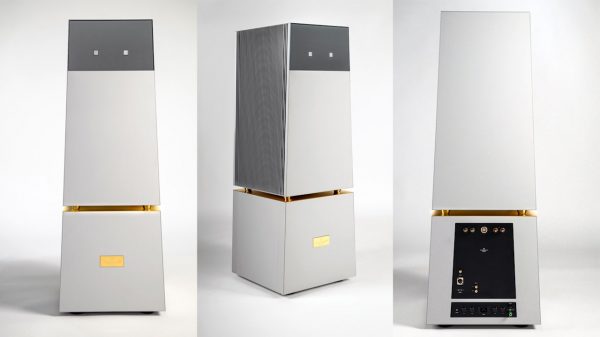
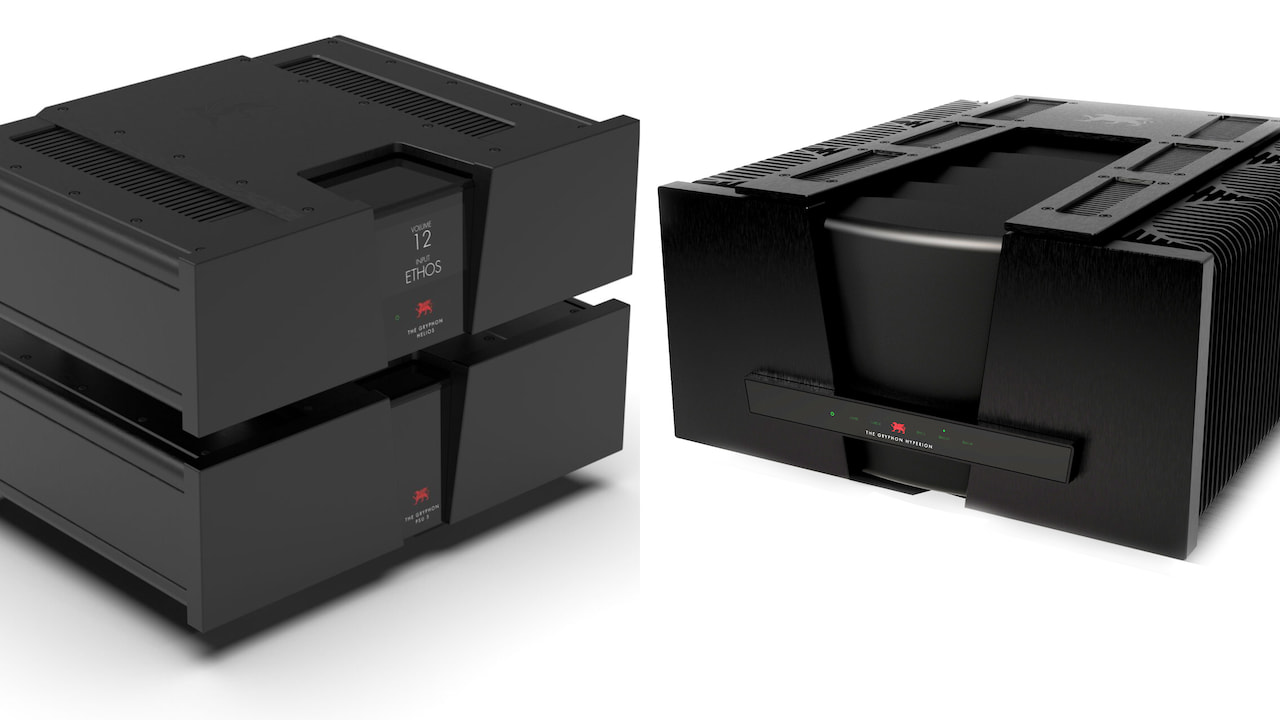
The new Gryphon Helios is a line preamplifier and the direct successor to the long-running Pandora preamplifier, which was introduced in 2012. Gryphon positions Helios below the flagship Commander, but this is not a stripped-down control center for the timid. It takes core ideas from Pandora, adds design work developed for Commander, and wraps the whole thing in a dual-mono chassis with separate power supply architecture, CNC-machined aluminum, and enough Danish black metal to make Copenhagen look underdressed.
Gryphon is showing Helios at High End Vienna 2026 in The Gryphon Room, Level 2, Room 2.31, fitted with both the PS3 balanced phono module and DAC3 digital module. The matching PSU 5 external power supply is priced at $20,800, bringing the Helios/PSU 5 combination to $50,600 before optional modules, cables, racks, and whatever else your dealer places on the altar.
Helios uses a true dual-mono configuration with separate mechanical chassis for the power supply and audio circuits. The circuit design includes a discrete Class A input buffer, a fully discrete balanced dual-differential Class A line stage, and zero global negative feedback. Gryphon also specifies a refined version of Pandora’s Class A input topology using ultra-low-noise dual JFETs.
Volume control is handled by a microprocessor-controlled 85-step relay attenuator using precision resistors and ultra-low-capacitance relays. The power supply section uses two custom 65VA toroidal transformers, one for each channel, with a total power supply capacitor bank of 2 x 83,000 µF. Gryphon also specifies separate power supplies for the digital section and the individual left/right analog channels.
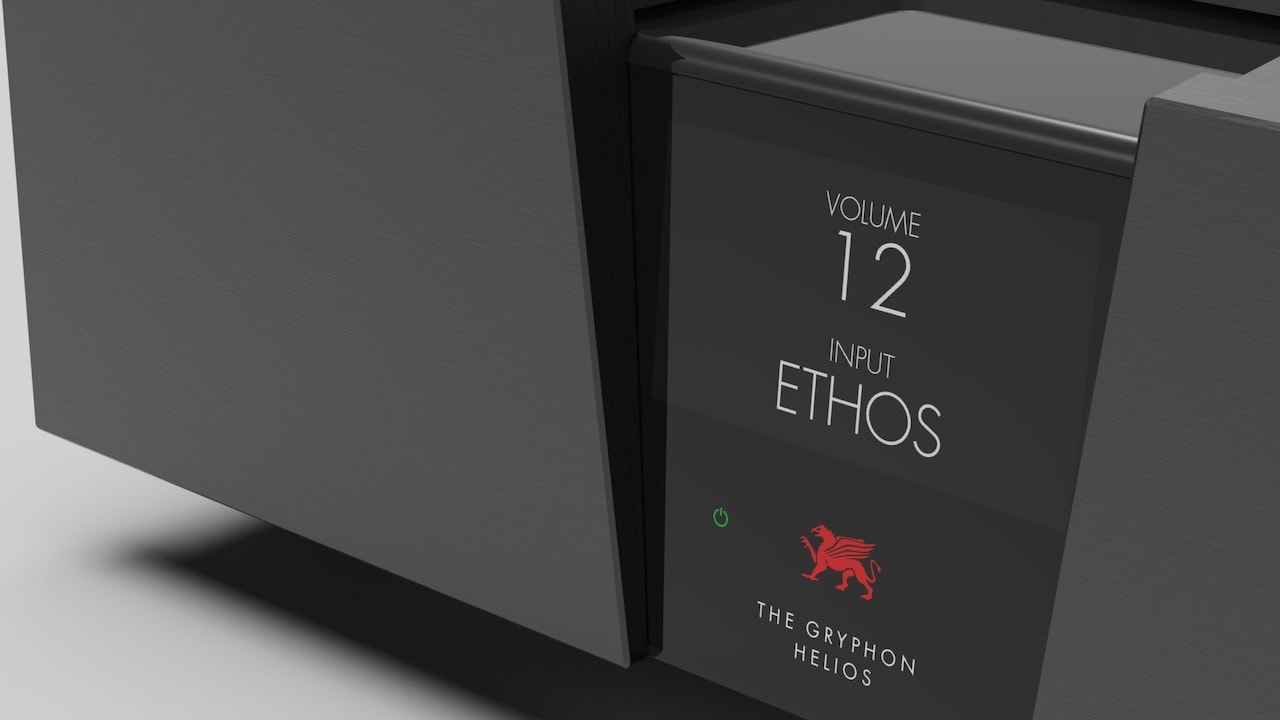
The chassis is built from extruded and CNC-machined aluminum, with the front display section protected by 4 mm glass. A 4.3-inch TFT capacitive touchscreen handles user interaction, and each chassis sits on proprietary Gryphon-designed spikes for resonance control. Subtle furniture it is not.
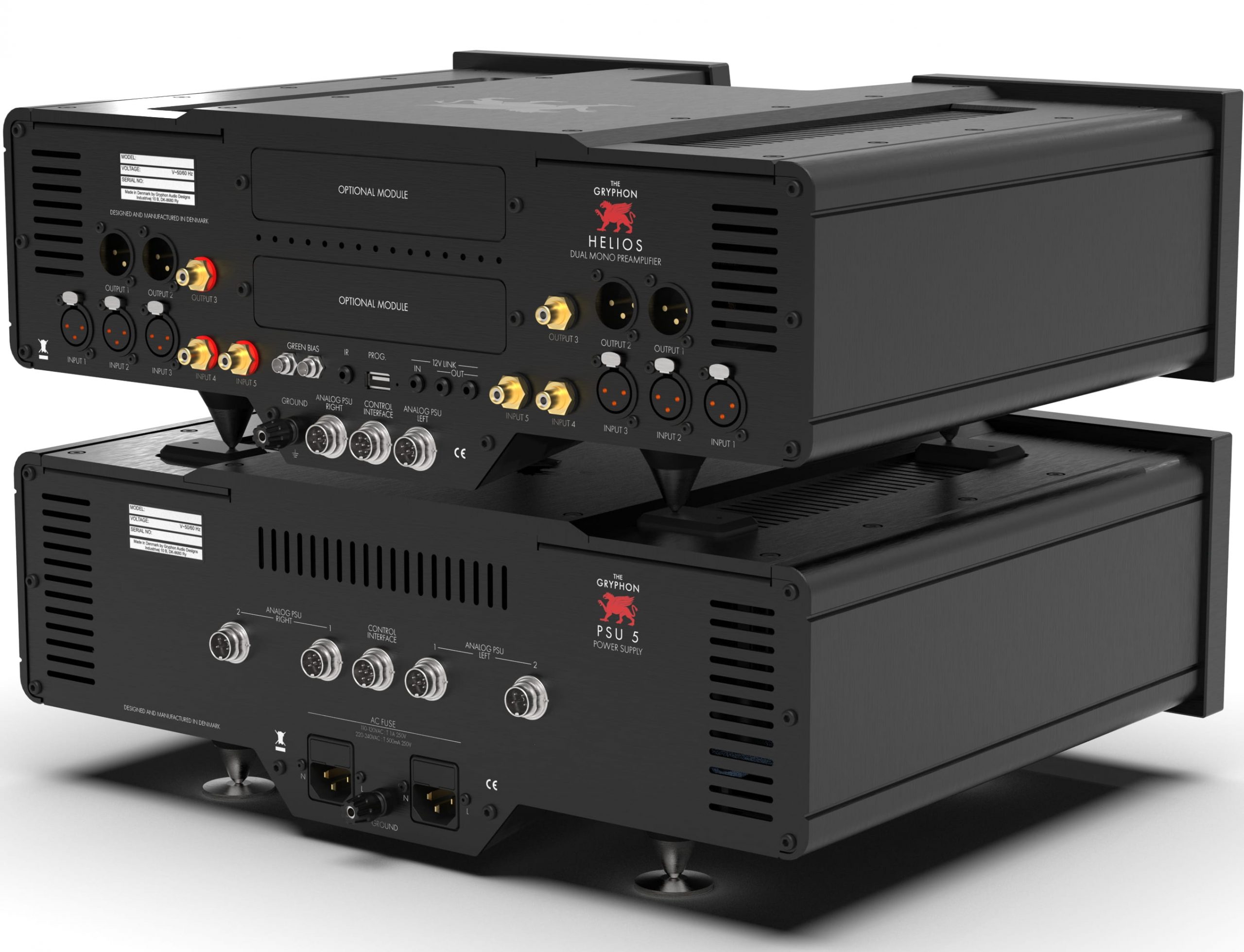
Connectivity includes three balanced XLR source inputs, two single-ended RCA source inputs, two balanced XLR main outputs, and one single-ended RCA main output. Helios also includes fixed-level AV inputs for surround system integration, because apparently even the Danish temple of two-channel purity has accepted that people watch movies.
System control features include adjustable channel balance, source level matching, startup volume, maximum volume, display intensity control, input renaming, and the ability to dedicate Input 3 via XLR or Input 4 via RCAas a fixed-level AV input. Helios also includes 12V Link In/Out, Green Bias control for compatible Gryphon power amplifiers, infrared remote control, and firmware updates via USB stick through the rear panel.
The optional DAC3 digital module adds one USB input, two S/PDIF inputs, one AES/EBU input, and one Toslink input. The optional PS3 phono module adds MM/MC cartridge support, which matters because a preamp at this level should not force vinyl users into another box.
Key electrical specifications include 25kΩ balanced input impedance, 12.5kΩ single-ended input impedance, 8Ω output impedance, and +18 dB gain. Gryphon lists bandwidth at 0.1 Hz to 1.5 MHz, -3 dB, with THD+N of 0.003% at 1 kHz, measured across a 10 Hz to 30 kHz bandwidth through the balanced output.
Maximum output is rated at 20 Vrms balanced and 9.5 Vrms single-ended. Maximum input is rated at 20 Vrms balanced and 10 Vrms single-ended. Standby power consumption is listed at 0.5 watts or less, while idle consumption is approximately 90 watts with both the PS3 and DAC3 modules installed. AC voltage range is listed as 110-120V or 220-240V, with 2 x IEC C14 AC inlets.
The Helios preamplifier chassis measures 47.5 x 38.7 x 17.3 cm (18.7 x 15.2 x 6.8 inches) and weighs 13.9 kg (30.6 pounds). The PSU 5 power supply has the same dimensions at 47.5 x 38.7 x 17.3 cm (18.7 x 15.2 x 6.8 inches) and weighs 18.2 kg (40.1 pounds).
Shipping requires two crates, each measuring 58 x 57 x 28 cm; the packed weights are listed at 25.2 kg and 29.2 kg. Both units are designed and built in Denmark, because apparently the Danes looked at modest black boxes and decided they needed more mass, more glass, and something to make the folks at Aavik drool with serious envy.
Gryphon Hyperion Power Amplifier
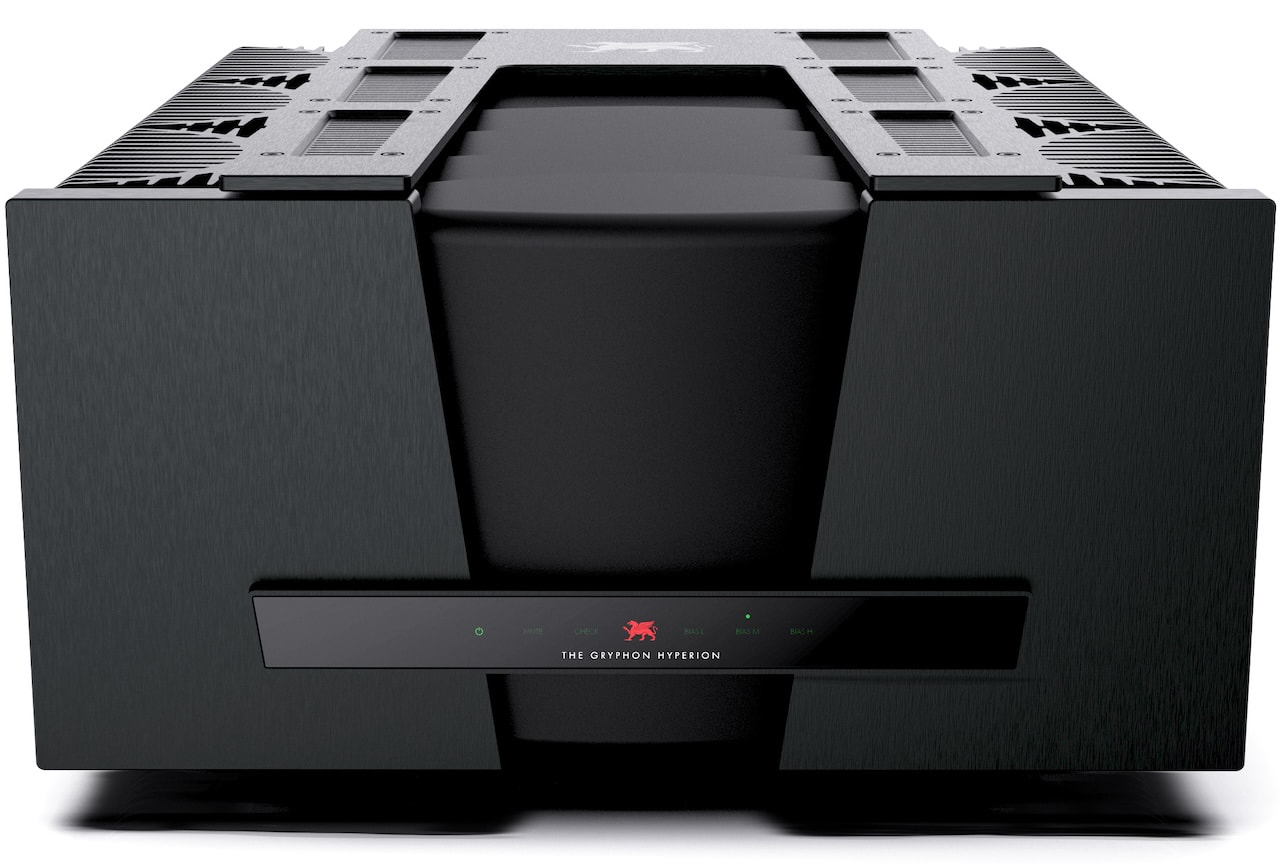
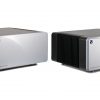
The new Gryphon Hyperion is a Pure Class A power amplifier and the direct successor to the company’s long-running Mephisto power amplifier, which was introduced in 2012 alongside the Pandora preamplifier. Gryphon is positioning Hyperion as a more compact and more accessible alternative to its flagship Apex amplifier, although “accessible” is doing some very Danish stretching when the stereo version starts at $80,200.
Inside, Hyperion uses the same output devices found in Gryphon’s flagship Apex Reference power amplifier. Gryphon specifies 40 output transistors per chassis, or 80 output transistors for a mono pair. That matters because this is not Gryphon tossing a new faceplate on an older platform and hoping nobody notices over the espresso machine.
The amplifier uses zero global negative feedback, which remains a core Gryphon design choice across its upper-tier amplification. Hyperion also uses Gryphon’s Class A amplifier topology, but with a new dual JFET implementation and a newly selected matched dual BJT transistor. Gryphon says the amplifier also uses a new printed circuit board developed specifically for Hyperion, with revised bias control and signal routing.
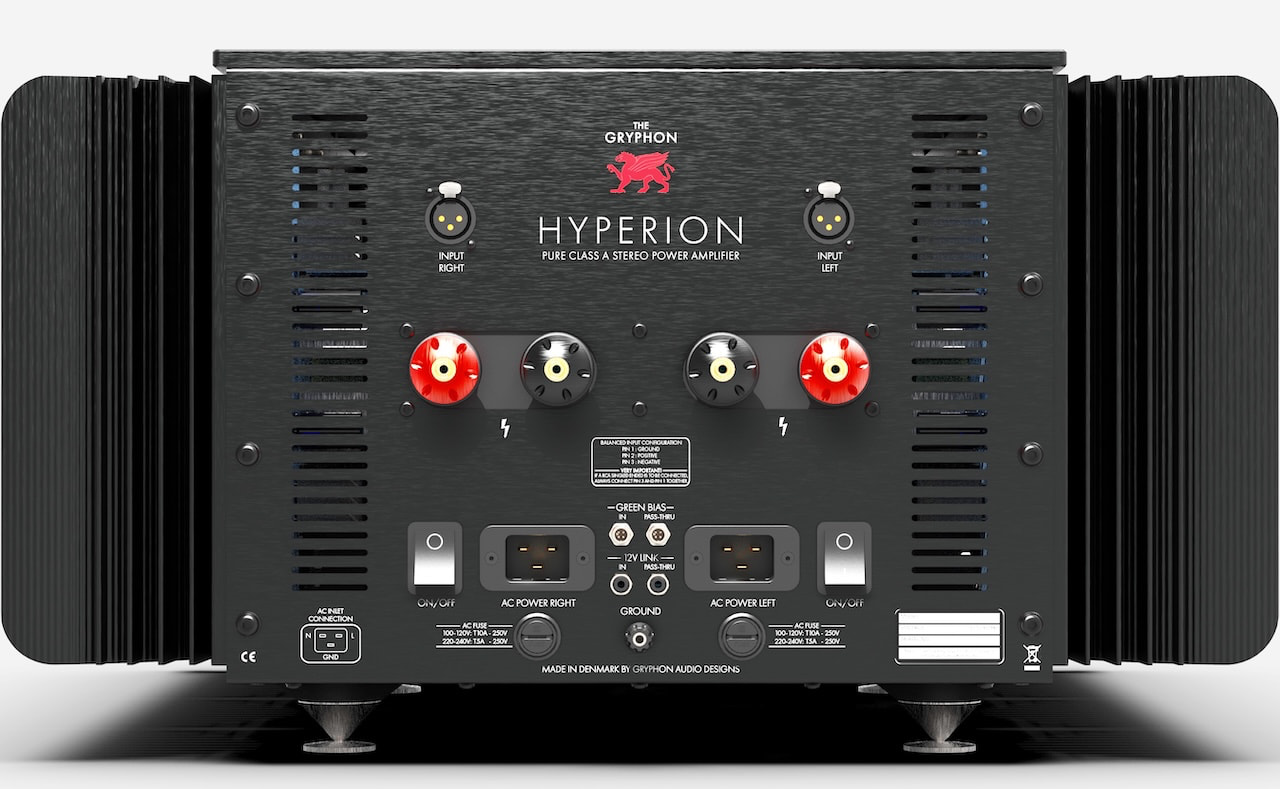
Hyperion’s internal wiring uses the same solid-core pure silver signal cable specified for Apex. The power supply has also been reworked compared with Mephisto. Instead of using one common transformer casting for both left and right transformers, Hyperion uses separate transformer castings. Gryphon also specifies separate linear power supplies for the digital and analog circuits.
Power supply capacitance is listed at 500,000 microfarads per chassis, which Gryphon says is more than a 10% increase over Mephisto. That is the kind of number that makes normal amplifiers look like they showed up with lunch money and a rather misguided sense of optimism.
Cosmetically, Hyperion also marks a transition for Gryphon. Along with Helios, it is one of the first Gryphon products created without visual design input from company founder Flemming Rasmussen. The amplifier retains the brand’s inverted triangle design cue, but Gryphon describes the new look as a bridge between its established visual language and the next phase of Gryphon industrial design.
Gryphon has not provided a full public specification sheet for Hyperion with rated power output, dimensions, weight, input impedance, gain, power consumption, or shipping details.
The Bottom Line
The Gryphon Helios and Hyperion matter because they replace two long-running Gryphon reference products: Pandoraand Mephisto. Helios brings trickle-down Commander thinking into a more flexible preamp platform, with dual-mono architecture, Class A circuitry, zero global negative feedback, optional DAC3 and PS3 phono modules, and the matching PSU 5 power supply.
Hyperion is the muscle: a new Pure Class A successor to Mephisto with Apex-derived output devices, 40 transistors per chassis, 500,000 µF of power supply capacitance, pure silver internal wiring, and zero global negative feedback.
Who should care? Gryphon owners, Mephisto/Pandora users, and anyone building a cost-no-object system around large, current-hungry loudspeakers. At $29,800 for Helios, $20,800 for PSU 5, $80,200 for Hyperion Stereo, and $160,400 for Hyperion Mono pair, this is not “upgrade curious.” This is Danish audio escalation with invoices.
For more information: gryphon-audio.dk
Related Reading:
- Gryphon Antileon Revelation Power Amplifier Roars In Munich: Danish Muscle Hits 5th Gen At HIGH END 2025
- Goer Dynamics Acquires Minority Stake In Gryphon Audio Designs
- Gryphon’s Apollo Turntable And Siren Phono Preamp Deliver Analog Playback Like Few Other Designs Available: High End Munich 2024
- I Just Listened To A $14,000 Power Conditioner From Gryphon. Is It Wrong That I Want One?