Founded in China in 2018, EarFun has carved out a steady reputation by focusing on what actually matters in affordable wireless audio: competent tuning, up-to-date features, and pricing that stays grounded in reality. We’ve previously covered the Wave Pro and Tune Pro, both of which showed that EarFun understands how to balance performance and cost better than many budget-focused rivals.
At CES 2026, EarFun is opening the year with three new products: the Air Pro 4+ and EarClip 2 true wireless earbuds, and the Wave Pro X wireless headphones. Rather than chasing luxury branding or inflated pricing, EarFun continues to refine its value-driven approach—delivering sensible features, accessible sound quality, and competitive price points. It’s another example of a China-based wireless brand getting a lot of the fundamentals right, especially for buyers who want modern wireless gear without stretching their budget.
EarFun Air Pro 4+: Flagship Features at a Budget-Friendly Price Point
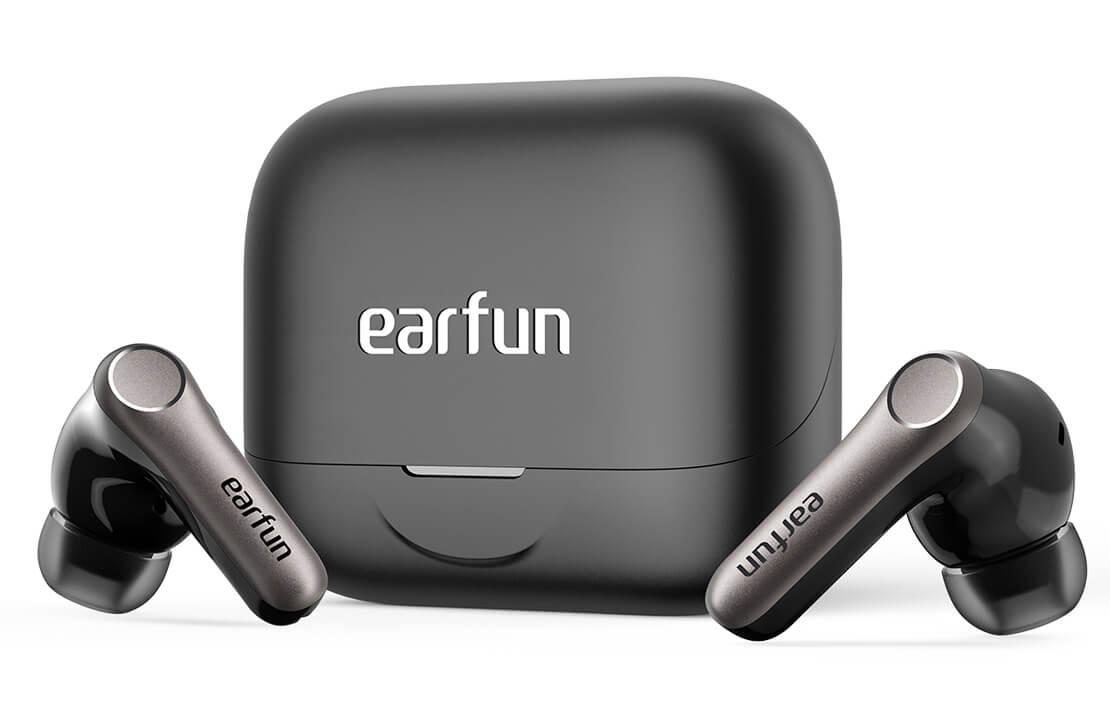
The Air Pro 4+ are true wireless earbuds from EarFun that use a Dynamic Hybrid driver configuration, pairing an ultra-light balanced armature with a 10mm dynamic driver (1 BA + 1 DD). The goal here is straightforward: deliver stronger low-frequency weight from the dynamic driver while preserving clarity and definition in the upper frequencies via the balanced armature.
To further shape the sound, EarFun incorporates its Nano Side-Fitted Acoustic Architecture (NSAA), a design approach intended to better control airflow and resonance within the earbud housing. The focus is on maintaining tonal balance and reducing unwanted distortion rather than simply boosting bass or treble for effect.
For noise control, the Air Pro 4+ features EarFun’s QuietSmart 3.0 Adaptive Hybrid Active Noise Cancellation, rated at up to 50dB. The system dynamically adjusts its ANC performance based on surrounding noise and listening conditions, offering flexibility for commuting, travel, or quieter indoor environments.
On the connectivity side, the Air Pro 4+ supports Bluetooth 6.0 via the Qualcomm QCC3091 chipset. Codec support is extensive for the category, including Snapdragon Sound, aptX Lossless, LE Audio with LC3, LDAC, and Auracast—covering both current high-quality Bluetooth audio standards and emerging broadcast-style use cases.

Beyond music playback, the Air Pro 4+ from EarFun is also designed with communication and everyday utility in mind. Each earbud incorporates a six-microphone array, supported by Qualcomm’s cVc 8 (Clear Voice Capture) noise-reduction technology and an AI-based processing algorithm. The intent is to improve call clarity by reducing background noise and isolating the user’s voice in real-world environments.
EarFun also adds an AI Translation feature that works through the companion app, enabling real-time translation across supported languages. While this isn’t positioned as a replacement for dedicated translation devices or services, it adds a practical layer of functionality for travel, casual conversations, and basic communication needs.
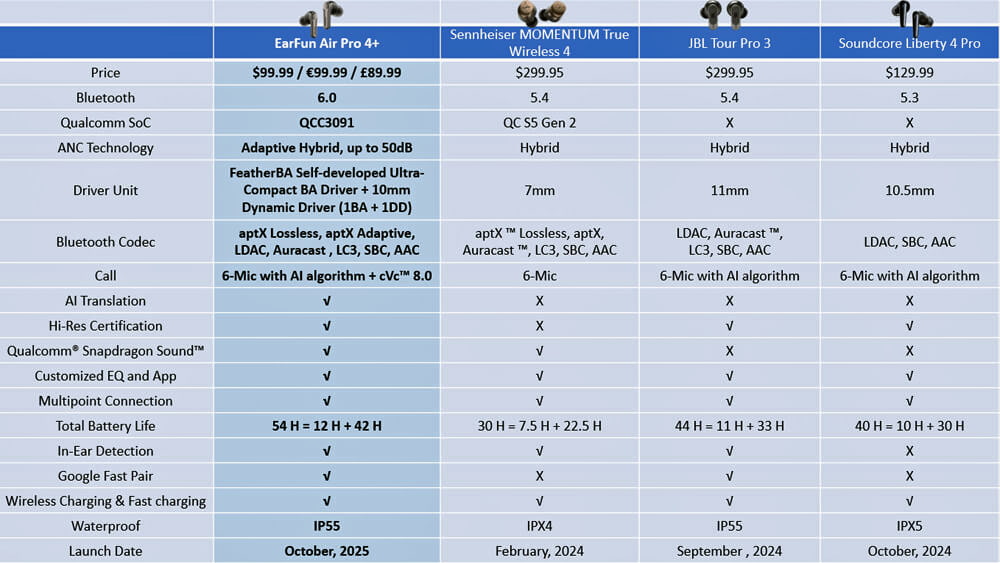
For a clearer picture of where the Air Pro 4+ fits in the crowded true wireless market, EarFun provides a detailed feature comparison against competing brands and models—highlighting differences in driver configuration, codec support, ANC capability, and overall feature sets.
EarFun Clip 2: Open-Style Wireless Earbuds Designed for Comfort and Everyday Awareness

According to EarFun, the Clip 2 is the first open-ear, clip-style wireless earbud to offer AI translation at a sub-$80 price point. That positioning is clearly aimed at users who want situational awareness and utility features without moving into higher-priced lifestyle or sports-focused alternatives.
The Clip 2 is built around an ultra-lightweight open-ear design that uses soft, skin-friendly materials intended for secure, all-day wear. EarFun also redesigned the elliptical sound port, increasing the size of the sound outlet to support a wider soundstage and improved detail compared to earlier clip-style designs.
Sound is handled by an upgraded 12mm dual-magnetic titanium composite dynamic driver, which EarFun says delivers deeper bass, better layering, and a more immersive presentation than typical open-ear earbuds. As with most open designs, the emphasis is on balance and clarity rather than isolation or maximum low-frequency impact.
Internally, the Clip 2 uses a next-generation SmartAudio chip built on a RISC-V architecture with integrated FPU, NPU, and PACC modules. The focus here is improved processing efficiency, lower power consumption, and more stable wireless performance. Bluetooth 6.0 support enables compatibility with Hi-Res audio and LDAC, and EarFun also includes 3D Surround Sound processing to create a more spatial, enveloping listening effect.
For calls and communication, the Clip 2 employs a quad-microphone ENC system with a four-mic array and enhanced noise reduction, designed to improve voice clarity in everyday environments. This setup also supports the AI Translate feature, extending the earbuds’ usefulness beyond music playback.

Additional convenience features include dual-device connectivity, allowing seamless switching between a phone, tablet, or laptop without re-pairing. For gaming and video use, the Clip 2 offers ultra-low latency performance rated at under 50ms, helping keep audio and visuals in sync.
EarFun also provides a detailed feature breakdown and comparisons with other clip-style earbuds from competing brands, offering context on where the Clip 2 sits in terms of design, feature set, and overall value.
EarFun Wave Pro X: Feature-Rich Wireless Headphones Built for Maximum Value

Moving from earbuds to full-size headphones, EarFun is positioning the Wave Pro X as a step forward from the earlier Wave Pro, describing it as the first dual-driver Qualcomm lossless ANC headphone with Auracast support. The emphasis here is on expanded connectivity and feature depth rather than a wholesale redesign.
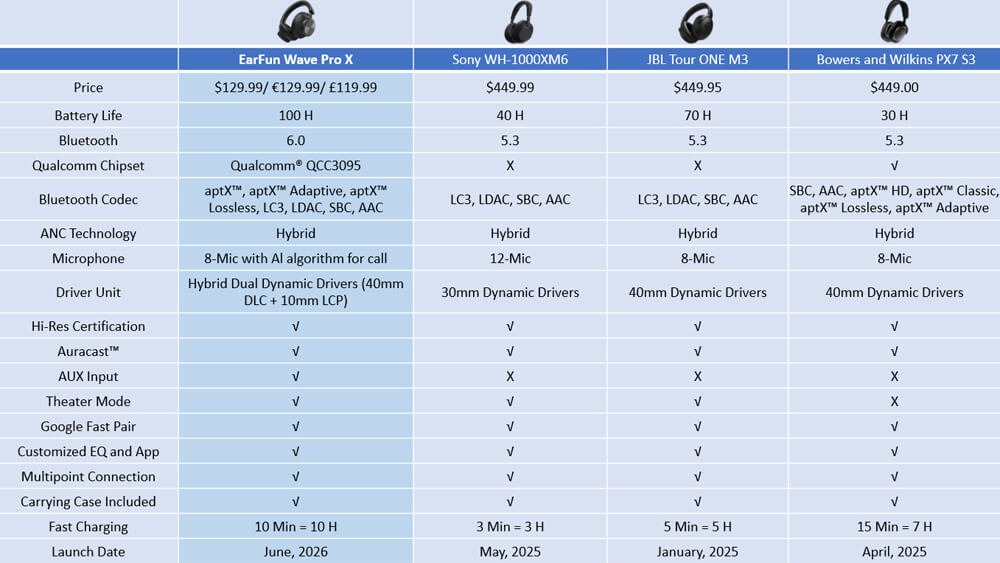
The Wave Pro X is built around the Qualcomm QCC3095 chipset, enabling Bluetooth 6.0 connectivity along with Auracast audio sharing. Codec support is broad and competitive for the category, including aptX Adaptive, aptX, aptX Lossless, LDAC, and LE Audio—covering both high-quality playback and newer broadcast-style use cases.
In addition to standard Bluetooth wireless operation, the Wave Pro X also supports a wireless USB connection, offering another option for connecting to computers or compatible devices. This adds flexibility for users who want stable, low-latency audio without relying solely on Bluetooth.
Sound reproduction comes from a dual dynamic driver configuration, combining 40mm DLC (diamond-like carbon) drivers with 10mm LCP (liquid crystal polymer) drivers. The design is intended to deliver stronger low-end impact while maintaining clarity and control across the midrange and treble, rather than leaning heavily in one direction.
For spatial processing, EarFun includes a Theater Mode that enhances stereo width and spatial presentation. Additional sound customization and feature control are handled through the EarFun Audio app, which also supports voice assistants for hands-free operation.
Gamers are catered to with a dedicated Game Mode accessible via the EarFun mobile app on iOS and Android. This mode is designed to reduce latency to keep audio and visuals better aligned during gameplay or video viewing. The app also provides access to a multi-band equalizer, ANC adjustment, and other system controls.
The Wave Pro X supports AUX wired listening while retaining hybrid active noise cancellation, allowing continued noise reduction even when used in wired mode. For calls and in-game communication, the headphones use a precision eight-microphone hybrid system aimed at improving voice clarity in a range of environments.
EarFun also outlines additional features and provides comparisons with competing wireless headphones, offering context on how the Wave Pro X stacks up in terms of connectivity, driver design, and overall feature set.

The Bottom Line
The wireless earbud and headphone market doesn’t forgive copycats, and standing out at CES takes more than louder specs or flashier colors. EarFun is making progress by focusing on the fundamentals—design that’s wearable, features that actually work, and pricing that stays realistic. Across the Air Pro 4+, Clip 2, and Wave Pro X, you get hybrid ANC, Bluetooth 6.0 with multipoint connectivity, broad codec support, wired Hi-Res listening where applicable, and battery life that’s competitive with far more expensive alternatives.
What really moves the needle is feature creep in the right direction. AI-assisted calling and AI Translation (available on the earbuds) are no longer luxury add-ons, and EarFun is bringing them to price points where most brands are still arguing about whether LDAC is “necessary.” It’s also worth noting that this is the same class of AI translation functionality that Apple effectively asks buyers to pay a significant premium for, bundled into much higher-priced products.
None of these models are pretending to be status symbols—and that’s the appeal. When you line up the feature sets, specs, and real-world usability against the competition, EarFun’s CES 2026 lineup holds its own and often undercuts rivals on price by a wide margin. Expect AI translation and similar smart features to become standard on wireless earbuds and headphones sooner rather than later. EarFun is simply getting there early—and doing it without inflating the bill.
Price & Availability
- EarFun Air Pro 4+ – $99.99 at Amazon (available Jan 6, 2026 in black or white)
- EarFun Clip 2 – $79.99 (available March 2026)
- EarFun Wave Pro X – $129.99 (available June 2026)
Related Reading: