
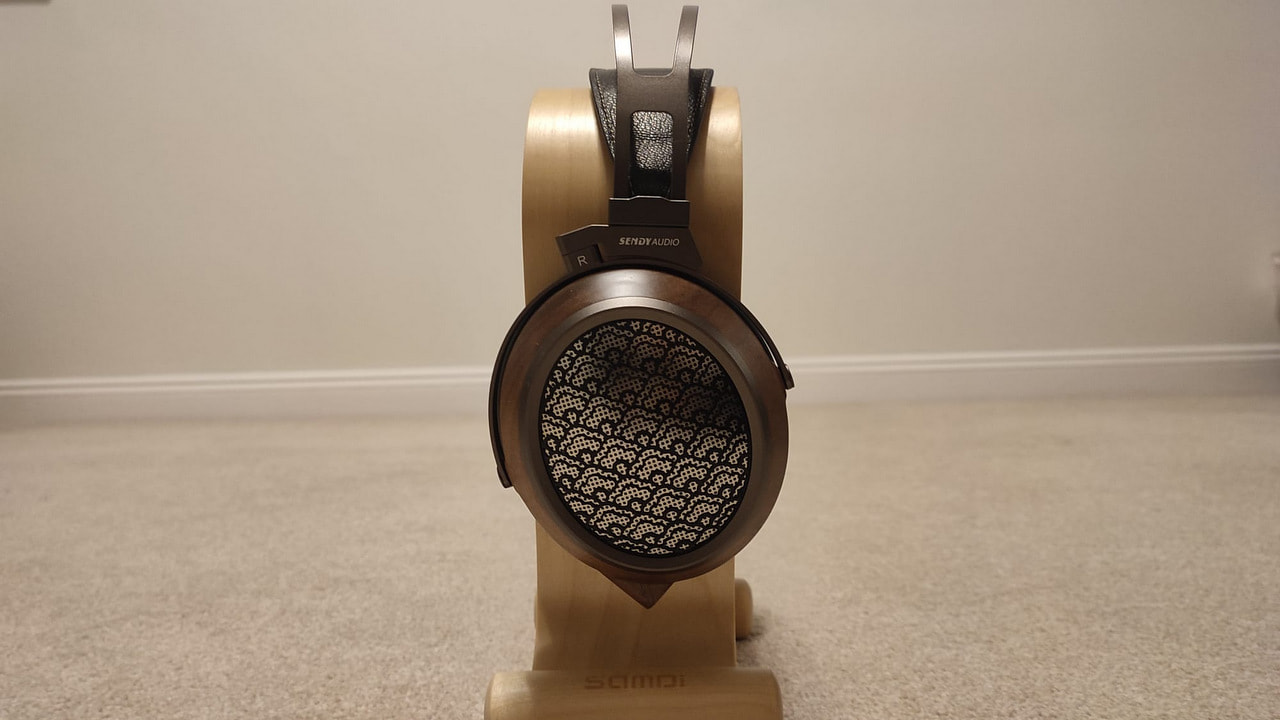
Sendy Audio isn’t trying to be subtle about where it sits in the Sivga family tree. Based in Dongguan, China, Sendy operates as the more upmarket sibling to Sivga, leaning harder into premium materials, higher prices, and a design language that clearly aims above the mainstream. Even its most affordable current over-ear model, the Aiva 2, lands at $599—hardly entry level by any definition.
We reviewed the Aiva 2 last year and came away impressed by both its sound quality and the level of fit and finish, which already hinted at where Sendy wanted to go next. That next step is the Sendy Audio Egret, priced at $799 USD before tax and currently available exclusively via AliExpress, where the platform applies a mandatory 20 percent tax at checkout, pushing the displayed total higher, though store and platform discounts can reduce the final price.
Sendy has positioned the Egret as a more refined, more ambitious planar magnetic headphone for the international market. I first heard the Egret briefly at CanJam London, in conditions that are about as far from ideal as it gets for evaluating open-back headphones, but the initial impression was strong enough to warrant a proper review.
Now that the Egret is in the office—thanks to Lily at Sivga—it’s time to find out whether that early promise holds up in a quieter room, with familiar gear, and without the trade-show noise floor getting in the way.
The Sendy Egret lands squarely in the middle of the planar magnetic pool which is definitely getting quite crowded. It’s not swinging at flagship pricing, but it’s also nowhere near entry-level, which is exactly where things get uncomfortable for established brands. Sendy doesn’t have the name recognition in North America or the EU that HiFiMAN, Audeze, Dan Clark Audio, or Meze Audio enjoy, but that lack of visibility shouldn’t be confused with a lack of capability.
Writing the Egret off because it doesn’t come from one of the usual heavy hitters would be a mistake. It’s also walking into a more crowded field than even a year ago, with fresh competition from products like FiiO’s FT-7, which I’ve just finished reviewing, and which targets the same buyer who wants serious planar performance without crossing into four-figure territory.

Technology & Specifications
Sendy Audio have clearly invested serious time and resources into developing new driver technology for the Egret. The planar magnetic diaphragm measures 98x84mm, but the more notable detail is its thickness: just 800nm. That places it among the thinnest diaphragms currently used in consumer headphones, at least on paper.
The diaphragm is coated using electron beam evaporation, a process Sendy says allows for extremely precise aluminium circuit patterning. In theory, this level of control should improve layering and allow for more deliberate tuning across the frequency range, though any real-world benefit will be addressed in the listening section rather than taken at face value.
Beyond the driver itself, Sendy is relatively restrained with published specifications. The Egret is rated for a frequency response of 20Hz to 40kHz, with a nominal impedance of 24 ohms and a sensitivity of approximately 95 dB/mW. On paper, that suggests a headphone that may benefit from a capable amplifier rather than casual portable use, something I’ll address in more detail when discussing drivability and system matching later in the review.
Design & Comfort
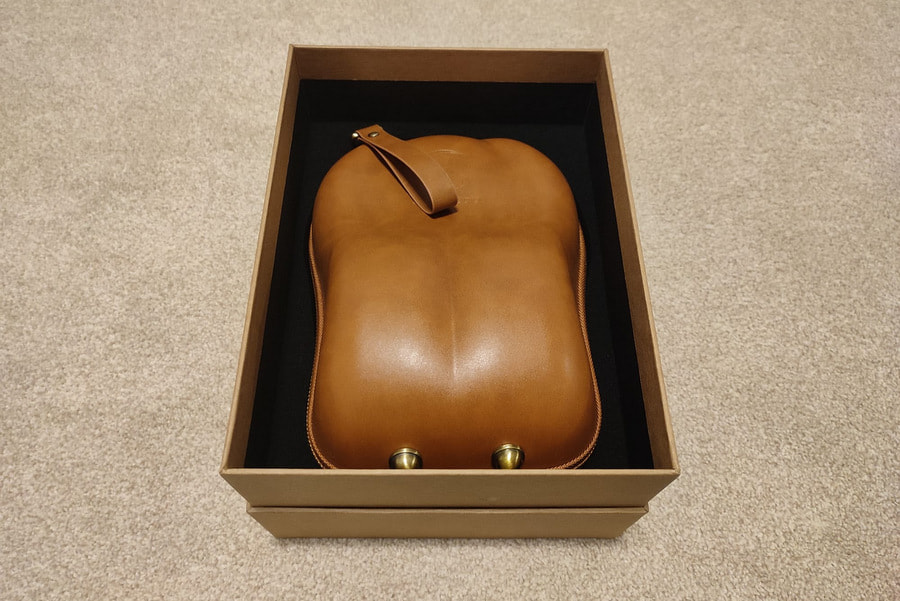
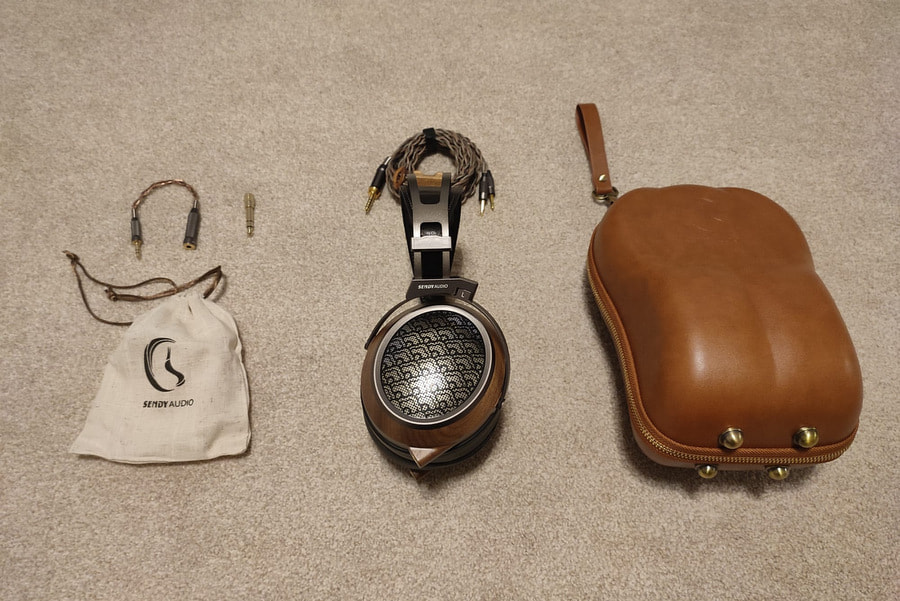
Included with the Egret is Sendy’s now-familiar hard leather carry case, often described as the “baby butt” case. The shape may invite a raised eyebrow, but there’s no arguing with the execution—it’s well made, rigid, and genuinely luxurious, not the sort of afterthought case that usually gets tossed into a closet.
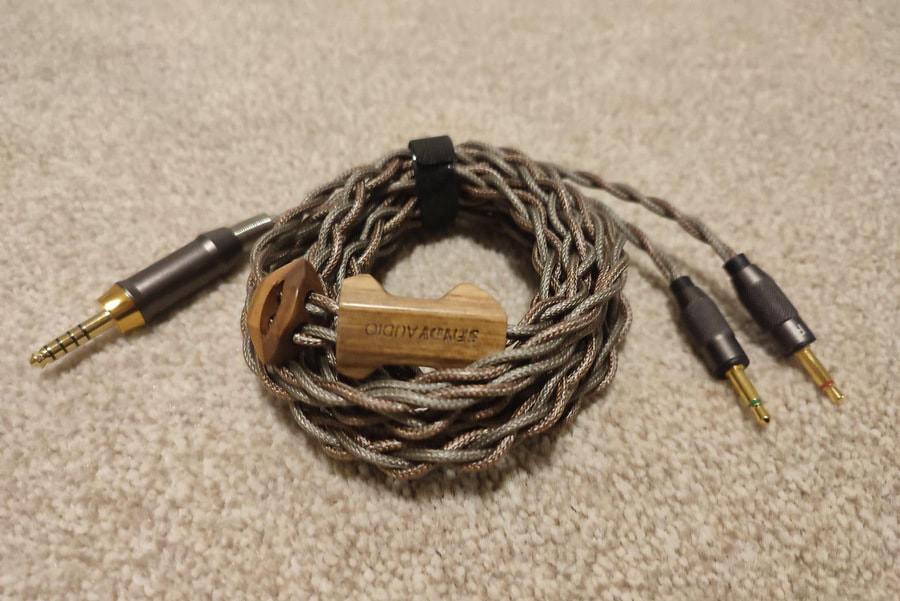
Inside, you’ll find a hemp storage bag containing two adapters: 4.4mm to 3.5mm and 3.5mm to quarter-inch. You’ll also find what is, without exaggeration, one of the highest-quality stock cables I’ve seen included with a headphone at this price. The cable construction is unusually elaborate, using 30 strands of Furukawa OFC, 10 strands of silver-plated OFC, and 10 strands of gold-enamelled OFC, each measuring 0.05mm in thickness. These are wrapped in copper and silver-plated mesh, finished with a PVC outer jacket, and hand-braided in a way that looks deliberate rather than decorative.
In practical terms, the cable behaves as well as it looks. Microphonics are essentially nonexistent, it drapes naturally, and it stubbornly refuses to tangle no matter how much you try to mistreat it. The connectors are machined from solid aluminium, while the splitters are made from real wood—because of course they are. I don’t subscribe to the idea that cables meaningfully alter sound, but craftsmanship still counts, and the cable included with the Egret feels like a deliberate statement rather than an obligatory accessory.
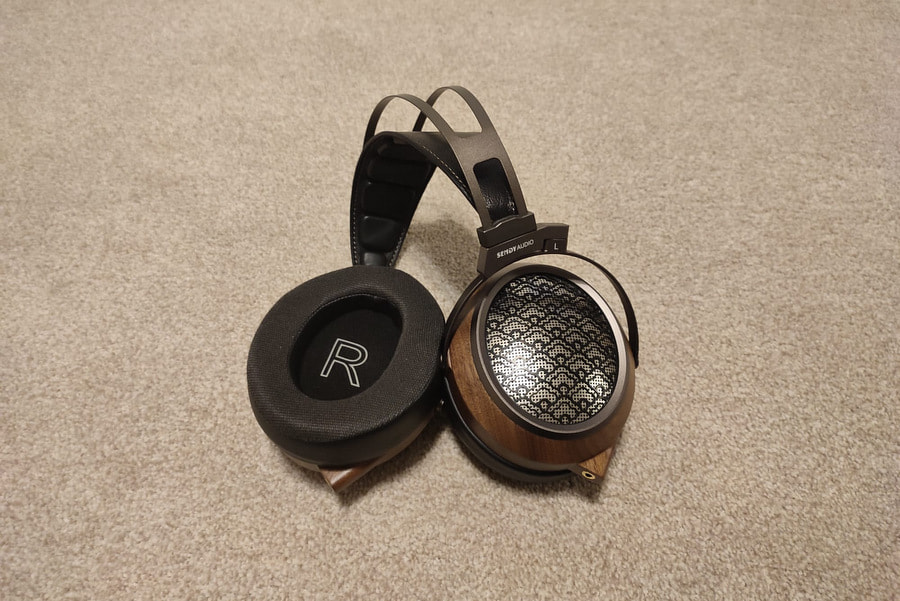
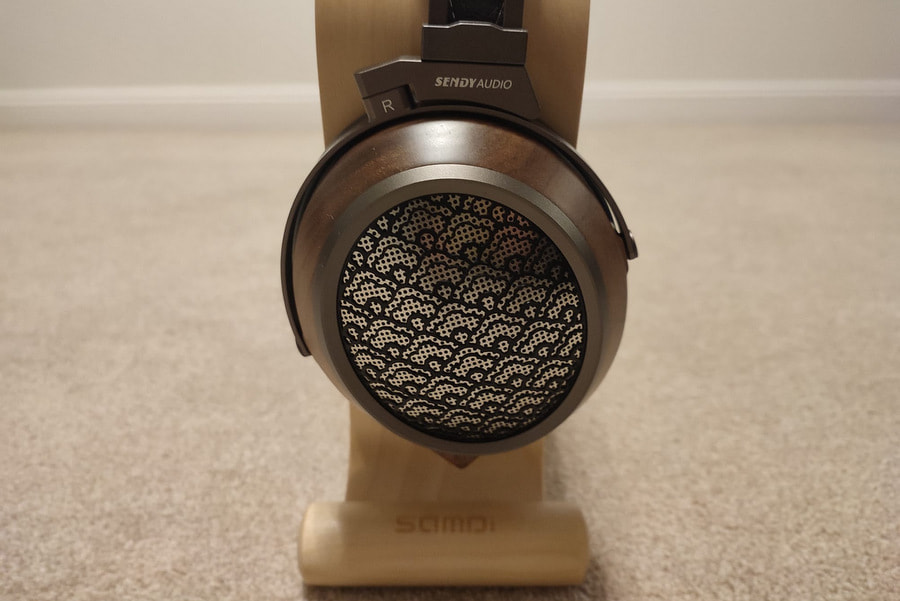
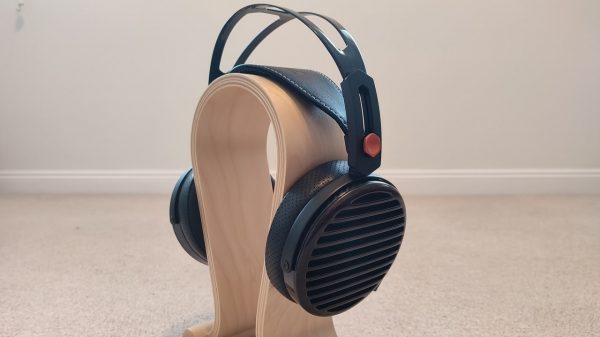
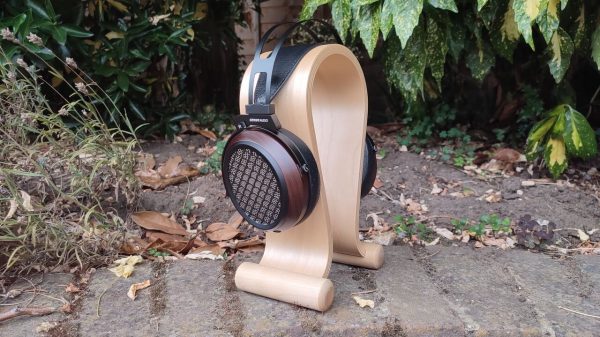
That level of attention to detail carries over to the headphones themselves, which both look and feel properly premium. The ear cups are crafted from black walnut sourced from North American forests, and the aluminium hardware—finished in anodised gunmetal—moves smoothly and silently. Hinges and pivots operate with the kind of resistance you want, not the kind that reminds you where corners were cut.
At a glance, some may argue that the Egret doesn’t look radically different from the less expensive Aiva 2. The overall silhouette is similar, but the execution is not. The Egret is physically larger, and the grille design on the outer cups is considerably more intricate. Sendy says the pattern is inspired by an egret in flight, and while I’ll leave the poetry to the marketing department, the result is undeniably more refined and upscale than what you get on the cheaper model.
All contact points are treated with equal care. Lambskin is used for the headband and the outer sections of the earpads, while the ear-facing surfaces employ a softer, more breathable fabric. The result is a headphone that remains comfortable over long listening sessions, with no noticeable pressure points or heat buildup. The pads are subtly angled to follow the natural contours of the head and neck, helping maintain a consistent seal around the ears without clamping force becoming an issue.
Despite a listed weight of 443 grams, the Egret never felt burdensome during extended use. There was no sense of neck fatigue, no constant urge to take them off after an hour. At this price point, it’s genuinely difficult to think of another headphone that feels as well built and as carefully finished as the Egret below $1,000.
My only minor complaint concerns the headband adjustment mechanism. It’s solid and confidence-inspiring, but also a bit too stiff to adjust while wearing the headphones. Any size changes were best handled before putting them on, which isn’t a deal-breaker, but it’s worth noting.
Listening
Before getting into the listening impressions, there is one issue that needs to be addressed: pronounced driver crinkling on my review unit. It’s not something you can ignore once you notice it, and pretending it didn’t happen wouldn’t be useful to anyone considering a purchase.
For those unfamiliar, some planar magnetic headphones can be sensitive to rapid changes in air pressure. With the Egret’s extremely thin diaphragms, I experienced audible driver movement whenever I adjusted the headphones on my head or pressed the cups more firmly against my ears. The sound is hard to miss and best described as similar to crushing a plastic bottle underfoot—brief, but unmistakable.
After raising the issue with Lily and Sendy’s R&D team, I was told this was isolated to my specific unit and, importantly, the first reported case of driver crinkling they had encountered with the Egret. Assuming that’s accurate, it’s unlikely to be a widespread issue, but it’s still worth documenting. In any case, driver crinkling is generally a nuisance rather than a failure point and does not cause long-term damage to the drivers themselves.
With that out of the way, I was able to continue the review without further issue. And once the music starts, the Egret quickly reminds you why it exists. To my ears, the sound is simply magnificent. The overall tuning and technical presentation align very closely with my personal preferences. That doesn’t mean it will be perfect for everyone—no headphone is—but you’d need a fairly unusual set of sonic priorities to find the Egret’s presentation genuinely objectionable.
Bass
What stood out immediately with the Egret, especially coming from long-term use of HiFiMAN’s over-ear lineup—was the presence of a subtle but clearly intentional midbass lift. It’s not heavy-handed, but it’s there, and it gives vocals along with instruments like drums and bass guitar a welcome sense of body and punch without sacrificing speed or control.
Just as importantly, that added weight doesn’t come at the expense of texture or transient performance. Bass notes remain well defined, with clean leading edges and convincing decay, avoiding the soft or pillowy presentation that can creep in when midbass is overcooked. The Egret keeps things lively and grounded without blurring the lines.
Subbass extension is also impressive. The Egret digs deep, delivering an audible and physical 20Hz rumble on tracks like “Why So Serious?” by Hans Zimmer and James Newton Howard—more convincingly so than the similarly priced and recently reviewed FiiO FT7. That low-end presence adds drama where it’s called for, without turning the presentation into a blunt instrument.
That said, the Egret is not a basshead’s headphone. The low-frequency emphasis is restrained and deliberate rather than indulgent. Even Sendy’s own Aiva 2 offers more outright bass quantity, and listeners chasing maximum low-end impact may find more satisfaction elsewhere. Still, compared to competitors like the HiFiMAN Arya Unveiled, the Egret delivers noticeably more slam and weight, striking a balance that feels purposeful rather than polite.
Midrange
With neither the lowest lows nor the highest highs being overly emphasised, it’s no surprise that the Egret’s midrange ends up being the star of the show. The tuning leaves plenty of room for the mids to breathe, and the result is a presentation that feels lively, expressive, and consistently engaging.
Both male and female vocals carry real weight and tonal richness without losing clarity. There’s a natural density to voices that avoids sounding thick or veiled, and placement is noticeably more intimate than on more overtly V-shaped competitors like the FiiO FT7. The Egret brings performers a step closer, which works particularly well for vocal-centric recordings.
A standout example was “Diamonds” by Sam Smith. Smith’s voice had a convincing sense of body and presence, carrying appreciable heft despite the naturally higher register. It’s the kind of midrange performance that draws attention to phrasing and emotion rather than just detail, and it plays directly to the Egret’s strengths.
Treble
Moving into the treble, the Egret doesn’t try to grab your attention with exaggerated sparkle or showy brilliance. Its upper-frequency tuning is restrained and measured, very much in keeping with the overall balance of the headphone. In that sense, it’s reminiscent of familiar reference points like the Sennheiser HD600 or the Audio-Technica ATH-R70x; headphones that prioritise tonal balance over treble theatrics.
That approach won’t thrill listeners who equate excitement with brightness, but it will appeal to those who value long-term listenability and even-handed tuning. The treble is smooth and controlled, never straying into harshness or fatigue, and it integrates naturally with the midrange rather than sitting on top of it.
Crucially, that smoothness doesn’t come at the cost of resolution. Fine details are still present and easy to follow, which speaks to the technical competence of the Egret’s ultra-thin planar drivers. You’re not dazzled by treble emphasis, but you’re also never left feeling that information is being withheld.
Technicalities & Soundstage
This is where the Egret really separates itself. Given its upper mid-fi pricing and the obvious emphasis on materials and build, I didn’t expect its technical performance to be genuinely competitive with far more expensive planars—but it was. And not by a small margin.
I directly compared the Egret’s detail retrieval, imaging, and layering to the significantly more expensive HiFiMAN HE1000 Unveiled, fully expecting the gap to be obvious. Instead, what stood out was just how close the Egret managed to get in all three areas. Low-level detail was easy to follow, spatial cues were clearly defined, and complex passages remained well organized rather than collapsing into a blur.
Imaging was pinpoint accurate, and the sense of spatial holography is among the best I’ve heard under $1,000. The one clear area where the Egret concedes ground to the HE1000 Unveiled is soundstage scale. The Egret doesn’t sound closed-in, but it also doesn’t deliver the same expansive, open presentation. Some degree of damping behind the drivers likely plays a role here, trading outright size for control.
Both microdynamics and macrodynamics were excellent. Subtle shifts in intensity were rendered convincingly, while larger dynamic swings carried real physical impact. Importantly, this sense of drive and weight never tipped into fatigue, thanks to the Egret’s smoother treble balance and overall tonal richness. It’s an impressive combination of technical performance and long-term listenability and not something you expect to find this easily below a kilobuck.
Drivability
I made a point of testing the Egret with a wide range of amplifiers and source gear, from full-size desktop stacks down to compact dongle DACs, to get a clear sense of how demanding it really is in day-to-day use.
On paper, the numbers already tell most of the story. With a rated impedance of 24 ohms and a sensitivity of 95 dB/mW, the Egret doesn’t present a difficult load. In practice, that translated exactly as expected. Using the FiiO JM21, which delivers 700 mW into 32 ohms, I reached a comfortable listening level of roughly 65–70 dB at around 40 percent volume on high gain. That left plenty of headroom, even without approaching a full watt of output.
Stepping up to more capable gear did bring incremental gains. My personal SMSL DO400 paired with the Aune S17 Pro, along with the JDS Labs Element IV DAC/amp and the ONIX Beta Xi2 dongle DAC, all delivered small but noticeable improvements. Dynamics felt a touch stronger, transients were cleaner, and the leading and trailing edges of notes were more clearly defined.
In short, the Egret doesn’t demand serious amplification to sound good, but it does scale with higher-quality power. You won’t need a monster amp to enjoy it, yet better gear rewards you with more authority and refinement rather than simply louder playback.

The Bottom Line
Sendy Audio doesn’t flood the market with new over-ear models, and the Egret makes a strong case for why that restraint works in their favor. At $799, it delivers exceptional build quality, standout materials, and a tuning that balances refinement with just enough energy to stay engaging. The custom 800nm planar drivers aren’t just marketing fodder either—they underpin a level of detail, imaging, and layering that comfortably competes with far more expensive headphones, even if absolute soundstage scale falls short of true flagships.
The Egret is not aimed at bassheads or treble thrill-seekers, nor is it trying to be a hyper-analytical studio tool. Instead, it’s for listeners who value tonal balance, midrange presence, long-term comfort, and real technical competence without needing a nuclear-powered amplifier. If you’re shopping in the sub-$1,000 planar space and assume the conversation begins and ends with the usual North American and European brands, the Egret is proof that assumption would be a mistake.
Pros:
- Excellent build quality with premium materials throughout
- One of the best stock cables included with any headphone at this price
- Comfortable fit suitable for long listening sessions
- Tasteful, mass-appealing tuning with a subtle bass lift
- Strong technical performance with impressive detail, imaging, and layering
- Easy to drive and scales sensibly with better amplification
Cons:
- Headband adjustment mechanism is stiffer than it needs to be
- Driver crinkling present on my review unit
Where to buy:
https://www.sendyaudio.com/product_d?id=6
https://www.aliexpress.com/item/1005010471420902.html
Related Reading:



















Andy
February 2, 2026 at 1:50 pm
20% tax!?!
What a collection of thieves. The retailer. Not Sendy.
Were they based in Russia at one point?
Ian White
February 2, 2026 at 2:53 pm
The 20% tax is a reflection of the current tariff environment and every manufacturer who sells through them has to deal with those rules. It does make them a lot more expensive, but as we pointed out, there are deals and other discounts.
Sendy/Sivga are based out of China.
IW