

DALI’s KUPID is what happens when a very grown-up hi-fi brand decides to stop overthinking itself. Instead of chasing luxury finishes or audiophile mythology, DALI distills its design philosophy down to fundamentals: properly engineered drivers, well-controlled cabinets, and obsessive in-house manufacturing—then scales the whole idea for desks, shelves, and smaller living spaces where most people actually listen.
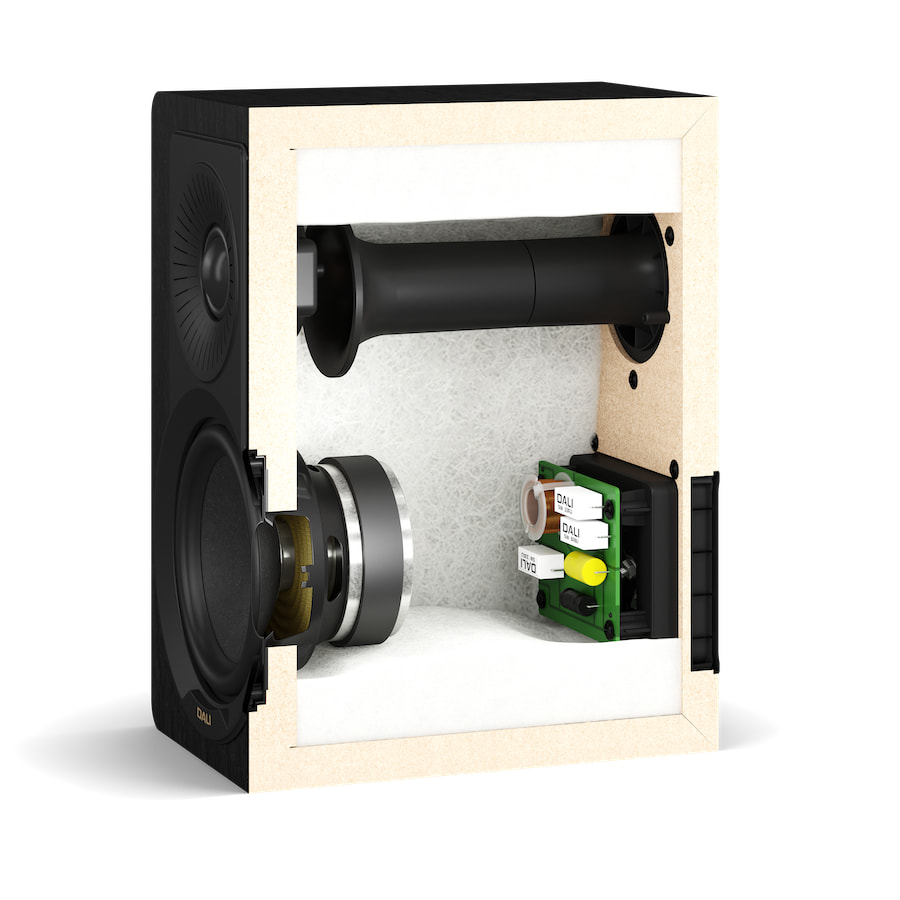
Everything that matters is built under DALI’s own roof—cabinets, drivers, crossovers, even the screws—because consistency and control matter more than romance at this price. The compact enclosure is designed to behave near walls, the dual-flare port keeps small-speaker theatrics in check.
At $600 USD, the KUPID isn’t trying to be a design trophy or a watered-down “lifestyle” box—it’s a nimble, dynamically confident small speaker with real pedigree, a treble that knows its limits without ever sounding dull, and enough Danish self-assurance to prove that compact doesn’t have to mean compromised.
Authentic DALI Sound, Just Without the Fairy Tales
At its core, the KUPID is unmistakably DALI—even if the return address on the box doesn’t read Nørager. Designed and engineered in Denmark, it follows the same core philosophy that runs through the rest of the lineup, from the excellent-value Oberon 5 floorstanders to the frankly end-game EPIKORE series. Precision engineering, sane acoustics, and musical priorities come first; excess romance comes later, if at all.
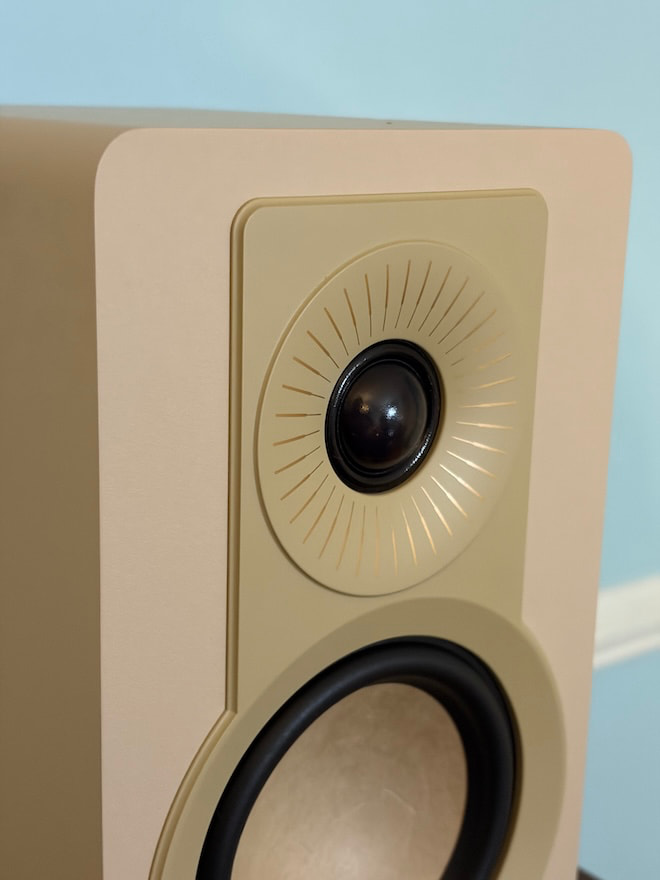
Textured magnetic grilles keep the look clean and flexible, leaning into Scandinavian restraint without sliding into the usual “boxy and boring” trap. They’re tidy, practical, and easy to live with—the kind of design choice that quietly does its job instead of demanding applause.
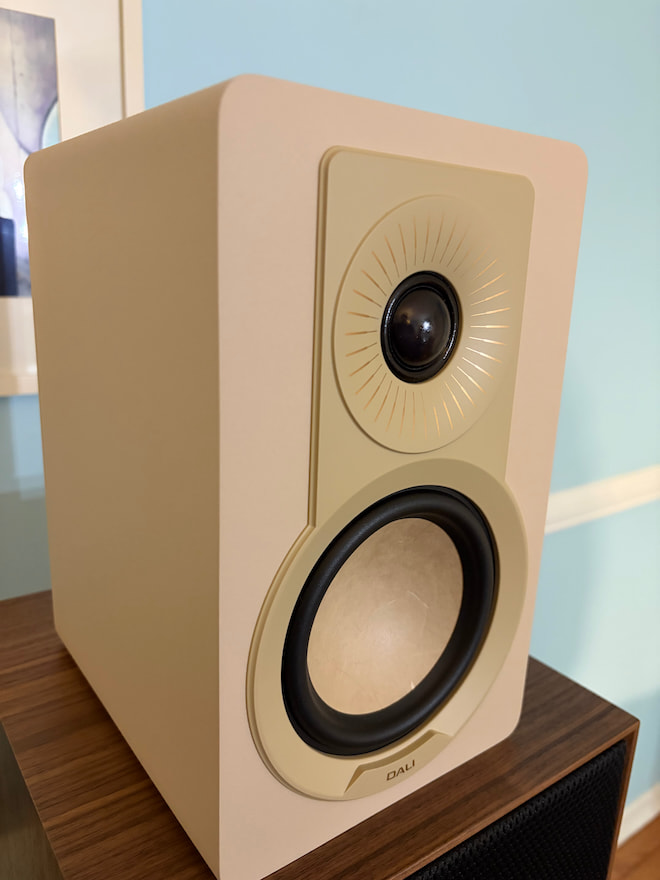
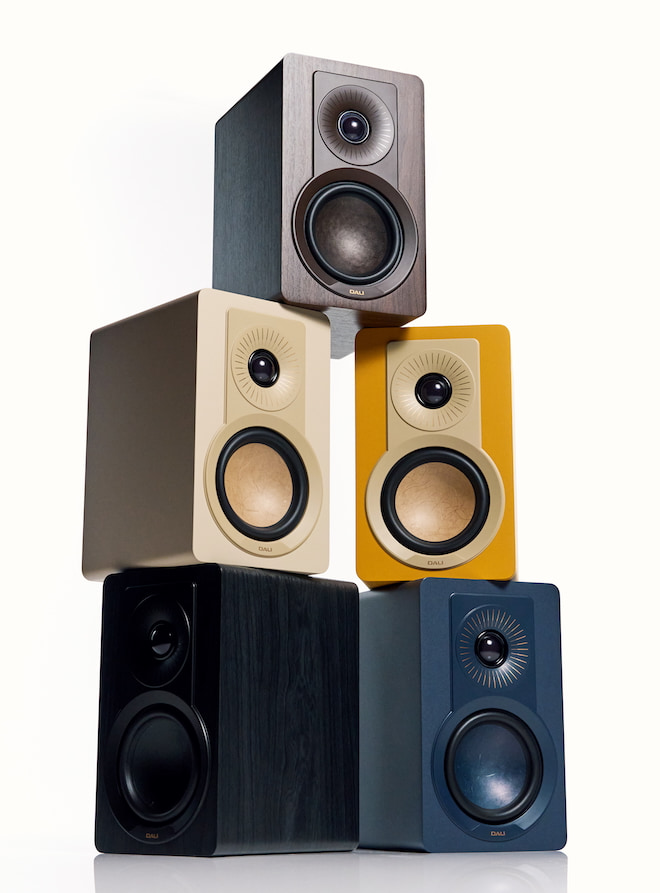
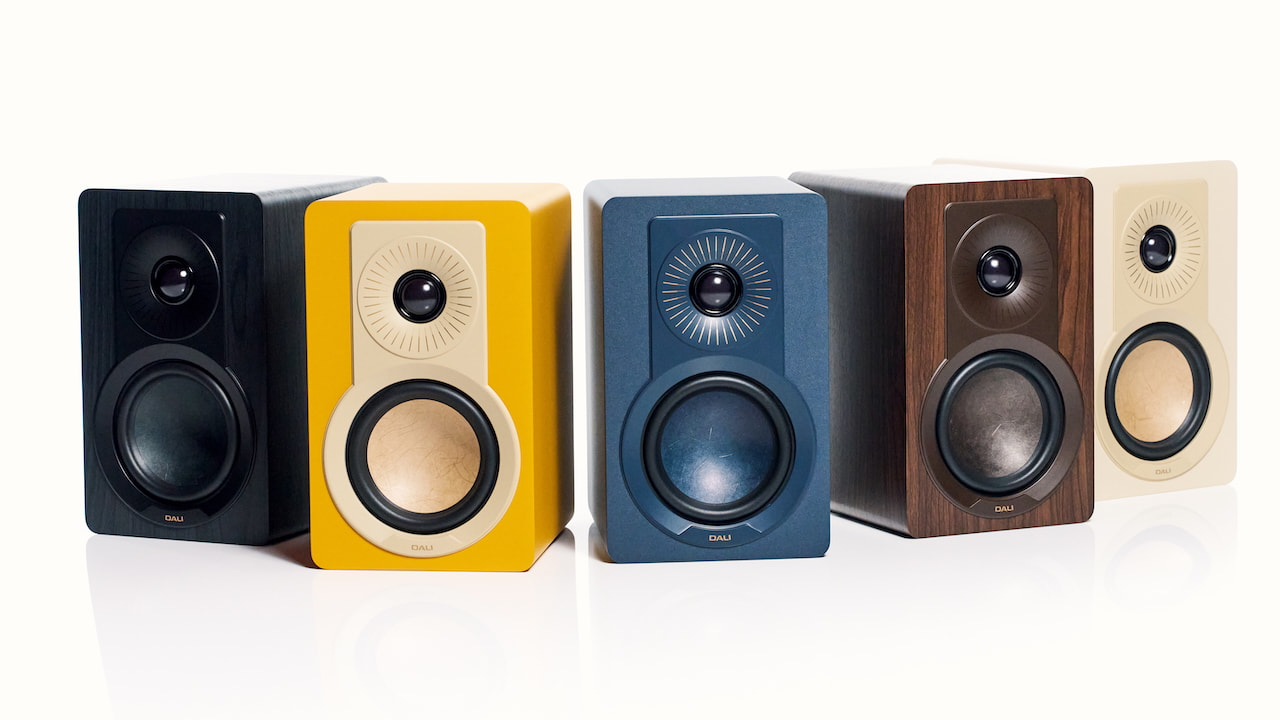
And then DALI does something refreshingly un-Danish: it adds color. Not a token accent, not a limited-edition afterthought, but five proper finishes—Black Ash, Walnut, Caramel White, Golden Yellow, and Chilly Blue—each paired with color-matched cones and grilles. Whether you want subtle, playful, or confidently loud, the KUPID refuses to disappear into the room like another pale wood cube auditioning for an IKEA catalog spread.
It almost feels deliberate. As if someone at DALI noticed that slapping “new colorway” on a product and calling it innovation has become a tired 2025 marketing crutch—and decided to just do it properly instead. Same speaker, same engineering priorities, but with a little visual backbone. About time.
Keeping It Simple
The KUPID follows a deliberately straightforward approach. It’s a single-model speaker with no tiers, no variants, and no attempt to complicate the buying decision. The goal is simple: offer a compact loudspeaker that fits easily on desks, shelves, or in smaller rooms, while carrying over DALI’s established design priorities without unnecessary add-ons.
The engineering reflects that same restraint. A 4½-inch paper and wood-fibre mid/bass driver with a ferrite magnet and low-loss rubber surround handles bass and midrange duties, focusing on control and consistency rather than maximum output. A 26mm soft-dome tweeter covers the high frequencies, chosen for predictable dispersion and low distortion within its operating range. The baffle and crossover are tuned to keep the drivers working together cleanly through the midrange, where placement and integration matter more than specs on a sheet.
Everything is anchored by a 2-way crossover set at 2,100 Hz, with a bass-reflex alignment tuned to 53 Hz. On paper, DALI rates the KUPID at 63 Hz–25 kHz (±3 dB) with a maximum SPL of 103 dB, which is believable for a compact box if you don’t expect nightclub physics from a 4½-inch driver.
The electrical side is the real tell: 83 dB (2.83V/1m) sensitivity and a 4-ohm nominal load. That’s not “cute little amp” territory. The numbers don’t lie—think 40 real watts as a practical floor, with DALI recommending 40–120 W. I ran them up near 100 W and they didn’t detonate, which is both reassuring and, frankly, what you want from a speaker that claims it’s built for real-world use.
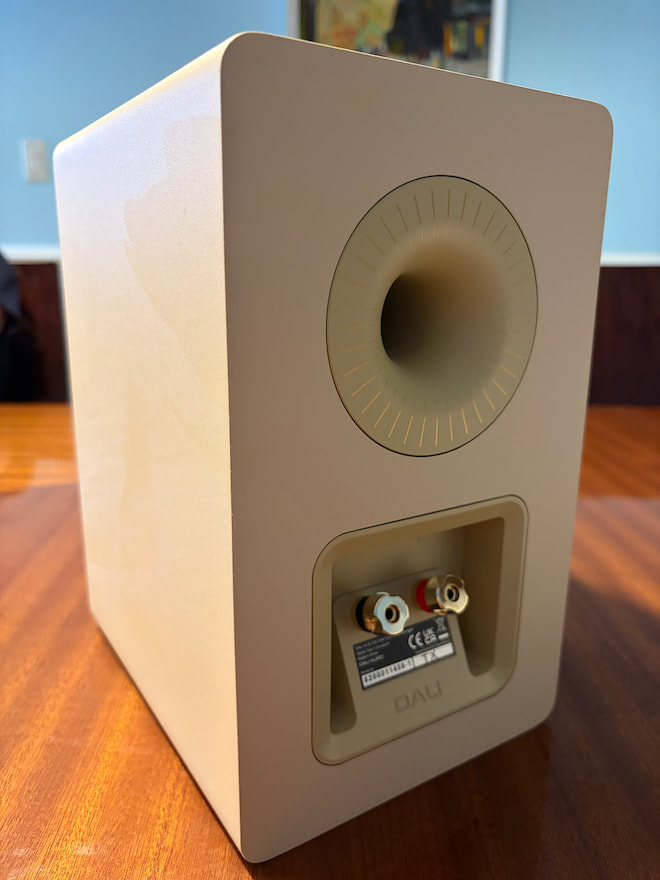
Setup is straightforward: single-wire binding posts, and placement options include stand, shelf, or wall using the included brackets. DALI suggests 2.5-60 cm (1-23.6 inches) from the rear wall, which tells you they’re expecting people to use these in actual rooms, not imaginary “perfect” ones. Physically, they’re compact at 237 × 140 × 195 mm (9.3 × 5.5 × 7.6 in) and weigh 2.9 kg (6.4 lb) each including the grille; shipping weight for the pair is 7.5 kg (16.5 lb).
Build quality puts the KUPID squarely in competition with speakers like the Q Acoustics 3000c Series and Wharfedale Diamond models, even if it doesn’t quite match them for surface-level finish or cabinet refinement. Those speakers look a bit more polished and furniture-forward, and that’s a fair distinction. The KUPID still looks good—especially in the Caramel White finish DALI sent me, which works exceptionally well on a dark walnut desk—but its priorities are clearly different.
DALI is competing here by spending the money where it actually matters. The drivers, crossover design, and cabinet tuning take precedence over luxury veneers or visual flourish. The result is a speaker that may not win a beauty contest against some British rivals, but doesn’t feel compromised or cheap either. It’s a deliberate trade-off, and one that makes sense if your focus is listening first and aesthetics second—without pretending those aesthetics don’t matter at all.
How the DALI KUPID Fits Into a Real-World Desktop or Small-Room System
Right out of the box, it was obvious the KUPID was destined for desk duty. Not everyone is working with a 60-inch-wide desk, but on a pair of IsoAcoustics Aperta stands, they fit cleanly on either side of my 27-inch Apple iMac without turning the workspace into a game of loudspeaker Tetris. The footprint is sensible, and the proportions make sense for nearfield use.
I also tried them on IsoAcoustics ISO-Puck Minis, which changed both the height and the ability to aim the tweeter properly at ear level. That mattered more than expected, especially on a desk. When I moved the KUPID onto 24-inch GHA metal stands, a little Blu-Tack kept everything planted and drama-free. For good measure, I parked them on my dining room credenza using both the ISO-Puck Minis and the stock feet. No surprises there—the KUPID isn’t precious about placement, but it does reward you for getting the height and angle right. In other words, it behaves like a well-designed small speaker, not a fussy one.
Because of end-of-year timing, the KUPID ended up being driven by a slightly odd but very real-world mix of amplifiers: NAD C 316BEE V2, Quad 3, Cambridge Audio AXA35, Advance Paris A10 Classic, Marantz M1, and the WiiM Ultra paired with the WiiM Vibelink Amp. It’s not a lineup anyone would curate on purpose, but it turned out to be a useful stress test.
Let’s be honest—almost nobody is buying a $600 pair of speakers with plans to hook them up to four-figure amplification. And they don’t need that. What the KUPID does show, however, is an ability to scale when you give it better electronics. Entry-level integrated amps will get you most of the way there, but as amplification quality improves, the speaker doesn’t bottleneck or fall apart. That’s not an invitation to overspend—it’s simply confirmation that DALI didn’t voice these to collapse the moment you move beyond bare-minimum power. In short, sensible amps make sense here, but the KUPID won’t punish you for owning something better.
Listening
Having owned more than a few pairs of DALI speakers over the years, I’m pretty familiar with the house sound. There are traits here that feel familiar, but the KUPID clearly isn’t trying to be a miniaturized greatest-hits package—and that’s a good thing. It has its own personality, and it doesn’t feel constrained by expectations set elsewhere in the lineup.
Spinning Kraftwerk made the low-end limits clear almost immediately. There’s no pretending otherwise. Bass here is tight and quick rather than weighty or room-shaking, but with the NAD/WiiM Ultra pairing, it was still lively enough to get my foot tapping against the bottom of the desk—which did not go over well with Tyrion, my West Highland Terrier, who prefers his mornings spent sleeping on my feet and gnawing on my NHL puck collection. Spacious? Yes. Deep? To a point. Agile and snappy? Absolutely. Even when I leaned on the volume, dynamic shifts were handled confidently—very confidently for a $600 pair of speakers.
The midrange is clean, slightly warm, and detailed without sounding etched or clinical. Vocals and instruments land naturally, without needing to be pushed forward for effect. The top end walks a narrow line—it feels extended and alert without tipping into hardness or glare, even on less forgiving recordings. Some of that balance almost certainly comes down to amplifier choice, but credit where it’s due: the KUPID never lost its footing. It plays within its limits, understands them, and sounds better for it.
Switching over to The Orb, Boards of Canada, Stereolab, and Deadmau5, the KUPID made a strong case for itself with electronic music. These compact Danish speakers keep the pace moving and the rhythm intact without pretending to deliver subwoofer bass. There is momentum and drive here. Think peppered herring with a bit of snap rather than something heavy and overcooked.
Amplification matters. A slightly warmer and properly powered amp suits the KUPID best. In North America, DALI’s distribution through Lenbrook means NAD and Bluesound are common partners in dealer showrooms, and the pairing makes sense. My C 316BEE V2 had no trouble driving the KUPID on a desktop or in a smaller room. The NAD’s slightly fuller upper bass and lower midrange helped balance the leaner presentation of the WiiM Ultra, resulting in a sound that felt more grounded and cohesive.
Vocals are a clear strength, but context matters. They’re not warm and full-bodied in the way the Wharfedale Super Denton can be, and they’re not as lean or matter-of-fact as the Q Acoustics 3020c either. The KUPID sits somewhere in between, with good clarity and presence, just on a smaller physical scale than either speaker. That trade-off is easy to accept on a desk, where neither the Super Denton nor the 3020c really fits all that gracefully to begin with.
The tweeter feels like a deliberate and sensible choice. It extends far enough, stays smooth, and never draws attention to itself. There isn’t an excess of top-end sparkle or air, and it won’t thrill anyone chasing hyper-detail from three feet away. Safe? Possibly. But in nearfield use, I’ll take controlled and listenable over analytical and edgy every time. The Advance Paris was clearly more amplifier than the KUPID needs, though it did manage to push them to their upper limits without things falling apart.
The Marantz M1 was a better match. Just enough weight and control to let them open up, and the treble never crossed into aggressive territory. The Ultra/Vibelink pairing will appeal to plenty of people because of price and connectivity, but sonically it leaned thinner than I preferred.
Listening to Nick Cave, Jason Isbell, David Bowie, and Sam Cooke, the KUPID never once masqueraded as a traditional British bookshelf speaker. Cave’s growl didn’t have the same weight it does through the Super Denton, but it was articulate enough that I never felt shortchanged. More importantly, there was enough clarity and presence to stay engaged while writing and editing. And when Yaz’s “Situation” came on, I found myself swaying in the chair and bouncing my feet across the floor without thinking about it. On a desktop, that’s a win.
Listening to Bruce Hornsby and the Range’s Grammy-winning The Way It Is alongside Nick Cave’s cover of “Avalanche” was revealing. Both are well recorded and place real demands on timing, texture, and tonal balance. Piano, in particular, became the dividing line. At times it sounded full enough to carry convincing weight, and at others it leaned more toward speed and clarity. I’d call that outcome a draw rather than a flaw.
Speakers like the Wharfedale Super Denton and a few others I’ve had through recently deliver more physical impact and a stronger sense of decay as notes bloom and fade. The KUPID doesn’t quite reach that level of gravitas. What it does prioritize instead is speed, detail, and clean dynamic shifts. Within its price and size constraints, it handles those priorities well, and for $600, the balance DALI struck here feels considered rather than compromised.

I was lucky to have the Andover Audio SpinPlay arrive at the same time, which made things more interesting. Using its 3.5mm to RCA output, I bypassed the built-in speakers and ran the turntable and phono stage straight into the NAD, Marantz M1, and Vibelink inputs. Even with the stock Audio-Technica MM cartridge, the tonal balance landed right where it should across all three setups. That was especially true with the leaner-sounding WiiM integrated amp, where the SpinPlay helped fill things out without tipping into excess.
Spinning recent Craft Recordings OJC reissues like Soul Junction, Plus 4, and Boss Guitar, it became clear that the KUPID is a speaker jazz listeners will appreciate. Pacing is strong, the presentation stays clean, and horns never cross into bite or glare. There’s enough presence to stay engaged without sounding forced. Sub-bass never really enters the conversation, but it doesn’t need to. Most of the musical information lives from the mid-bass up, and in that range, the KUPID and SpinPlay pairing worked together comfortably and convincingly.
Imaging and soundstage are best described as average, but that’s not a criticism in a desktop context. The sound does extend beyond the edges of the cabinets, and imaging is precise and easy to lock onto, but anyone expecting a vast or immersive presentation from a compact nearfield setup is shopping in the wrong aisle. For desk use, it’s coherent, stable, and does exactly what it needs to do without drawing attention to itself.
Moved onto the credenza in our 20 × 13 × 9 dining room, the KUPID handled the space better than expected. It didn’t project with the same authority as the Quad 3 paired with the Wharfedale Super Denton, but it still filled the room in a convincing way. Sitting at the table working on my laptop, I found myself more impressed by the speaker’s sense of jump and dynamic responsiveness than by its scale. It may not dominate the room, but it stays engaging and composed in a way that feels entirely appropriate for its size and intent.
The Bottom Line
The DALI KUPID succeeds by knowing exactly what it is and refusing to pretend otherwise. It’s a compact, desk-friendly loudspeaker with real engineering behind it: fast, controlled bass for the size, a clean and articulate midrange, and a smooth, well-judged top end that never turns edgy in nearfield listening. It’s easy to place, forgiving of real rooms, and agile enough to keep pace with electronic music, jazz, and vocals without sounding dull or overcooked. On a desk or in a smaller space, it does the job cleanly and consistently.
Potential buyers should be clear-eyed. This is not a speaker for flea-powered amps, nor is it trying to fill large rooms with authority. Bass depth is limited by physics, soundstage scale is modest, and finish quality, while solid, doesn’t quite match some British rivals that lean harder into furniture-grade presentation. Pair it with a competent amplifier that has a little warmth and real current, give it sensible placement, and it rewards you with balance, speed, and musical engagement rather than hi-fi theatrics.
At $600, the KUPID earns its keep. It competes honestly, sounds better than many lifestyle-focused alternatives, and avoids the trap of being either too polite or too analytical. That combination—fun, easy to live with, properly engineered, and affordable—is exactly why it earned an Editors’ Choice Award for 2025. Speakers can, in fact, be enjoyable, practical, sound good, and not bankrupt you all at once. What a concept. Let’s hope more brands remember that.
Pros:
- Compact size works exceptionally well on desks and in smaller rooms
- Clean, articulate midrange that handles vocals and acoustic instruments with ease
- Smooth, well-controlled treble that avoids fatigue in nearfield listening
- Fast, tight bass for the size, with good rhythmic drive and dynamics
- Not fussy about placement; performs well near walls and on furniture
- Scales with better amplification without falling apart
- Sensible design choices and solid engineering where it matters
- Bold finish options that stand out without feeling gimmicky
- Strong overall value at $600
Cons:
- Low sensitivity and 4-ohm load mean low-powered amps need not apply
- Bass depth is limited by cabinet size; no substitute for a subwoofer
- Soundstage scale is modest, especially compared to larger bookshelf or floorstanding speakers
- Fit and finish, while solid, aren’t as refined as some similarly priced British competitors
- Not designed to fill large rooms with authority
Where to buy:
Related Reading:
- DALI Oberon 5: The Audiophile System Builder
- Q Acoustics 3020c Review: Proper British Speakers That Sound Brilliant With A Warm Amp — No Need To Raid Your Sock Drawer For Spare Cash
- Best Bookshelf Speakers: Editors’ Choice 2025
- Vera-Fi Vanguard Scout Bookshelf Speakers And Caldera 10 Subwoofer Review: Budget Bliss
















Anthony
December 29, 2025 at 1:51 pm
Have only heard good things about these so far. The blue finish is cool but definitely not something I could blend into my office or den system.
How heavy are these?
The wall-mount option does not appeal to me.
Ian White
December 29, 2025 at 3:16 pm
Anton,
Read the review again. But they’re not heavy. The wall-mount doesn’t appeal to me because of the rear port, but I can see it working for people. I rather like the cream white because it contrasts with the wood desk, and bookshelves in my office. They are very good speakers for the money.
IW
Larry
January 2, 2026 at 10:18 pm
Hi Ian,
I wanted to give other people a chance to opine before I added my two cents. 🙂
The mid-priced market segment is a tough area. I see that Q Acoustics has bumped the M20HD from $499 to $729. I’m not sure if it was due to cost-related or tariff-related reasons.
The Dalis at their EU price are a great buy, but at the US price, that seems high, given the competition.
For passive speakers, a quick check at Crutchfield shows dozens of speakers priced below $500.
KEF still seems to be blowing out the LSX LTs at Costco for $600, which is a great buy.
I’d be curious to know why the USD price on the Dalis is double the EU price. My hunch is it’s currency value plus tariffs, but that’s a large difference.
Larry
Ian White
January 2, 2026 at 11:17 pm
Larry,
I can confirm that tariffs were the cause for the Q Acoustics price hikes.
My eyebrow went up when we did the initial DALI KUPID news story and I was asked to correct the price within 24 hours.
It’s not made in the EU and I suspect it’s a combination of the two reasons you mentioned. It is a lot cheaper overseas.
And DALI offers other speakers that are made in Denmark that are similar in price but also superior in terms of build quality and parts.
IW
Michael Larsen
January 3, 2026 at 4:07 pm
insane price $600 In denmarm they cost what is equal to 408 dollars
Ian White
January 3, 2026 at 6:15 pm
Michael,
The seems to be the prevailing commentary so far. I was initially puzzled by the pricing because the DALI Spektor 2 are only $400 USD right now on Amazon. I’m sure that’s remaining inventory that Lenbrook has in North America – but I would pick the Spektor 2 at that price over the KUPID. Not even a contest.
I think DALI will have to rethink the pricing.
IW