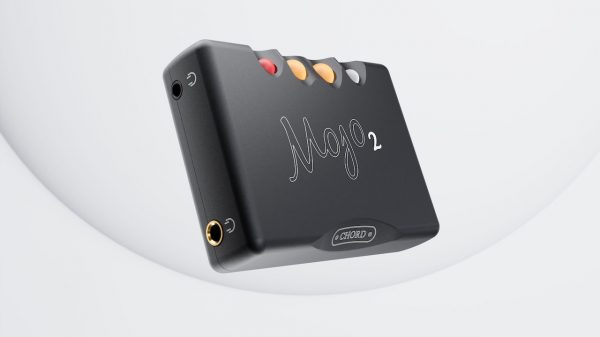
If you’ve been in this hobby long enough to remember when phones still had headphone jacks, you know the drill: if you wanted real power and real sound, you strapped a DAC/amp to your phone like some cyberpunk life-support module. It was bulky, heavy, and absolutely worth it. Then the 3.5mm port vanished, the dongle era exploded, and brands like Cayin started pushing things forward with devices like the RU9—portable gear that didn’t just replace the jack, but flat-out humiliated it.
Most people folded and bought TWS buds. And that’s fine—comfort and convenience usually win. But there’s still a stubborn faction of us dragging full-size wired headphones onto planes like it’s 2010. I once looked around mid-flight at a sea of Bathys, XM-series Sonys, and Bose ANC pods… then looked down at my Lawton-modded TH-900s chained to an xDuoo XD05 and realized I was definitely not like the other children at school. But anyone who’s heard a TH-900—stock or modded—knows why: no wireless headphone touches that low-end slam or sheer dynamic force.
Some of the other diehards reading this are already rolling their eyes and muttering, “An xDuoo XD05? Ughhhh.” But let’s be honest: the standalone DAC/amp market basically withered the moment the dongle craze took over and every manufacturer tried cramming an entire audio chain into something the size of an AA battery. Convenience ruled. Output power didn’t. And anything larger than a pack of gum suddenly became “old-fashioned.”
Thankfully, Cayin didn’t get that memo—or ignored it on purpose. With the new RU9, they’ve decided to resurrect the portable DAC/amp for a new generation and actually push it forward instead of shrinking it into irrelevance.
This is the same company that gave us the N8 with switchable tube and solid-state amplification, the RU6 that brought R2R to dongles, and the RU7 that delivered a 1-bit DSD DAC small enough to lose in your jacket pocket. The RU9 is their victory lap: nearly every innovation from the past few years, fused into one compact device that’s supposed to outclass the entire dongle category.
At $499 USD, the RU9 has to be more than a fancy USB stick with delusions of grandeur. It has to earn desktop-level respect. The question is… does it?
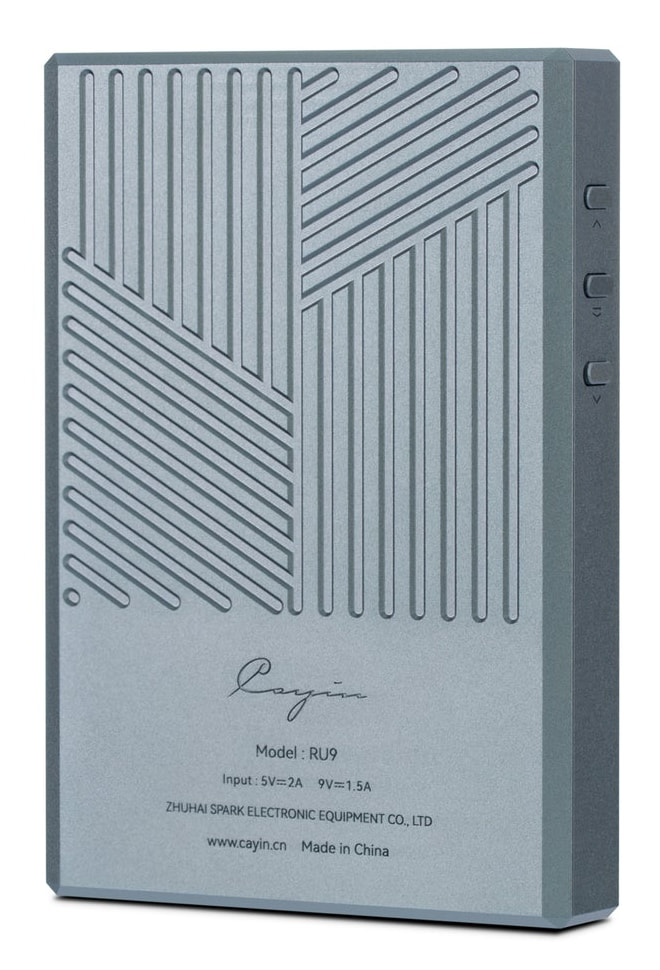
Unboxing & Build Quality
Like most Cayin gear, the RU9 arrives with the kind of understated elegance the brand has made its calling card: a minimalist sleeve on the outside, a stealth-black inner box on the inside. Pop the lid and you’re greeted by the RU9 sitting securely in a foam cradle up top, with the accessories tucked neatly below. And—also very Cayin—the accessories aren’t the usual afterthought. You get a leather case with MagSafe attachment, plus a magnetic ring for those of us whose phone cases skipped that feature. The cable bundle includes a USB-C to USB-A adapter and a right-angle USB-C-to-C OTG cable that’s genuinely useful. Honestly, if Cayin sold that little OTG cable separately, I’d stockpile a few.
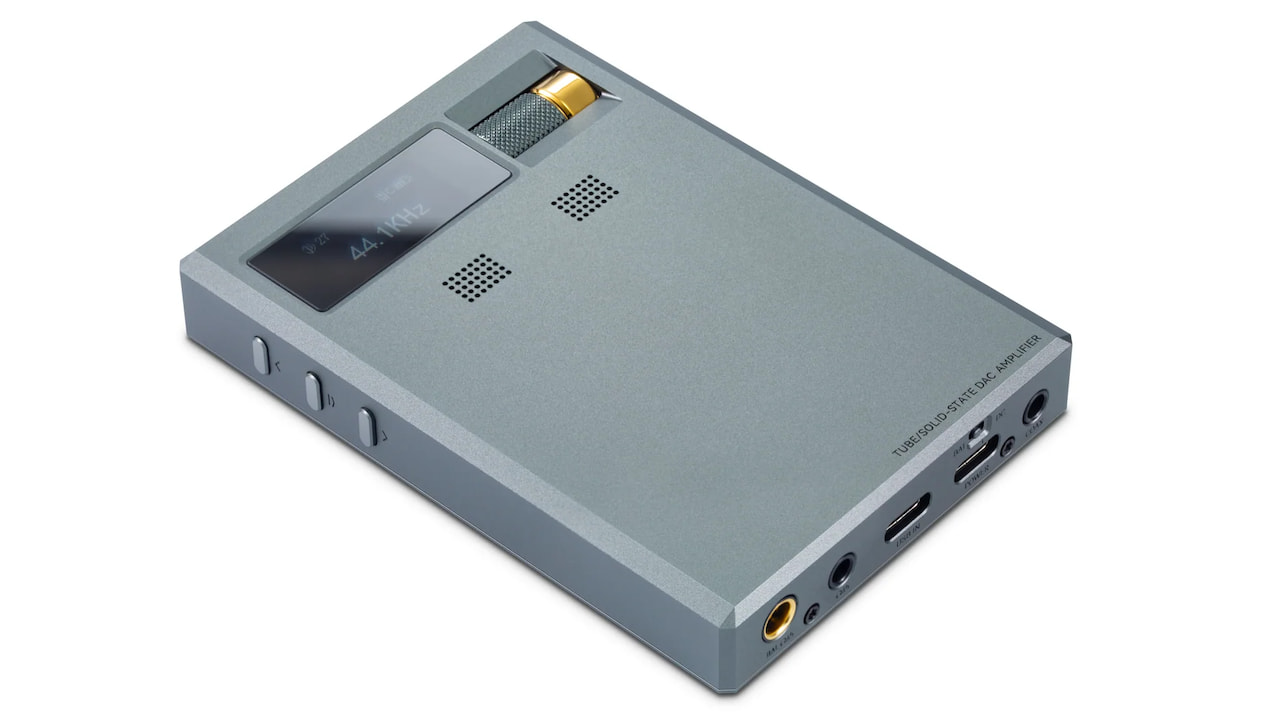
Lift the RU9 out of its nest and you’re holding something about the size of a deck of cards (4 x 2.75 x 1 inch) and roughly 150 grams. The CNC-machined aluminum chassis accounts for most of that weight—and it feels every bit as solid as the spec sheet implies. Designed to ride piggyback on your phone, the RU9’s footprint is small enough not to block the camera on normal-sized devices like the iPhone Air or Samsung S25. Once attached, it stays put surprisingly well; it only tries to make a break for freedom if you shake your phone like you’re testing a paint can.
RU9 Design
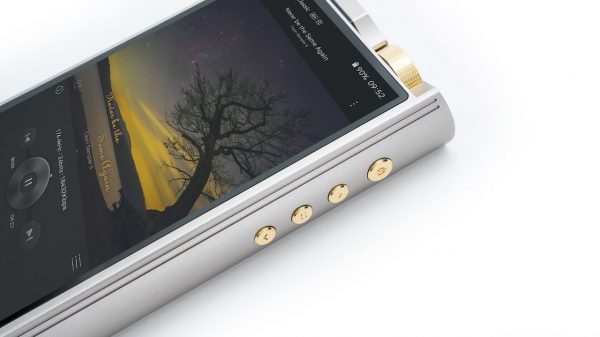
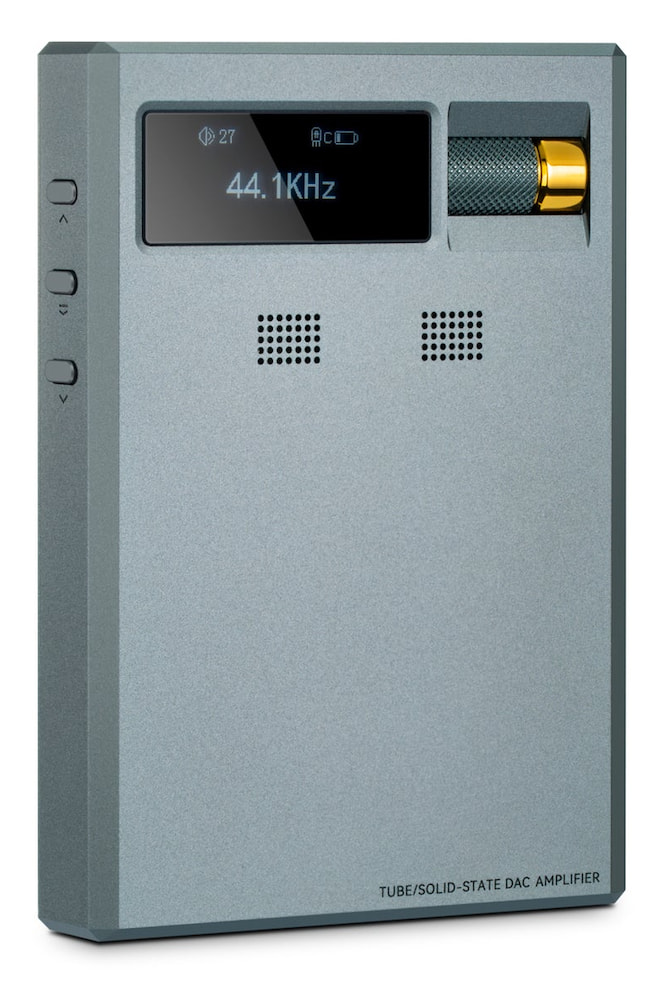
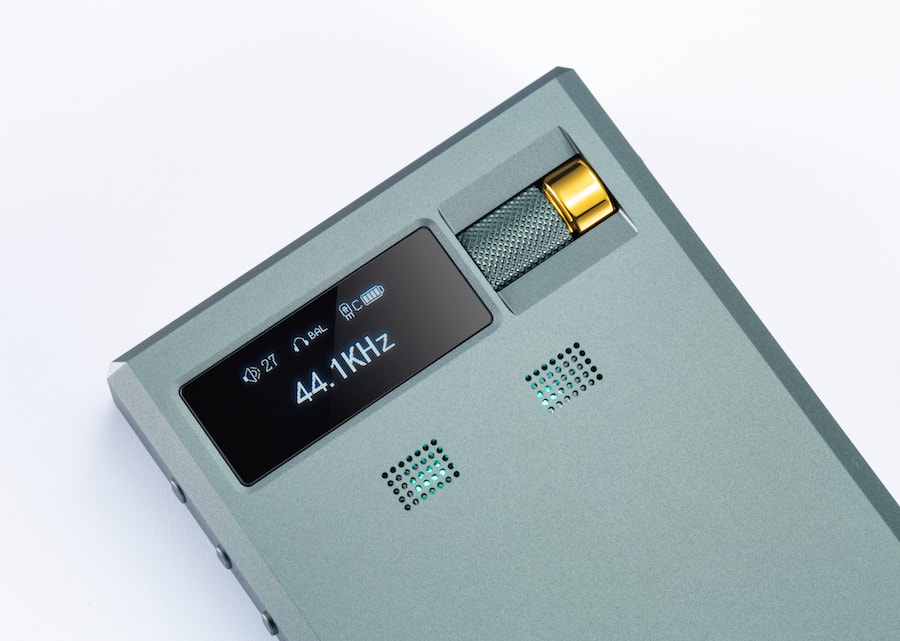
The RU9 takes a slightly unconventional approach to layout and design, starting with the top panel: a clear window gives the Bluetooth antenna an unobstructed path, while the front face hosts a compact display in the upper-left corner and a satisfyingly large volume knob directly beside it. Just below those sit two vents, through which the Korg NuTubes glow when enabled—an undeniably cool visual choice. The display itself keeps things practical, showing battery status, sample rate, and the settings menu when needed. Flip the unit over and the back is clean and modern, with a geometric cross-line pattern up top and the usual make/model info neatly printed at the bottom.
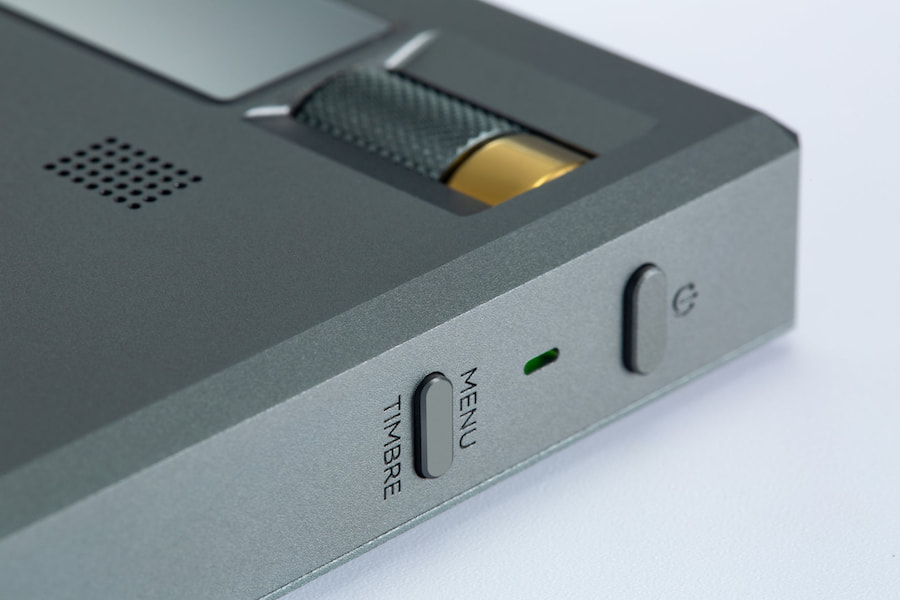
Control placement is straightforward. On the left side you’ll find three transport controls: forward/next at the top, play/pause in the middle, and reverse/back at the bottom. The right side mirrors that layout, but with system controls instead—power at the top, an LED indicator below it, and a multifunction button beneath that handles menu access and timbre selection. Everything is logically arranged, easy to hit without looking, and feels more like a shrunken desktop component than a typical dongle-style device.
The power button pulls double duty: a quick tap wakes or sleeps the display, while a long press handles full power on/off. The LED indicator is equally efficient, glowing red while charging and shifting through different colors to reflect the active sampling rate during playback.
The multifunction button is where things get interesting—it cycles between solid-state, Classic Tube, and Modern Tube modes with a quick press, or opens the Settings menu with a long press. Once you’re in the menu, the volume wheel becomes your scroll control, and a quick press of the multifunction button confirms selections. To exit, hold the button again. Simple, clean, and very Cayin.
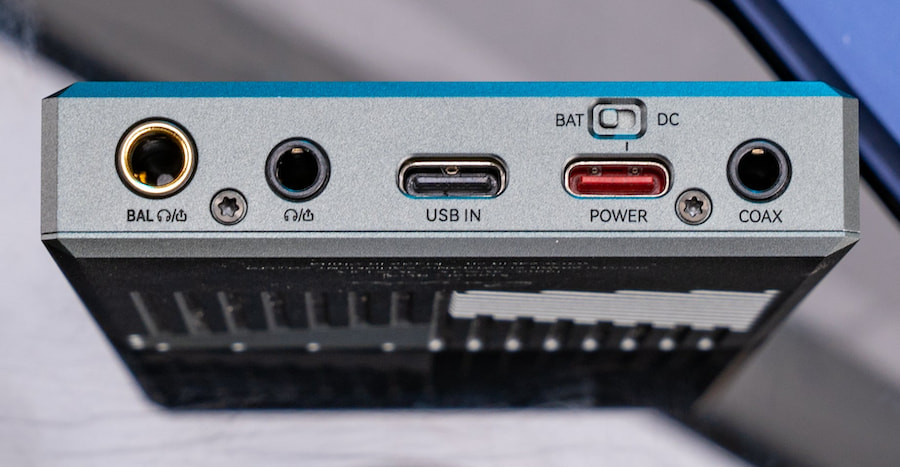
All I/O lives on the bottom edge, starting with a 4.4mm balanced output and a 3.5mm single-ended jack. Both can be switched between variable headphone out and fixed line-out in the Settings menu. Gain applies globally—LO or PO—which means you get three gain levels even for Line Out, a rarity in portable gear. Next are two USB-C ports: one for data/input, and one dedicated to power, identified by its red interior so you don’t plug the wrong thing in mid-flight.
Above the power port sits a small toggle that enables or bypasses the internal battery for desktop operation. And at the far right is a coaxial (copper S/PDIF) input, rounding out a shockingly complete set of connections for something this size.
It’s worth pointing out that charging the RU9 requires using the dedicated power port and leaving the unit in battery mode. Flip the switch to bypass and connect a high-power USB charger, and the RU9 unlocks its “Hyper” operating mode—boosting output power and raising the amplifier rail voltage for maximum grunt. It’s a clever design choice that gives you desktop-level performance when you’re not relying on the internal battery.
The included case is equally well thought out. The RU9 slides in from the top and fits snugly—secure, but not so tight that you need dental tools to pry it out. The top and bottom remain open so every port and the Bluetooth antenna stay accessible. The front has a generous cutout for the screen and volume wheel, plus two smaller openings for the NuTube vents. A single cutout on the right provides visibility for the LED indicator. It’s functional, protective, and very much in line with Cayin’s habit of including accessories that don’t feel like an afterthought.
Internals: Where the Real Madness and the Magic Happens
USB duties are handled by the XMOS XU316, a modern workhorse that gives the RU9 both UAC 1.0 driverless support for older hardware and full UAC 2.0 performance for anything current. It pushes up to 32-bit/768 kHz PCM and DSD512, so the digital ceiling is basically irrelevant here.
Bluetooth input comes courtesy of Qualcomm’s QCC5125, which brings AptX Adaptive, the legacy AptX variants, LDAC, AAC, and SBC to the table. In short: if your device has Bluetooth, the RU9 will talk to it—and sounding better than it has any right to over wireless. Coaxial input remains the usual 24-bit/192 kHz PCM limit, but it’s still a welcome addition for expanding the RU9’s usefulness beyond phones and laptops.
From there, the digital signal heads into a dual-mono pair of AK4493SEQ DAC chips. This is AKM’s latest Velvet Sound iteration of the 4493, sporting higher maximum sampling rates to match the XU316, lower power draw, and six digital filters for fine-tuning. The 4493 has been a staple in AKM’s lineup for years, but the SEQ revision is a meaningful upgrade, not just a firmware tweak.
From the DAC stage onward, everything inside the RU9 is fully duplicated—true dual-mono, with the left and right channels completely isolated. That cuts noise and crosstalk to impressively low levels, though it also bumps up cost and power consumption. Cayin clearly decided purity mattered more than efficiency here.
Amplification is where things get interesting—and a bit complicated—because the RU9 doesn’t rely on a single topology. Instead, it uses three separate amplification phases, each serving a specific role. Phase One is a buffer stage built around Toshiba 2SK209 JFETs. Think of this as the signal “preparation zone,” where the microscopic output coming off the DACs gets lifted to a level the Korg NuTube can actually work with.
Phase Two is where the user gets a choice: Tube Mode or Solid-State Mode. Both Tube modes (Classic and Modern) behave the same at this stage, so we don’t need to split hairs yet. What matters is that you’re deciding whether the signal heads into a NuTube-based amplification path or a more traditional transistor-based path—essentially two personalities baked into one device.
If you select Tube Mode, the signal moves from the initial JFET buffers into a pair of Korg 6P1 NuTubes—essentially modern, ruggedized equivalents of a 12AU7. Each 6P1 is a dual-triode, giving Cayin two fully independent signal paths per tube, which allows for true differential amplification inside a remarkably compact device. It’s old-school analog charm, but engineered for portable abuse.
Switch over to Solid-State Mode, and the signal is rerouted into a quad array of TI 1662 op-amps paired with Nexperia transistors and the necessary support circuitry. Using two op-amps per channel maintains a fully balanced, fully differential path—no half-measures just because it’s the “solid-state” side of the house.
Regardless of which Phase 2 path you choose, everything reunites at the final gain/buffer stage: another set of Toshiba JFETs. This stage stabilizes the output, lowers the output impedance, and ensures the RU9 plays nicely with a wide range of headphones. Tubes are notorious for high output impedance and can struggle with low-impedance IEMs and portables, but this design keeps the RU9 comfortably compatible with anything from 8 ohms to 600 ohms without turning the frequency response into modern art.
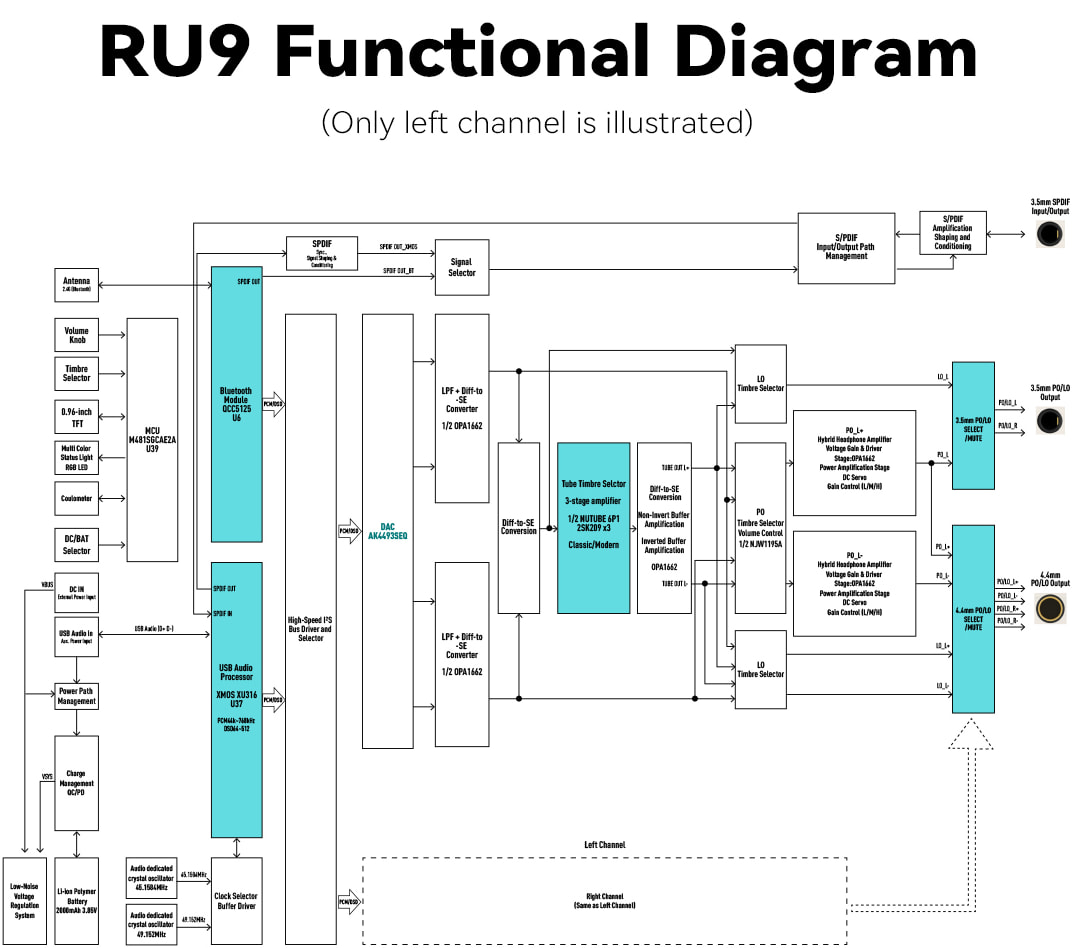
Tube Mode splits into two distinct voicings: Classic and Modern. Both use the same physical signal path, but Cayin manipulates the NuTube’s behavior through different feedback circuits. Classic mode leans on the 6P1’s local feedback, giving you that warmer, more fluid, vintage tube presentation—rounded edges, richer mids, and a little extra glow. Modern mode, on the other hand, uses a large-loop negative feedback network outside the tube, tightening the response for cleaner transients, firmer bass, and more precision. Same tube, two personalities.
As with any tube—NuTube included—there’s a warm-up period. When you switch into a tube mode, the RU9 inserts a six-second delay to let the 6P1 reach operating temperature before audio passes through. It’s normal, it’s intentional, and it’s a small price to pay for getting real tube behavior in something this portable.
Output power on the RU9 depends on three variables—mode, port, and whether you’re running off the internal battery or external DC. In battery mode, the single-ended 3.5mm output delivers 310 mW @ 32Ω, while the balanced 4.4mm doubles that to 620 mW. Switch to DC (bypass) mode, and things step up: single-ended climbs to 420 mW, and balanced jumps to a full 1,000 mW @ 32Ω. For a device this size, those numbers are firmly in “mini desktop” territory.
The complication doesn’t end with power. Frequency response, SNR, THD+N, and channel separation all vary depending on the path you choose—solid-state, Classic Tube, or Modern Tube. Every configuration hits at least 20 Hz – 22 kHz and 104 dB SNR, but THD+N and separation change significantly once tubes enter the picture, as expected. Solid-state is predictably cleaner; tube modes trade a bit of measured purity for the harmonic flavor people actually want tubes for.
Battery Life: Because Great Sound Shouldn’t Die Before Your Layover Does
With all the variables at play, battery life is just as fluid as the RU9’s amp stages—and it swings pretty dramatically depending on how you run it. The most efficient setup is solid-state through the 3.5mm output, which gets you roughly 5 hours. Stick with solid-state but move to the 4.4mm balanced output, and you’re looking at about 4.25 hours. Flip into either Tube mode and things drop fast: about 3 hours, regardless of port. (Makes sense—NuTubes aren’t exactly “half-power” friendly for single-ended listening.)
To me, that spells it out clearly: the RU9 can run on its internal battery in a pinch, but that’s not its natural habitat. This thing wants DC mode, either with a hefty portable power bank or a proper 45W+ USB charger. Treat it like a miniature desktop amp that happens to be pocket-sized, and your expectations will land exactly where Cayin intended.
Listening: The RU9’s Triple Personality Disorder (In a Good Way)
I ran the RU9 through just about every source I had on hand: multiple phones, a Windows laptop, a MacBook, a CD transport via coax, and even the xDuoo XT-10ii digital transport. I also tested the Bluetooth input over both AptX and LDAC to get a complete sense of how the RU9 behaves wirelessly. On the headphone side, I cycled through a wide spread of full-size cans and IEMs to see where this thing shines and where it starts sweating.
In solid-state mode, the RU9 lands squarely in near-neutral territory with enough power and grip to keep most headphones honest. There’s no obvious emphasis or dip across the spectrum; extension at both ends is strong, detail retrieval is clean, and the stage feels well-proportioned without any artificial stretching. It’s a very “what you feed it is what you get” presentation, but with enough musicality to avoid sounding clinical.
Switch to Classic Tube mode, and the personality shifts. Mid-bass steps slightly forward, warmth increases through the mid-bass and lower mids, and the overall tuning leans toward a mild V—subtle, but definitely more textured and full than in solid-state. Detail takes a small step back, but it’s traded for a smoother, more fluid tonality that flatters vocals and instruments with natural decay.
Modern Tube mode sits squarely between the solid-state and Classic Tube personalities. Bass is pushed forward like in Classic mode, but it hits with quicker recovery, giving it a noticeably tighter, more controlled feel. The lower mids pick up some weight and warmth as well, but not to the same degree as Classic mode—think “tube flavor” without the full vintage glow. If you enjoy the liquidity tubes bring to vocals but hate sacrificing detail for syrup, Modern mode is probably the sweet spot.
With ultra-sensitive IEMs, noise performance is better than expected. The Campfire Andromeda—my usual hiss detector—revealed a slight noise floor only in high gain, and Hyper mode made it a bit more obvious. Still, this is not a realistic pairing for those settings, and the fact that the RU9 remains very usable with the Andromeda suggests it will play nicely with all but the pickiest low-impedance hybrids.
At the opposite extreme, I pushed the RU9 with 600Ω loads, including the AKG Sextett and the Beyerdynamic DT-990, using the 3.5mm output in battery mode. Both reached comfortable listening levels with room to spare. No strain, no compression—just clean output. That’s impressive for something that can literally hang off the back of a phone.
Big planars weren’t a problem either. The Audeze MM-500 and HiFiMAN Susvara both ran surprisingly well off the single-ended output, which is not something I expect to say about any portable amp. The HE-6, predictably, was the toughest customer—usable only from the balanced output, and even then you’re asking a pocketable device to do the job of a small power plant. That’s not a knock on the RU9; it’s just the HE-6 being the HE-6. Every amp has limits, and the RU9’s are impressively far out for its size.
Connection type didn’t meaningfully change performance. USB, coax, and Bluetooth all behaved consistently once I dug into the settings menu, enabled wireless, and got everything talking. Samsung users will need to tweak LDAC settings for best results, but once configured, LDAC and AptX were both stable and clean. The only caveat: Bluetooth range maxes out around 10 yards, and it needs line of sight. Put a wall—or your body—between the source and the RU9, and breakup starts creeping in.
The Bottom Line
People love asking reviewers for “the best,” and the truth is always the same: there is no best—only what works best with the rest of your chain. The perfect amp for someone running hyper-sensitive IEMs is absolutely not the same amp you’d hand a 600Ω vintage beast or a low-sensitivity planar. That’s why most portable solutions fall apart the second you push them outside their comfort zone.
The Cayin RU9 is the rare exception. Its versatility isn’t a marketing bullet point—it’s the product. Three gain levels, solid-state plus two distinct tube modes, Hyper mode for desktop-style grunt, battery or DC operation, and three input types including Bluetooth give it a range few “dongles” can touch. Whether you’re pairing a 64 Audio U12t, a HiFiMAN Sundara, or the new HEDD D1, the RU9 adapts without losing its core strengths. And if you want to swap between a neutral presentation, classic tube warmth, or a modern tube snap depending on the playlist, the RU9 caters to that without feeling gimmicky.
Most importantly, the sound quality actually delivers. You’re not just getting flexibility—you’re getting real performance. Solid-state is clean and neutral, Classic Tube mode gives you that thick, honeyed mid-bass glow, and Modern Tube mode threads the needle with tighter bass and better detail. It’s like having three personality profiles built into one very compact device.
Where the RU9 stumbles is battery life. Three hours in Tube mode and five in the most efficient configuration is not “all-day portable.” This is a device best used in DC mode with a power bank or wall charger if you expect long sessions. Think mini desktop amp that happens to travel well, not true all-day dongle.
Who should consider it?
Anyone who wants a portable DAC/amp that can legitimately replace a small desktop rig, enjoys experimenting with different sonic flavors, or runs a wide range of headphones—from sensitive IEMs up to demanding planars. If convenience and all-day wireless portability matter more than everything else, look elsewhere. But if you want serious sound, genuine versatility, and real tube character in a device you can stick to the back of your phone, the Cayin RU9 stands alone.
Pros:
- Three distinct sound signatures: Solid-state, Classic Tube, and Modern Tube, each genuinely different and genuinely useful.
- Serious power output for a portable device—up to 1,000 mW balanced in Hyper/DC mode.
- Excellent versatility: 3 gain levels, battery or DC operation, wired + Bluetooth inputs, and full dual-mono architecture.
- Works with almost anything: From sensitive IEMs to high-impedance dynamics to big planars.
- Balanced and single-ended outputs, both switchable between headphone out and line out.
- Premium build with a clear display, intuitive controls, and a high-quality MagSafe-compatible case.
Cons:
- Short battery life: 3-5 hours depending on mode; not ideal for long flights or full workdays.
- Bluetooth range is limited to roughly 10 yards with required line-of-sight.
- Tube warm-up delay (6 seconds) may annoy impatient listeners.
- Can get warm in Hyper mode, especially when powering harder-to-drive cans.
Where to buy:
Related Reading: