
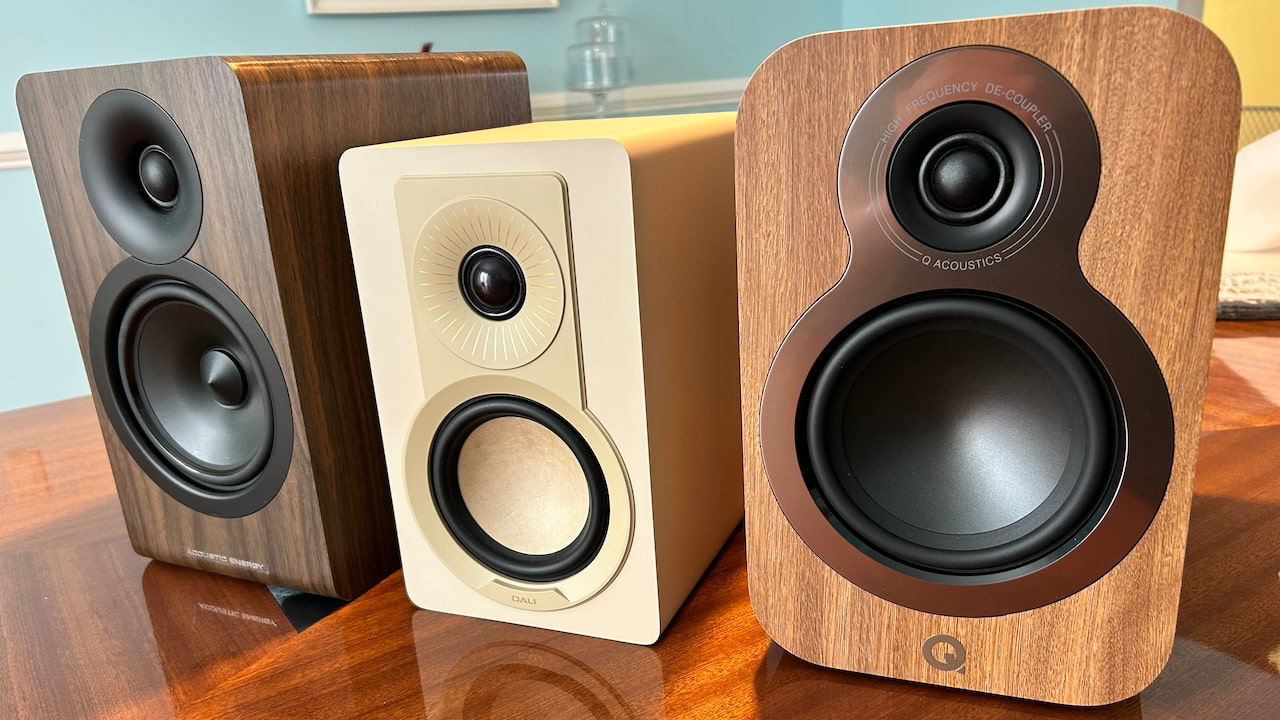
This Best Compact Speakers Shoot-Out exists thanks to an unplanned reality check. I had abdominal surgery 26 days ago, and the rule is simple: nothing over 15 pounds for eight weeks. That knocks big speakers and heavyweight components straight off the list. If it looks like it needs a dolly, a spotter, or a motivational speech, it’s out.
What it leaves is the category most people actually live with: compact, affordable speakers that fit on a desk, behave in a small room, and don’t require a chiropractor or a second mortgage. Call it enforced realism. Or, to put it in Landman terms, this isn’t about drilling the deepest well—it’s about seeing which rigs actually hold up when you’re stuck working with what you’ve got.
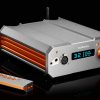
Desk space is limited. Mine is 62 inches wide with a 27-inch iMac on a stand. Under it sits a working pile of DACs and headphone amps from Schiit Audio, Topping, and FiiO. The Apos x Community Gremlin, an Editors’ Choice winner in 2025, is the smallest piece of gear here and still pulls its weight. That layout leaves room for compact speakers on stands on either side of the iMac. That is the physical limit.
I could have used active speakers. I own several pairs. But I also use network amplifiers, affordable integrated amplifiers, turntables, CD players, and network players, all placed onto an adjacent IKEA EXPEDIT. That setup lets me stream, spin CDs, and play records without committing to one box or one app. Passive speakers make that flexibility possible. A subwoofer will come later because electronic music demands it, and I’m far enough away that only I and the dog are affected, and he barely flinches while chewing on my new pair of Vans as I crank it.
That brings us to the DALI KUPID, Acoustic Energy AE100 MK2, and Q Acoustics 3020c. All three are compact. All three are affordable. All three are designed to sit in your line of sight all day, which means industrial design matters whether marketing departments like it or not. You stare at these things for eight to ten hours while you work. If they look cheap, you will resent them. If they sound bad, you will turn them off.
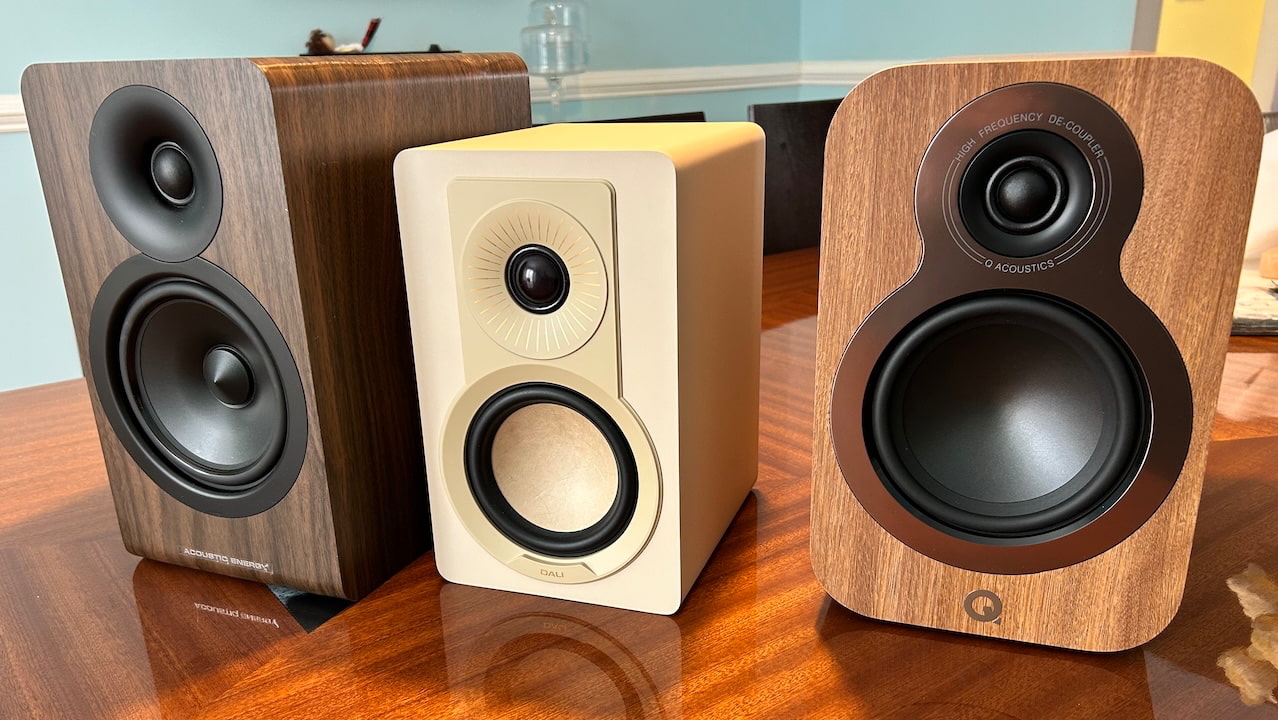
About Those Complaints, and What’s Coming Next
Shoot-outs always get someone’s nose out of shape because the speaker they wanted isn’t included right now. That’s not a flaw. That’s entitlement. Walk into a door. It’ll fix it right up. The schedule doesn’t bend because someone refreshed a product page this morning and decided it mattered.
There will be three shoot-outs total. Nine speakers. All ranked. No participation trophies, but no false shame either. Unlike Canada’s World Junior hockey team, finishing third here doesn’t mean you failed. It means you beat six other competitors.
So unless something changes, the next round is set: Vera-Fi Vanguard Scout, Wharfedale Diamond 12.1i, and ELAC Debut 3.0 DB53. Same rules. Same desk. Same system flexibility. They’ll be judged on sound, design, and whether they make sense for people who actually live with their speakers all day. By the end of Q1, every one of the nine will be placed where it belongs.
Fair Rules. Real Gear. No Cable Cults.
The rules are simple and grounded in reality. I’m using gear that makes sense, is actually available in 2026, and doesn’t require a second job. No magic boxes. No mystery tweaks. And absolutely no five-figure cables. If a speaker needs $150,000 worth of wire to sound convincing, that’s not high-end audio. That’s cosplay for people who confuse spending with thinking.
As for favoritism, there is exactly three. My dog. Neil’s Kitchen in Long Branch, who are keeping me alive with “healthier” versions of their sandwiches while I recover. And the Detroit Red Wings, who are somehow in a playoff spot at 54 games, which means I’m already bracing for the inevitable eight-game losing streak in an Eastern Conference where everyone is separated by less than ten points and nobody feels safe.
And since it needs saying out loud: this industry keeps stepping on its own throat. Last week, a Facebook exchange with the owner of a major hi-fi forum went sideways after I questioned a podcast trying to justify spending $150,000 on cables. Not whether someone can buy them, but how that conversation helps the industry or doesn’t actively repel new listeners. The response from the forum owner and a dealer involved was predictable. If you can’t afford them, you’re dumb, jealous, or uninformed.
That attitude is exactly why younger people walk away. Not because they don’t love music. Because they don’t want to be talked down to by people selling jewelry disguised as engineering.
Digital playback is handled through a combination of the WiiM Ultra, WiiM Pro Plus, and the Cambridge Audio MXN10 network player, all connected over a Netgear Wi-Fi 7 mesh system. Streaming music is sourced from TIDAL and Qobuz. CD playback is handled on a rotating basis using available players in the system.
Amplification is rotated between several current and affordable options, including the Marantz M1 network amplifier, NAD C 316BEE V2 integrated amplifier, WiiM Vibelink Integrated Amplifier, and Audiolab 6000A integrated amplifier.
Analog playback is provided by the Andover Audio SpinPlay turntable. Vinyl selections vary and are not limited to specific genres or pressings.
The system is centered around an Apple iMac, with an Apple MacBook Pro used when working on the bed. Speakers are placed on IsoAcoustics Aperta stands. Cabling throughout the system consists of entry-level products from QED, AudioQuest, and Analysis Plus.
Q Acoustics 3020c ($549)
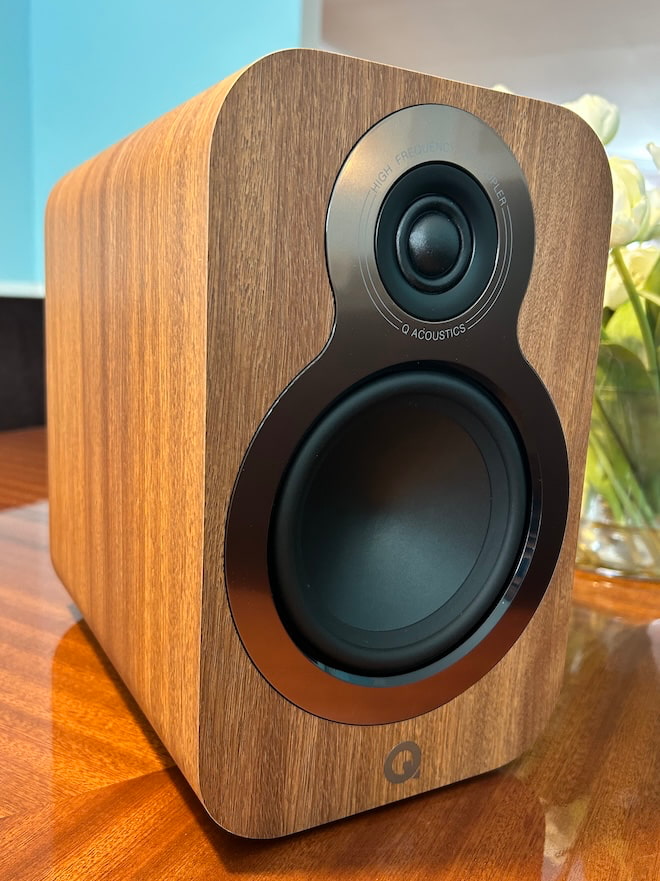
The Q Acoustics 3020c builds on proven design work from Q Acoustics’ higher lines without pushing the price into a different category. It uses the C3 Continuous Curved Cone derived from the 5000 and Concept Series, along with P2P internal bracing to reduce cabinet resonance. Driver isolation has also been improved. The net effect is cleaner midrange performance and better overall control compared to earlier 3000-series models.
The 3020c uses a 120mm mid-bass driver and a 22mm tweeter, with a rated frequency response of 60 Hz to 30 kHz. Sensitivity is 87 dB with a nominal 6-ohm impedance that drops to 3.3 ohms. It is best matched with amplifiers in the 30–100 watt range and worked consistently well with affordable integrated amplifiers and compact network amplifiers during testing. Bass response is more controlled than previous generations, making the speaker less sensitive to wall placement.
Pricing has increased to $549 due to tariffs, but the improvements in clarity, imaging, and tonal balance keep the 3020c competitive within its class of compact standmount speakers.
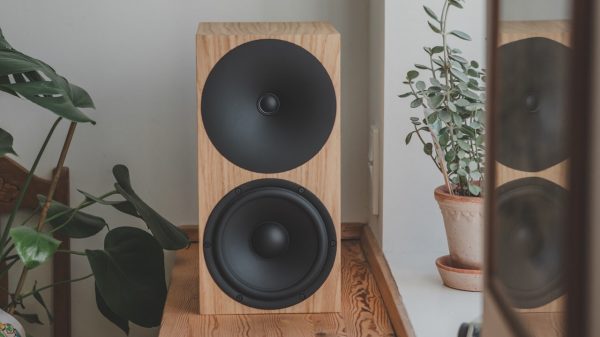
Physically, the cabinet measures 254 × 155 × 251 mm (10.9 × 6.9 × 11.1 inches) and weighs approximately 12 pounds per speaker. It fits easily on furniture or 24-inch speaker stands. Finish options include Pin Oak, Claro Rosewood, Satin Black, and Satin White.
Readers looking for a deeper analysis can find additional listening impressions in my in-depth review here.
DALI KUPID ($600)
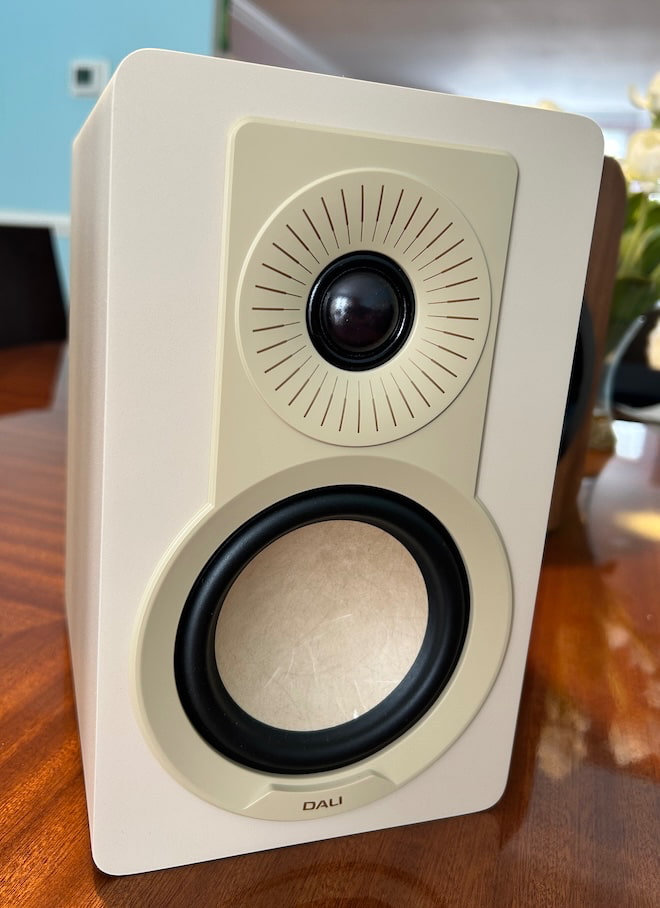
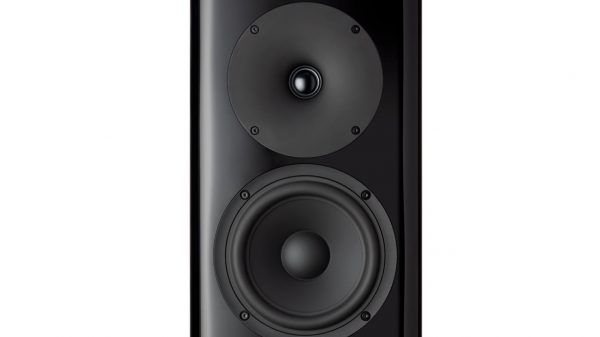
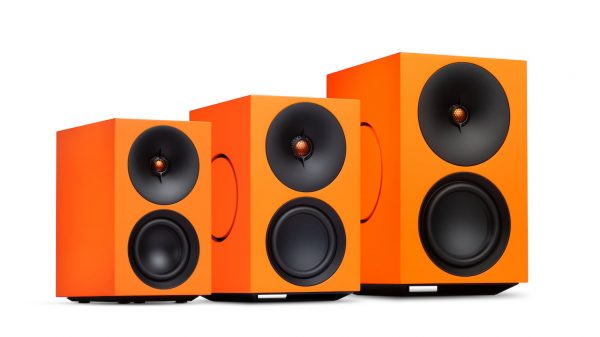
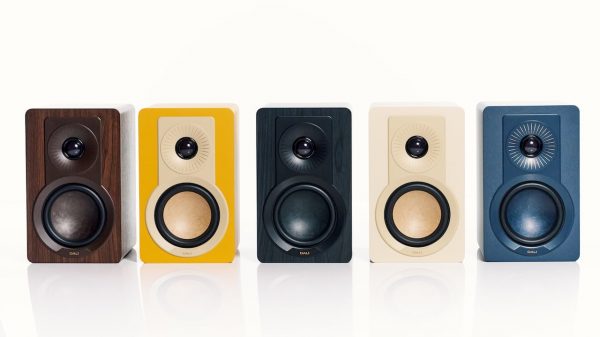
The DALI KUPID applies DALI’s design approach to a smaller, more affordable speaker without cutting corners where it matters. Key components—drivers, cabinets, crossovers, and hardware—are produced in-house, which keeps tolerances consistent and voicing predictable. The compact cabinet is designed to work well close to walls, the magnetic grilles keep the front clean, and the five available finishes acknowledge that small speakers are often placed in visible spaces.
The KUPID uses a 4.5-inch paper and wood-fibre mid-bass driver paired with a 26mm soft-dome tweeter, crossed over at 2,100 Hz. Integration between the drivers is well controlled, with a clear midrange and bass performance that is appropriate for the cabinet size. A dual-flare rear port helps manage airflow and avoids common small-enclosure issues such as chuffing or exaggerated mid-bass. Rated low-frequency extension is 63 Hz.
Sensitivity is rated at 83 dB, so the KUPID benefits from capable amplification, but placement flexibility is a strength. It can be wall-mounted, placed on shelves, or used on stands without demanding ideal positioning. Build quality reflects a practical, cost-conscious approach rather than luxury finishing, while performance remains competitive.
North American buyers have been vocal about pricing. At roughly $600 in the U.S., the KUPID costs noticeably more than it does in the EU, where pricing is more favorable. Tariffs are the difference, and there’s no clever way around that reality.
Readers looking for more detail can find extended listening impressions in our in-depth review here.
Acoustic Energy AE100 MK2
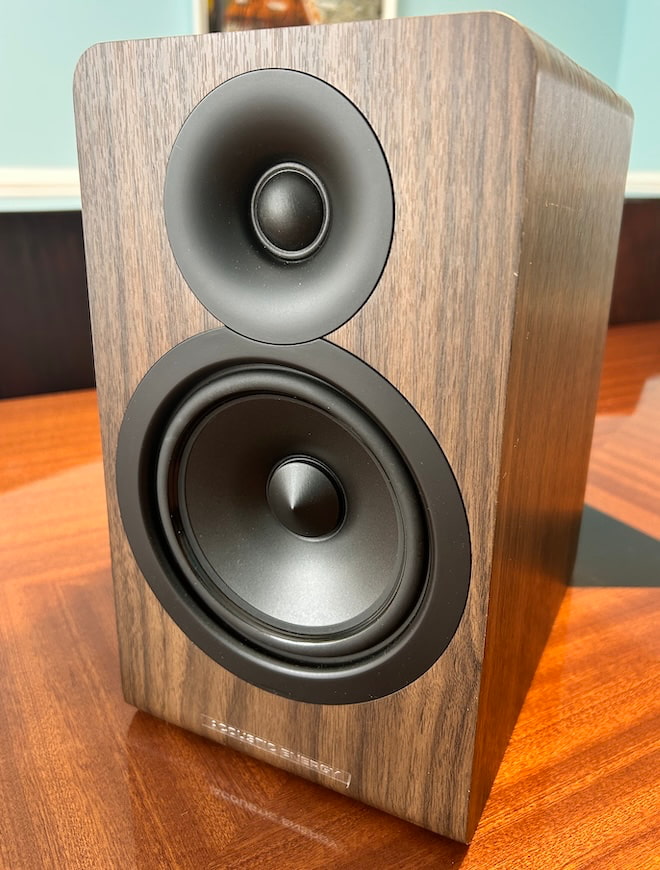
The Acoustic Energy AE100 MK2 is a ground-up redesign rather than a revision of the original 100 Series. While Acoustic Energy aimed to preserve the compact dimensions and clean appearance of its predecessor, the engineering brief focused on increasing bandwidth, power handling, and overall capability within a still-manageable enclosure.
The most significant change is the move from the long-serving 4-inch paper cone driver to a new 5-inch mid-bass unit. The new driver uses a four-layer voice coil with flux rings and a long-throw, high-force motor system, designed to deliver higher output and improved dynamic headroom. To accommodate the larger driver without a major increase in cabinet size, Acoustic Energy transitioned from MDF to 15mm HDF (High Density Fibreboard). HDF allows thinner walls while maintaining stiffness and mass comparable to the previous 18mm MDF construction.
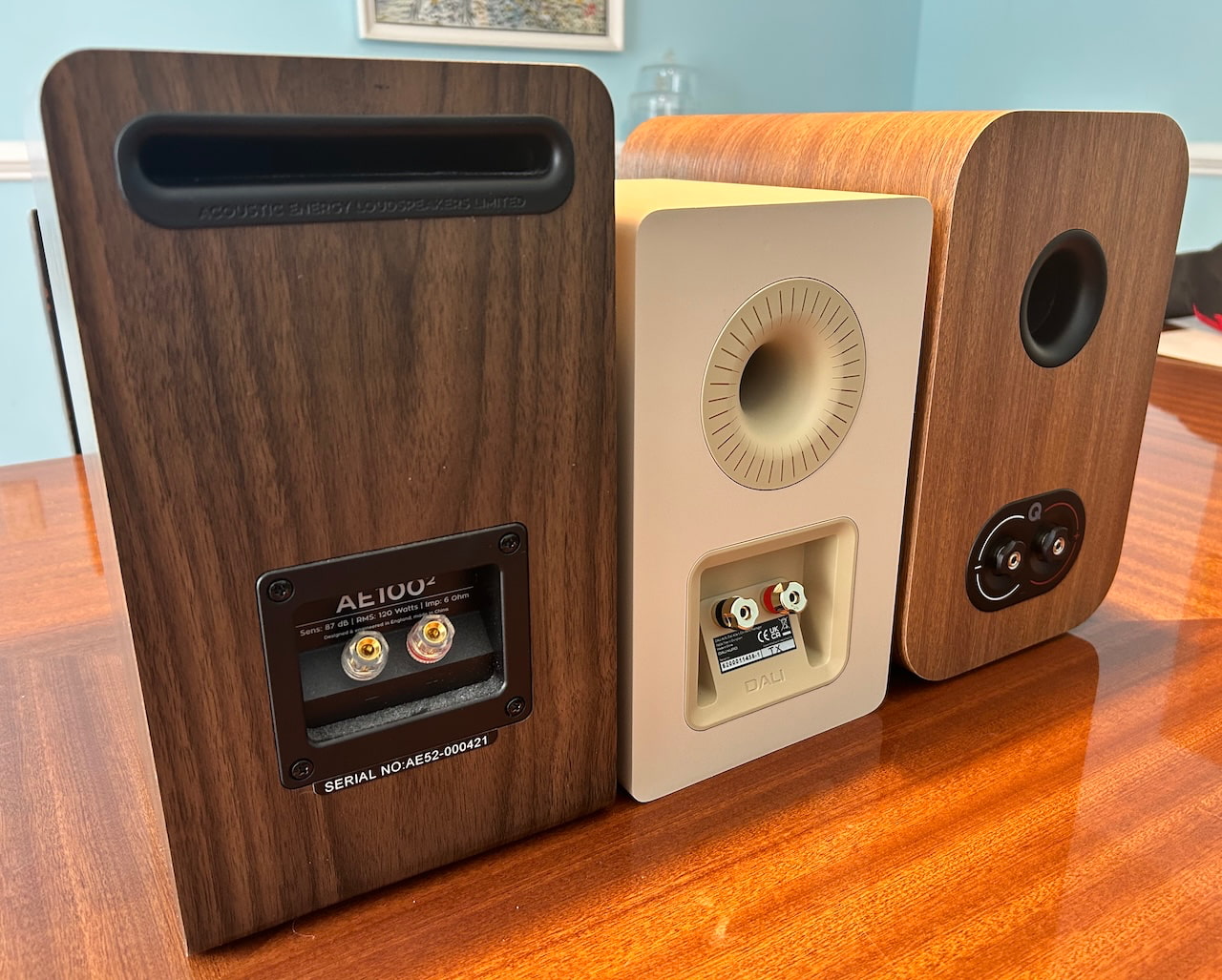
This change results in a cabinet that is approximately 15 percent larger externally, while delivering roughly a 30 percent increase in internal volume compared to the earlier AE100. Bass loading is handled by a slot-shaped rear port positioned at the top of the back panel, providing a large cross-sectional area while minimizing air turbulence at higher output levels.
High frequencies are handled by a 25mm soft-dome tweeter using Acoustic Energy’s Wide Dispersion Technology. The cabinet design draws visual and structural cues from the company’s higher-end 500 Series and is finished in satin white, black, or walnut vinyl veneer.
The AE100 MK2 is specified with a frequency response of 51 Hz to 26 kHz and a sensitivity rating of 87 dB with a nominal 6-ohm impedance, though it presents a more demanding load in practice than the specifications alone might suggest. Physical dimensions are 290 × 165 × 250 mm (W × H × D), and each speaker weighs approximately 10 pounds. Build quality is solid, with an inert feel in hand, a well-executed walnut vinyl finish free of visible seams, and a single pair of binding posts.
Readers looking for additional detail and extended evaluation can find more information in our in-depth review here.
Build Quality
Build quality varies noticeably across the three designs, despite comparable price positioning.
The standout sleeper is the Acoustic Energy AE100 MK2. On paper, it’s priced like an entry-level compact, but in the hand it feels closer to something a tier above. The HDF cabinet construction, mass, and overall inertness give it a seriousness that isn’t obvious from photos alone. It looks and feels more expensive than its price suggests, and that restraint works in its favor.
The Q Acoustics 3020c delivers exactly what longtime Q Acoustics fans expect: solid construction, clean execution, and finishes that elevate the product visually. The Pin Oak and Claro Rosewood options in particular are standouts, working equally well in traditional spaces and more modern rooms. It doesn’t try to surprise you. It just feels properly made, which is part of the appeal.
The DALI KUPID, at $600, is the most divisive from a build perspective. DALI has decades of experience designing and manufacturing speaker cabinets and is one of the largest OEM suppliers in Europe, so this isn’t a question of capability. The KUPID simply aims in a different direction. The finish and detailing don’t feel as sophisticated as the other two, but the color options are more playful and expressive. Less elegant, more fun. Whether that’s a positive or a drawback will depend on taste, not quality control.
Round One Listening: Voices, Grit, and No Place to Hide
Round One Listening leaned heavily on vocals and material that exposes midrange balance quickly: Nick Cave, Amy Winehouse, Natalie Bergman, Sia, Sam Cooke, Jason Isbell, and Jonatan Alvarado.
All three speakers share a few important traits. The midrange is clean and transparent, which is critical at this price. Vocals are not overly thick, and tonal balance is generally even across the board. None of these speakers sound obviously colored in the vocal range, and that alone puts them ahead of a lot of similarly priced competition.
The Q Acoustics 3020c is the most neutral of the three. Some listeners may even find it slightly analytical, which is not something you could say about older Q Acoustics designs. It is also the most sensitive to amplifier matching. Lean amplification pushes it toward sterile and unengaging, while overly warm amplification can dull its strengths. With the right balance, it delivers clarity and air without sounding forced.
The DALI KUPID handles vocals particularly well. The balance through the midrange, upper midrange, and lower treble is well judged. It never sounds etched or aggressive, even on recordings that can easily tip that way. Vocal textures remain clear without being spotlighted.
The Acoustic Energy AE100 MK2 is also well balanced, but it carries more weight in the upper bass and lower midrange. That gives voices and instruments a bit more physical presence. The top end is more assertive than the DALI, but not out of control, and it stays engaging across a wide range of material.
Amplifier pairing mattered. The NAD C 316BEE V2 and Marantz M1 worked consistently well with all three speakers, offering the right mix of control and tonal balance. The Audiolab 6000A and WiiM Vibelink leaned too neutral here, stripping some life out of the presentation rather than adding clarity.
None of these speakers fall apart with vocal-heavy material. The differences come down to voicing, balance, and how forgiving they are of system choices.
Nick Cave’s “Avalanche” proved to be a useful stress test for all three speakers. It’s gritty, slightly forward, and built around piano and strings that carry real weight.
The DALI KUPID handled the track well overall. Cave’s vocal sat naturally in the mix and the presentation stayed composed, but the limited low-end extension took some weight out of the piano. Still engaging, just missing some impact at the bottom.
The Q Acoustics 3020c was the cleanest and most open of the three. It offered a more transparent window into Cave’s vocal, with piano and strings sounding particularly resolved when paired with the NAD and Marantz. The top end was the most detailed and airy here, without drawing attention to itself. The bottom end is tighter than it is deep or impactful.
The Acoustic Energy AE100 MK2 gave Cave’s voice more physical weight and presence, but at the expense of some transparency. The top end was more assertive than the DALI and less controlled overall.
On this track, the balance of clarity, openness, and detail gave the edge to the 3020c.
Amy Winehouse’s “Valerie” and Natalie Bergman’s Gunslinger” live in different neighborhoods and come home at different hours. Winehouse’s BBC-session take is hard-edged and forward, the top end ruthless and honest, her voice right in your space whether you invited it or not. There’s warmth there, but it’s dangerous warmth. You feel the pull. You also know how it ends. We lost a gem, and the recording never lets you forget it.
Bergman’s “Gunslinger” is cleaner on the surface but offers a different kind of grit. A pop song about falling for the wrong guy, tilted high in the mix, emotionally exposed. I first heard it driving back from Toronto to Jersey in the late-summer of 2025. It stuck. More lived-in than anything Taylor ever wrote. Been there. Felt that. Hand tapping the wheel at a red light. Someone in a Volvo full of chaos glances over. You grin. She thinks about it. You don’t.
All three speakers handled both tracks competently, but each took a different approach. The DALI KUPID was the most fun here. Its pop-leaning balance handled dynamic swings easily, and the top end stayed under control throughout. It didn’t exaggerate the slightly hazy chorus on “Gunslinger” and never turned Winehouse’s edge into glare. Clean, composed, and forgiving in the right ways.
The Q Acoustics 3020c made Winehouse sound bigger and more forceful than the other two. It’s a speaker that scales with power and rewards being driven properly. Give it enough current and it delivers impact and openness without losing focus. Starve it, and it goes flat. This one needs meat on the bones.
The Acoustic Energy AE100 MK2 landed between the two. It brought good punch and vocal presence, shaped by a slightly more forward upper bass and lower midrange. Less transparent than the Q, more assertive than the DALI.
All three share one reality check: they want real amplification. Modest sensitivity, impedance dips, and small drivers mean sterile or underpowered amps won’t get it done. Control and authority matter here. Get that right, and their differences come into sharp focus.
Jonatan Alvarado is still unfamiliar territory for most listeners, which is a shame. I first heard him while reviewing the Bowers & Wilkins 703 S3 back in 2023, and the impression stuck. Voces de Bronce (2023, TIDAL, 16-bit/44.1kHz) is an ethereal, hauntingly beautiful recording that fills the listening space edge to edge when a system gets it right.
Mic placement, and possibly the Atmos encoding, pushes Alvarado slightly back into the soundstage, but that distance never robs the performance of richness or power. If anything, it adds scale and atmosphere. This track rewards systems that can resolve space without thinning the voice, and all three speakers handled it well.
The Q Acoustics 3020c delivered the most top-end extension, giving the recording more air and openness without spotlighting sibilance. The Acoustic Energy AE100 MK2 gave Alvarado’s voice more physical weight and body, though with slightly less clarity through the upper registers. The DALI KUPID sounded clean and detailed, but didn’t project the same sense of scale as the other two.
This is a track that thrives with EL84 or EL34 tube amplification, and it can be goosebump-inducing through speakers like the Q Acoustics 5040. Tube amps aren’t on hand here, and they would fall outside the $1,000 ceiling set for amplification or amp-plus-streamer combinations. Within those limits, all three speakers did justice to the recording, each emphasizing a different strength without breaking the spell.
Round Two Listening: Electronic Space, Rhythm, and Control
Round Two Listening shifts the focus to electronic music from Kraftwerk, The Orb, Deadmau5, Boards of Canada, and Aphex Twin. This is material I usually reserve for headphones. Nearfield desktop listening can sound impressive at first, but it’s easy for it to collapse into a wall of effects if the speaker can’t manage space, timing, and control. When it works, though, it’s transportive. Lean back in the chair. Wide soundstage. Somewhere warm. Cape Town. Beach air. Biltong in hand. Old wounds closing. A moment that doesn’t ask questions.
All three speakers handled this material well, but they approached it differently. The DALI KUPID stood out for rhythm and pace. It kept electronic patterns tight, separated layers cleanly, and stayed dynamically agile even as tracks became more complex. It felt the most “locked in” to the pulse of this music.
The Acoustic Energy AE100 MK2 brought more force to the presentation. Bass reached deeper and hit harder, giving tracks more physical weight. It favored impact over finesse, but never lost control.
The Q Acoustics 3020c sounded leaner by comparison, but exceptionally clean. Its soundstage was the widest of the three, with strong spatial cues and a sense of openness that worked particularly well on ambient and layered recordings.
All three were engaging enough that volume occasionally needed to come down. Pulsing synth lines and low-frequency swells had Tyrion the Wonder Westie paying close attention, which is usually a good sign that the speakers are doing something right.
Final Round Listening: Jazz, Tone, and Time
Final Round Listening turned to jazz from Mal Waldron, Lee Morgan, Miles Davis, John Coltrane, Donald Byrd, and Wes Montgomery. Most of this round was vinyl, with thanks to Craft Recordings and Acoustic Sounds for keeping Mark Smotroff and me busy throughout 2025.
Playback came via the Andover Audio SpinPlay, using its internal phono stage, which made sense in the context of this system. Vinyl doesn’t sound “better.” It sounds different. More grit. More smoke. Less surgical detail. More grounded. Like a good noir where nobody’s clean and everyone pays for it.
The differences here were subtler than in the earlier rounds. All three speakers gave horns proper bite. The Q Acoustics 3020c pushed that bite the furthest. Horns cut harder, then disappeared into space with more audible decay. It also handled spatial cues best, delivering greater depth and separation on well-recorded sessions.
The Acoustic Energy AE100 MK2 favored a fuller, weightier presentation. Bass impact was stronger than either the Q or the DALI, and percussion had more snap and physical presence. It leaned into momentum and drive rather than finesse.
The DALI KUPID was solid but less resolved in this context. There was less texture to chew on, particularly with percussion, which sounded more controlled but also more artificial compared to the other two.
Jazz exposed fewer flaws and more preferences. The 3020c handled space and decay best, the AE100 MK2 delivered the most impact, and the KUPID played it cleaner but simpler. Different reads on the same smoky room.
The Bottom Line
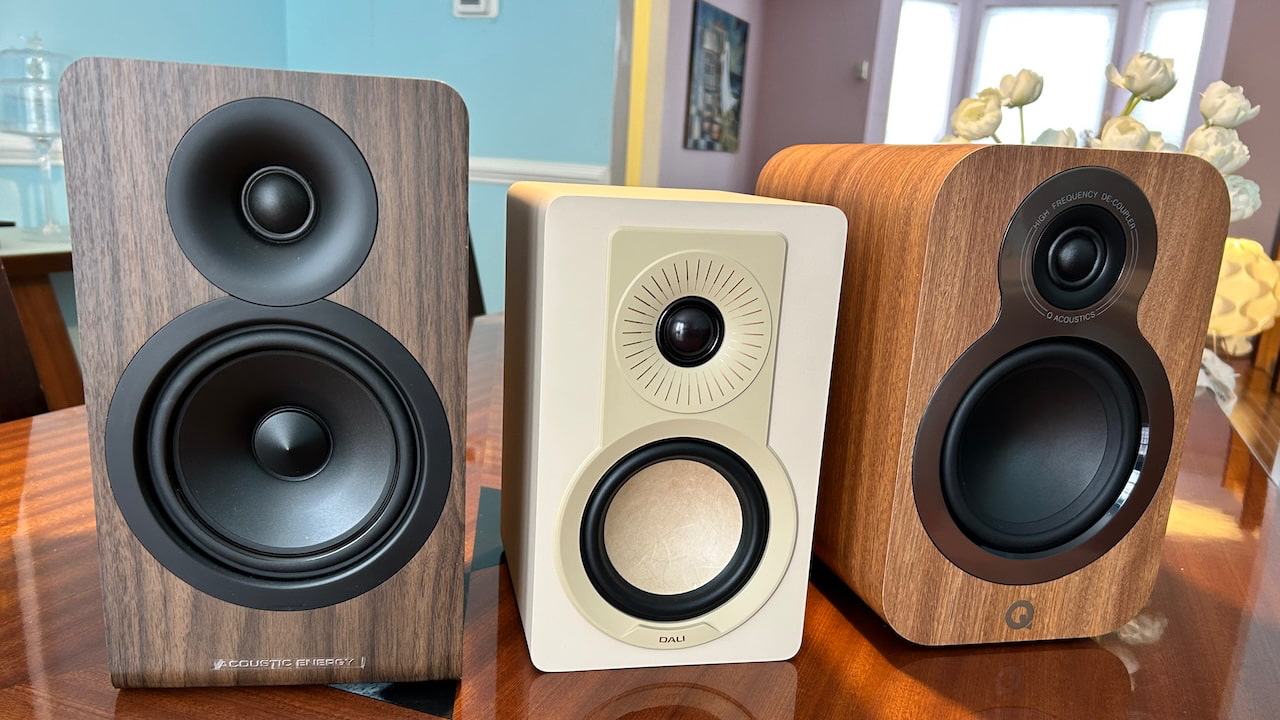
All three speakers deliver strong value and are easy to build a system around. None of them demand exotic amplification or careful hand-holding, and all three make sense in real rooms with real electronics.
The DALI KUPID is the most fun of the group, particularly with electronic music. Rhythm, pacing, and separation are its strengths, and it keeps complex tracks engaging without sounding aggressive. The trade-off is resolution. Compared to the other two, it doesn’t dig as deeply into recordings, especially with acoustic material and jazz. It prioritizes enjoyment over analysis.
The Acoustic Energy AE100 MK2 offers the most physical presentation. Bass impact is stronger, percussion hits harder, and vocals carry more weight. It’s less transparent than the Q Acoustics, but it brings scale and authority that work well across rock, jazz, and electronic music. It also looks and feels more expensive than its price suggests.
The Q Acoustics 3020c is the most neutral and resolving of the three. It handles space, decay, and top-end extension better than the others, but it’s also the most sensitive to system matching. Get the balance right and it’s exceptionally clear. Get it wrong and it can sound lean or uninvolving.
In the end, there’s no loser here. Each speaker has a clear personality, each does something better than the others, and all three represent solid value for the money. Pick based on how you listen, not on brand loyalty, and building a satisfying system around any of them is straightforward.
Where to buy:
- Acoustic Energy AE100 MK2 – $499/pair
- DALI KUPID – $600/pair at Amazon | Crutchfieild
- Q Acoustics 3020c – $549/pair at Amazon
Related Reading:
- Best Bookshelf Speakers: Editors’ Choice
- Vera-Fi Vanguard Scout Bookshelf Speakers And Caldera 10 Subwoofer Review: Budget Bliss
- Acoustic Energy Marks 40 Years With AE1 Anniversary Edition Loudspeaker: A Classic That Still Refuses To Age Quietly
- DALI KUPID Review: A Compact Danish Speaker That Sounds Bigger And Less Polite Than It Looks?














Antonio
January 28, 2026 at 4:40 pm
Appreciate the effort that went into this and looking forward to the next two installments.
Thank you for focusing on speakers that most of us can afford.
The DALI look unfinished. Maybe it’s just me, but they don’t look as nice and at $600 — don’t feel like a bargain compared to the other two speakers.
Which subwoofer are you thinking of using?
Ian White
January 28, 2026 at 4:46 pm
Anton,
Doing these kinds of shoot-outs takes a lot of time, so expect the next one in 3-4 weeks. March will happen after CanJam NYC 2026.
I like all 3 speakers from the first round, but they are very different sounding and YMMV depending on what amplifier/sources you have. I am more of a bookshelf speaker listener (aside from the Q Acoustics 5040 and Magnepan LRS) so this type of reviewing is easier for me to put together.
The DALI are more modern looking and I rather like the cream finish over the other models. It has a Danish modernist feel that will work for people who might not have a lot of space and it’s neutral.
The Q Acoustics 3020c looks great and is quite the beast. It was the hardest to use on the desktop.
Subwoofer will be REL or Vera-Fi.
IW
Michael Little
January 28, 2026 at 5:05 pm
Hi Ian,
I am really looking forward to this series as you recover, hopefully it’s uneventful.
My favourite desk top system has to be the Sonus faber Lumina I that I used for quite a while driven by an M10v2 with a Rel TZero sub.
That system left to fund upgrades to my main system so this is a very timely exercise.
Ian White
January 28, 2026 at 6:36 pm
Michael,
It’s going ok. Slow but not a race. The blizzard did not help.
I reviewed those when they came out and loved them. One of the best values in their lineup.
The reality is that I spend so much time now in front of a computer (and not in my main listening room), that I needed to make some changes. Will be an exciting series to complete.
IW
Larry
January 29, 2026 at 8:35 am
Hi Ian,
Glad you’re still mending. By the time you get back to this in March, if the dollar continues to weaken, there could be another round of price increases.
Oh joy! 🙂
Larry
Ian White
January 29, 2026 at 5:22 pm
Larry,
Very likely going to happen. For all of these brands.
IW
Andries Combrink
February 10, 2026 at 1:48 am
You had me with Cape-town and Biltong!
Ian White
February 10, 2026 at 2:01 am
Andries,
She had me with Biltong and Cape Town. But I messed that up. Story for another time. One of the most beautiful cities in the world and she was too.
Still looking for the perfect Gatsby.
IW