

This story was sponsored by Edifier.
Edifier came to CES with a message that’s refreshingly practical and very on-brand: “Cross-Scenario Audio Solutions for Modern Home Entertainment.” Translation—stop thinking in silos. Desktops, living rooms, hybrid workspaces, secondary systems, and everything in between are no longer separate audio problems. Edifier’s latest lineup is built to move fluidly across all of them, with products designed to connect, adapt, and scale without forcing users to rethink their entire setup every time they change rooms—or screens.
That positioning matters in a brutally crowded wireless speaker market where dozens of companies are battling for the same shelf space and streaming subscriptions. Louder specs and trendy finishes aren’t enough anymore. What Edifier is showing at CES leans hard into real-world use: flexible connectivity, modern streaming support, compact form factors that don’t scream “tech appliance,” and systems that make sense whether they’re parked next to a monitor, under a TV, or pulling double duty in a shared space.
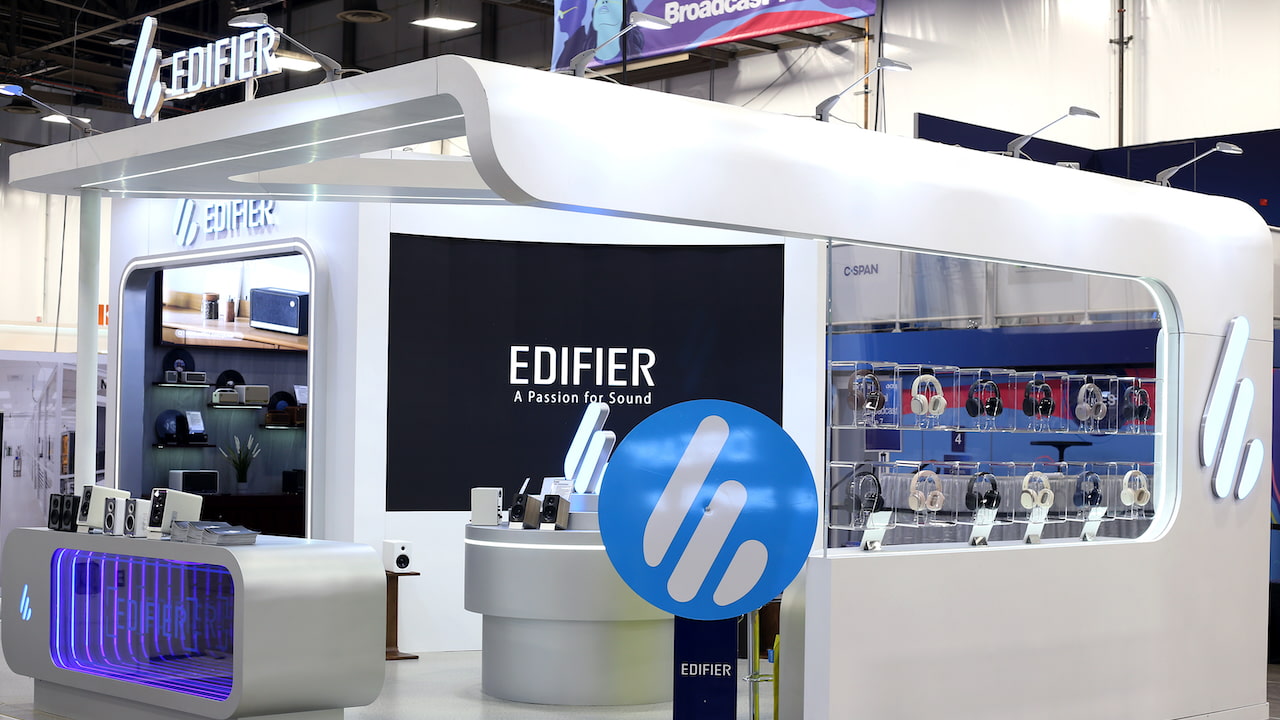
Edifier didn’t get here by accident. Over the past few years, the brand has quietly—and sometimes very loudly—built momentum by pairing solid industrial design with features people actually use, and sound quality that usually costs more than the asking price. While plenty of competitors chase lifestyle cred or audiophile buzzwords, Edifier’s CES lineup sticks to a clearer idea: audio that works everywhere you live, work, and listen.

With that broader strategy in place, Edifier has been methodically expanding its wireless speaker lineup without asking buyers to take out a second mortgage on their listening rooms. Sensible pricing, features that translate to real use cases, and performance that actually holds up have given the brand legitimate traction in a market that punishes half-baked ideas. In 2025, that approach showed up clearly in coverage of the MR5 and S880DB MKII—both sub-$400 designs aimed at listeners who want flexibility without cutting corners. The newly introduced M90 doesn’t replace either model; it widens the net, giving buyers another option that fits neatly into Edifier’s growing ecosystem rather than forcing a reset.
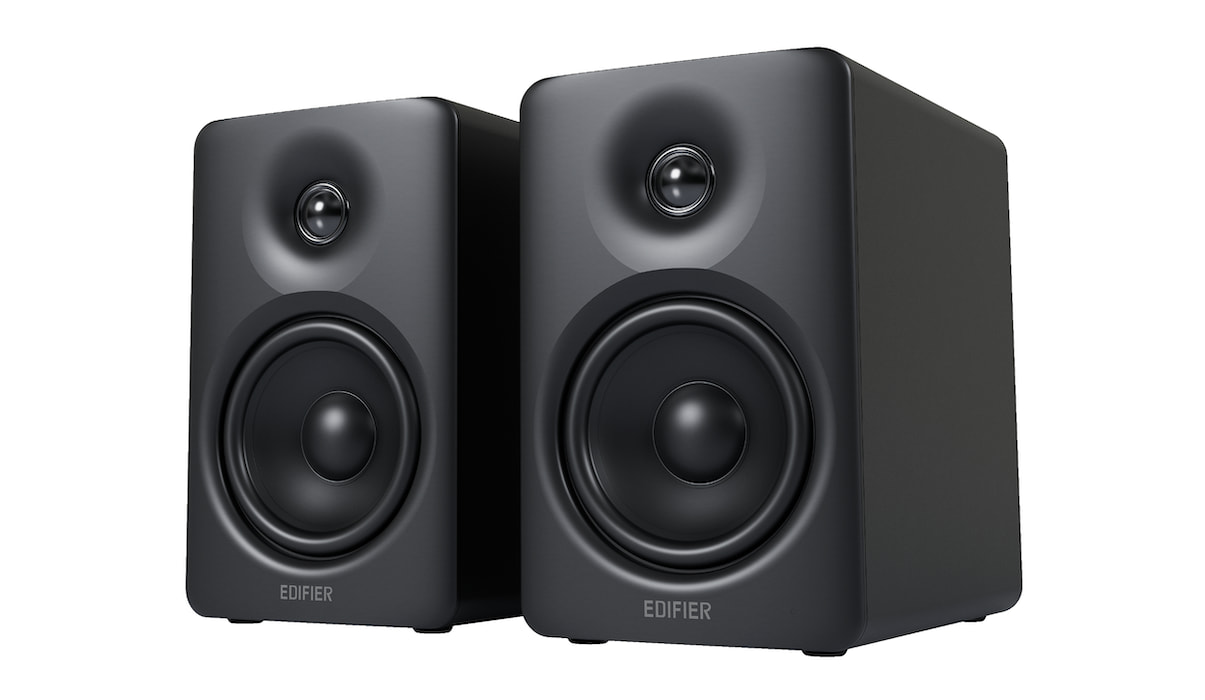
Edifier M90 Wireless Speaker
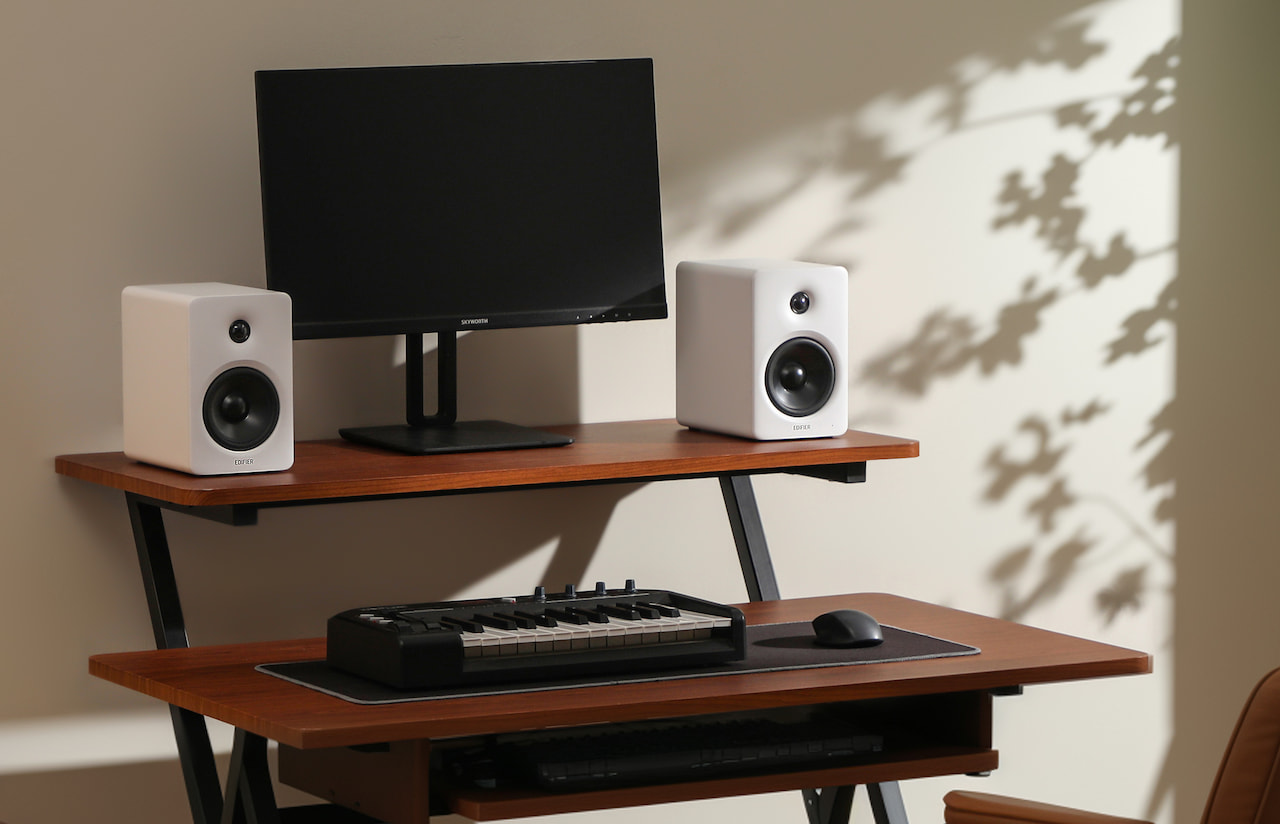
Building on the momentum of the M60 ($199 at Amazon) released in 2024, Edifier’s new M90 active speaker is designed to feel equally comfortable on a desk or in a home entertainment setup. The goal with the M90 is straightforward: bridge the gap between desktop audio, TVs, streaming platforms, and gaming consoles without forcing users to juggle multiple systems or compromises.
Ease of use is clearly part of the brief. The M90 offers onboard controls for quick adjustments, an omnidirectional remote for couch-friendly operation, and support for the Edifier ConneX mobile app on iOS and Android—covering everything from basic control to setup without turning the experience into a troubleshooting exercise.
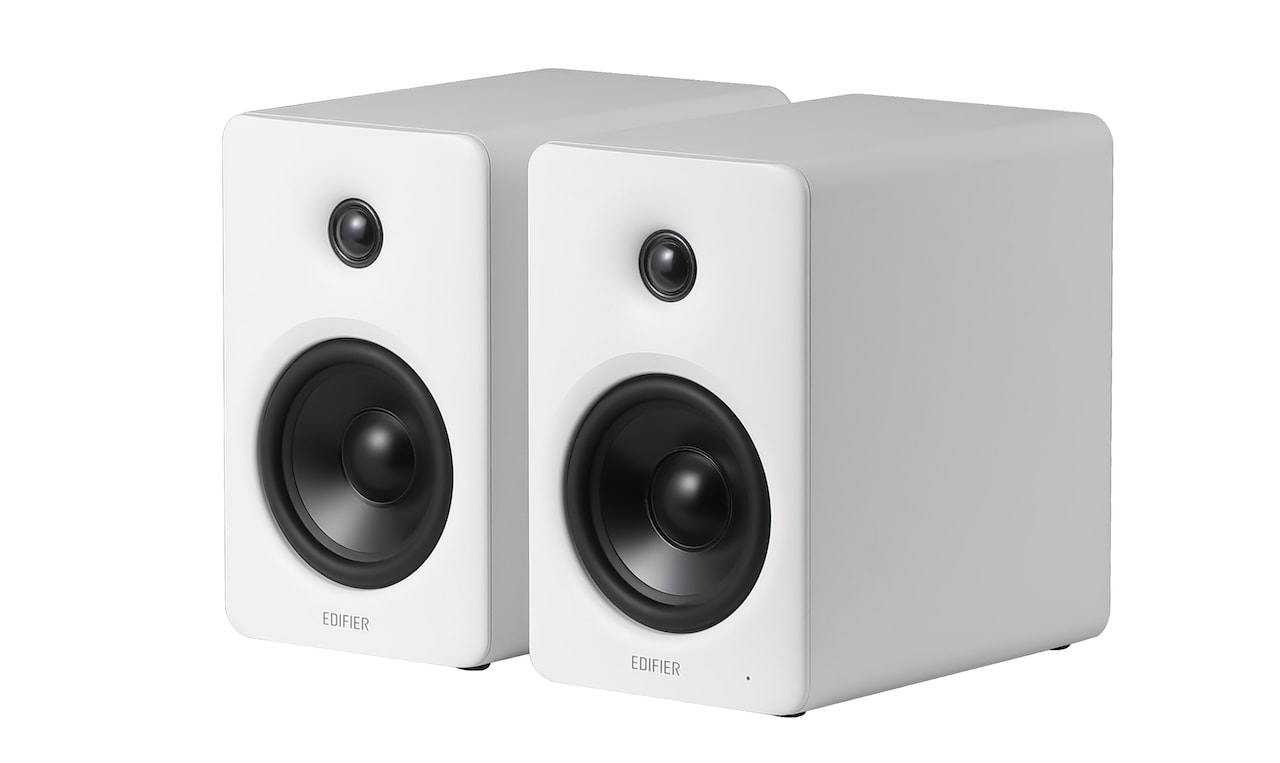
The Edifier M90 uses a two-way driver configuration built around a 4-inch long-throw mid-bass driver paired with a 1-inch silk-dome tweeter. Power is rated at 100 watts RMS, with maximum output reaching up to 100 dB SPL, putting it comfortably into small-room and near-field territory without pretending to be something it isn’t.
The system is bi-amped, allowing each driver to be controlled independently, and supports 24-bit/96kHz audio resolution depending on the source. In practical terms, that means cleaner signal handling and better control over dynamics—assuming you feed it something better than a heavily compressed stream.
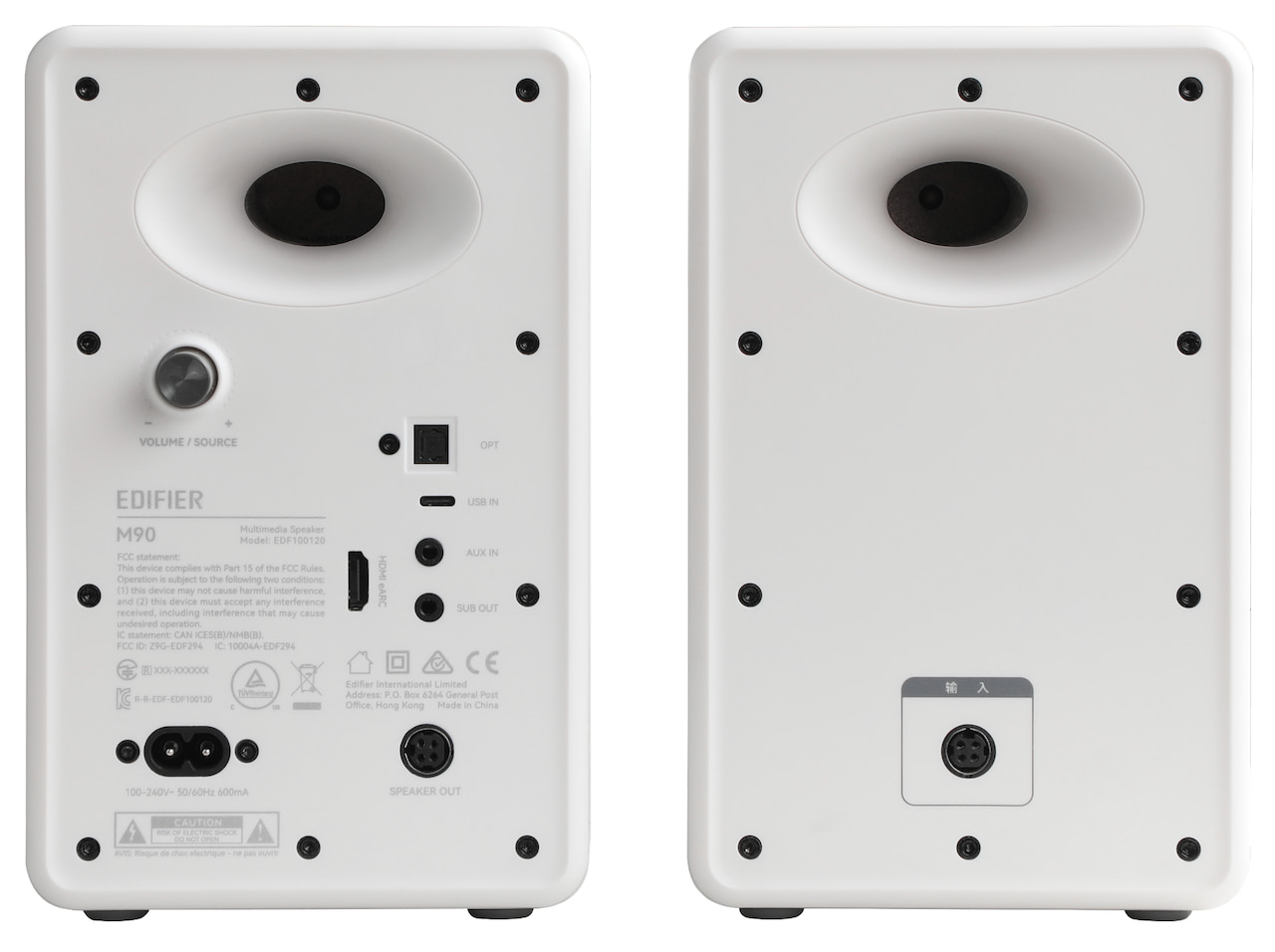
DSP plays a central role in shaping the M90’s sound, optimizing performance across different types of content from music and video to gaming. On the rear, connectivity is refreshingly broad, with Line-in, Optical, USB-C, and HDMI eARC on tap, covering most modern use cases.
Wireless duties are handled by Bluetooth 6.0, with support for LDAC and multipoint, allowing higher-quality wireless playback and seamless switching between devices. In a market where wireless convenience often comes at the expense of fidelity, Edifier is clearly trying to keep both camps reasonably happy.
The M90 may be the headline act, but it isn’t a one-off. At CES 2026, Edifier is showing how the rest of its lineup supports the same “cross-scenario” idea from different angles: the MR3 and MR5 focus on compact, DSP-managed monitoring for desktop and home-studio setups, while the QR65 targets modern gaming and creator desks with a hi-fi-forward design and a more restrained approach to ambient lighting.
Near-Field Monitor Series: Built for Modern Workflows
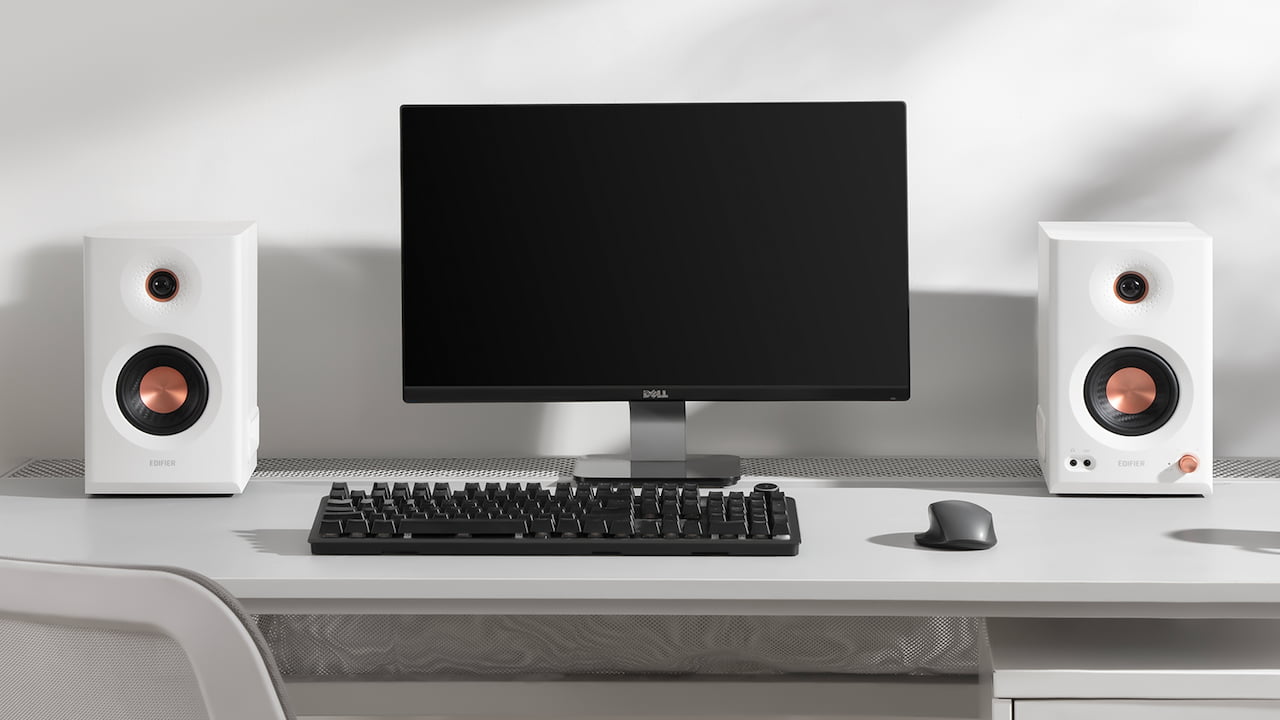
Edifier’s MR Series remains the backbone of its desktop and home-studio strategy. Designed for compact spaces and hybrid workflows, these near-field monitors prioritize accuracy and consistency over flash. The MR3 ($149.99 at Amazon) targets space-constrained desktop setups, while the three-way MR5 adds a built-in woofer and side-mounted acoustic lens to deliver deeper bass from a relatively small enclosure. Across the series, Edifier relies on end-to-end DSP, bi-amp or tri-amp amplification, tonal tuning, and room/placement compensation, paired with wide off-axis response for usable listening beyond the traditional sweet spot. Both the MR3 and MR5 earned Japan’s VGP 2025 Design Award—a nod to execution, not marketing noise.
QR Series: Gaming Aesthetics, Hi-Fi Intent
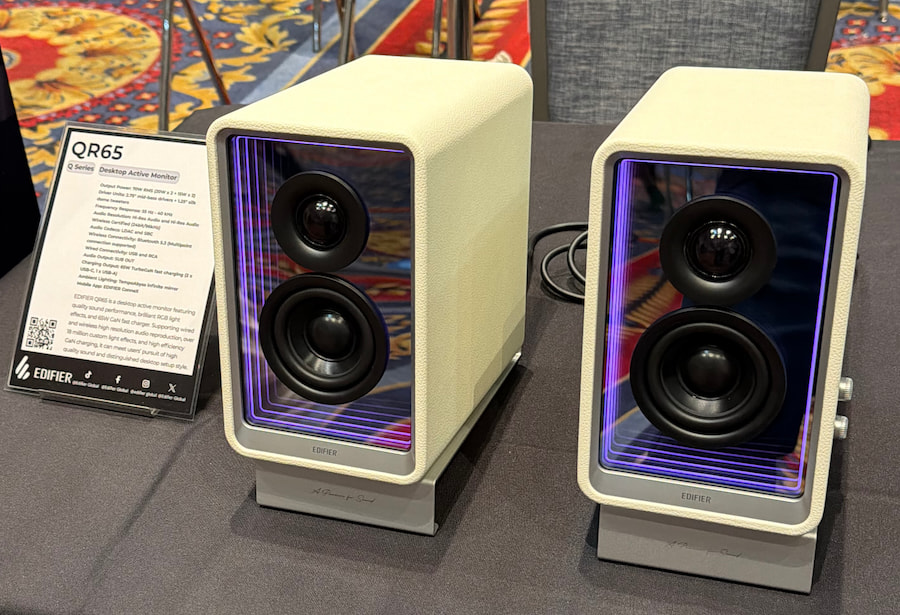
The QR Series reflects how gaming desks have evolved into multi-purpose hubs for streaming, content creation, and remote work. Rather than leaning into aggressive RGB, the QR65 ($499 at Amazon) and QR30 ($169 at Amazon) take a restrained approach. Their Infinity Mirror design produces subtle ambient lighting that adds depth without overwhelming a clean setup. Under the hood, these are firmly hi-fi designs. The QR65 uses a two-way configuration with a long-throw mid-low driver and silk-dome tweeter, delivers 70W RMS via bi-amped DSP, and employs a precision maze-type bass-reflex port for controlled low-end response. A built-in GaN fast charger adds practical value, simplifying power delivery and cable management on crowded desks.
Edifier M90 vs. M60 Comparison
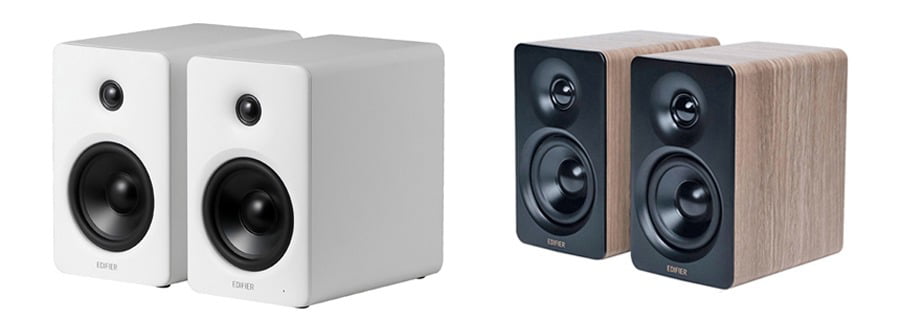
| Edifier Model | M90 (2026) | M60 2.0 (2024) |
| Product Type | Wireless Desktop Speaker | Wireless Desktop Speaker |
| Price | $369.99 | $199.99 |
| Toal Output Power (RMS) | 100 watts | 66 watts |
| Biamplification (RMS) | Tweeters: 15W x 2 Mid-low: 35W x 2 | Tweeters: 15W x 2 Mid-low: 18W x 2 |
| Tweeters | 1” Silk Dome | 1” Silk Dome |
| Woofers | 4” long-throw aluminum diaphragm | 3″ long-throw aluminum diaphragm |
| Frequency Response | 50 Hz – 40 kHz | 58 Hz – 40 kHz |
| Signal-to-Noise Ratio | ≥ 85dB(A) | ≥ 85dB(A) |
| Input Sensitivity | AUX: 450 ± 50mV USB-C: 500 ± 50mFFS Bluetooth: 500 ± 50mFFS HDMI eARC: 500 ± 50mV (PCM Stereo) Optical: 500 ± 50mFFS | AUX: 500 ± 50mV USB-C: 450 ± 50mFFS Bluetooth: 450 ± 50mFFS |
| Audio Inputs | Bluetooth AUX (3.5mm) USB-C HDMI eARC Optical | Bluetooth AUX (3.5mm) USB-C |
| Bluetooth Version | 6.0 | 5.3 |
| Bluetooth Codec Support | SBC, LDAC | SBC, LDAC |
| Mobile App | Edifier ConneX App | Edifier ConneX App |
| High Res Audio Certified | Hi-Res Audio and Hi-Res Audio Wireless Audio | Hi-Res Audio and Hi-Res Audio Wireless Audio |
| Subwoofer Output | Yes | – |
| Bluetooth Multi-Point Connection | Yes | – |
| Controls | Power Knob Volume +/- Source Switch Remote Control | Touch panel Volume +/- Power / Source switch |
| Enclosure Construction Material | MDF | MDF |
| Dimension (WxHxD) | Right Speaker 133 x 212 x 225 mm (5.2 x 8.4 x 8.9 inches) Left Speaker 133 x 212 x 210 mm (5.2 x 8.4 x 8.3 inches) | Each Speaker 100 x 168 x 147 mm (4 x 6.6 x 6.8 inches) |
| Weight | 6.05 kg | 3.07 kg |
The Bottom Line
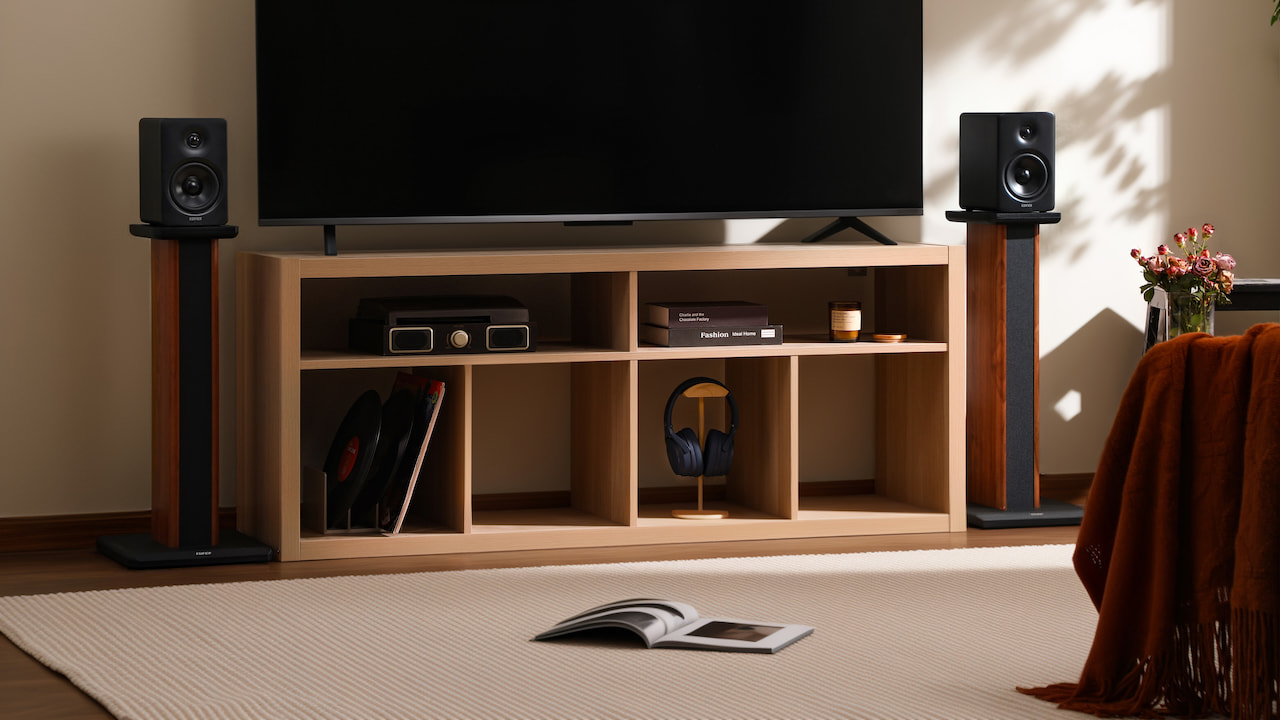
Edifier arrived in Las Vegas with a clear message: this is no longer a brand content to sit on the sidelines of the wireless speaker market. Alongside the debut of the M90 active speakers, Edifier is also showing established models from its MR and QR series, reinforcing just how deep—and deliberate—its current lineup has become across desktop, lifestyle, and home entertainment categories.
The M90 sits at the center of Edifier’s CES strategy, and the positioning is clear: one active speaker designed to work across multiple scenarios without forcing compromises. Described by Edifier as a “cross-scenario, multi-purpose” system, the M90 is intended to cover TV and home-entertainment duties just as comfortably as PC, desktop, and casual Bluetooth listening.
Built on the foundation of the M60, the M90 pushes further into gaming and living-room use. It delivers higher output from a slightly larger enclosure, adds Bluetooth 6.0 with LDAC and multipoint support, and expands physical connectivity with HDMI-eARC and a dedicated subwoofer output. The inclusion of a remote reinforces the shift away from strictly near-field use, signaling a system designed to operate just as easily from across the room as it does next to a keyboard.
In the context of Edifier’s broader CES showing, the M90 feels like a smart and calculated move. It strengthens the company’s push into living-room audio and gaming without abandoning its desktop roots.
Price & Availability
The Edifier M90 will be available for $369 at Amazon.com in early March, 2026.
For more information, visit edifier.com.
Related Reading:
- Edifier MR5 Studio Monitors Review
- Edifier MR4 Studio Monitors Review
- Edifier S880DB MKII Wireless Speakers








Anton
January 8, 2026 at 6:02 pm
Is this the company that bought and saved STAX?
These look like a great deal at the price.
How do they include all of the connectivity options and support the hi-res Bluetooth codecs (licensing fees) at that price?
Anthony Ferretto
January 12, 2026 at 8:40 am
None of the official product pages or CES 2026 announcements list a subwoofer output, and the published rear‑panel photos show no sub‑out jack. What makes you suggest they have sub out?
Brian Mitchell
January 12, 2026 at 9:11 am
The rear photo of the M90 above does show a “SUB OUT” port, and we heard them at CES last week connected to a subwoofer.
Ian White
January 12, 2026 at 12:23 pm
Anthony,
Look above the “speaker out” on the primary speaker. There are the certification logos and above that is the “Sub Out.”
IW