
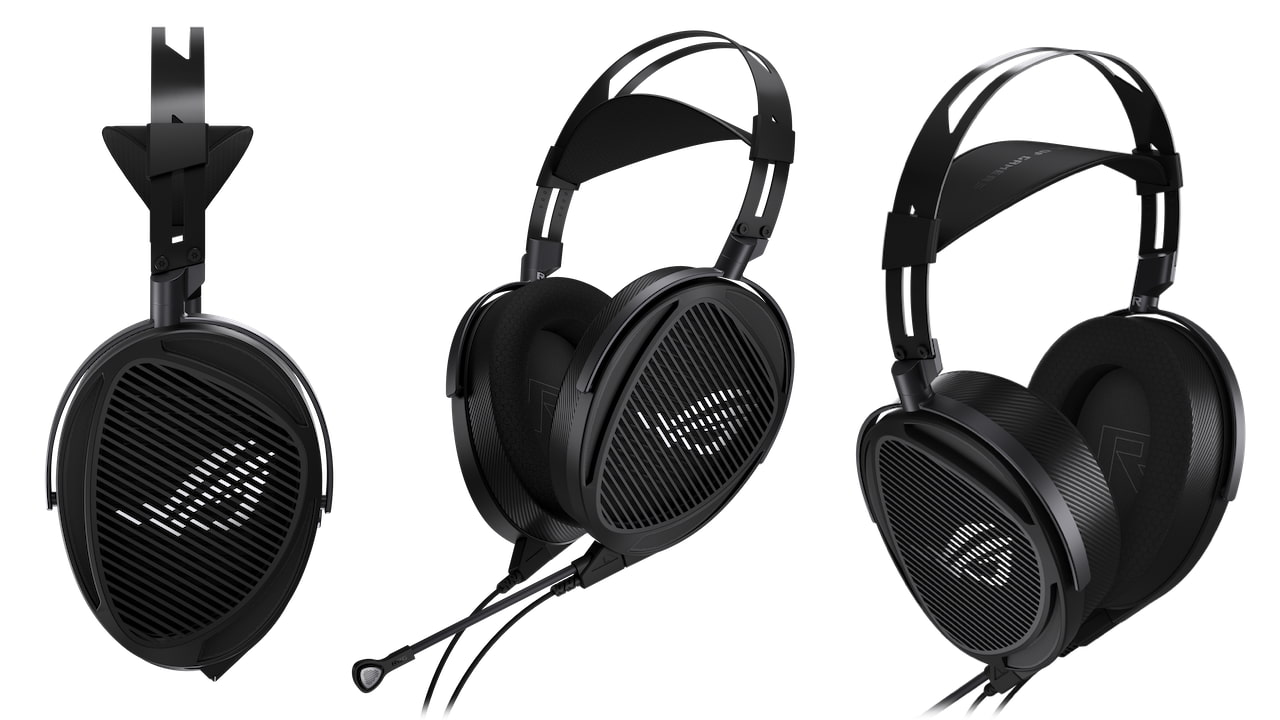
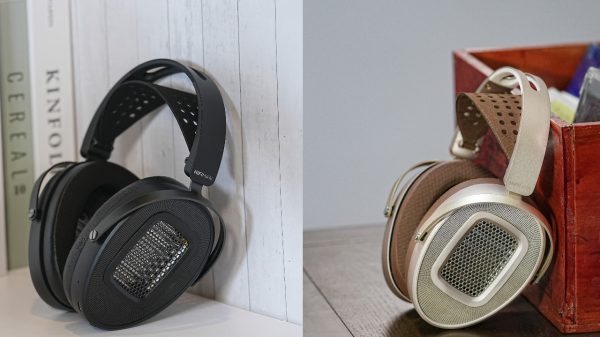
With the ROG Kithara, ASUS makes it clear this is not a side project. Developed in collaboration with HiFiMAN, Kithara is an open back planar magnetic headset built for gamers who care about sound quality as much as competitive performance. Large 100mm planar drivers, an ultra wide frequency response, a full band MEMS boom microphone, and balanced connectivity place it firmly in audiophile territory without losing sight of long session comfort and positional accuracy.
And let’s be honest about the timing. ASUS and HiFiMAN are clearly gearing up for a gunfight with Audeze and the new Maxwell 2, also debuting at CES 2026. Gaming is now a multi billion dollar industry, and premium headsets have become status pieces as much as tools. The Iron Throne is in play, and nobody is backing down.
ASUS ROG Kithara

Audeze didn’t just win the gaming headset conversation over the past few years—they effectively owned it. The success of the Maxwell was so significant that it helped drive Sony to acquire Audeze, cementing Audeze’s position as the reference brand for serious gaming audio. With the Maxwell 2 arriving at CES 2026, Audeze controls the narrative going in. Everyone else is reacting.
That’s what makes the ASUS and HiFiMAN partnership behind the ROG Kithara genuinely interesting. ASUS brings scale, distribution, and deep credibility in competitive gaming, while HiFiMAN brings decades of planar magnetic know-how and audiophile legitimacy. This isn’t a cosmetic collaboration or a tuning exercise—it’s a deliberate attempt to build something that can stand next to Audeze on sound quality, not just features or branding.
It’s also telling that ASUS avoided locking the headset into a single platform or wireless ecosystem, opting instead for a flexible wired approach that works across PCs, consoles, DACs, and amps.
So what actually makes the ASUS ROG Kithara different, and why does it matter
Let’s take a closer look.
At a technical level, the ROG Kithara stands apart because it is built like an audiophile headphone first and a gaming headset second—a deliberate departure from how most “high-end” gaming headsets are engineered.

The foundation is the ROG-tuned 100mm planar magnetic driver developed with HiFiMAN. A driver this large is unusual even in the audiophile space, and it allows Kithara to move air with very low distortion while maintaining speed and control.
The specified 8 Hz to 55 kHz frequency range is less about chasing spec-sheet bravado and more about headroom; the drivers operate well within their comfort zone in the audible band, which contributes to cleaner transients, better microdetail, and more stable imaging. The open-back architecture further reinforces this by creating a wide, natural soundstage with clear spatial separation—an advantage for positional cues in games and a more realistic presentation for music.
Communication is treated with similar seriousness. Instead of a narrowband gaming mic, Kithara uses a full-band MEMS boom microphone with a 20 Hz to 20 kHz response and a high signal-to-noise ratio. Separate signal paths for the microphone and headphone audio reduce crosstalk, which helps keep voices clean and intelligible even in noisy multiplayer environments. The result is voice reproduction that sounds natural rather than compressed or brittle, which matters just as much for team play as it does for streaming or calls.
Where Kithara really differentiates itself is connectivity. Rather than locking users into a proprietary wireless system or single connector, ASUS opted for a fully analog, modular approach. The included balanced cable supports swappable 4.4 mm balanced, 3.5 mm, and 6.3 mm single-ended plugs, making the headset equally at home on desktop DACs and amplifiers, gaming PCs, consoles, and traditional hi-fi gear.

A USB-C to dual 3.5 mm adapter extends compatibility to laptops and mobile devices, while the dual 3.5 mm cable with separate mic and audio plugs accommodates classic PC setups. This level of flexibility is rare in gaming headsets and signals that Kithara is meant to move between audiophile and gaming systems without compromise.
Physically, the design balances durability and long-term comfort. A lightweight metal frame and hinges provide structural integrity without pushing the 420-gram headset into fatigue territory for extended sessions. The adjustable headband and memory-foam padding distribute weight evenly, while the inclusion of both leatherette-with-fabric and velour ear cushions allows users to fine-tune comfort and acoustic character depending on preference.

Taken together, the Kithara’s specs tell a consistent story. This is not a feature-stacked gaming headset chasing mass appeal, but a carefully engineered open-back planar design aimed at listeners who already understand what balanced connections, planar drivers, and proper amplification can deliver. In that sense, Kithara’s uniqueness lies less in any single specification and more in the fact that ASUS and HiFiMAN treated it as a serious audio product that happens to excel at gaming.
What to Know Before Using the ASUS ROG Kithara
Because the Kithara is an open-back headset, it behaves very differently from the closed-back gaming headsets most players are used to. Ambient sound passes freely through the earcups, which means you will hear people talking, room noise, and other environmental sounds. This is normal behavior, not a defect. Open-back designs are best used in quieter spaces where external noise will not interfere with gameplay.
That same open-back structure also explains why the bass may sound lighter at first. Bass energy is not sealed inside the earcups, so you lose some of the physical “thump” common to closed-back designs. What you gain instead is a more balanced frequency response, better separation, and cleaner bass definition. Combined with the planar magnetic drivers, the Kithara delivers bass that is deeper and more detailed than typical dynamic-driver gaming headsets, even if it does not hit with the same sheer impact.

Console compatibility is straightforward but comes with limitations. The Kithara can be connected to PlayStation, Xbox, and Nintendo Switch controllers using either the balanced cable or the microphone cable. However, when using the microphone cable, the mic and audio are split into two separate 3.5mm plugs. Most console controllers only accept a single combined input, so the microphone will not function in that configuration.
It is also not recommended to use third-party dual-3.5mm-to-single-3.5mm adapters with the microphone cable. The dual-plug design is intentional and helps reduce crosstalk so your in-game audio does not bleed into the microphone. Using an adapter defeats that design and can result in degraded voice quality or unwanted audio leakage to other players.

Specifications
| Connectors | 3.5mm/4.4mm/6.3mm, USB-C adapter |
| Driver | 100mm HIFIMAN planar magnetic driver |
| Frequency response | 8Hz – 55KHz |
| THD | <0.03% at 1kHz @ 94dB |
| Headphone Jack | Dual 3.5mm |
| Impedance | 16 Ohms |
| Microphone | EMS Mic on detachable cable (SNR 74dB) |
| Frequency response (mic) | 20Hz – 20KHz |
| Sensitivity | -36 ±3 dB |
| Dimension | 170 x 260 x 110 mm |
| Product weight | 420g |
What’s in the Box
- 1x ROG Kithara open-back planar magnetic gaming headset
- 1x Dual 3.5mm-to-dual 3.5mm boom mic cable (1.8m)
- 1x Dual 3.5mm with 3-in-1(3.5/6.3mm single-ended, 4.4mm balanced) plug cable (1.8m)
- 1x USB-C to Dual 3.5mm adaptor 2x ear cushion sets
- 1x ROG hybrid fabric set
- 1x ROG leatherette set
- 1x Frequency response measurement card
- 1x Warranty booklet
- 1x Quick start guide
The Bottom Line
The upcoming Audeze Maxwell 2 and the ASUS ROG Kithara are aimed at the same high-end gaming audience, but they solve the problem in very different ways—and that difference will matter depending on how and where you play.
Maxwell 2 leans hard into convenience and versatility. Bluetooth 5.3, support for LE Audio and LDAC, and a massive battery rated for more than 80 hours of wireless playback make it a true do-everything headset. It can move seamlessly between console, PC, and mobile use without a cable in sight, and the closed-back design with large dynamic drivers delivers strong bass impact and isolation that works well in noisy environments. For users who want one headset that handles gaming, travel, and everyday listening with minimal friction, Maxwell 2 is clearly designed to be that product.
The ASUS ROG Kithara takes the opposite approach. It is entirely wired, open-back, and unapologetically focused on sound quality and positional accuracy rather than portability or battery life. The planar magnetic drivers, balanced connectivity, and open design prioritize imaging, separation, and realism over isolation and convenience. This makes Kithara better suited to quiet rooms, dedicated gaming desks, and audiophile setups with external DACs and amplifiers—but far less flexible if wireless use or travel is part of the equation.
In practical terms, Maxwell 2 is about control, simplicity, and all-day usability across platforms, while Kithara is about precision, transparency, and soundstage. Neither approach is inherently better, but they cater to very different users. One is built to dominate the mainstream high-end gaming market. The other is designed for players who are willing to give up wireless freedom in exchange for a more traditional, audiophile-style listening experience.
Price & Availability
The ASUS ROG Kithara will be available for $359 USD.
Related Reading:
- SteelSeries Arctis Nova 7 Gen 2 Series: Next-Gen Wireless Gaming Headset Takes Aim At Audeze Maxwell
- AZLA Launches ARES Clear Hybrid Gaming Earphones With Audiophile-Grade Sound And Gaming Tuning
- Sony Launches INZONE H9 II Wireless Gaming Headset And E9 In-Ear Monitors For Gamers
- More New Products from CES 2026




















Crion
January 12, 2026 at 9:26 pm
Kithara sounds great until you understand it has no usb or dongle available.
Maxwell 2 anc will be the interesting one.
But I must say that Bathys has so much better sound IMHO.
But Bathys needs a dongle of they want to compete better with maxwell 2 anc.
Ian White
January 13, 2026 at 12:41 am
Fredrik,
The Kithara is great sonically, but I have a hard time wrapping my head around the open-back design for gaming. When ASUS sent me the original press material, I was confused that it wasn’t a wireless design. But they decided to stick with the wired route.
The Maxwell 2 is going to be very popular, but it’s not a revolutionary change over the original.
I showed both to my son (19, college kid, addicted to his Xbox) and nephew (21, college kid, professional eGamer with six figures in prize money) and they were totally confused by the Kithara.
“Nobody wants an open-back gaming headset. That’s totally dumb.”
Me: “But you play alone in the dark and nobody can hear you.”
Them: “Nobody wants an open-back gaming headset.”
I’m looking forward to trying both.
IW