

Table of contents
Introduction
If you still think streaming amplifiers aren’t the future of high-end audio, it might be time to hop off the gear-fetishism train—preferably before NJ Transit or the TTC leaves you marooned between stations. The writing is on the wall: network amplifiers now sit at the center of the modern hi-fi system, combining streaming, DACs, amplification, and a full operating system in one chassis without forcing you to spend Aavik or Devialet money (and yes, that Devialet review is coming later this month).
What’s driving this shift isn’t just convenience—it’s the rise of Class D designs that are now outperforming a lot of Class A/B and even Class A amplifiers when it comes to power delivery, efficiency, noise performance, thermals, industrial design, and straight-up sound. And the ecosystem matters just as much as the hardware. Support for Spotify Connect (including Spotify Lossless), Qobuz Connect, TIDAL Connect, Roon, Internet Radio, podcast access, and room-correction software has become table stakes. Add in Bluetooth options such as aptX, aptX Lossless, LDAC, and AirPlay, and suddenly these machines feel less like integrated amps and more like future-proof platforms.
That’s ultimately what separates the leaders in 2025: they combine real audiophile performance with stable apps, seamless connectivity, and an everyday user experience that makes a stack of separates feel positively prehistoric.
What to Look For?
- Bluetooth and Wi-Fi Support — Does it offer support for aptX, aptX HD, aptX Adaptive, aptX Lossless, SBC, AAC, and the latest Wi-Fi protocols?
- Connectivity Options — Does it include a headphone amplifier, phono pre-amplifier, subwoofer output, USB Type-C connector, USB Type-A/B input for flash drives, RCA line level inputs and outputs, HDMI ARC/eARC for connection to a TV?
- Multi-Room Streaming — Can you stream from the streaming amplifier to other wireless or Bluetooth loudspeakers throughout the home? Can it stream to a pair of Bluetooth IEMs or headphones?
- Power Amplifier — What kind of amplifier is used? Class A/B or Class D? How much power does it output into 8 ohms or 4 ohms?
- DAC — What kind of DAC is included? Does it support a minimum of 32-bit/192kHz PCM and other formats like DSD or MQA?
- Control App — Has the manufacturer created a great sounding brick that is unusable because of the app or is it very easy to use? Does the app work well with Apple, Android, and Windows-based devices? Are you perfectly fine with the device if you lose the remote? How often does the manufacturer update the control app with new features such as room correction software or bug fixes?
- Sound Quality — Regardless of price, just how good does this streaming amplifier sound? If it can’t offer similar or superior sonics to a standard integrated amplifier and network player, what is the point of buying one?
Best Streaming Amplifiers of 2025
WiiM Amp Ultra ($529)
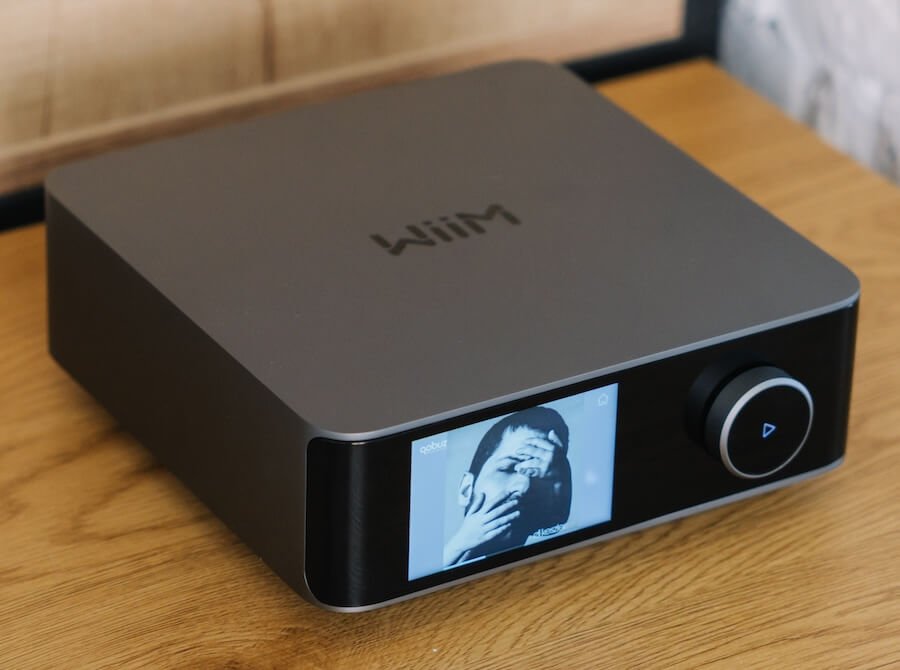
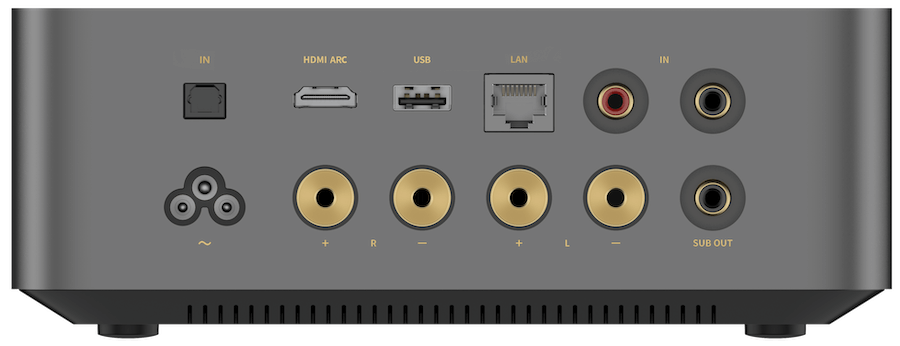
While we can’t say we are a fan of the omission of the headphone out, phono in and line level outs (compared to the WiiM Ultra), and the lack of AirPlay and native Apple Music support may limit its appeal to fans of Apple’s ecosystem, there’s a lot to like about the WiiM Amp Ultra. We appreciated its high quality color touch screen, generous amplification power, flexible EQ, room correction and customization parameters as well as its dynamic yet refined sound. When paired with a capable pair of speakers, the WiiM Amp Ultra provides virtually all a music fan could want in a budget HiFi stereo system: robust features, excellent sound quality, intuitive operation and access to nearly all of the popular music streaming services.
If you want a little more flexibility, consider pairing the unpowered WiiM Ultra with WiiM’s VibeLink Amp, but then you’ll have the added complexity of a second box. For a single-box powered streaming solution, you can’t go wrong with the WiiM Amp Ultra. Highly recommended.
Go to full review | $529 at Amazon
Marantz Model M1 ($1,000)

The Marantz Model M1 is a compact wireless streaming amplifier that delivers 100 watts per channel with remarkably low distortion (0.005% THD) and enough muscle to drive most bookshelf or small floorstanding speakers. It’s designed for modern simplicity—just add speakers and stream via HEOS, which now supports TIDAL Connect, Qobuz Connect, Spotify Lossless, and Roon Ready functionality. The M1 stays entirely in the digital domain, supporting 24-bit/192kHz PCM and DSD playback, ensuring pristine signal integrity from source to output.
A dedicated subwoofer output with adjustable crossover and level trim allows for fine-tuned bass integration, while HDMI ARC/eARC, AirPlay 2, and Bluetooth add flexibility for both TV and multi-room setups. It’s $200 pricier than Denon’s Home Amp, but the refined build, dynamic sound, and expanding HEOS platform make the Model M1 one of the most practical and forward-thinking all-in-one amplifiers Marantz has ever built.
Learn more | $1,000 at Amazon | Crutchfield
Ruark R610 ($1,899)

The Ruark R610 doesn’t just play music—it commands attention. Delivering 75 watts per channel of Class D power, a 32-bit/384kHz DAC, and support for Spotify Lossless, TIDAL Connect, and Qobuz Connect, this British-built streaming amplifier punches well above its compact footprint. It covers everything from AirPlay to Google Cast, Bluetooth 5.1 with aptX HD, and virtually every digital file format worth mentioning. The 5-inch TFT display is crisp and modern, and Ruark’s RotoDial interface with a rechargeable Bluetooth remote makes operation feel premium and intuitive. Punchy, detailed, slightly warm, and very alive, the R610 is a compact powerhouse that reminds you why anyone still bothers with high-end audio at all.
Go to full review | $1,899 at Audio Advice
Naim Uniti Nova Power Edition ($10,000)

The Naim Uniti Nova Power Edition (PE) takes everything great about the original Nova and doubles down with 150 watts per channel of Class D power, transforming it into a genuine all-in-one flagship. Powered by Naim’s latest NP800 streaming platform, it delivers hi-res playback up to 32-bit/384kHz, DSD128, and seamless access to Spotify Connect, Apple Music, TIDAL (and TIDAL Connect), Qobuz Connect, plus AirPlay 2, Chromecast, Bluetooth aptX Adaptive, and Roon Ready certification. It handles everything from FLAC and AIFF to ALAC, WAV, and even MP3 or AAC for those clinging to old playlists.
HDMI ARC lets it pull TV duty, and the Focal & NAIM app integrates effortlessly across the brand’s multi-room ecosystem. With class-leading clarity, scale, and dynamic drive, the Uniti Nova PE delivers uncompromising power and performance in a single sleek chassis—ideal for those who want reference-level sound without the clutter of separates.
Go to full review | $9,999 at Focal NAIM America
Aavik U-288 Unity Amplifier ($30,000)
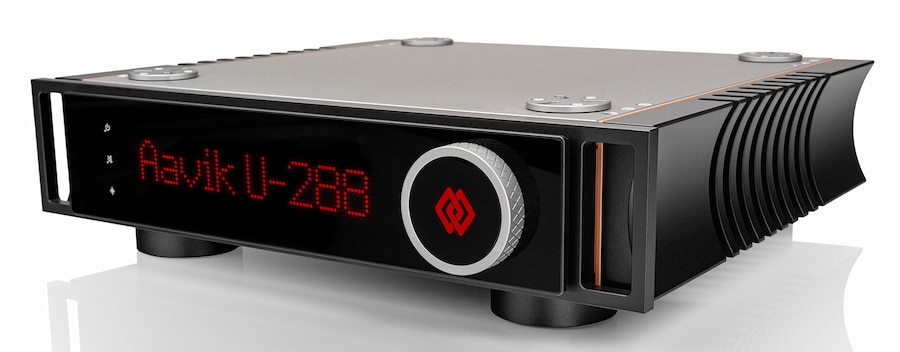
The Aavik U-288 Unity Amplifier is an unapologetic display of Danish excess—part streamer, DAC, preamp, and power amp, all crammed into a single slab of minimalist perfection. Co-designed by Flemming Erik Rasmussen(formerly of Gryphon Audio) and Michael Børresen, it redefines what Class D can sound like—muscular, full-bodied, and hauntingly natural. Delivering 300 watts per channel into 8 ohms (and 600 into 4), it uses Aavik’s latest Pascal-based UMAC Class D topology, complete with active Tesla coils, anti-resonance circuitry, and enough internal wizardry to make other high-end brands question their life choices.
Sonically, it’s a revelation—thunderous yet composed, with bass that feels seismic but perfectly sculpted. The midrange carries weight, texture, and humanity, while the treble stretches into infinity without ever crossing into glare. It’s ruthlessly transparent yet never sterile, revealing everything in the recording—good or bad—without flinching. Built like a tank, 22.8kg of Danish defiance, it’s as much an art piece as an amplifier. Sure, it costs thirty grand, and yes, that’s wallet-crushing—but once you hear it, you realize it’s not just another amp. It’s one of the ten best components I’ve ever heard. Ever. And that’s the sad, beautiful truth of Danish hi-fi brilliance: they’ll make you believe in perfection—then hand you the bill.
Learn more | $30,000 at Audio Group Denmark
The Bottom Line
Streaming amplifiers are no longer the “future” of high-end audio — they’re the present, and they’re winning on every front that actually matters. You get serious power, low noise, razor-sharp efficiency, and industrial design that no longer looks like it escaped from a 1990s telecom rack. The newest Class D platforms have matured to the point where they outperform a lot of Class A/B and Class A hardware, while adding full streaming ecosystems, app control, room correction, and support for every major service and codec people actually use daily.
As more listeners consolidate around Spotify Lossless, Qobuz Connect, TIDAL Connect, and Roon — and as manufacturers continue to refine the software side of these units — the network amplifier becomes the default hub of the modern system. Not a compromise, but the cleanest path to great sound. This category will only grow in importance because it removes friction, cuts the cost of entry, and gives people the performance and flexibility they want without filling a rack with boxes. The audiophile world finally has a component that delivers both high fidelity and high practicality, and that’s a win the industry can build on.
Related Reading:























ORT
April 8, 2022 at 12:53 am
By my faith, I canna believe ye have left the gorgeous Marantz 40n owt o’ this mix!
’tis doubtless the Grail o’ any group o’ integrated amps, laddie and therefore shouldna been left owt! Penance I would give ye but alas, I fear ye are lost to the Naimless One and given o’er to the Dark Side o’ the Farce…For now.
ORT
Ian White
April 8, 2022 at 2:03 pm
ORT,
Until I try at home…I can’t include.
Ian
ORT
April 9, 2022 at 1:36 am
Ummmmm…I thought you did just that and wrote about here it on Feb. 15th, 2022?
It was a good review too.
ORT
Ian White
April 9, 2022 at 2:30 am
ORT,
The Marantz? That wasn’t a formal review. I spent a few hours with it in two systems but I don’t consider it the same as the Naim which I had at home for 3 months.
The Marantz was very impressive based on that experience but until I have it at home with my own speakers — the Naim holds onto its title.
Best,
Ian
Justin
April 8, 2022 at 11:43 am
One concern I would have with the Naim is dust collecting on top.
Ian White
April 8, 2022 at 2:01 pm
Justin,
Valid but I use a soft cloth with it.
Ian
Beosker
December 25, 2024 at 11:20 am
Another con not mentioned with the Marantz M1 is that it doesn’t have Qobuz. I would have bought one for my living room but I use Qobuz
Ed B
December 26, 2024 at 12:33 pm
Thanks Ian, enjoyed the article. Hope you get the chance to review the Eversolo DMP A8, the I currently enjoy in my 2-chnl system, or their newer A-10. I think you’ll like them a lot. Enjoy your gear!!
Ian White
December 26, 2024 at 3:38 pm
Ed,
EverSolo, Ruark, Marantz, NAD, Bluesound, Hegel, and McIntosh will be the focus in Q1 and Q2.
Best,
IW
ORT
December 26, 2024 at 4:58 pm
Hello the house!
Being a HEOS enthusiast (some might say, “nutcase”) I like Denon/Marantz. A lot.
The Marantz M1 is $200 more but it does have a 5 year(!) warranty versus the Denon’s 1 year warranty. Or at least that is what I think I read at their respective US websites.
I now have the Denon Home Amp and if it does what I ask of it, I shall purchase an M1 for our family room and a pair of small bookshelf speakers and powered sub.
ORT
Ian White
December 26, 2024 at 5:05 pm
ORT,
It’s a weird play considering the two companies are siblings. Nearly identical specifications and the same HEOS system. Same amount of power as well. The differences are minimal but having only heard the M1 — I don’t know how much it offers sonically over the Denon Home Amp.
IW
ORT
December 26, 2024 at 5:31 pm
Hi Ian –
Having become VERY impressed with my new Marantz CD60, I will be adding the M1 to my home. In truth, I am downsizing a couple of rooms due to my having been exposed to “gold Kryptonite”.
I have friends from work that I will be giving some of my equipment to (they are happy to have it and they are as family to me!) and just hooking the Marantz CD60 (I will also get a black/gold model down the road) for use with CDs. No more 300/400 disc changers. They are going to friends that want them and will happily use them.
But I am a music and movie enthusiast and will be more than satisfied and am keeping the room I have my AVR-X4300H in but will be putting new carpet and a pair of recliners in there for film. I have my three Andover setups for records and my 7 ‘tables will be rotated across them. Headphones will also be used in two of MY rooms, LOL!
And HEOS works great for me, my older brother and his wife and my daughter and her family. If Qbuz ever migrates to the HEOS platform I shall be happy to give it a go!
This wasn’t supposed to happen to me but it did, LOL!
ORT
Ian White
December 26, 2024 at 7:41 pm
ORT,
Told ya it was good. I’m also downsizing in 2025. Will explain soon.
IW