Table of contents
CES 2026: Observations from the Show Floor
CES, formerly known as the Consumer Electronics Show, is seen by many as the electronics industry’s most important proving ground—where manufacturers reveal the products, platforms, and technologies that will define what consumers actually buy in 2026 and beyond. While the show used to favor audio and video gear, it has morphed to cover a myriad of industries, including automotive tech, AI, smart home, PCs, appliances, mobile phones and robotics.

This year’s event, like years past, sprawled across the Las Vegas Convention Center and extended into surrounding hotels and invite-only off-site events that technically sat outside the official CES footprint. If we encountered it in Las Vegas during CES 2026 (January 6-9), it was eligible for our Best in Show consideration. Our focus was deliberately on consumer high-end audio and video, categories that now incorporate a smaller but more concentrated footprint at CES.
On the audio side in particular, many high-end and specialty brands continue to prioritize regional and category-specific shows over mass-market trade events. The Venetian, once home to scores of high-end audio vendors, was a virtual ghost town this year, with only a handful of high-end audio brands showing up to display their wares.
While robots and AI were the stars of CES 2026, TVs and other displays were still prominent, with no shortage of new models, revised technologies, fresh marketing language, and ever-larger screen sizes. At the same time, CES 2026 underscored that the industry may be reaching a form of “peak TV.” As OLED, RGB and Mini-LED backlighting and quantum-dot-enhanced displays converge on similar levels of picture performance, competition is increasingly shifting toward industrial design, ease of use, integrated sound, larger screen sizes and overall system convenience and integration. Samsung, Hisense, TCL and LG all introduced significant refinements to last year’s already high-performing TV lineups. But neither Sony nor Panasonic had TVs on display. Also notably absent was 8K—after years of tentative support from the industry, we didn’t spot a single 8K television on the show floor.

Of course, there was no shortage of AI integration and enhancement, now embedded across TVs, headphones, earbuds, wearables, and emerging form factors like smart glasses. Voice interaction should improve incrementally in 2026, but the broader promise of AI fundamentally transforming consumer electronics remains a work in progress. CES 2026 offered plenty of iteration, but no clear “iPhone-level” inflection point poised to redefine the category for the next decade.
With audio largely eschewed at CES, some of what we did encounter was genuinely impressive. The clear audio story this year was the continued rise of active and wireless loudspeakers—not portable Bluetooth speakers, but system-grade products designed to replace traditional component stacks. The need for a dedicated hi-fi rack is rapidly disappearing, as consumers can now plug in two – or in some cases, one – powered speakers and have a complete high-fidelity system, or achieve convincing spatial audio from a single soundbar-style product.
Passive loudspeakers, at least at CES, appear to be losing relevance. We didn’t see (or, more importantly, didn’t hear) a single new passive speaker debut on the show floor—a notable first for CES. SVS did showcase its existing floor standing speaker lineup on the main convention center show floor, but its only new product introductions were a subwoofer and a soundbar, both of which offered exceptional performance. Klipsch displayed new loudspeaker prototypes for viewing only (no active demos), and we did hear a passive loudspeaker under NDA that cannot yet be discussed.
Without further ado, here are our picks for best audio and video products from CES 2026.
Best in Show – TVs
Samsung 130-inch Micro RGB LED/LCD TV
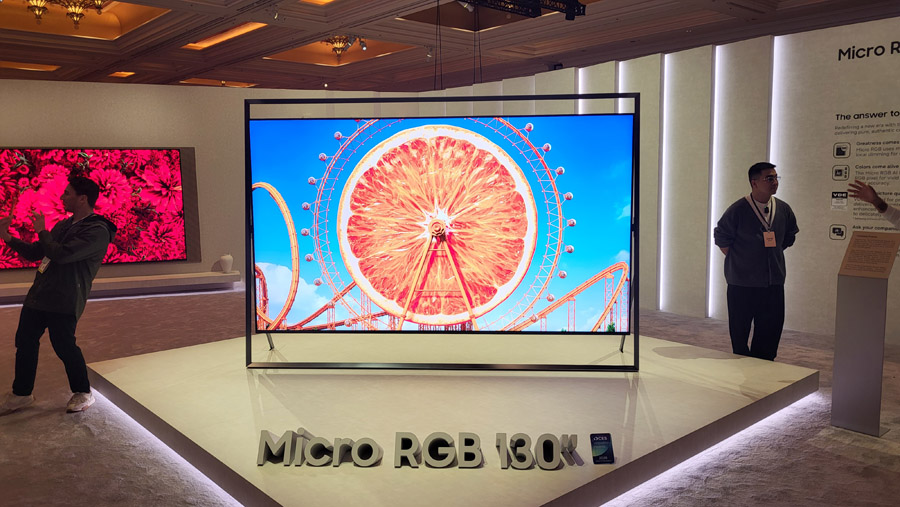
Although the Samsung rep who gave us a tour of their CES line-up before their “First Look” event told us this was a proof of concept, the company later clarified that they intend to bring this actual TV to market at some point. And if they do, it will be an impressive achievement. We’ve never seen a TV this big cut from a single piece of mother glass. It offers about 6.5% more viewable surface area than the also enormous 116-inch Hisense 116UXS.
Like the Hisense, the Samsung offers RGB backlighting, which makes the set more efficient than a traditional LED/LCD TV (important at this screen size), as well as allowing it to reproduce 100% of the elusive BT.2020 color gamut. The 130-inch behemoth was shown in an elegant “Timeless Frame” easel type frame as well as mounted on wall with a classy layered look. We’d recommend finding the studs when you mount one of these on the wall. Hollow wall anchors ain’t gonna cut it.
Samsung has yet to announce pricing or delivery dates for the 130-inch MicroRGB TV, but we have some more photos and details here.
Hisense 116UXS 116-inch RGB MiniLED LCD TV

As in 2025, Hisense may deliver the largest production model consumer television in 2026 (if Samsung doesn’t follow through with its 130-inch TV). But the Hisense story goes beyond sheer size. The 116-inch 116UXS introduces second-generation RGB Mini-LED backlighting technology, adding an additional cyan backlighting element alongside red, green and blue to improve color precision and light control. This is something no other TV brand is offering in 2026. How much of that translates into meaningful real-world performance gains remains to be seen, though the display model offered impressive black levels, realistic motion and rich color saturation. Hisense claims the tech offers improved viewing comfort and reduced eye strain, both of which become even more important on the larger sized screens. But you’ll need both the space and budget for a display of this scale. Pricing and availability has not yet been announced, but with last year’s 116-inch model selling for around $25,000, we expect some degree of sticker shock.
TCL X11L SQD (Super Quantum Dot) MiniLED TV

TCL’s flagship TV for 2026, the X11L brings the introduction of Super Quantum Dots (SQD). SQD represents an improvement to Quantum Dot color tech which widens the already extended color gamut. TCL says this revised SQD color layer, combined with an enhanced color filter allows them to reproduce 100% of the BT.2020 color spectrum, without some of the color cross-talk artifacts that can be seen on RGB-backlit LCD TVs. And the tech is exclusive to TCL for the foreseeable future. TCL’s CSOT manufacturing arm is the only one currently making these new panels.
TCL’s flagship SQD TV is one of the few new models for 2026 that can already be ordered. But be prepared to pay for the privilege: the X11L starts at $6,999 for a 75-inch model (not yet shipping) and goes up from there with an 85-inch size selling for $7,999 and the largest 98-inch version selling for $9,999 (all prices MSRP).
The company had 85-inch and 98-inch models on display at CES with deep almost “OLED level” blacks and vivid colors. The sets include an integrated speaker system, designed in partnership with Bang & Olufsen, which sounds much better than most TV speakers we’ve heard. It also supports the addition of up to four wireless speakers and a subwoofer thanks to Dolby Atmos Flex Connect technology, which is built-in. Google Gemini AI is also available, so your voice and text searches go beyond just recommendations on what to watch.
LG G6 OLED TV

LG’s flagship OLED TV for 2026, the G6 includes the company’s new Tandem RGB 2.0 OLED panel, now enhanced with “Hyper Radiant Color” technology. This includes a 20% brightness boost over last year, improved picture processing, and a new Reflection-Free Premium screen coating which minimizes room light reflection without sacrificing those deep OLED black levels. LG says the G6 is nearly 4 times brighter than its entry level B series OLED, so it delivers strong performance even in bright rooms. We can confirm that the G6 on display in the Fontainebleau hotel at CES delivered a bright punchy image, with excellent black levels, even with the room lights fully lit. The new Alpha 11 Gen 3 processor includes a dual AI engine with 70% improvement in GPU processing for improved picture performance as well as 12-bit video processing (though it is still a native 10-bit panel).
LG W6 Wallpaper OLED TV


First introduced in 2017, LG’s super-slim Wallpaper OLED TV has been reborn in 2026 as the W6 Wallpaper TV, but with some notable improvements: a lower price, wireless connectivity, improved picture performance and built-in speakers. While the W6 is a bit thicker than the original, the new one is only 9mm (0.35 inch) thick and can be mounted flush to the wall thanks to a unique recessed mounting system. It also now includes speakers, where the original required a separate soundbar connected via a wired dongle.
As for wiring on the W6, all you’ll need is a power plug. The TV comes with LG’s latest wireless Zero Connect box which accepts all of the source components and transmits the audio and video to the TV wirelessly at 4K resolution at up to 165Hz refresh rate. Meanwhile, the W6 features all the picture performance and usability enhancements from the G6 OLED in a slimmer overall form factor. LG did not disclose precise pricing at the show but did say that the W6 would be available for a “small premium” above the G6. Considering the original Wallpaper TV sold for $20,000 in a 77-inch size, we’re expecting the new model to come in at less than a third of that price.
Samsung S95H OLED TV

While the “Art TV” category is becoming increasingly competitive, consumers who want a TV that can blend into the background and display artwork when not in use have always had to sacrifice TV picture quality to do so. With the new flagship S95H OLED TV, this trade-off is no longer necessary. The new model features an elegant picture frame surrounding the TV as well as the ability to display art from Samsung’s extensive Art Store. For the first time, customers can display still frames of artwork on an OLED TV screen, without risk of long term burn-in or image retention.
The S95H features Samsung’s Glare-free matte screen which virtually eliminates ambient light reflection as well as a brightness increase over last year’s model. Samsung says the S95H can hit 2,700 nits of peak brightness (10% window) which makes it quite capable for bright room viewing. Also, the new model includes all of the input/output ports (HDMI, etc.) right on the unit itself, instead of requiring a separate One Connect box like last year’s flagship model (S95F). Customers who do prefer to use a separate connection box will have the option to do so via an optional plug-in module that supports Samsung’s wireless OneConnect box.
Loewe Stellar OLED TV
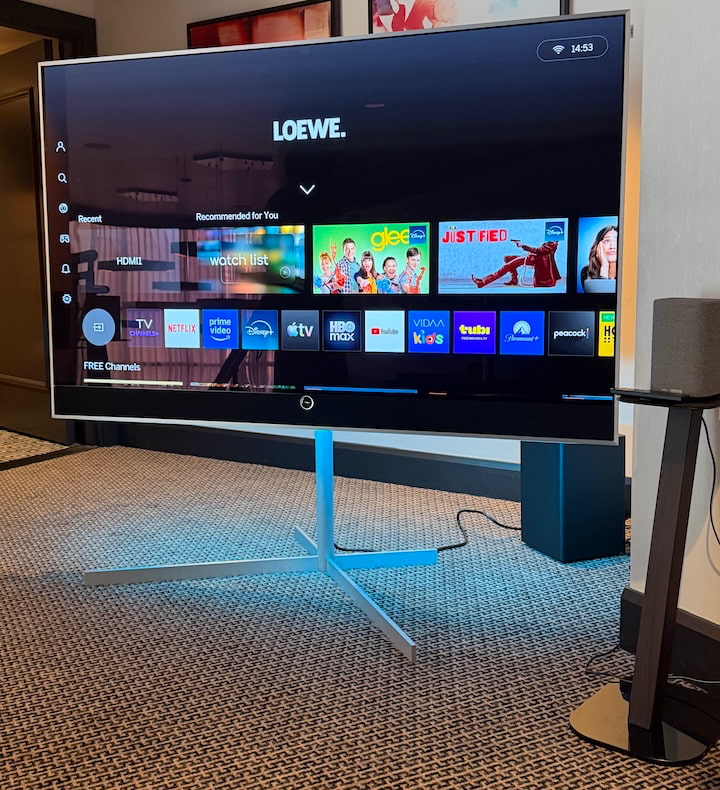
High-end German brand Loewe is re-entering the crowded North American TV market in 2026 with a full OLED lineup ranging from 42 to 97 inches, positioning itself firmly at the luxury end of the spectrum. These are stylish all-in-one, bespoke televisions that combine the best built-in TV sound we’ve heard to date with meticulously crafted metal casework and an elegant rotating stand. They combine the latest generation LG OLED panels with Loewe’s advanced picture processing and premium chassis. Just as much design objects as displays, the 65-inch and smaller models feature a uniquely finished rear panel made from a lava-based cement—yes, actual cement—underscoring Loewe’s focus on materials and visual impact as much as performance.
Rather than build their own smart O/S or streaming platform, Loewe TVs will feature the popular VIDAA O/S, which provides access to all of the major audio and video streaming apps. Prices start at approximately $5,000 for the 42-inch model and go up to $45,000 for the 97-inch screen size.
Best in Show – Projectors
Hisense PX4-PRO UST Projector

As the inventors of the “Laser TV” category, Hisense knows a thing or two about laser TVs or UST (Ultra Short Throw) projectors, as they’re also called. The Hisense PX4-PRO will replace the PX3-PRO (the 2024 UST Showdown Winner), by pushing performance further with a new dynamic iris for enhanced contrast, increased brightness (3,500 Lumens) and support for VRR/Free Synch for those who enjoy big screen gaming. With the increased brightness comes support for larger screen sizes (200-inch diagonal, up from 150 inches on its predecessor). With upgraded specifications and an expected launch price at less than half that of Hisense’s flagship L9Q, the PX4-PRO is shaping up to be the performance-to-value UST projector to beat in 2026. It is expected to begin shipping in Q2, 2026.
Soundcore Nebula X1 Pro 4K Projector / Mobile Theater Station

You may know Anker for their power banks and charging cables, but the company also produces some outstanding high value audio and video products, including speakers, headphones, earbuds and projectors. Their new Soundcore Nebula X1 Pro 4K Mobile Theater Station ($4,999 at Amazon) is basically a high-end 7.1.4-channel home theater system complete with 3500 Lumen Triple laser-powered projector on wheels that you can take with you anywhere you go.
Featuring four integrated, detachable wireless speakers, each with multiple drivers facing all directions, the X1 Pro supports Dolby Atmos in a 7.1.4-channel configuration. Its 3500 lumen peak light output make it suitable even in bright rooms and its integrated Google TV OS gives you access to all the popular audio and video streaming apps. Just roll up, plug it into wall power and shine it at a wall or screen and you’re ready to rock. The four wireless speakers last up to 8 hours on a charge, and can be positioned virtually anywhere. The main cabinet also includes a down-firing subwoofer for extended bass response.
Valerion VisionMaster MAX Projector

While we were impressed with Valerion’s VisionMaster Pro 2, on active display at last year’s CES, we were even more blown away by its higher performance version, the VisionMaster Max, which lit up a 200 inch screen at CES 2026. Watching a variety of movie and TV clips, the Vision Master Max offered excellent contrast and shadow detail as well as bright punchy colors. Housed in a compact cube, the Valerion VisionMaster Max ($4,999 at Amazon) offers performance that rivals dedicated home theater projectors from the likes of Sony, Epson and JVC. It includes a dynamic iris, integrated power zoom, focus and lens shift and 3,500 ISO Lumens of peak brightness, supporting screens up to 300 inches. Stay tuned for an in-depth review.
Best in Show – Home Audio
Focal Mu-so Hekla Powered Speaker

Perhaps the biggest surprise at CES came from the Focal Mu-so Hekla, which should become available March/April 2026 in North America for $3,600. While it resembles and can function like a soundbar, Focal is careful not to frame it as one, positioning Hekla instead as a single-box, high-performance all-in-one speaker. What stood out was its ability to project a convincing 360-degree soundfield that extends well beyond the enclosure and remains effective across multiple seating positions, rather than collapsing into a narrow sweet spot. Add the integrated circular touchscreen interface, remote control, and deep integration with the Focal/Naim app ecosystem, and the Mu-so Hekla emerges as one of the most thoughtfully engineered audio products we encountered at CES 2026 which also offers excellent sound from both stereo sources and multi-channel immersive audio.
The Canvas HiFi Frame (aka “The Frame HiFi”)

Samsung’s The Frame TV is one of their top sellers as it allows your TV to pass as artwork when not in use. But what if you want your TV viewing to actually sound good? You can’t just plug in a traditional soundbar as that would destroy the aesthetics. And this is where the Canvas HiFi speaker comes in.
The Canvas “The Frame HiFi” (priced from $5,478) combines the elegant Canvas HiFi Speaker with Samsung’s The Frame TV, transforming it into a seamless all-in-one display and sound system. In terms of both industrial design and audio performance, the system stands apart from every integrated TV-speaker solution we’ve encountered, regardless of price. Its on-board Bacch 3D processing makes sound from music and movies truly immersive, without the need for any additional speakers. For viewers who want serious sound from their television without visible wires or external speaker boxes, this is the most complete solution available—offered in sizes from 55 to 85 inches, with The Frame TV sold separately.
Naim CI-Uniti 102 Streaming Amplifier
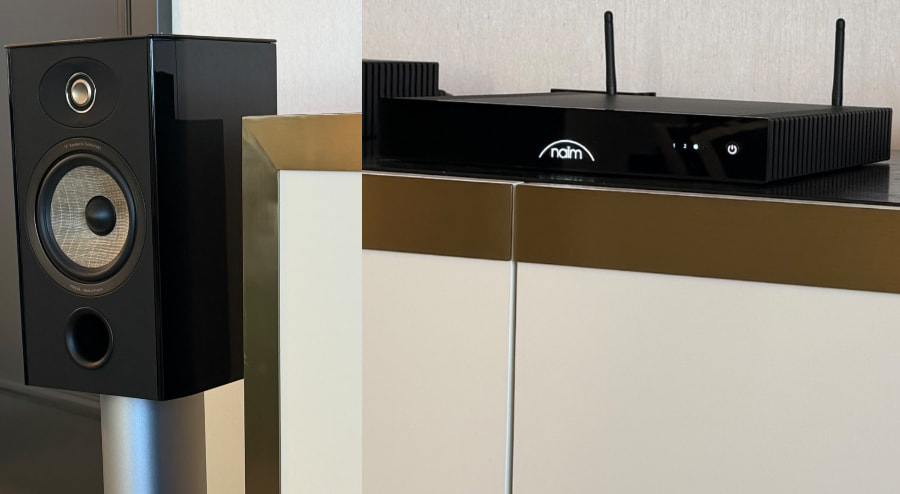
The Naim CI-Uniti 102 ($1,799) can easily fly under the radar thanks to its understated black box design, but that would be a mistake. This is a highly capable streaming amplifier designed for custom installation that does not feel compromised for serious listening. Control is handled entirely through a single, well executed Focal and Naim app, keeping setup and day to day operation simple. When paired with compatible Focal loudspeakers, it offers preconfigured Speaker Profiles with full DSP calibration. It also supports wired and wireless multi-room systems with up to 32 zones, handles up to 32-bit/384 kHz PCM digital playback, is available in a rack mounted version for CI installations, and remains cool to the touch even under sustained use.
Our founder, Brian Mitchell, spent time with the CI-Uniti 102 driving Focal Aria Evo X N1 speakers ($2,598 per pair), and the presentation was unmistakably Focal and Naim. The system was highly resolving, handled dynamic shifts with ease, and delivered excellent pace and timing without ever sounding forced or congested. Think of it as a Naim Uniti Atom at roughly half the price, trading Class A/B amplification for a higher power Class D design rated at 150 watts per channel instead of 40 watts. The result is more power, greater flexibility, and in real world use, better sounding performance (at least to Brian’s ears).
LG Sound Suite Speaker System

While TCL may have been first to market with a Dolby FlexConnect wireless speaker, LG is the first company to offer a full suite of Dolby Atmos FlexConnect wireless speakers, including two different speaker models (M5 at $249 and M7 at $499 each), a subwoofer (W7 at $599) and the first soundbar to include Dolby Atmos FlexConnect (the H7 at $999). The M5 includes front-firing and up-firing drivers while the M7 includes drivers facing different directions plus a top-firing driver for more room-filling sound. This flexibility allows customers to create an immersive multi-channel home theater speaker system without wires either with or without a soundbar, depending on their own specific needs.
With multiple speaker drivers, pointing upward, forward and to the sides, the LG H7 soundbar can reproduce a 5.1.3 channel system on its own, or up to a “13.1.7” channel system by combining the sub with four of the company’s M7 wireless speakers. In our experience, companies play a little fast and loose with their channel counts so hopefully we’ll be able to confirm the decoding in the future with a review sample.
We did get to hear a demo of the LG Sound Suite progressing from the TV’s built-in speakers, to the TV plus a pair of M7 speakers and finally to the TV plus H7 soundbar plus subwoofer plus four M7 speakers for a fully immersive system. The demo was impressive as the system’s integrated calibration routine allows you to compensate for less than perfect placement, creating real immersive surround sound without wires and without rigid speaker placement requirements.
SVS PB-3000 R|Evolution Subwoofer

The SVS 3000 Series has long been the company’s best-selling subwoofer line by hitting a genuine price-to-performance sweet spot, and three models—the Micro, sealed, and ported variants—will receive updates in 2026. We heard the ported PB-3000 in a 5.2.4 home theater setup, where it benefited from clear trickle-down technology borrowed from SVS’ larger designs, albeit with a more compact 13-inch driver compared to the 15-inch units in the 5000 Series and the 17-inch driver in the flagship 17-Ultra Series. The result is the same bone-rattling, low-frequency authority SVS is known for (down to 16 Hz in the ported version and 17-18 Hz in the sealed version), delivered in a more affordable and space-friendly package.
Both versions of the sub are expected to begin shipping this month (January, 2026) with the sealed version (SB-3000 R|Evolution) selling for $1,200 and the ported version (PB-3000 R|Evolution) selling for $1,700.
SVS R|Evolution Soundbar

SVS used CES to introduce its first-ever soundbar system, and the defining design choice is deliberate restraint rather than feature overload. The SVS R|Evolution Soundbar is engineered as a complete, closed ecosystem, allowing SVS to optimize the soundbar around the assumption that low-frequency output is always handled by the included wireless subwoofer, while optional rear speakers pair automatically without Wi-Fi configuration or manual calibration. The soundbar itself employs a dedicated three-way acoustic layout for the left, center, and right channels, using nine custom drivers powered by 180 watts of internal amplification, with a clear focus on output capability, dialogue intelligibility, and front-stage coherence rather than aggressive upfiring or side-firing driver arrays.
Dolby Digital, Dolby Digital Plus, Dolby Atmos and PCM decoding are all supported across stereo through immersive mixes, though DTS decoding is not currently being offered. Dolby Atmos virtualization is available so that up-firing drivers are not necessary. Dolby Dialogue Enhancer and an onboard Auto EQ room correction system are included to optimize performance in your specific room.
Low-frequency performance is anchored by the included R|Evolution Wireless Subwoofer, built in a compact cube design, featuring a 12-inch high-excursion driver and a 600-watt continuous Class-D MOSFET amplifier. It is shipped with the soundbar, pre-paired for immediate use. Bass lovers can add a second sub to the system, which will be available ala carte. Connectivity is comprehensive, with Wi-Fi-based streaming via Apple AirPlay 2, Google Cast, Spotify Connect, and Bluetooth, supporting music playback up to 24-bit/96 kHz, alongside HDMI 2.1 with ARC/eARC, app-based control, and a traditional IR remote.
The SVS R|Evolution soundbar is expected to begin shipping in the first half of 2026 in two bundles: the soundbar plus subwoofer bundle is expected to sell for around $1,500 and the bundle that adds rear speakers should sell for around $1,800. Pricing for the additional (optional) subwoofer has not yet been determined. Get more details in our YouTube video with SVS product designer, Smith Freeman.
Onkyo TX-RZ51 9.4-channel A/V Receiver

We don’t typically single out untested prototypes, but Onkyo earned the exception by being the only company to introduce new A/V receivers at CES, and the 2026 lineup is built on an internal architecture we’ve already evaluated hands-on, including our Editor’s Choice pick for the TX-RZ30, released in late 2024. The new range receives a full industrial design refresh, including a large front-panel display, upgraded DSP and DACs, and support for up to six independently controlled subwoofers on select models. Within the lineup, the TX-RZ51 appears positioned as the price-to-performance sweet spot for those with medium to large home theater requirements. It includes nine channels of on-board amplification with four independent subwoofer outputs (up to 5.4.4 or 7.4.2), expandable to 11 channels with the addition of a separate 2-channel amp.
In addition to carrying on its inclusion of DIRAC Live on all new models at no additional cost, all of the new Onkyo receivers will have options to upgrade to DIRAC Bass Control and DIRAC ART (Active Room Treatment) for a fee. This will allow you to get the absolute best performance from your speakers in any room. Onkyo will also introduce a dedicated preamp/processor (PR-RZ91) and separate multi-channel power amps in the near future (PA-RZ04 4-channel amp and PA-RZ11 11-channel amp), which we also love to see (and hear).
Pricing and availability of the new line-up has not yet been announced but we expect the earliest we’ll see these products is late 2026. We’ll share additional details when we get them.
Best in Show – Speakers
Klipsch The Sevens II Powered Speakers

Klipsch marked its 80th anniversary at CES by updating its powered bookshelf loudspeaker lineup with three models—The Fives II, The Sevens II, and The Nines II—all built around the company’s horn-loaded tweeter technology with electronics co-developed with Onkyo to maintain a consistent house sound. In brief listening sessions, The Sevens II emerged as the most balanced of the three, delivering tighter bass control and cleaner output than The Fives II, helped by its larger woofer and added features such as Dirac Live room correction and expanded wireless support. All three models support Dolby Atmos playback via virtualized height channels, aiming to deliver a more immersive presentation for movies and music without external processors (or additional speakers) required. All three support wired or wireless connectivity, though the Fives II required an XLR wired connection between the speakers themselves (The Sevens II and Nines II can be connected to each other wirelessly or wired).
A key structural update is the new single-piece BMC (Bulk Molding Compound) baffle with an integrated Tractrix horn, designed to increase cabinet rigidity while improving dispersion and consistency across the listening area. Low frequencies are handled by Klipsch’s Jet Cerametallic woofers, scaled appropriately by model size. Setup is designed to be simple: users run a short calibration routine using the included microphone through the Klipsch Connect Plus app, which also manages system control. Built-in streaming support includes Google Cast, Apple AirPlay 2, Spotify Connect, TIDAL Connect, and Qobuz, enabling direct playback without the need for an external streamer.
The new speakers are expected to being shipping this Spring with MSRP pricing as follows:
- The Fives II ($1,399.99/pair)
- The Sevens II ($1,999.99/pair)
- The Nines II ($2,399.99/pair)
Samsung Music Studio 7 Wireless Speakers

The Samsung Music Studio 5 and 7 wireless speakers offer refreshingly unique designs combined with whole home integration that can link up to 10 units together for multi-room audio. The industrial design comes from renowned French designer, Erwan Bouroullec, who previously collaborated with the company on their “The Serif” art TV. Although each Music Studio speaker can be used individually or as stereo pairs, or paired with a compatible Samsung TV for surround sound, the larger Music Studio 7 (LS70H model) cleverly conceals 4 speaker drivers (front, top, left, right) for immersive audio support by itself or paired with other compatible Samsung speakers for a full home theater system.
We heard the Music 7 both standalone and in an immersive surround system and found that it offered full bodied sound in a compact and stylish form factor. It also includes integrated playback controls including a unique “Spotify Play” button on top for those who want to jump right into their favorite songs or playlists on Spotify without having to reach for their phone.
The Music Studio 5 is expected to be priced at $249 and the Music Studio 7 will be priced at $499. Both are scheduled to begin shipping this Spring.
Edifier M90 Active Desktop Speakers

Edifier’s M90 is designed to function as a true “cross-scenario” speaker, combining compact dimensions with enough power and connectivity to cover desktops, consoles, and TV-based setups without complication. It supports a wide range of inputs, including Bluetooth 6.0 with LDAC and multipoint, optical digital, and HDMI eARC, allowing it to integrate easily into both PC and home-entertainment systems. Physical controls on the cabinet handle quick adjustments, while an omnidirectional remote enables at-a-distance operation, and the Edifier ConneX app for iOS and Android provides straightforward access to setup, source management, and basic sound tuning.
Internally, the M90 uses a two-way design with a 4-inch long-throw mid-bass driver and a 1-inch silk-dome tweeter, powered by a 100-watt RMS amplifier and capable of peak output around 100 dB SPL. The overall approach favors flexibility and practicality over specialization, making the M90 a sensible option for users who want a single powered speaker solution to handle multiple roles without excessive cost or complexity.
We listened to the M90 at Edifier’s booth on a variety of tracks and found that it offered much bigger and more dynamic sound than its compact cabinet suggested, particularly when paired with the optional subwoofer. The M90 will sell for $369.99/pair and its companion subwoofer is priced at $169.99.
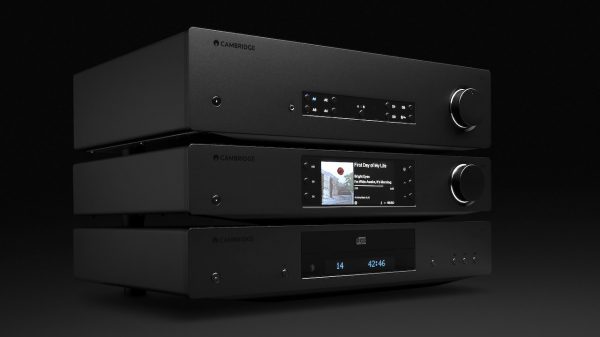
Cambridge Audio L/R X Active Wireless Speakers

Cambridge Audio’s new L/R Speaker Series marks the British brand’s bold leap into fully active wireless stereo systems, pairing StreamMagic Gen 4 streaming platforms with integrated amplification and multi-room support to take direct aim at KEF’s LS lineup. The largest of the three models, the L/R X ($2,399/pair), is still smaller than it looks, standing only 13 inches (330mm) tall, while sounding like full range floorstanding speakers. Bass down to 35Hz seems physically impossible, yet a stereo pair achieves it, thanks to a staggering 800 watts of total Class D power in a 2.5-way design with dual passive 6″ radiators. Meanwhile, comprehensive connectivity includes HDMI eARC, optical digital (Toslink), MM Phono, RCA, USB-C and even a subwoofer output. All of it adds up to an immensely enjoyable wireless speaker that comes in five colors.
Brane Audio Party Pro Powered Speaker

Brane’s Party Pro speaker (we would have called it the “Big Brane”) was an unexpected surprise we found in one of the few remaining audio suites at the Venetian. The Party Pro aims to deliver a 30X deep-bass advantage over conventional woofers, moving up to 1,000 cc of air with bass down to ~26 Hz and concert levels of sound output at 107 dB. Although we can’t verify that claim, we were literally shocked to hear (and feel) the output of a single Repel-Attract Driver 2 (RAD2) driver in its prototype form. If the final version – which will have two of these drivers – approaches or exceeds what we heard, the Party Pro will set a new benchmark in party speaker performance. This one has all the hallmarks of being a game-changer, at least in terms of low bass reproduction from a compact cabinet. Price still pending, but could range from $1,199 to $1,399.
Best in Show – Headphones & Earbuds
Loewe Leo Headphones

The Loewe Leo are luxury wireless noise-cancelling headphones that justify their premium pricing through exceptional build quality, comfort, and thoughtful physical controls that feel intuitive rather than ornamental. Sonically, they’re tuned for detail, accurate midrange reproduction, and tight, controlled bass—eschewing the heavy low-end emphasis common to models from Beats, Bose and Sony. The result is a wireless ANC over-ear headphone that genuinely challenges the assumption that you still need a wired design for “serious” music listening. Combine that with an infinitely updateable design, inspired by Swiss watches, and you have a pair of headphones worth investing in. They’re available now in Europe for 1,299 Euros and will be on sale in the U.S. soon for $2,000.
If you’re into more conspicuous consumption, consider the “Ice Diamond” edition in collaboration with Jacob&Co, featuring 456 diamonds in white gold ($135,000) and the “Noir Rainbow” version adorned with multi-colored sapphires in rose gold ($115,000), which are just dripping with extravagance.
T10 Bespoke TWS Earbuds

The T10 Bespoke true wireless earbuds weren’t new for 2026, but CES marked the first time we heard them in person—and they made an immediate impression. Their stylish pendant-style charging case and ultra-compact micro-earbud design, rooted in Klipsch driver technology, set them apart visually, but it was the sound that stopped people in their tracks. During demos hosted by the designer himself, Mr. HiFi Bear (Bear Clark), a growing line of listeners followed us through the session, openly surprised by just how big and refined these tiny earbuds sounded.
Like the Loewe Leos, the T10 Bespoke TWS Earbuds are built around the philosophy of Swiss watches, using gaskets and screws, rather than permanent glue and sonic welds. This makes the buds easily serviceable. When the battery wears out in a couple of years (as all batteries do), you can send them into the manufacturer for a quick and affordable replacement. So while they’re not cheap (prices start at $3,000), they may end up being the last pair of earbuds you’ll ever need to buy.
ASUS/HiFiMAN ROG Kithara Open-Back Gaming Headphones

The ASUS ROG Kithara stands apart from conventional gaming headsets by leaning unapologetically into audiophile territory. Built around 100 mm planar magnetic drivers in an open-back configuration co-engineered with HiFiMAN, it prioritizes wide, natural imaging and tonal accuracy over isolation or spectacle. The stated 8 Hz–55 kHz frequency response isn’t marketing bravado so much as driver headroom, allowing the planar diaphragms to operate comfortably in the audible range with cleaner transients, finer microdetail, and more stable positional cues—advantages for both competitive gaming and serious music listening. The open-back design further enhances spatial separation and soundstage realism, but it also introduces the most obvious trade-off: zero isolation and significant sound leakage, making it poorly suited for shared or noisy environments.
Communication is handled with equal seriousness via a full-band MEMS boom microphone rated from 20 Hz to 20 kHz, avoiding the compressed, narrowband character typical of gaming mics. Flexible connectivity rounds out the design, with a balanced cable and swappable 4.4 mm balanced, 3.5 mm, and 6.3 mm terminations. The result is a headset that behaves more like a high-end open-back headphone with a mic attached—technically impressive, but potentially problematic for users expecting the privacy and isolation of a traditional gaming headset.
Our CEO and founder Brian Mitchell and I listened to a few tracks on the ROG Kithara and found they offered the kind of detailed open sound we’ve come to expect from planar magnetic headphones but with all the accessories and adapters you’d need to pair it with virtually any gaming console or PC. Highly recommended for gamers who want more from their listening. The ROG Kithara headphones, complete with mic and adapters is expected to sell for $359 in the U.S.
EarFun Wave Pro X

EarFun’s Wave Pro X distinguishes itself by combining an unusually deep feature set with aggressive pricing, positioning it closer to midrange premium models than typical sub-$130 headphones. Built around Qualcomm’s QCC3095 platform, the Wave Pro X supports Bluetooth 6.0 with Auracast, LE Audio, and a broad codec stack that includes aptX Adaptive, aptX Lossless, LDAC, and LC3, covering both high-quality playback and emerging broadcast-style use cases. Wireless USB connectivity adds a second low-latency option beyond Bluetooth, which is particularly useful for PC gaming and video playback. Sound is handled by a dual dynamic driver design pairing 40 mm DLC drivers with 10 mm LCP drivers, a configuration aimed at separating bass authority from mid and high-frequency clarity. Hybrid active noise cancellation is supported in both wireless and wired AUX modes, an uncommon but practical inclusion.
An eight-microphone adaptive array manages calls and in-game communication, while the EarFun companion app provides access to latency-focused Game Mode, multi-band EQ, and ANC tuning on iOS and Android. The headline 100-hour battery life further reinforces the Wave Pro X’s appeal, though its feature density may be more than some users need, and real-world performance across ANC, latency, and voice capture will ultimately determine whether the execution matches the specifications.
Although these are EarFun’s first set of headphones over $99, a quick listening session suggests that they’re worth that slight premium, particularly as competitive models sell for double that or more. If your ears want to have a little fun, the EarFun Wave Pro X is definitely worth a listen.
The Bottom Line
Although CES continues to shift focus away from the traditional “consumer electronics” products it used to feature, this is simply a sign of the times. AI and robotic helpers capture the imagination while audio and video gear has become more commoditized and less exciting. Fortunately there are still companies who are dedicated to advancing the state of the art in sound and video reproduction, and these were a few of the products that stood out to us this year.
Related Reading:
- Capital Audiofest 2025 – Best In Show
- Audio Advice Live 2025 – Best in Show
- CEDIA Expo 2025 – Best In Show – Podcast
- T.H.E. Show SoCal 2025 – Best in Show
- CanJam SoCal 2025 – Best in Show
- CanJam London 2025 – Best In Show
- NAMM 2025 – Best in Show
- CES 2025 – Best in Show