
Table of contents
Not everyone is shopping for new components or loudspeakers right now—and let’s be honest, that’s not because the itch is gone. While inflationary pressure has eased and a handful of manufacturers quietly rolled prices back toward pre-pandemic sanity, most did the opposite and doubled down. The result? Fewer people upgrading boxes, and more people looking hard at how to make what they already own sound better. That’s where audio accessories come in—some offer small, worthwhile gains, while others, like properly implemented room correction software, can be legitimate game changers that pull you off the endless gear-fetish treadmill and remind you why you started this hobby in the first place: to enjoy music, not chase specs.
Let’s also clear the air while we’re here. Spending $1,000 on a power cord won’t transform your system, and neither will a four-figure “audiophile” network switch wrapped in marketing copy and mysticism. Those purchases tend to enrich everyone except the listener. If you really want a return on investment, spend that money on more music—records, CDs, high-resolution downloads, concert tickets. The improvement is immediate and guaranteed. So what has actually worked for us—measurably, audibly, and without the snake-oil aftertaste? Let’s take a walk.
Best for Cleaning Vinyl Records
HumminGuru Ultrasonic Vinyl Record Cleaner

The HumminGuru Ultrasonic Vinyl Record Cleaner lands right in the sweet spot for people who want genuinely effective record cleaning without dedicating half a room—and a small mortgage—to the cause. This is a quiet, compact, 40 kHz ultrasonic machine that does the job without brushes, chemicals, or ritual sacrifice. You fill the removable 350 ml tank with distilled water, drop in a 12-inch record (7″ and 10″ adapters sold separately), hit clean, dry, or auto, and let cavitation bubbles do the work. Two cleaning durations (2 or 5 minutes), paired with 5- or 10-minute drying cycles, give you flexibility without menu-diving insanity. The duo 40 kHz system is strong enough to lift embedded grime from grooves without chewing up your vinyl, and the built-in air filter keeps airborne dust from undoing the cleaning during drying. At 6.8 pounds, it’s small enough to stash in a Kallax cube—try that with a traditional vacuum cleaner and see how that goes.
Now let’s talk reality: the VPI HW-16.5—once the default “serious vinyl person” option—now costs $1,200, which is roughly double what it sold for in 2019. It’s still effective, still built like a tank, and still loud enough to wake the neighbors, but the value math has shifted hard. The HumminGuru isn’t trying to replace industrial-strength vacuum machines; it’s offering a modern, ultrasonic-first alternative that’s quieter (60-70 dB), gentler, and far easier to live with day to day. No fluids to mix, no brushes to wear out, no shop-vac theatrics. For collectors who clean records regularly—and want consistency without the noise, mess, or four-figure buy-in—the HumminGuru makes a very convincing case that ultrasonic cleaning is no longer a luxury flex. It’s just the smarter move in 2025.
Where to buy: $599 at Amazon | $397 at HumminGuru
Petru Visualizer & Record Stand
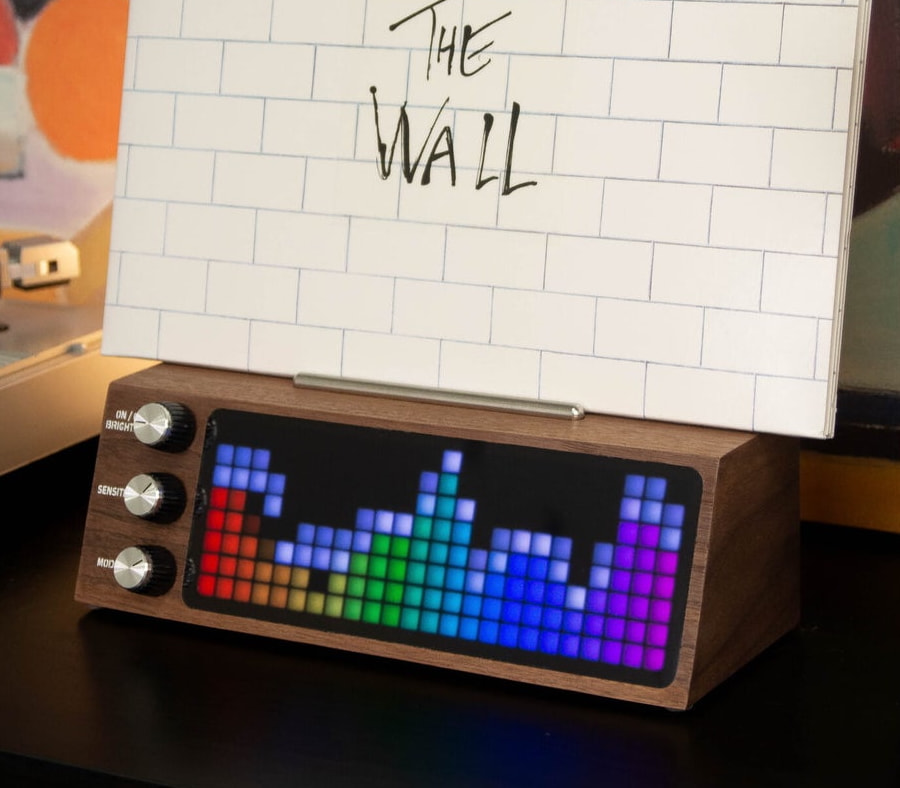
The Petru visualizer/record stand is one of those vinyl accessories that makes zero difference to the sound and still manages to be oddly compelling. It’s a solidly built, good-looking slab of wood and acrylic that holds your “now playing” LP while throwing out subtle, music-reactive lighting via a built-in microphone (or a wired connection if you want to be tidy about it). The visual effects are tasteful rather than full EDM meltdown, which matters if you don’t want your listening room to look like a Twitch stream gone wrong. Setup is dead simple, it runs off USB-C, and it does exactly what it promises: add atmosphere and a bit of theater to the ritual of spinning records. The catch? At roughly $220, it’s priced like a piece of hi-fi rather than a vibe accessory, and there’s no illusion this is anything other than eye candy.
Where to buy: $229 at Petru Designs
Best Affordable Cables
Expensive audiophile cables are a tough sell for a lot of people—and frankly, they should be. After nearly three decades of collectively lighting money on fire chasing “transformational” cables that delivered little more than lighter wallets, the skepticism is earned. That doesn’t mean better-made cables don’t matter at all. Solid construction, proper shielding, good connectors, and sane engineering can absolutely help with noise rejection and long-term reliability. What it does mean is that blowing a disproportionate chunk of your budget on a single power cord or interconnect is a terrible strategy if your goal is better sound rather than better bedtime stories.
Let’s be clear: $3,000 power cords are not some hidden path to audio enlightenment. You’ve probably noticed that reviews of these products are universally glowing—systems suddenly achieve “black backgrounds,” “holographic imaging,” and “previously unheard micro-detail.” Funny how that works. Do you honestly think a reviewer who gets loaned (or quietly discounted) four-figure cables is eager to publish a skeptical take? And do you think the manufacturer is lining up to send the next review sample if the verdict isn’t an unbroken river of praise? Please.
Ethernet cables are where this nonsense really jumps the shark. Being told that spending $1,000—or more—on an Ethernet cable will meaningfully improve a properly designed digital network is an insult to basic engineering. Bits either arrive intact or they don’t. If your system sounds better after swapping in a luxury Ethernet cable, something else changed—or you really wanted it to. Spend sensibly, buy well-made cables from reputable brands, and put the real money where it actually matters: speakers, source quality, room setup, and music. The rest is mostly audiophile theater.
Advance Paris LINK Cables

Advance Paris’ LINK cables make a refreshingly rational argument for spending real money on cabling without stepping into full-blown audiophile fantasy camp. The lineup has finally landed stateside—speaker, RCA, XLR, subwoofer, Toslink, and coaxial digital—and even with EU tariffs in play, pricing remains surprisingly sane. The message is clear and mercifully free of nonsense: OCC copper, solid connectors, good materials, and no expectation that you’ll believe a cable should cost as much as a used Honda. No $1,000 one-meter Ethernet cables, no $3,000 power cords, and no implication that your system is broken until you buy them. Advance Paris seems well aware that most consumers aren’t gullible enough to swallow that particular baguette, with a few loud forum exceptions.
Physically, the LINK cables are well judged. The black woven mesh is tightly wrapped, feels durable, and looks more premium than many similarly priced competitors, but without the absurd girth that makes some cables feel like plumbing supplies. These are flexible, easy to route, and don’t fight you when you’re working behind a rack. Advance Paris doesn’t publish detailed shielding diagrams, which will irritate the spec-obsessed, but in practical use there were no noise issues. The connectors deserve specific praise: the RCA plugs and banana connectors feel solid, properly machined, and built to survive more than a few system swaps, avoiding the flimsy “premium in name only” trap.
Sonically, the LINK coaxial and RCA cables lean slightly to the darker side of neutral. That doesn’t mean dull or veiled—it means a bit more weight through the mids and treble, less edge, and a presentation that favors body and texture over spotlighting detail. Compared directly with QED and Chord cables in the same price range, the LINK gives up a touch of their crispness in exchange for a more composed, grounded sound. There’s more flanken on the bone, but the meat is still clean and well defined. Detail is resolved without being shoved forward, which makes longer listening sessions easier on the nerves.
System matching matters, and the LINK cables played this game well. My Pro-Ject and E.A.T. tube phono stages already lean warm, while Denon and Ortofon cartridges bring speed and bite, and the LINK cables landed comfortably between those poles. The result was nothing shouty, nothing artificially glossy, and nothing slow or syrupy. Compared to the British-made QED Golden Anniversary XT, which tends to sound warm and forgiving, the French LINK adds a bit more polish and control from top to bottom. It’s less pub pint, more structured Bordeaux—still rich, but with a knowing smirk and better posture.
Taken as a whole, the Advance Paris LINK range delivers subtle tonal warmth that adds body without killing detail, competitive pricing across the entire lineup, consistently high build quality, and a flexible, easy-to-live-with design that doesn’t pretend cable thickness equals performance. The slightly darker tonal balance won’t suit listeners chasing strict neutrality, the lack of published shielding specs will bother the spreadsheet crowd, and already warm systems may find the presentation a touch too smooth. But for listeners who want high-quality cables without being talked down to—or talked into financial self-harm—the LINK series feels like a welcome dose of French sanity in a category that too often confuses confidence with credibility.
Read our review | $69-$499 at Advance Paris
QED Golden Anniversary XT Loudspeaker Cables

Loudspeaker cables remain one of the most exhausting topics in hi-fi, and after 24 years of listening to—and living with—dozens of different brands, I’m increasingly tempted to grab something at random from the toy trunk in my basement office and call it a day. That trunk, for the record, once belonged to my 19-year-old son, who decided he was far too mature for it. The irony is not lost on me. Cable discourse often feels stuck at the same developmental stage, long past the point where perspective should have kicked in.
That said, synergy is real, and pretending otherwise doesn’t help anyone. I’ve had more than a few genuinely head-scratching moments where $3,000 loudspeaker cables sounded objectively wrong with certain speakers or amplifiers—overcooked, dull, brittle, or just plain awkward. As absurd as it sounds, swapping in a basic $100 pair immediately fixed the problem. Not “different,” not “interesting,” but better. More balanced, more coherent, more musical. Expensive cables aren’t automatically superior, and in some systems they can actively get in the way. The lesson isn’t that cheap is always better—it’s that blindly chasing price tags instead of system balance is a fast way to make your setup worse, not better.
I already own multiple sets of QED loudspeaker cables—including the XT25, Reference XT40i, and Signature Revelation—and they’ve proven to be consistently affordable, well made, and genuinely useful tools for someone who has to rotate through a steady stream of loudspeakers and amplifiers. They’re neutral enough to stay out of the way, predictable enough to trust, and built well enough to survive constant swapping without falling apart. In other words, they do exactly what reviewer cables are supposed to do without demanding attention or draining the budget.
The new QED Golden Anniversary XT loudspeaker cables come in at an even lower price point than the XT25, which cost me about $130 for a six-foot pair, and that alone makes them hard to ignore. For the money, they’re a legitimate bargain. Build quality is solid, the terminations are properly executed, and the overall sound quality is clean, balanced, and free from obvious sins. They’re easy to recommend because they don’t try to be clever or flashy—they just work.
That said, none of this magically makes them the perfect solution for every system. System synergy still applies, room acoustics still matter, and personal taste hasn’t been repealed. The Golden Anniversary XT cables deliver excellent value and sensible performance, but like any cable, they’ll make more sense in some setups than others. That’s not a flaw—it’s just reality, and it’s a far more honest place to land than pretending one cable can solve everything.
Read our review | $374 at Amazon
Best for Speakers
IsoAcoustics ISO-PUCK Mini

Vibration control tweaks have always been a mixed bag, even after more than 20 years of living with platforms, cones, and assorted isolation devices. Some work well with certain components, some do very little, and results are never universal. The trouble starts when the tweak costs as much as—or more than—the component it’s meant to improve. At that point, common sense should kick in and ask why the money isn’t being spent on better hardware instead.
The IsoAcoustics ISO-PUCK mini earns credibility largely because of where the company comes from. IsoAcoustics spent decades designing radio and television studios for the CBC, where vibration control is a practical necessity, not an audiophile talking point. The ISO-PUCK mini is their most affordable product at $99 for a set of eight. Each puck measures 1.7 by 0.7 inches and supports up to six pounds, making them a realistic option for many bookshelf speakers rather than an exercise in excess.
IsoAcoustics started in the pro world with studio monitor isolation and later expanded into consumer products like speaker stands and isolation feet. The ISO-PUCK mini uses a simple approach: the top surface grips the speaker, while the bottom decouples it from the shelf or stand. In use, cabinet interaction with the supporting surface was effectively eliminated, especially in the bass, even at higher listening levels.
What the ISO-PUCK mini won’t do is fix a speaker’s inherent flaws. Bright tweeters stay bright, and small speakers don’t suddenly grow deep bass. What you get instead is tighter low-end response and improved clarity by removing unwanted vibration. At $99, it’s a sensible, engineered solution—useful, fairly priced, and refreshingly free of magical thinking.
Read our review | $114.99 at Amazon | Crutchfield
IsoAcoustics GAIA Neo
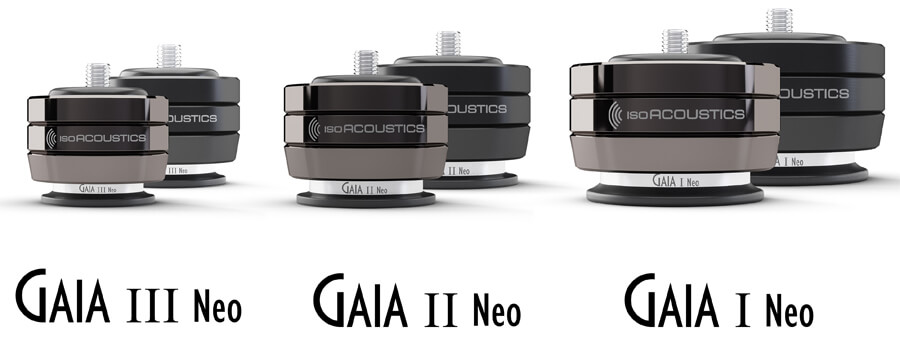
Vibration control is still one of the most misunderstood—and aggressively oversold—corners of audiophilia. This is the space where some companies will happily charge you $800 for “energy stones” that promise spiritual awakening for your soundstage. Spoiler: they don’t work. IsoAcoustics sits on the opposite end of that spectrum. Their products are widely used in professional studios, trusted by serious manufacturers, and—most importantly—actually do something measurable and audible. The GAIA Neo isolation feet build directly on that reputation, refining a design that’s been around long enough to prove it isn’t snake oil.
IsoAcoustics introduced the original GAIA series back in 2016, offering threaded isolation feet designed to decouple loudspeakers from the floor and reduce vibration feeding back into the cabinet. The GAIA Neo models take that core concept and upgrade it with improved materials, higher load capacity, and a more user-friendly design intended for everything from compact floorstanders to genuinely massive reference speakers. The goal remains the same: reduce floor-borne vibration that can smear detail, soften bass definition, and generally make very expensive loudspeakers underperform.
One of the smarter updates is the Neo’s rotating lower ring, which allows for easy height adjustment without compromising alignment—no lock nuts, no fiddling, no profanity required. The isolator housing now sits flush against the speaker base, using an integrated O-ring that compresses for a secure, properly aligned fit. IsoAcoustics also includes floor sliders, which make positioning heavy speakers far less painful. Slide them into place, tilt, remove the sliders, and you’re done. Each GAIA Neo model ships with the three most common thread sizes, covering the vast majority of speakers, with alternate threads available if needed.
It’s also worth keeping perspective. The earlier GAIA III models are still effective and noticeably less expensive, making them a sensible option for many systems. What these aren’t meant for is $500 bookshelf speakers or $1,000 floorstanders. In that scenario, the math doesn’t work—spend the money on a better amplifier or source instead. But if you’re running high-end loudspeakers anywhere from roughly $1,500 up to the truly absurd $150K tier, the GAIA Neo feet make sense. They won’t change a speaker’s voicing or fix bad design, but they will let good speakers perform closer to their potential—which, in this category, is exactly the point.
Learn more | $299-$739 at Crutchfield | Amazon
Best for Headphones
The headphone world might be smaller than full-size hi-fi, but it’s just as allergic to standardization. Between 2.5mm, 3.5mm, 4.4mm balanced, 6.35mm, XLR, Lightning, and USB-C, it doesn’t take long to realize that your shiny new headphones and your equally shiny new DAC or amp often refuse to speak the same language. Add in the industry’s fondness for “balanced only” outputs, and suddenly perfectly good headphones are sidelined for no good reason.
This is where adapters stop being accessories and start being survival gear. A well-made adapter keeps your system flexible, lets you mix and match gear without re-cabling everything, and prevents the all-too-common scenario where a new dongle DAC renders half your collection temporarily useless. Done right, adapters don’t degrade sound, don’t add noise, and don’t feel like a compromise—they simply make the modern headphone ecosystem usable. In a space this fragmented, a small investment in the right adapters saves money, frustration, and more than a few unnecessary “upgrades.”
iFi 3.5mm to 4.4mm Adapter

The iFi 3.5mm to 4.4mm Adapter is one of those small, inexpensive fixes that quietly eliminates a lot of unnecessary frustration. At $19 on Amazon, it’s an easy way to connect your favorite 3.5mm single-ended headphones to devices that now favor 4.4mm balanced outputs—without spiraling into anxiety about signal loss, questionable wiring, or flimsy build quality. It’s compact, solidly made, and does exactly what it’s supposed to do: work.
As 4.4mm balanced outputs become increasingly common—not just on iFi gear but across modern DACs and portable amps—this adapter makes sure your existing headphones don’t get left behind. No drama, no audible penalty, and no feeling that you’ve compromised your setup just to make mismatched gear cooperate. If you’re tired of staring at a perfectly good pair of 3.5mm headphones while your new device stares back with a 4.4mm socket, problem solved.
Where to buy: $19 at Amazon
ddHiFi DJ65M Adapter

The ddHiFi DJ65M (6.35mm female to 3.5mm male) is proof that something simple doesn’t automatically mean something easy. Adapters in this size category are surprisingly hit-or-miss, often plagued by loose tolerances, noisy connections, or bargain-bin construction. The DJ65M avoids all of that by using a Neutrik 6.35mm female port, a 24k gold-plated 3.5mm male jack, and high-purity OCC copper wiring, all housed in a solid machined 6063 aluminum alloy shell. At $29.99 on Amazon, it feels properly engineered rather than improvised, and it’s the kind of adapter you can trust with good headphones instead of treating as a temporary hack.
Where to buy: $29.99 at Amazon
Best Power Line Conditioner
IsoTek V5 Polaris

One of the longest-running and most tedious arguments in audio circles is whether power conditioners do anything useful—or whether they’re just expensive furniture for people who enjoy arguing on forums. When you factor in the reality that most homes are wired with bargain-grade outlets and miles of cable whose primary job is not burning your house down, it’s fair to question why anyone would spend thousands of dollars trying to “fix” what’s coming out of the wall. It all starts to feel a bit like audio Hawkins Lab: mysterious forces, dramatic claims, and very little agreement about what’s actually happening.
Over the past 28 years, I’ve owned exactly two power line conditioners. Not dozens. Not a constantly rotating stack of “reference” upgrades. Two Chang Lightspeed 6400 units that cost $650 each back in 1998—and they’re still in service. I know they work because when I unplug my two main TVs from them, the noise floor becomes visible almost immediately. Image sharpness drops, background haze creeps in, and both displays are fully ISF calibrated, so this isn’t placebo or sloppy setup. Clean power matters—but only for certain components. Some gear benefits from conditioning. Some absolutely does not. That distinction is critical, and it’s why blanket recommendations are usually wrong.
The IsoTek V5 Polaris fits squarely into the “does the job it claims” category. At $895 with the included Initium C13 power cable, it’s a compact six-outlet power-cleaning bar designed to reduce both Differential Mode and Common Mode noise while maintaining stable current delivery. Compared to the previous version, IsoTek claims nine times more Differential Mode filtering, lower resistance for better amperage delivery, a 60 percent improvement in DC resistance, and upgraded surge protection rated at 45,000A. All of that comes in a chassis that weighs just over five pounds and doesn’t dominate your rack.
Each outlet is isolated and references a central PCB with doubled copper loading and silver plating to prevent noise from hopping between components. IsoTek’s delta filter topology delivers more than 20 dB of noise reduction at 1 kHz and roughly 42 dB at 10 kHz—right where RFI tends to get annoying. Internal wiring is silver-plated 6N oxygen-free copper with an FEP dielectric, and IsoTek’s KERP design helps ensure consistent resistance across all outlets. It supports 100–240V operation, up to 10A, handling 1,150W at 115V or 2,300W at 230V, depending on where you live.
In real-world use, the V5 Polaris makes its case most clearly with source components and displays, where reduced noise actually translates into visible and audible improvements. Power amplifiers are another story—I’d still plug those straight into the wall unless you know exactly what you’re doing. The takeaway is simple: the IsoTek V5 Polaris isn’t magic, it won’t fix bad gear, and it won’t justify itself to skeptics who think all conditioning is snake oil. But used correctly, in the right system, it does what a power conditioner is supposed to do—clean up the mess without getting in the way.
Where to buy: $895 at Crutchfield
The Bottom Line
Accessories are where common sense goes to die if you’re not careful. Cables, isolation devices, adapters, and power products can absolutely improve a system—but only when they’re used rationally, priced sanely, and applied to gear that’s actually worth optimizing. Spend real money on speakers, amplification, sources, and rooms first. After that, well-made cables, proper isolation, smart adapters, and selective power conditioning can refine performance, improve usability, and lower noise without veering into audiophile cosplay. What they won’t do is fix bad gear, override poor system matching, or justify prices that rival core components. The moment an accessory costs more than what it’s supposed to help, you’re no longer tuning a system—you’re subsidizing mythology. Buy the stuff that’s engineered, proven, and priced like it exists in the real world, and skip the rest.
Related Reading:
- Stranger Things Strike Again: IsoAcoustics, IsoTek & the Great Weiner Resurrection: Editor’s Round-Up
- Best Headphone Accessories For Beginners: Affordable Upgrades Without The Head-Fi Hype
- Best Bookshelf Speakers: Editors’ Choice





















Anton
December 26, 2025 at 12:10 pm
The VPI is such a waste of money at this point. From $650 to its current price is utterly ridiculous. Nothing has changed about it. Just greed on their part.
The HumminGuru does a better job for a lot less money.
IsoAcoustics makes legitimate stuff. Have a pair of their Aperta stands and they are invaluable.
Ian White
December 26, 2025 at 3:53 pm
Anton,
So the VPI HW 16.5 has survived the test of time, but it has a few flaws.
The vacuum is uncomfortably loud and it eventually moved me to sell my 8 year-old unit.
The reservoir was a PITA to deal with.
The price increase has been hard to ignore because the changes to the cabinet and overall performance are not worth an additional $700. It will last forever and it cleans well, but the price is hard to justify.
IW
barryb
December 27, 2025 at 3:38 pm
Thanks for letting us know about Hummminguru.
Depending on the system specifics, power cords can be the most important element in the wire game. In my experience, the more resolving a system, the more important cables become – even digital cables.
It’s not a matter of just ones and zeros. We now have a better understanding of why digital sound so different. They need to be very high speed to prevent adding jitter. This is audible. There are things you can do to a digital cable to make it sound much worse, though it transmits all the data. Put a ferrite choke on it. Put it in a vibrating environment. There are things that can help – better connectors, damping on the connectors, a Shun Mook jacket over the cable.
Generally, audiophiles are not suckers. They are the shrewdest consumers I’ve ever seen. When they spend their money for sound, they generally get better sound (according to their tastes).
Many times in audio the engineering goes way beyond simple engineering analysis. Look to the people who do the best engineering – like Wadax – they consider factors you’ve never dreamt of.
Ian White
December 27, 2025 at 4:11 pm
Barry,
You made me laugh at the Shun Mook mention. Audiophiles are indeed suckers if they think that’s not a rip-off. Power cables are hit and miss. I use third-party power cords on my Cambridge Edge A, network players, and wireless speakers but within reason. $500 power cords on a $500 network player are dumb. $1,000 ethernet cables are a total rip-off. I’ve had manufacturers send me their “best” in that category and the improvements were so minimal, that I sent them back and didn’t waste time writing it up.
We all agree that digital (and analog) can sound very good or nothing special for the money. I would rather steer readers and people who are not audiophiles toward products that will genuinely improve their listening experience; better loudspeakers, amplifiers, and sources.
The feedback from readers (letters we don’t publish) is that high-end accessories only turn people off and their improvement for the money makes the industry look bad.
IW