Table of contents
Introduction
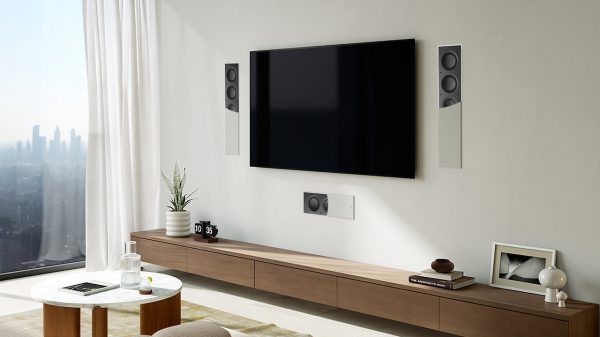
In-wall and in-ceiling speakers have come a long way, and the old assumption that you’re “settling” just because the speakers disappear into the architecture is badly outdated. Done right, architectural speakers can deliver serious sound quality—and when it comes to Dolby Atmos, in-ceiling speakers aren’t a compromise at all; they’re the correct solution for height effects.
What’s changed, especially since COVID, is the level of performance now available in these categories. Many manufacturers have expanded their architectural lineups dramatically, and the best in-wall and in-ceiling models are now voiced to match their bookshelf and floorstanding speakers, often using the same high-end drivers and trickle-down technology. In some cases, performance has reached a point where these speakers can rival—or even outperform—certain freestanding models. That kind of performance doesn’t come cheap. Nor should it.
Choosing the right architectural speaker isn’t just about specs on a page. Placement, room construction, listening goals, and system integration all matter, which is why most people are better served working with a qualified custom integrator—unless you truly know what you’re doing. These speakers need to be wired properly, installed correctly, and dialed in with the rest of the system to deliver what they’re capable of.
The speakers on this list are ones I’ve personally installed, reviewed, or heard extensively in demos. As a general rule, I favor in-ceiling models with larger woofers. They sound fuller, richer, and deliver more convincing bass—especially important in distributed audio systems where a subwoofer often isn’t part of the plan. Whether you’re building a dedicated home theater, a custom media room, or adding high-quality two-channel audio throughout the house (including outdoors), there are outstanding architectural options available. Pair them with a knowledgeable integrator, and you’re not just hiding speakers—you’re building a system your entire family can enjoy for years.
Monitor Audio Creator Series

Monitor Audio recently did a complete revamp on its architectural line-up, and the result is the new Creator Series. The “sweetspot” of this line-up is the Tier 2 speakers, which features the same Rigid Surface Technology II drivers found in the company’s Silver 7G line-up. I always recommend going with an 8-inch driver if possible, as it gives fuller, richer sound, but Monitor redid its speaker design with this series, and now the large speakers feature a 9-inch woofer in the same form factor/cutout as an 8-inch woofer.
If you’ve got the budget – and a room the demands higher performance, step up to the Tier 3 speakers which use drivers and technology ported down from Monitor’s Platinum series. The C3L speakers produced some of the best sound I’ve heard from in-ceiling speakers, with crystalline detail. If you need an in-wall, the rectangular W3M use Monitors MPD II transducer to deliver incredible detail and musicality!
- Tier 1: $399 – $649 at Crutchfield
- Tier 2: $599 – $1,379 at Crutchfield
- Tier 3: $1,099 – $3,379 at Kevro
Origin Acoustics Director Series

Not only are Origin Acoustics Director Series speakers among the easiest architectural models to install, they also sound legitimately excellent—and the range is broad enough to fit almost any application. The lineup runs from the compact 3-inch D39 all the way up to the flagship 10-inch D109, which is capable of reaching down to a claimed 25Hz—serious bass territory for an in-ceiling design.
I use the D105 speakers in my dining room, and the jump in low-end performance from the larger 10-inch woofer is not subtle. There’s noticeably more weight, depth, and scale, giving music a fuller, more convincing presentation whether it’s playing quietly in the background or pushed to more realistic, concert-level volumes. It’s a great example of why larger architectural speakers—when installed correctly—can deliver real, room-filling performance without ever calling attention to themselves.
Revel PerformaBe Architectural

Ever since I heard Andrew Jones give a demo of his TAD Reference One loudspeakers at CES, I’ve been a sucker for a beryllium tweeter! I also love the (still expensive but much more affordable!) performance of Revel’s PerformaBe line-up, which feature beryllium tweeters for terrific detail. So, it’s not much of a stretch to say I love the sound of the PerformaBe Architectural series which all feature the same 1-inch beryllium tweeter as found in the company’s PerformaBe line-up. If there’s a room where you demand uncompromised performance but can’t install a free-standing speaker, or need the perfect surround and height speakers to match for your Revel front channels, these will deliver!
- W126Be (2-way 6.5-inch in-wall) $1,925 at Crutchfield
- W226Be (2-way dual 6.5-inch in-wall) $2,475 at Crutchfield
- W228Be (3-way dual 8-inch in-wall) $3,850 at Crutchfield
- C128Be (2-way 8-inch in-ceiling) $1,650 at Crutchfield
JBL Synthesis

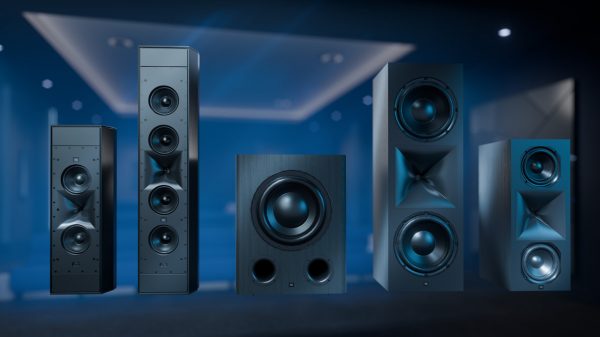
JBL speakers are used in more commercial movie theaters than just about anyone else, and the company’s Synthesis lineup is as close as you’re going to get to real cinema sound in a home environment without calling an architect and a structural engineer. You could use Synthesis speakers for distributed audio, but let’s be honest—that’s not really their mission. These are built to shine in dedicated home theaters, and that’s where they make the most sense.
The Synthesis range is broad and deliberately modular, with freestanding, in-wall, and in-ceiling models all designed and voiced to work together. That mix-and-match flexibility makes it easier to build a cohesive system without sonic mismatches as you move around the room. A defining trait of the Synthesis design is the use of compression tweeters paired with High-Definition Imaging (HDI) horns, a combination that delivers serious dynamics, high SPL capability, and the kind of effortless impact that makes movie soundtracks feel alive.
At CEDIA Expo this past year, a full JBL Synthesis system more than held its own against systems costing ten times as much—proof that you don’t need to spend a million dollars to get genuinely cinematic sound at home. You still need the room, the calibration, and the right installer—but on the speaker front, Synthesis delivers the goods.
- SCL-5 7-inch 2-way In-ceiling ($2,200 each)
- SCL-6 Quad 5.25-inch 2.5-way In-wall ($1,650 each)
- SCL-7 Dual 5.25-inch 2-way In-wall ($1,100 each)
- SCL-8 5.25-inch 2-way In-ceiling ($1,100 each)
Theory Audio Design

One of the things I genuinely admire about Theory Audio Design is that they don’t play the usual product-ladder game. There’s no “good, better, best.” They only do best. When it comes to architectural speakers, that philosophy is taken to its logical extreme: just three models—the iw25 in-wall and the ic5 and ic6 in-ceiling speakers. That’s it. No filler.
All Theory speakers use compression tweeters, and they are built to play loud—with SPL peaks exceeding 118 dB when properly deployed. While reviewing the system, an opening gunshot in Dunkirk quite literally made me jump in my seat. That kind of dynamic shock doesn’t happen by accident. Theory takes a system-based approach, meaning the speakers are designed to be used with the company’s DLC Amplified Loudspeaker Controller, which handles both amplification and DSP to extract maximum performance. If you have a room—or multiple zones—that demand serious output without falling apart sonically, Theory has a solution that doesn’t blink.
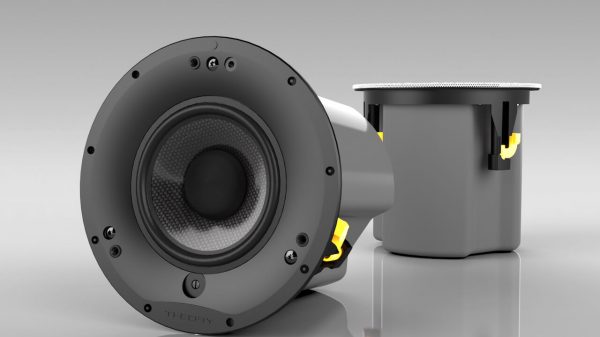
The ic6 is labeled an “in-ceiling” speaker, but that description barely scratches the surface. This is a highly versatile point-source coaxial design that works just as well in ceilings, walls, surface-mount cabinets, or even pendant enclosures. At its core is a 1.4-inch advanced polymer compression driver concentrically mounted within a 6.5-inch carbon fiber woofer. Frequency response is rated at 68 Hz-23 kHz (-3 dB). Yes, it can be paired with a subwoofer—but it doesn’t need one to sound complete. The sense of fullness, dynamic slam, and sheer scale from a speaker this size is, frankly, ridiculous.
More recently, Theory introduced the ic5, a more compact in-ceiling speaker featuring the same 1.4-inch advanced polymer compression driver, except with a 5-inch carbon fiber woofer. It brings much of the ic6’s performance DNA to a smaller footprint for residential, commercial, and even marine applications offering up to 114 dB of output across a wide 120° coverage area. Translation: even the “bad seats” in the room get clean, intelligible, and impactful sound.
Bottom line? Theory Audio Design doesn’t make architectural speakers for people who want background noise. They make them for people who want real dynamics, real scale, and zero compromise—and are willing to do it right.
- ic5 – $695 each
- ic6 – $1,000 each
- iw25 – $1,500 each
Triad TS-IC83

This is my company’s go-to architectural speaker for most projects. It hits the sweet spot between price and performance, delivering consistently good sound throughout the house without pretending it needs to be something exotic. And let’s be honest—you’re not heading into the bathroom for critical listening sessions, and you don’t need to spend a small fortune to enjoy music that sounds right while you’re getting ready in the morning.
Built around an 8-inch woven carbon-fiber woofer, the speaker plays down to 42Hz, which is more than enough low-end weight for most distributed audio applications where a subwoofer isn’t part of the plan. High frequencies are handled by a pivoting 1-inch silk-dome tweeter, allowing you to aim the highs back into the listening area for better clarity and balance—an often overlooked but genuinely useful feature.
Because Triad is a company that lives and breathes custom installation, flexibility is part of the appeal. The speaker can be ordered with a black or white painted grille, or finished in any custom color you specify, making it easy to integrate cleanly into just about any space. It’s a practical, well-thought-out solution that sounds good, installs easily, and makes a lot of sense for real-world homes.
Canvas HiFi
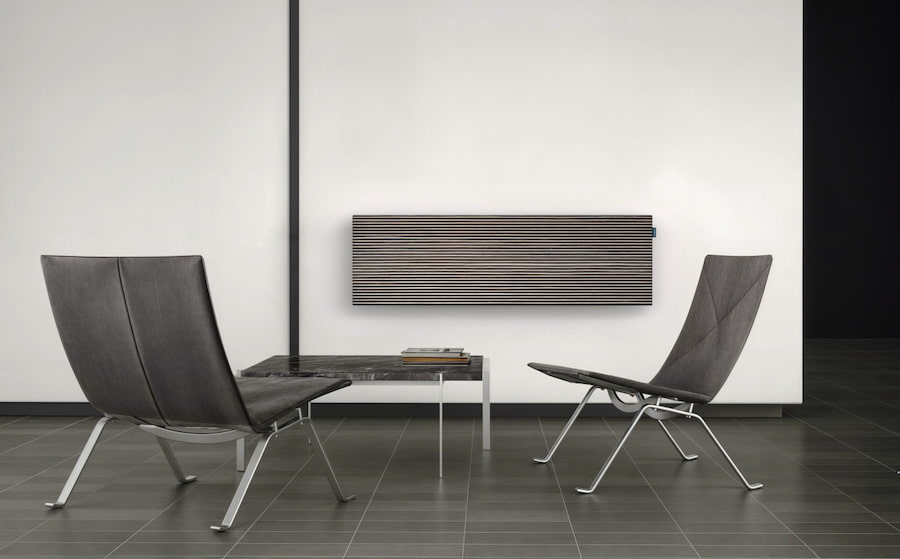
As an on-wall audio solution, eCoustics Founder, Brian Mitchell has been very impressed with Canvas HiFi’s ability to fill a room with rich, dynamic sound. Although technically it’s a “soundbar,” it functions extremely well as a standalone all-in-one wireless speaker system thanks to its included mounting bracket. Just connect to power, and stream from Spotify over Wi-Fi or Bluetooth in seconds. It’s hard to believe an on-wall speaker is that easy to use and setup, when most competing in-wall solutions require passive speakers wired to an equipment rack.
Additional tuning only takes about 90 seconds from a companion phone app that optimizes sound to your room’s acoustics, while ground-breaking Bacch 3D audio processing creates incredibly enhanced soundscapes. Simply put, the speaker has an uncanny ability to disappear in the room while offering a soundstage that is far wider and taller than its size would suggest. And because it delivers full-range sound down to 30Hz, there’s no need for the added complexity of a subwoofer. Even off-axis and low-volume background listening is pleasant, without being distracting.
Not only is Canvas HiFi’s sound captivating, but its design is too. Interchangeable grilles pop on/off in various widths, styles and colors, either in fabric or slatted wood finishes. When used under a TV, different sized grilles can be purchased that match the width of 55- to 85-inch TVs to create a seamless look.
Thanks to its versatility, design, and sound, Canvas HiFi is the one to beat.
SVS 3000 In-wall Subwoofer

When given my druthers, I would almost always opt for an in-room subwoofer versus an in-wall subwoofer as the price/performance ratio favors a freestanding sub. However, if you have a room/spouse that doesn’t allow you to plop down a giant sub on the floor, then the SVS 3000 In-Wall is one of the best performers I’ve heard. The 3000 In-wall features dual 9-inch high-excursion drivers in an ultra-rigid aluminum cabinet that delivers the kind of massive low-end performance that you’d expect from SVS, rated +/- 3dB at 22 Hz! I’ve installed this on several projects and this sub always delivers. And like most of SVS’ products, the 3000 In-Wall comes at a price that won’t destroy your budget. If you’re going to go with this, spend the extra $1000 and get a dual sub system. This will deliver smoother, deeper bass across more seating positions and deliver a tactile low-end you can feel!
JL Audio Fathom IWS

If there’s an in-wall subwoofer that one-ups SVS, it’s the JL Audio Fathom In-Wall—and it’s not particularly subtle about it. If you’ve got the budget and the requirement for an in-wall solution, this is the one you spec when compromises aren’t on the menu.
A single 13.5-inch Fathom IWSv2 with its dedicated amplifier will set you back about $7,200, and a dual-sub setup pushes to $11,600. That’s real money, but the performance justifies the ask. A big part of what makes the Fathom so effective is its unique “floating” mount design, which minimizes vibration transfer into the wall structure and lets that massive 13.5-inch driver move serious air without turning your framing into a sympathetic resonator.
The catch—and it’s a real one—is installation. This isn’t a casual retrofit. Expect significant wall surgery unless the sub is planned in from the start during new construction or a major remodel. But when installed correctly, the payoff is undeniable. The Fathom In-Wall delivers true in-room subwoofer performance while remaining visually discreet, and for high-end installs where the brief calls for the best possible bass without visible boxes, there’s simply nothing better.
Related Reading: