Noble Audio isn’t some overnight TikTok brand pretending to know acoustics. The Wizard, John Moulton, has been building serious in-ears since 2013, earning a loyal following with wired models like the Katana and Sage before unleashing increasingly wild custom designs such as the Sultan. That craftsmanship eventually bled into wireless, first with the Falcon and Knight, and then with the FoKus lineup—a series built on the idea that wireless IEMs don’t have to settle for bargain-bin driver counts or flavor-of-the-month tuning.
The FoKus Rex5 was the first real warning shot: five drivers per side, a 4-way crossover, LDAC, aptX Adaptive, and Audiodo sound personalization—basically a custom IEM disguised as “wireless.” Yes, plenty of cheaper competitors tout LDAC, but they’re usually a single dynamic driver or a basic hybrid. A true DD + Planar + 3x BA wireless architecture is almost unheard of at any price, let alone $449, which made the Rex5 a bit of a technical marvel.
Of course, that level of ambition comes with headaches—battery life, housing size, weight—but Noble somehow kept it sane and comfortable. Honestly, the bigger surprise was that it didn’t cost more.
And now, in 2025, Noble is throwing a bone to listeners who want the FoKus DNA without the FoKus price. Enter the FoKus Amadeus, a streamlined sibling that swaps the Rex5’s complex driver stack for a newly developed 8.3mm triple-layer dynamic driver while keeping much of the tech and sonic philosophy intact. It’s a “simplify, not downgrade” strategy—and for a company known for custom-level builds, it’s a smart one.
Noble FoKus Amadeus Unboxing and Build: What You Actually Get
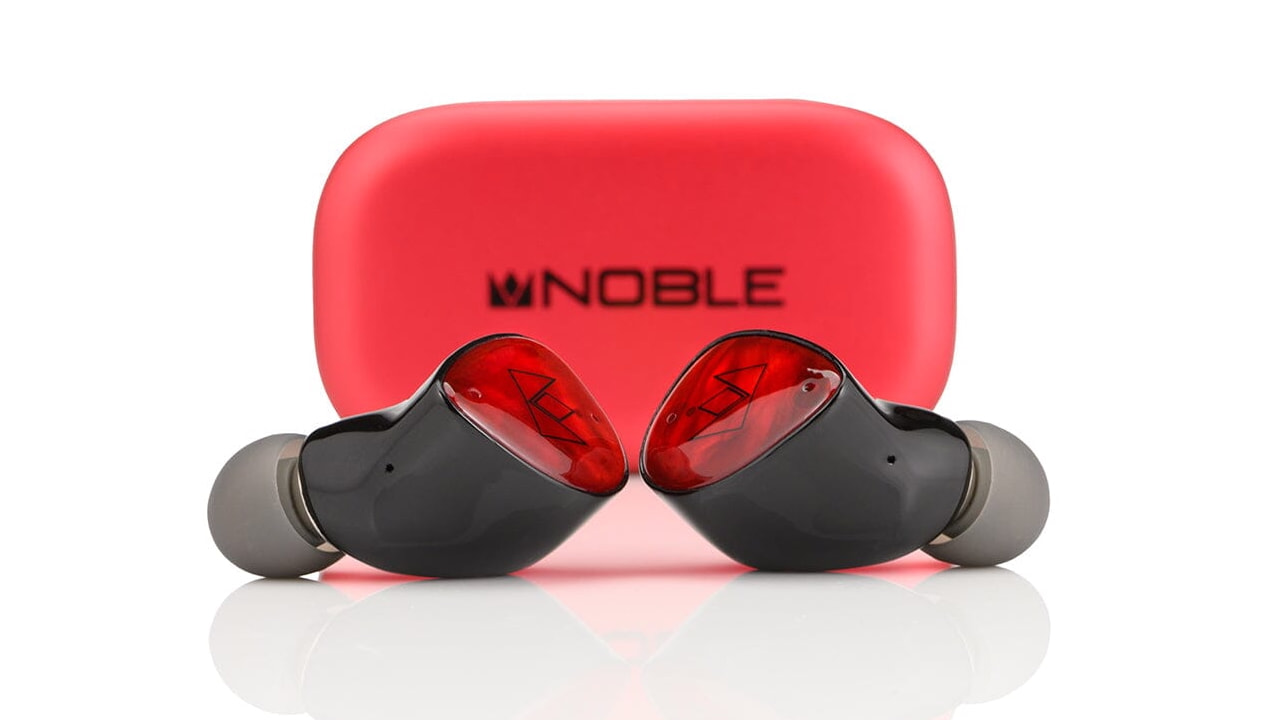
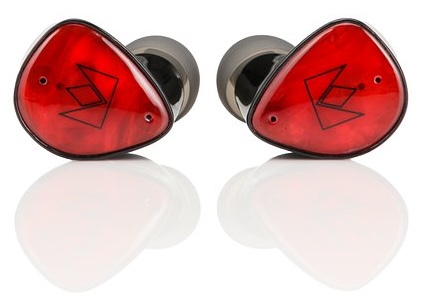
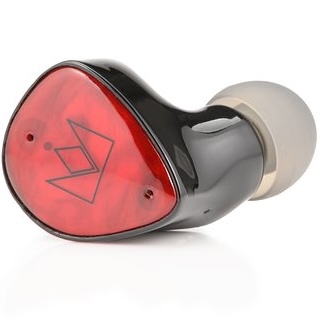
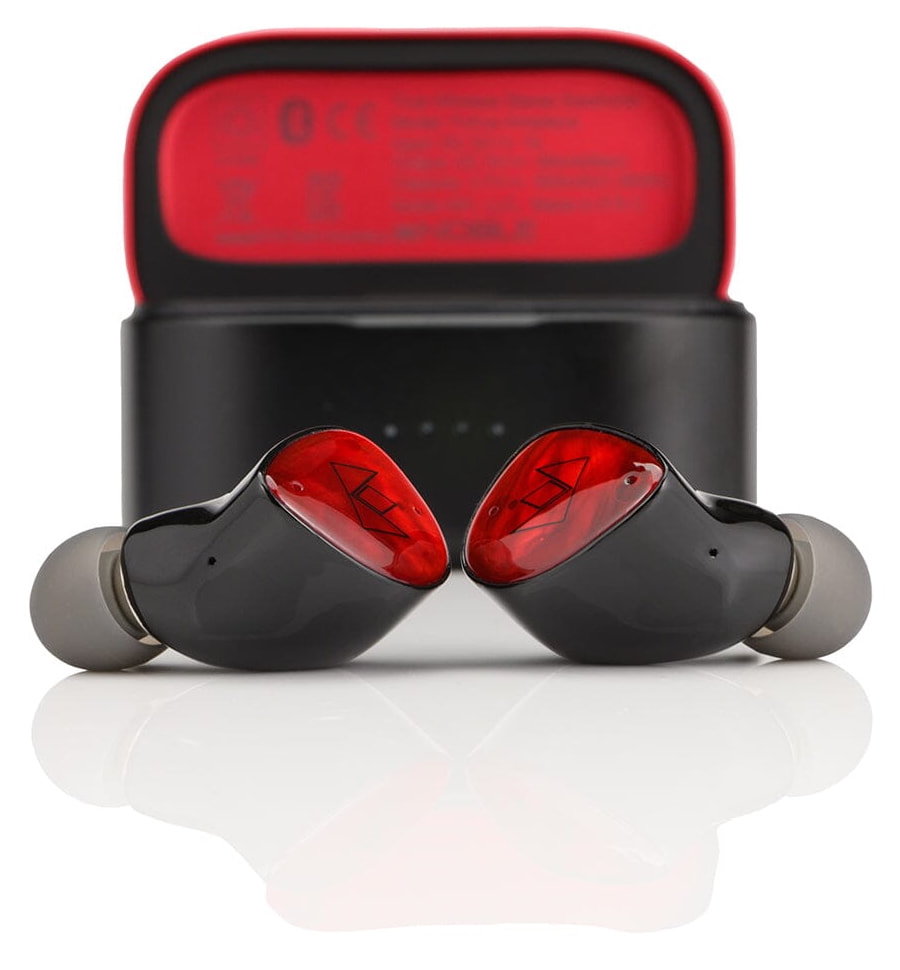
The Noble FoKus Amadeus arrives in retail-friendly packaging, complete with a peg-board hanger and a front panel that loudly flexes its LDAC and aptX Adaptive support. Flip it over and you get the full spec rundown. Slide off the outer sleeve, lift the lid, and the earpieces and charging case sit neatly in a foam surround. And, to paraphrase Henry Ford, you can have any color you want—as long as it’s red. The case lid and faceplates share a deep crimson finish, while the rest of the shells stick to a flat black that keeps things understated.
Under the foam you’ll find the manuals, pouch, charging cable, and six sets of ear tips, because Noble likes to make sure you don’t run out of fit options.
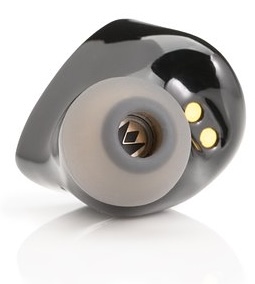
The earpieces themselves use a familiar inverted teardrop profile: a semi-circular faceplate, a custom-shaped inner shell a bit over a centimeter deep, and an aluminum nozzle with a defined lip for tip security. Two charging pads sit tucked between the concha spur and nozzle. The inner shell is smooth, the faceplate has dual pinhole vents, and overall dimensions land in the “large depth, medium everything else” category.

On the scale, the earpieces came in at 4.2 grams each (without tips) and the case at 55.5 grams empty—solidly middle-weight compared to similarly spec’d competitors. The result is an in-ear that fits comfortably enough but sits slightly proud of the ear, with about half the shell depth riding outside.
Inside the FoKus Amadeus: Drivers, Tuning, and Core Technology
The Noble FoKus Amadeus runs on Qualcomm’s QCC3091, giving it Bluetooth 5.4 with support for aptX Adaptive, LDAC, legacy aptX variants, AAC, and SBC. Power comes from a 65mAh cell in each earpiece, which translates to roughly 9-10 hours of playback under normal conditions. Keep the volume modest and ANC off and you can push closer to 12 hours; turn on every feature and you’ll land just under 8 hours. The charging case adds about three full recharges, for a total of around 40 hours before you need a wall outlet. Quick charging and wireless charging are both onboard—Noble didn’t cheap out on the basics.
Inside, Noble uses a newly developed 8.3mm dynamic driver with a triple-layer diaphragm. As usual, the company isn’t spilling much about the materials or construction, but it’s safe to assume it builds on the tuning philosophy behind the Rex and Prestige Encore, along with Noble’s wired models. Specs list a 37Ω nominal impedance, 113 ±2 dB sensitivity at 1 kHz, and a frequency range of 20 Hz – 20 kHz.
With a 3mW output ceiling, the Amadeus isn’t a volume monster. It can hit hard when called for, but if your goal is “eardrum roulette,” these aren’t the earbuds for you. Noble tuned them for quality over brute force—and they behave exactly like that.
FoKus Amadeus App & Touch Controls
The FoKus Amadeus uses touch sensors on each faceplate, and the default layout is straightforward: a single tap on either side handles play/pause and call control; a double-tap on the left raises volume while the right double-tap goes to the previous track; triple-tap left lowers volume, and triple-tap right skips forward. If that layout feels backwards or cramped, the Noble app lets you fully remap the controls, which is a welcome bit of flexibility.
The app’s real focus, though, is tuning. You get a 10-band EQ with presets for jazz, pop, classical, folk, rap, and a default curve. There’s also Audiodo’s personalized tuning, which runs a hearing test and builds a custom profile based on the results. For quicker adjustments, Noble includes a Dark/Bright tonal slider and a simplified 3-band EQ with broad strokes for bigger sonic shifts.
ANC and Transparency Mode are also controlled through the app. I ended up assigning ANC to one of the touch gestures so I could toggle it when paired to devices—like PCs—that don’t support Noble’s app at all.
One last note: firmware updates require the app, so even if you don’t use the EQ features, you’ll want the app installed for updates and control customization. Noble’s wireless line evolves quickly; skipping updates isn’t a great idea.
Listening
Sub-bass digs reasonably deep, but it’s not here to steal the spotlight. The mid-bass takes the lead, stepping forward with good control and a cleaner presentation than you typically get from wireless earbuds in this price range. What you don’t get is brute-force impact—slam and cinematic rumble aren’t the Amadeus playbook. This tuning prioritizes texture and articulation over theatrics, and the bass behaves exactly like a well-disciplined neutral tuning should: present when the track demands it, invisible when it doesn’t.
The lower mids carry solid weight with no bass bleed creeping in, so male vocals cut cleanly through the mix while still sounding natural. Guitars have a hint of bite but feel ever so slightly smoothed by the tuning. Strings show good timbre with a touch of upper emphasis that adds the energy they need to sound lifelike. Piano lands with convincing weight in the lower registers and thins predictably up top.
Upper vocals sit a step ahead of the lower ones, giving the presentation a bit of lift without drifting into harshness—Noble clearly wanted clarity, not glare.
Most of Audiodo’s personalization magic targets the midrange and lower treble, and I ran multiple profiles to see how much the tuning could be pushed. The problem is the test itself—there’s no clean way to “game” it without second-guessing your own ears, either pretending to hear things you didn’t or ignoring things you clearly did. After a few rounds, I found that while Audiodo added more body and density to the mids, it also thickened the presentation enough that I preferred the cleaner, more open sound with personalization switched off.
There’s a noticeable lift in the lower treble, which gives percussion some welcome snap and helps upper vocals step forward, but otherwise the treble is best described as smooth and polite. That doesn’t mean “lacking detail”—the information is there—but Noble keeps it firmly on the non-fatiguing side. Cymbals carry slightly less energy than you’d hear in a truly accurate reproduction. Don’t expect a lot of sparkle or air up top; instead, the Amadeus opts for small, controlled boosts that brighten the mix just enough without offending the treble-sensitive.
The Amadeus delivers a surprisingly solid soundstage, with more width than depth and an above-average sense of height. I don’t usually expect expansive staging from in-ears—especially ANC-equipped ones—so it was a pleasant surprise to hear the Amadeus present a space that feels larger and better proportioned than most wireless competitors.
Imaging is clean and reliable, making it easy to position instruments across the stage even if overall separation is only average. One area where the Amadeus overperforms is stereo separation. The left/right distance feels wider than usual, giving instruments more room to breathe and allowing panning effects to move with real presence. That extra space helps with pinpointing specific cues in a mix, and in a pinch, the Amadeus could even pull double duty for casual gamingthanks to that spatial clarity.
ANC & Transparency Performance
The Amadeus lands squarely in the middle of the ANC pack. It’s not competing with the class leaders, and passive isolation isn’t its strongest suit either, so the ANC is best thought of as a way to reduce outside noise rather than erase it. Manage your expectations and it does its job: most environmental sounds drop to a level that’s easy to ignore so you can stay focused on the music. But if you’re banking on the Amadeus to survive a cross-country flight with a screaming toddler two rows back, you’ll probably wish for stronger attenuation.
Transparency mode is similarly situational. It works well as long as you keep playback volume modest; once you turn things up, the music overwhelms outside voices. I found transparency most useful below roughly 65 dB, where ambient sounds still cut through without competing with the track.
The Bottom Line
The Noble FoKus Amadeus slots neatly into Noble’s lineup as a semi-custom, boutique-leaning wireless IEM priced like a mainstream flagship. Instead of chasing the usual V-shaped “big brand” tuning, the Amadeus takes a more disciplined approach with a neutral signature centered on midrange clarity and lower-treble lift. That alone makes it stand out in a category obsessed with bass quantity. It’s a far better match for jazz, classical, acoustic, and anything where tone and texture matter more than artificial excitement.
Sonically, it delivers clean lows, natural mids, smooth treble, and staging that’s better than most ANC-equipped wireless IEMs. Imaging is reliable, stereo separation is wider than expected, and the triple-layer 8.3mm driver keeps things controlled rather than flashy. The trade-off is that the Amadeus won’t satisfy bass-heads, sparkle-chasers, or anyone who wants a fireworks show in the top octave. Output power is modest too—great for normal listening, not ideal for those who like to test the limits of their eardrums.
Feature-wise, the Amadeus offers excellent battery life, wireless charging, and a customization suite that’s actually useful. Noble’s app is basic outside the tuning tools, but the 10-band EQ, Dark/Bright slider, and Audiodo personalization make it one of the more capable tuning platforms in the TWS space. ANC and Transparency, however, land firmly in the middle of the pack: good enough to take the edge off the environment, not strong enough to compete with Sony or Apple on long flights or loud commutes.
For listeners who want a neutral, mature, custom-influenced wireless IEM without paying custom prices, the Amadeus hits its target cleanly. It excels in clarity, timbre, staging, ergonomics, and value for a boutique product. It falls short only in areas where Noble clearly chose restraint—ANC strength, ultimate treble air, and visceral low-end punch. If your priorities lean toward accuracy and refinement instead of quantity and hype, the FoKus Amadeus is one of the more compelling TWS choices in its price bracket.
Pros:
- More neutral than most TWS, with solid midrange weight
- Strong battery life with fast and wireless charging
- Excellent tuning options, including 10-band EQ and Audiodo personalization
- Good soundstage and stereo separation for a wireless IEM
Cons:
- Slight veil and smoothing in parts of the signature
- Limited to a single color (red/black)
- ANC is only mid-tier compared to class leaders
- Output power is modest at higher volumes
Where to buy:
Related Reading:
- SOUNDPEATS Air5 Pro+ Launch: XMEMS Drivers, AI ANC, And Lossless Bluetooth For Under $130
- Noble Audio Launches FoKus Prestige Encore: Luxury Wireless Earbuds With High-End Design And Sound
- AirPods Pro 3 Review: Better Features, Worse Sound — Apple’s Backward Step In Audio
- Final’s TONALITE Wireless Earbuds Use Advanced 3D Head And Ear Scanning To Deliver Personalized Sound And Timbre Control