Edifier isn’t wasting any time. It feels like the MR4 barely cooled off on my stands before the new MR5 showed up at the door — a bigger, pricier, and far more ambitious follow-up aimed squarely at budget-conscious creators who want real studio performance without real studio invoices. Edifier, the same Chinese conglomerate that owns Stax and partners with Phil Jones on AirPulse, usually keeps its own-branded gear in the “sane money” category. The MR4 proved that point at $169 with more performance than anyone expected.
But the Edifier MR5 doesn’t replace it — it leapfrogs it. At $349 USD, this isn’t a minor refresh; it’s Edifier taking a confident step up the ladder and daring you to ask whether the extra spend is actually worth it. That’s the question this review is here to answer.
Edifier MR5 Unboxing & First Impressions
The box is noticeably larger than the MR4’s and carries more heft, tipping the scale at just under 25 pounds (11 kg). Inside, Edifier keeps things straightforward: a quick-start guide sits on top, the speakers are well-protected in dense foam, and all accessories are tucked into their own compartment to prevent the usual shipping carnage.
You get everything you need right out of the gate — a power cable, a proprietary DIN speaker-link cable that stretches a useful 98 inches (2.5 meters), a 3.5mm-to-3.5mm cable, and a 3.5mm-to-RCA cable. With both wired inputs and wireless support on board, setup is a plug-and-play affair. No mystery boxes, no missing pieces, just open, connect, and get listening.
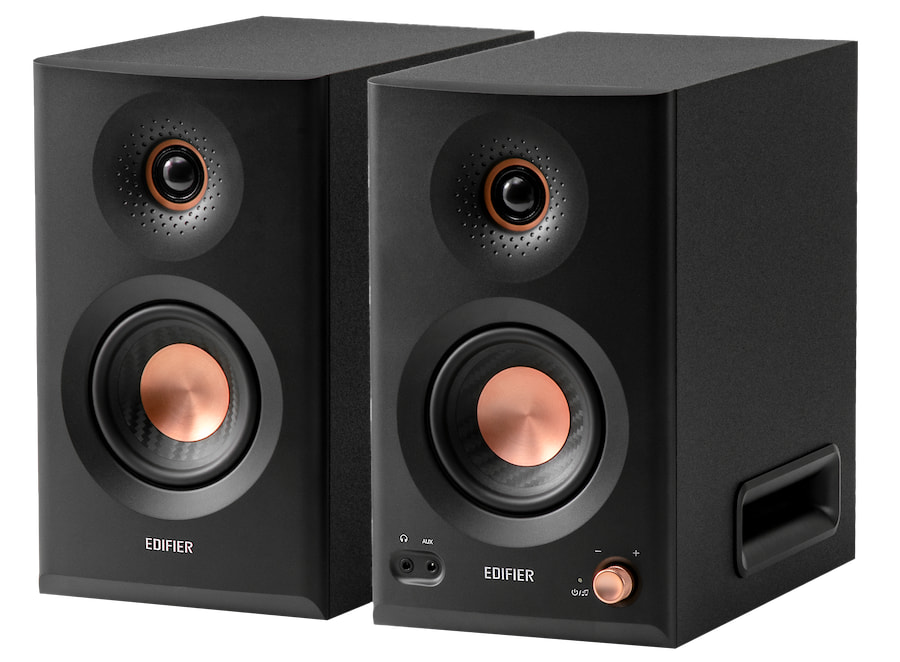
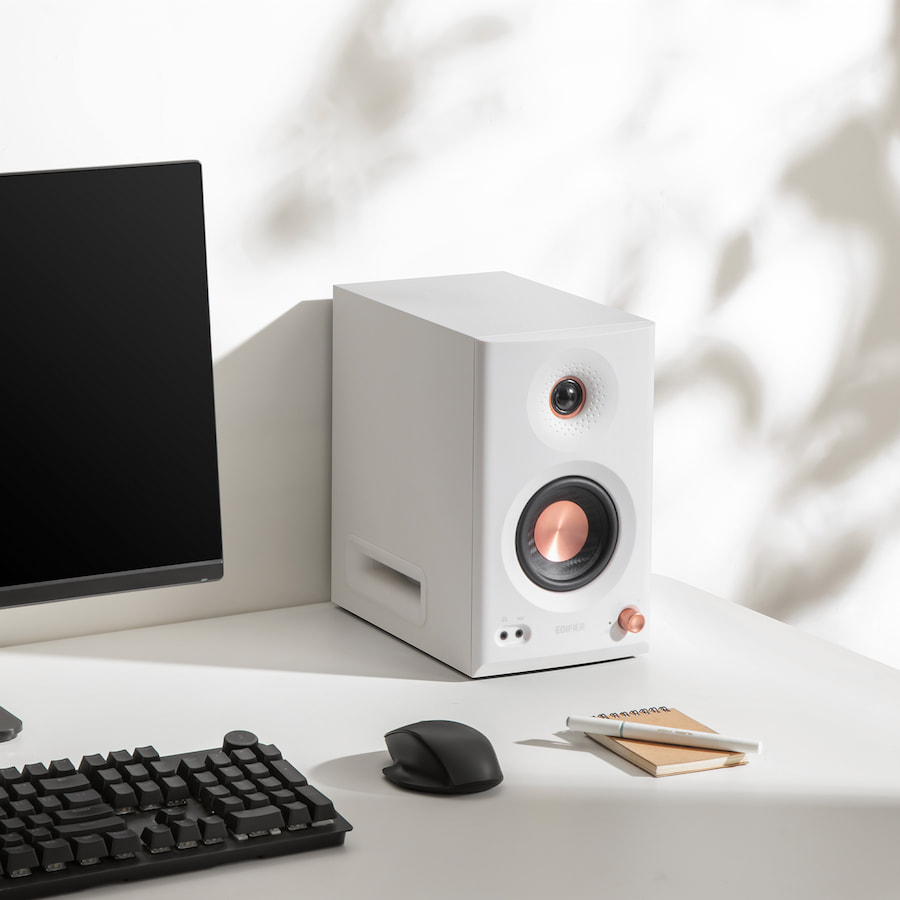
Edifier keeps the visual options simple: black or white, consistent with the rest of the MR lineup. Our review unit arrived in black, and the finish is clean, understated, and appropriately studio-leaning. The MR5 is noticeably larger than its MR4 sibling, standing just under 10.5 inches (264 mm) tall and 6.3 inches (160 mm) wide. Depth varies slightly between the pair; the active right speaker runs 11 inches (280 mm) deep thanks to its front and rear controls, while the passive left speaker is a bit shorter at 10 inches (257 mm).
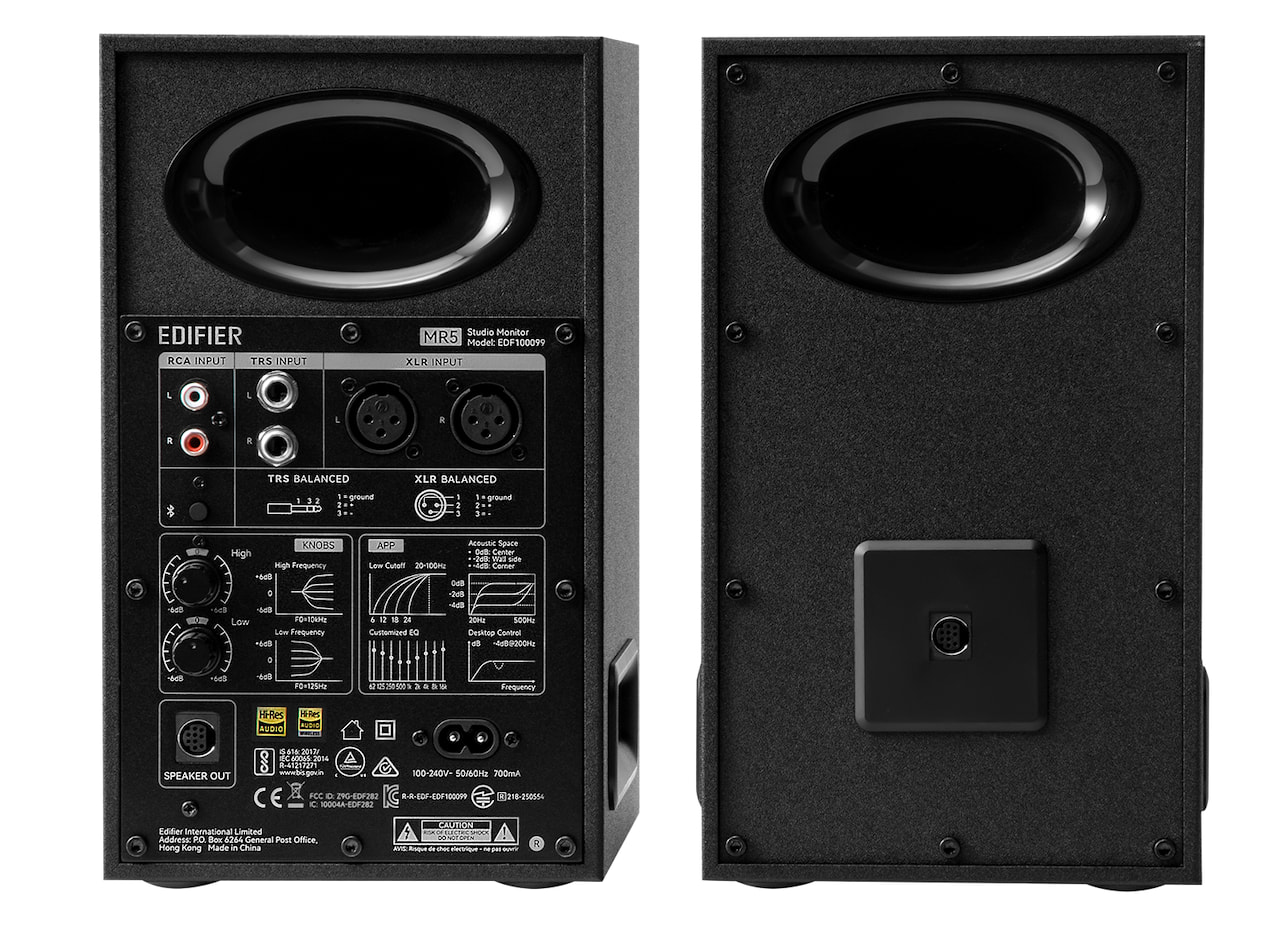
Both monitors use a large rear-firing oval port positioned directly behind the tweeter, which means placement matters. If these are going on a desk, you’ll need to leave breathing room behind them to avoid turning the bass into pudding. Edifier also added side vents aligned with the lower half of the midrange driver as part of the bass-reflex system — those, too, need to stay unobstructed. That alone will knock the MR5 off the list for buyers with cramped setups, especially since the smaller MR4 is far more forgiving in tight quarters.
On the upside, the included rubber feet grab the surface well and kept both speakers planted throughout testing; no wandering, rattling, or unwanted movement even at higher listening levels.
The biggest shift in the MR5 — and the one that sets it apart from the MR4 and earlier MR models — is the move to a true 3-way design. At first glance, you wouldn’t know it. From the front, the MR5 doesn’t look radically different: you see a tweeter, you see a midrange driver, and that’s it. The secret is underneath. The woofer is a down-firing, internal unit, and those side vents you noticed earlier line up with the hidden woofer to complete the bass-reflex system. It’s an unconventional layout for a speaker in this price range, but Edifier clearly wanted to squeeze more low-end authority out of this footprint.
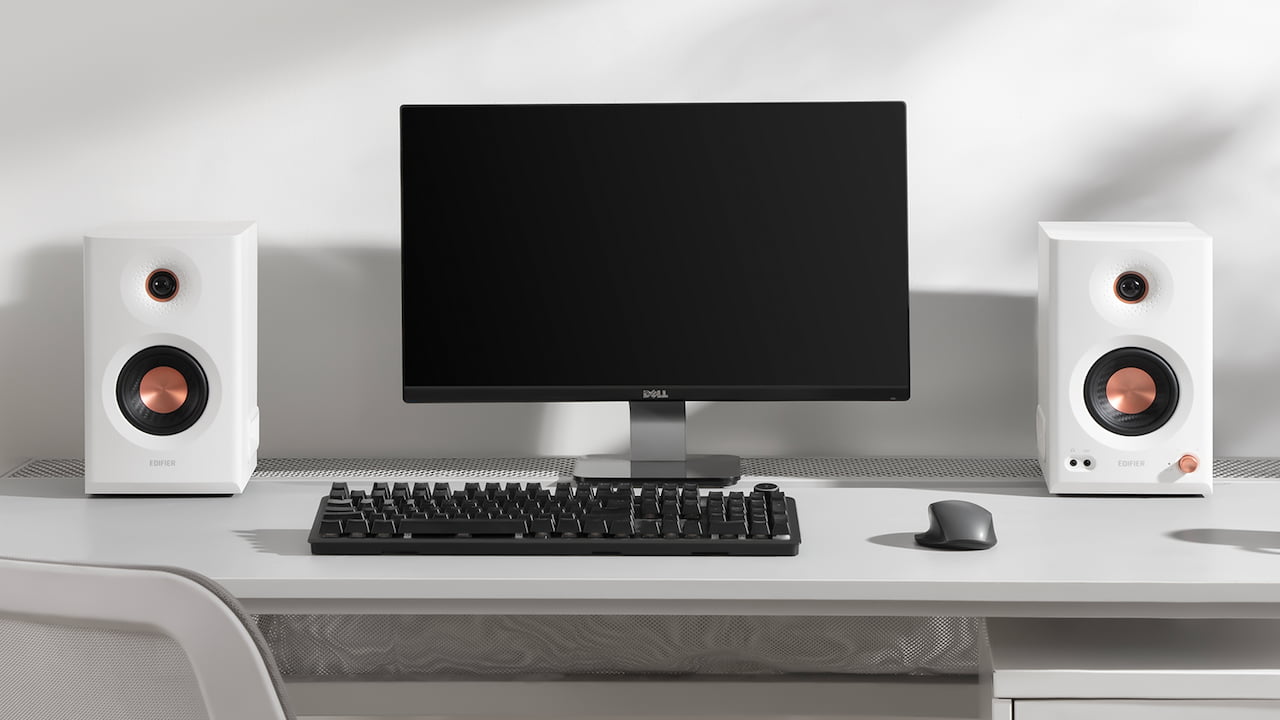
Aesthetically, the MR5 is one of Edifier’s better-looking studio designs. Copper accents draw attention to the drivers and the power/volume knob, giving the monitors a touch of polish without drifting into “gaming speaker” territory. The tweeter is ringed in copper, while the midrange driver uses a copper center cap over a Kevlar/carbon-fiber–style cone. It’s clean, modern, and subtle — the kind of design that fits in a studio, an office, or a living-room setup without raising eyebrows.
Internals: What’s Going On Under the Hood
Edifier didn’t phone in the internals on the MR5 — far from it. The 1-inch silk-dome tweeter sits in a dimpled waveguide designed to extend treble, improve clarity, and keep off-axis performance predictable, which is exactly what you want in a nearfield monitor. The midrange driver is a 3.75-inch dynamic unit — an unusual and very intentional size choice. It slots right between the 3.5-inch MR3 driver and the 4-inch MR4 driver, signaling that Edifier engineered this specifically for the MR5 instead of raiding the parts bin.
The down-firing woofer reinforces that impression. It’s a long-throw design built into a patented acoustic chamber that vents out through the side ports. It’s an unconventional layout but one that gives the MR5 more low-end authority than you’d expect from a cabinet this size.
Behind the input panel sits a true 3-way crossover feeding three amplifiers per speaker — one for each driver — so the tweeter, midrange, and woofer all get their own dedicated power and frequency band. Output is rated at 10 watts for the tweeter, 15 watts for the midrange, and 30 watts for the woofer, for a combined 110 watts RMS across the pair. This active tri-amp approach means each driver only amplifies what it actually plays, reducing noise and distortion compared to a single amp pushing the full spectrum and letting the crossover sort it out.
Edifier lists frequency response at 46 Hz – 40 kHz, which, if real-world performance lines up, puts the MR5 firmly in “serious monitor” territory for its price.
Edifier MR5 Connectivity
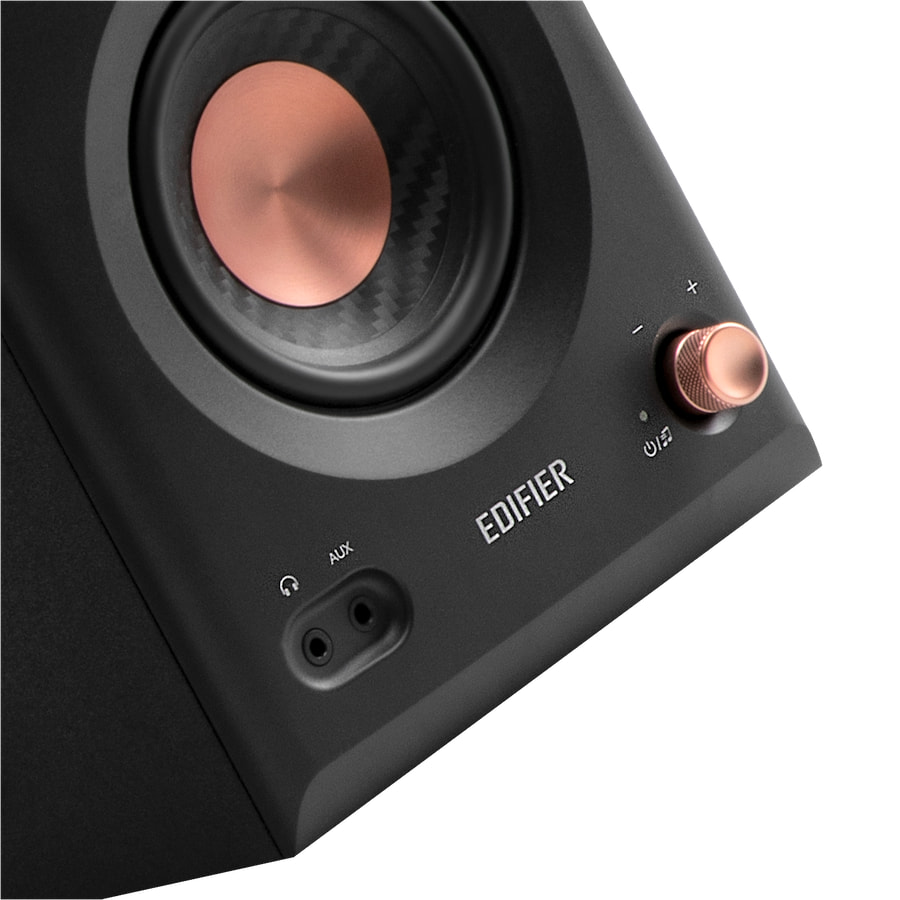
Connectivity lives entirely on the active speaker, and Edifier gives you plenty to work with. Up front, you get a 3.5mm input and a matching 3.5mm output opposite the multi-function control knob. Spin the MR5 around and the rear panel is stacked with RCA inputs, a pair of ¼-inch TRS ports, and a pair of balanced 3-pin XLR inputs — a legitimately robust selection for a $350 monitor.
Wireless is handled by Bluetooth 6.0 with support for LDAC up to 24-bit/96 kHz at 990 kbps, plus the usual SBC fallback. Multipoint is onboard as well, which makes swapping between devices painless. The one conspicuous omission is USB audio. It’s not a dealbreaker, but it would have made the MR5 even more flexible for desktop users.
Getting music playing is easy: the included 3.5mm-to-RCA cable had me up and running from a dongle DAC in seconds. Holding the pairing button for a couple of seconds triggered an audible prompt, and my Samsung S25 latched onto the MR5 immediately via LDAC — albeit not at the highest bitrate by default. To unlock full LDAC quality, you’ll need to flip the proper settings inside the Edifier Connex app.
Control App
Edifier’s app situation is a bit of a split timeline. The older Edifier Connect app handles legacy TWS models and earlier M, Q, and R-series speakers. The newer Edifier Connex app (iOS/Android) is where most of the brand’s current products live — and the MR5 requires Connex. If you own both new and older Edifier gear, you may end up juggling both apps. Welcome to ecosystem adulthood.
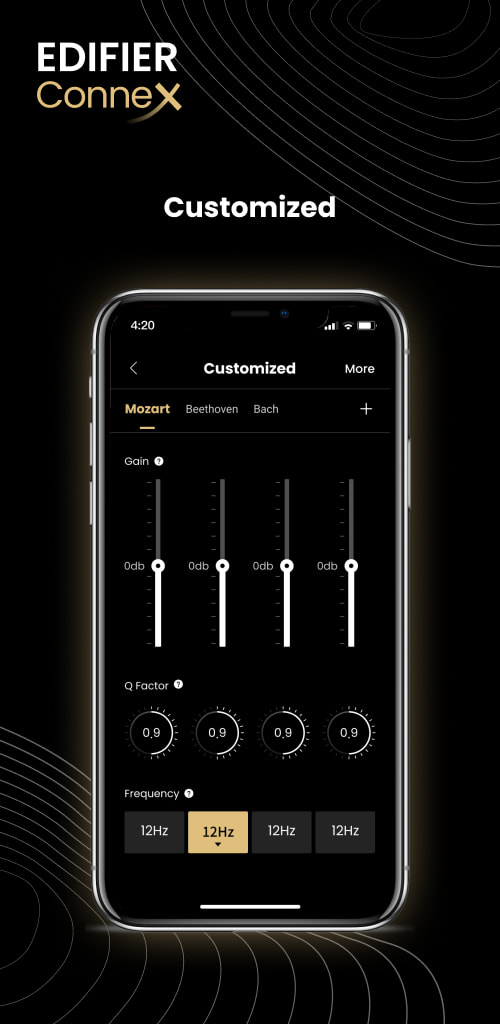
Within the Connex app, enabling full-fat LDAC isn’t difficult, but it’s not obvious either. Head into Settings → HD Audio Codec and switch from the default 44.1/48 kHz mode to the 96 kHz option. The MR5 will disconnect and reconnect at the higher bitrate, and then you’re actually getting the performance you paid for instead of the Bluetooth equivalent of “diet LDAC.”
A small but very welcome feature is the ability to assign the active speaker as left or right. Out of the box, the MR5 hardwires the active unit to the right channel, and without the app, you can’t change that. As a left-handed user, flipping the channels in software is a quality-of-life upgrade I appreciated immediately.
The main page gives quick access to sound modes and acoustic tuning. Sound modes include Monitor (neutral), Music (a mild V-shape), and Custom, which unlocks a 9-band EQ. The LED on the active speaker changes accordingly — red for Monitor, green for Music, and blinking green for Custom — so you always know what mode you’re in at a glance.
The acoustic tuning tools are surprisingly robust for this price point. You can adjust low-frequency roll-off (both cutoff and slope), compensate for shelf or corner placement, and use the desktop control to tame reflections from a cluttered workspace. It’s not the most intuitive UI on earth, but the feature set is strong and genuinely useful.
Physical Controls: Hands-On Simplicity Done Right
The active speaker keeps things simple with a front volume knob that also serves as the power switch. A quick press cycles through listening modes, while a long press turns the system off. The knob uses an infinite-rotation design, so there are no hard stops. When you hit the top or bottom of the volume range, the LED flashes to let you know the command was received.
On the rear panel, Edifier includes two tuning knobs labeled High and Low. These adjust everything above 10 kHz or below 125 Hz, each offering a six-decibel range with a clear center detent for the neutral position. It is an easy and effective way to fine tune the MR5 without opening the app.
The only other physical control is the Bluetooth pairing button located in the center of the rear panel on the active speaker. Press it, pair your device, and you are ready to go.
Listening
The MR series is built for nearfield use, so I started exactly where Edifier expects these speakers to live. I placed the MR5 pair four feet apart on my desk, roughly two feet from the rear wall with nothing close enough to interfere with the side vents or rear ports. I connected them through the 3.5 mm to RCA cable for laptop playback, used the XLR inputs on my audio interface, and then paired them over Bluetooth with a Samsung S25 and a sixth-generation iPad mini.
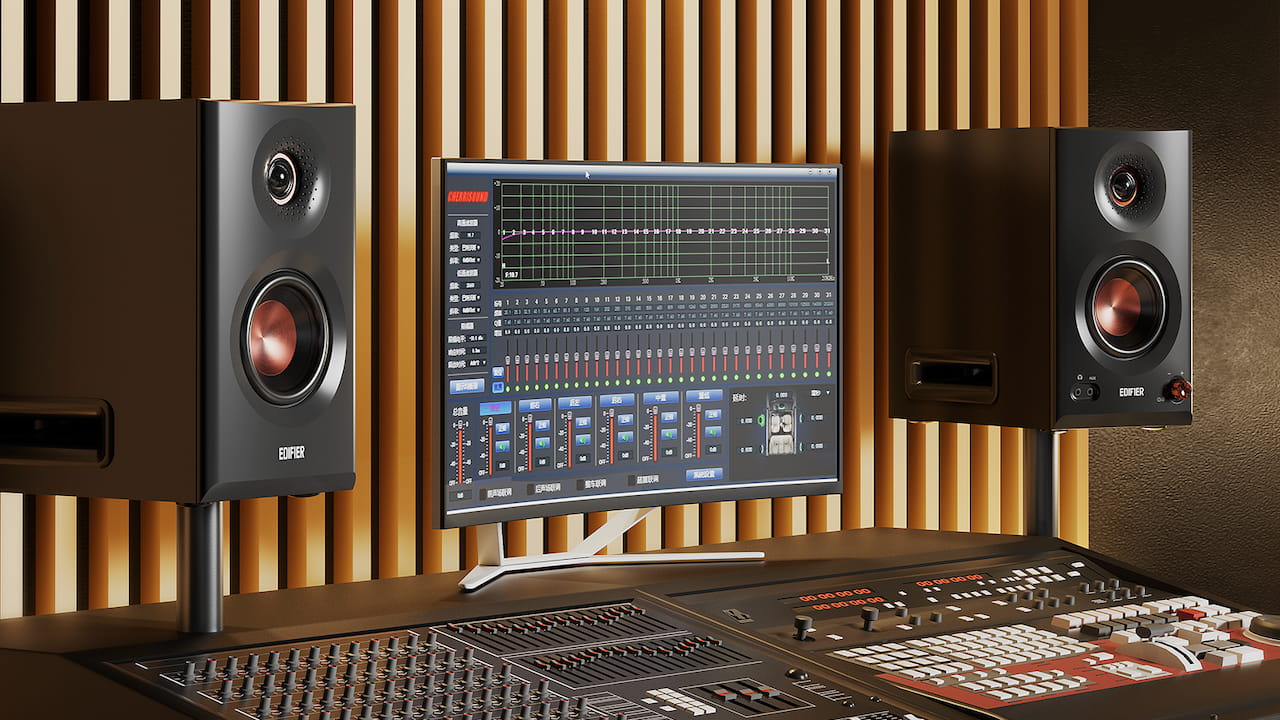
Right away, the tuning showed its hand. The MR5 stays close to neutral from about 50 Hz up to roughly 2.5 kHz, where the upper mids begin to rise before hitting a small but audible peak around 4 kHz. It is not a dramatic spike, but it is the one noticeable deviation from an otherwise steady and even response. The good news is that the MR5 reacts well to EQ. Adjustments through the app take a second or two to apply, while changes made on a mixer show up almost immediately. For anyone mixing on a budget, the accuracy and stability here are impressive for the price.
Switching over to Music mode changes the presentation right away. Bass output increases, the upper treble lifts to match, and the MR5 takes on a more energetic, consumer-friendly curve. It works well for most mainstream genres, and again, EQ changes settle in quickly when you want to fine tune the sound.
Neither listening mode generates much output below the 50 Hz line, so anyone chasing room-shaking sub-bass will need to add a subwoofer to the system. That said, the bass that is there is tight, controlled, and respectable for a speaker of this size. One thing I did notice is that from a distance, the mids and treble take the lead. This is likely due to the forward-firing tweeter and midrange driver working against a down-firing woofer. These monitors were never meant to fill a large room or be heard far off-axis, so this is more about realistic expectations than a criticism of the MR5 design.
What really stands out is how clean the MR5 stays at higher volumes. My usual listening level is around 75 dB, but pushing these monitors up to 90 dB didn’t introduce any fuzz, smear, or strain. Even edging toward the upper limits — right up to the point where I risked getting the “turn it down” look from the other half — the sound stayed composed. Whether you listen quietly or drive the MR5 close to its ceiling, the presentation remains clear and confident.
The Bottom Line
The MR4 was an easy win because of its price and performance, so the MR5’s much higher sticker initially raised an eyebrow. The design looked like a mash-up of the MR3 and MR4, and the jump to $349 made me wonder whether Edifier was reaching a little too far. Instead, the MR5 turns out to be a serious upgrade that hides its biggest advantage in plain sight. That down-firing woofer changes the entire equation and puts the MR5 in its own lane at this price.
In practice, this is one of the strongest powered monitors you can buy for $350. It stays close to neutral, responds predictably to EQ, and holds its composure at every volume level I threw at it. For anyone mixing, mastering or producing on a budget, the MR5 brings real accuracy to a desktop setup without forcing you into pro-studio pricing. And with a quick tap into Music mode, it shifts gears into a very enjoyable everyday speaker for work, gaming or casual listening.
If you need a compact monitor that can play clean, honest and surprisingly full for its size, the MR5 should be on your shortlist. It’s a smart buy for creators, students, home-studio beginners and anyone who wants real monitoring performance without blowing up their budget.
Pros:
- Clean near neutral tuning that works for mixing and everyday listening
- Responds well to EQ in both the app and on external gear
- Noticeably deeper and tighter bass than the MR3 or MR4
- Strong output with very low distortion even at higher volumes
Cons:
- Larger cabinet and side vents require more desk space and careful placement
- Higher price than earlier MR models, which may push out entry-level buyers
Where to buy:
Related Reading:
- Edifier S880DB MKII Wireless Speakers: Hi-Fi Evolution With Bluetooth 5.3, LDAC, And Italian Style At $399?
- Edifier MR4 Powered Studio Monitor Speakers: Review
- Dutch & Dutch 6c: A Smaller, Smarter Active Speaker With BACCH Spatial Audio
- Audioengine Releases HD3 Next Gen Wireless Speakers For Your Desktop