Devialet does nothing by accident, and the Phantom Ultimate 108 dB wireless speaker under review here is a very deliberate statement. This is the same company that gave us the Mania, the Astra and Astra Opéra de Paris integrated amplifiers, and the Dione soundbar—products where engineering, design, and attitude are inseparable. Subtlety has never been part of the brief, and Devialet isn’t pretending otherwise.
The real question is whether the Phantom Ultimate 108 dB is all presentation and bravado; a galette with no fève inside—or whether, once you strip away the gloss and the French pretense, it’s one of the most genuinely satisfying wireless speaker experiences you can buy today.
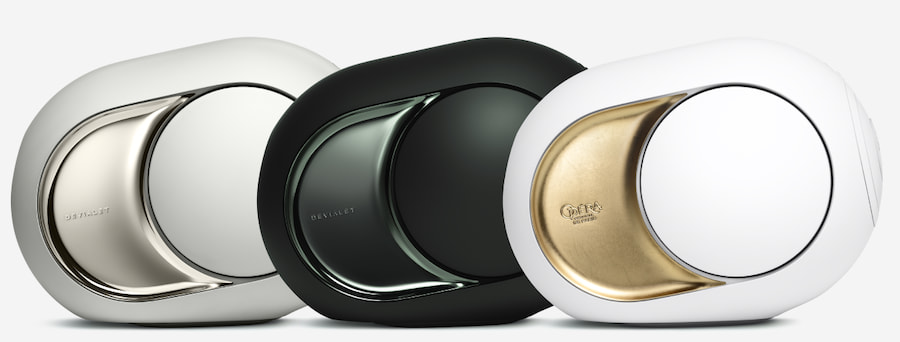
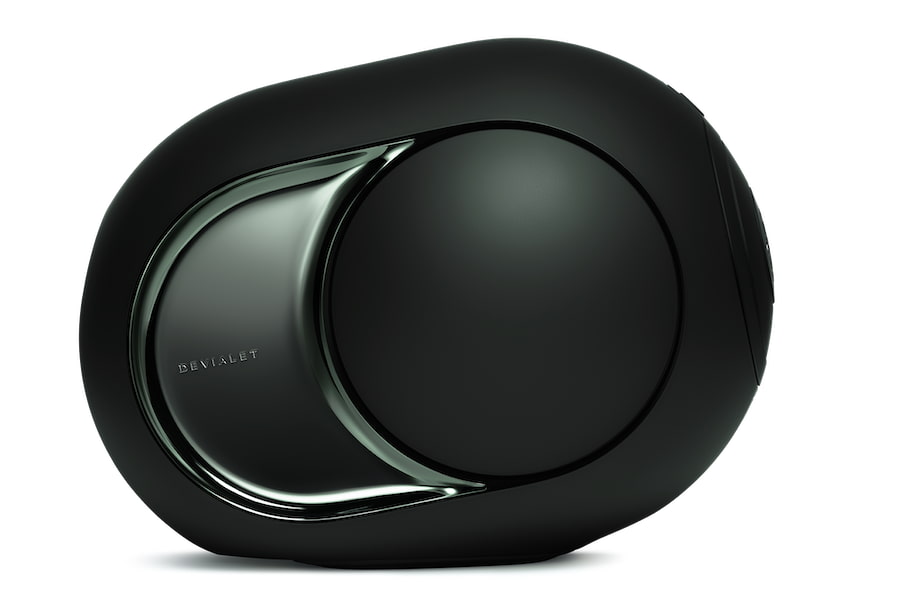
The new Phantom Ultimate lineup doubles down on what Devialet does best: extreme performance wrapped in industrial art, powered by next-generation ADH amplification that treats subtlety like an unfashionable Louis Vuitton tote from two seasons ago. Offered in the flagship 108 dB model at $3,800 (each) and the more compact 98 dB version at $1,900, these speakers are loud, ambitious, and technically obsessive by design. the full-size 108 dB flagship and the more compact 98 dB, both clearly designed to be seen as much as heard.
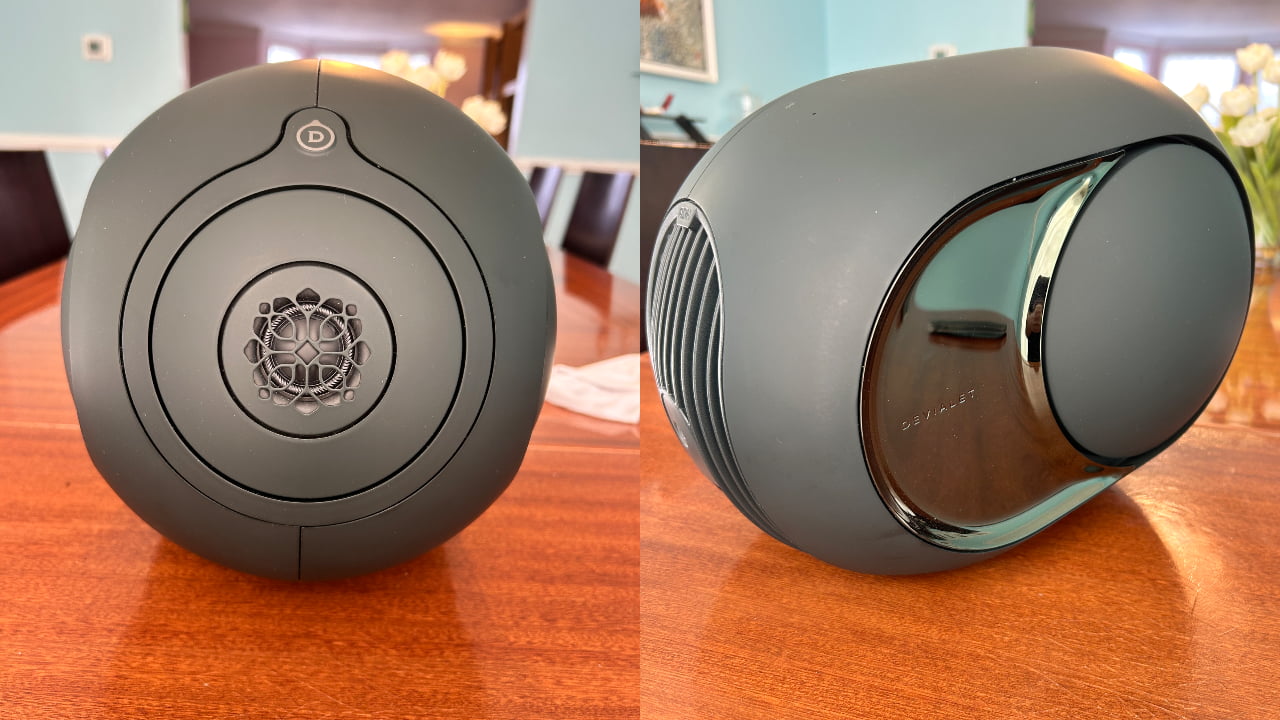
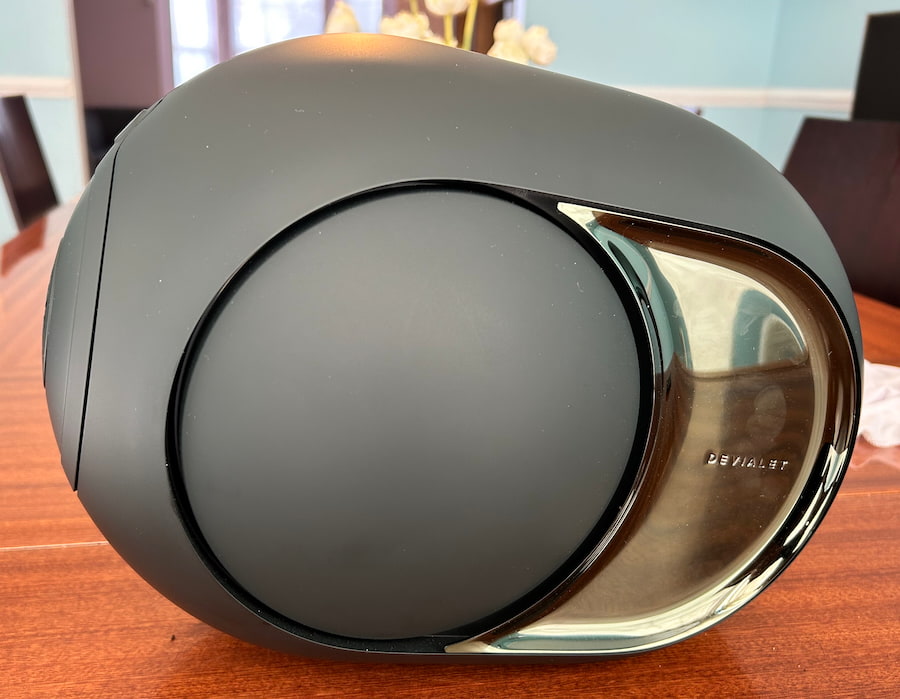
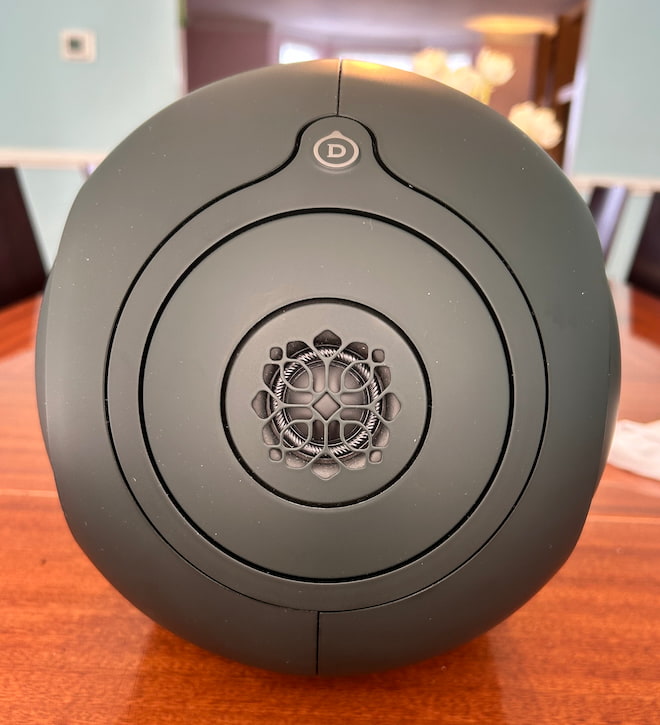
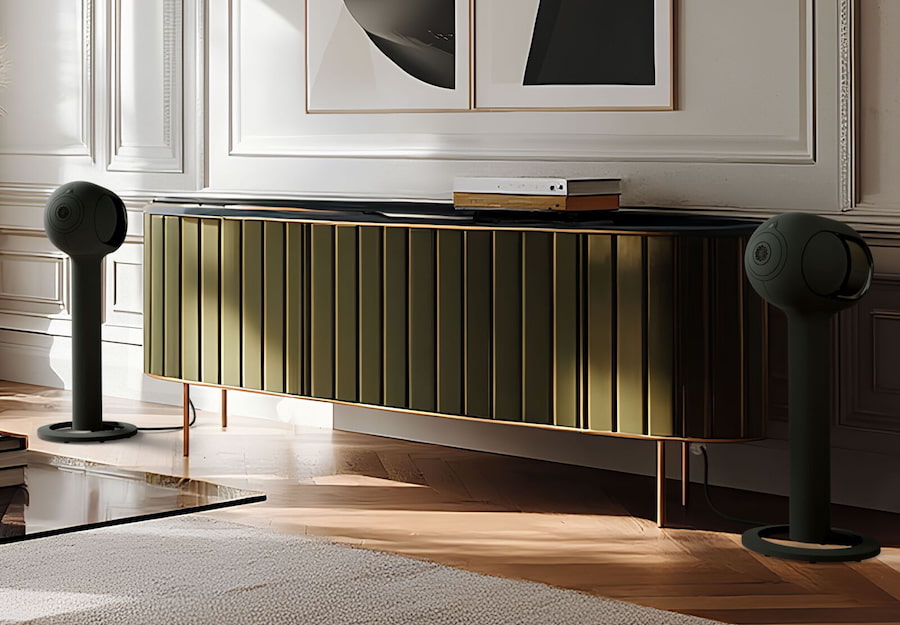
Finish options include Deep Forest, a dark green paired with black chrome accents, and Light Pearl, an ultra-matte off-white that leans modern rather than flashy. Devialet supplied a pair in the Deep Forest finish, and my overall impression is that they integrate easily into a wide range of rooms.
The darker green and black chrome accents work with both traditional and modern furniture, and they don’t clash with common flooring or carpeting choices, which makes placement less of a design headache than you might expect from something this distinctive.
Devialet Phantom Ultimate: Fifteen Years of French Obsession, Precision Engineering, and a Taste for Gold
Devialet has been headquartered in Paris since 2007, and in that time they’ve made it very clear they are not interested in blending in or asking permission. The Phantom Ultimate is the result of more than fifteen years of focused engineering, design iteration, and a very French refusal to accept “good enough.” With hundreds of patents across acoustics, electronics, signal processing, and manufacturing, Devialet isn’t chasing novelty—they’re refining a very specific idea of what modern high end audio should look and sound like.
Every curve, finish, and yes, the gold detailing, is intentional. Call it excess if you want, but this is what happens when engineers land in Paris, drink the espresso, ignore the noise, and build exactly what they want—whether the rest of the world is ready or not.
At the core of the Phantom Ultimate collection are several proprietary technologies that shape how Devialet designs and controls its wireless speakers. The focus here is precision and system management rather than novelty, with each technology serving a clearly defined role.
At the foundation of the Phantom Ultimate 108 dB is ADH New Gen (Analog Digital Hybrid) amplification, which pairs a Class A analog stage with Class D amplification for efficiency and control. In this latest iteration, Devialet has refined the control algorithms to extend high-frequency response up to 35 kHz while keeping thermal behavior and power delivery stable at higher listening levels. The goal here isn’t just output, but consistency when the speaker is pushed.
SAM (Speaker Active Matching) operates continuously in the background, monitoring the drivers in real time and adjusting phase and amplitude as needed. This allows the system to maintain accuracy while ensuring the drivers stay within safe operating limits, particularly during complex or high-energy passages where distortion or stress would otherwise creep in.
Low-frequency performance is handled by HBI (Heart Bass Implosion), which uses opposing woofers in a sealed enclosure to achieve bass extension down to 14 Hz. Instead of relying on a large cabinet, this approach focuses on control and symmetry, allowing the Phantom Ultimate to produce deep bass from a relatively compact enclosure without sounding loose or overblown.
For everyday use, AVL (Adaptive Volume Level) helps smooth out level changes by automatically adjusting output based on the content being played. This keeps dialogue, music, and dynamic material balanced without constant volume adjustments, particularly when switching between different sources.
All of this is managed by a new intelligent processor built around the NXP i.MX 8M Nano SoC, which handles signal processing more efficiently than previous generations. Its role is largely invisible, but critical, supporting the speaker’s real-time adjustments without adding unnecessary complexity to the user experience.
Together, these elements explain why the Phantom Ultimate behaves differently from many wireless speakers, emphasizing control and consistency over showmanship.
Devialet Phantom Ultimate 108 dB: French Overkill or a Serious Wireless Speaker?
Devialet positions the Phantom Ultimate 108 dB as its most advanced Phantom yet, and on paper it’s a serious piece of work: new driver architecture, updated processing, and a feature set built around modern streaming and connectivity. The design brief is clear; high output, wide bandwidth, and tight control without turning the speaker into a complicated science project for the owner. Devialet also points to four newly registered patents tied to the Ultimate platform, which is their way of saying this isn’t just a cosmetic refresh with a new paint code.
The core hardware is a three-way layout built around a new-generation aluminum dome tweeter, a new-generation aluminum midrange dome, and two new-generation ABS-dome woofers. The bass system is engineered for low-frequency extension and control, the midrange is meant to reduce resonance so voices and instruments stay clean, and the tweeter redesign focuses on durability and refinement up top.
In practical terms, that translates to a claimed frequency response of 14 Hz to 35 kHz within plus or minus 6 dB, which is a very wide window for a single-box wireless speaker, and a maximum output rated at 108 dB SPL at 1 meter. Total amplification is listed at 1,100 watts, and Devialet is using 32-bit/96 kHz processing as the platform for all of the internal DSP and system management.
Connectivity is current and straightforward. The Phantom Ultimate 108 dB supports Wi-Fi 6 and Bluetooth 5.3, and it runs on Devialet’s DOS 3 software platform. Streaming support includes AirPlay, Google Cast, Roon Ready, Spotify Connect (with lossless promised “coming soon”), TIDAL Connect, and UPnP.
The control center is the Devialet app, which adds practical listening presets like Music, Podcast, and Cinema modes, and handles updates so the system can evolve over time.
One important note from my time with the speakers: Qobuz Connect was not part of the deal during this review period. Based on how aggressively Devialet has been expanding protocol support, I wouldn’t be shocked if that changes, but I’m not treating it as a feature until it’s actually live.
Physically, the Devialet Phantom Ultimate 108 dB is deceptively compact-looking, but it’s not small once you measure it (or try to lift it like you’re still twenty five). The cabinet is 246 mm (9.7 in) wide, 342 mm (13.5 in) deep, and 255 mm (9.7 in) tall, and each speaker weighs 11.1 kg (24.5 lbs), and yes—this is the part where my doctor would have preferred I respected my post-surgery lifting limits. I didn’t. Moving them is a two-hands, pay-attention job, and once they’re in place you’ll understand why Devialet isn’t pretending these are “portable” in any meaningful sense.
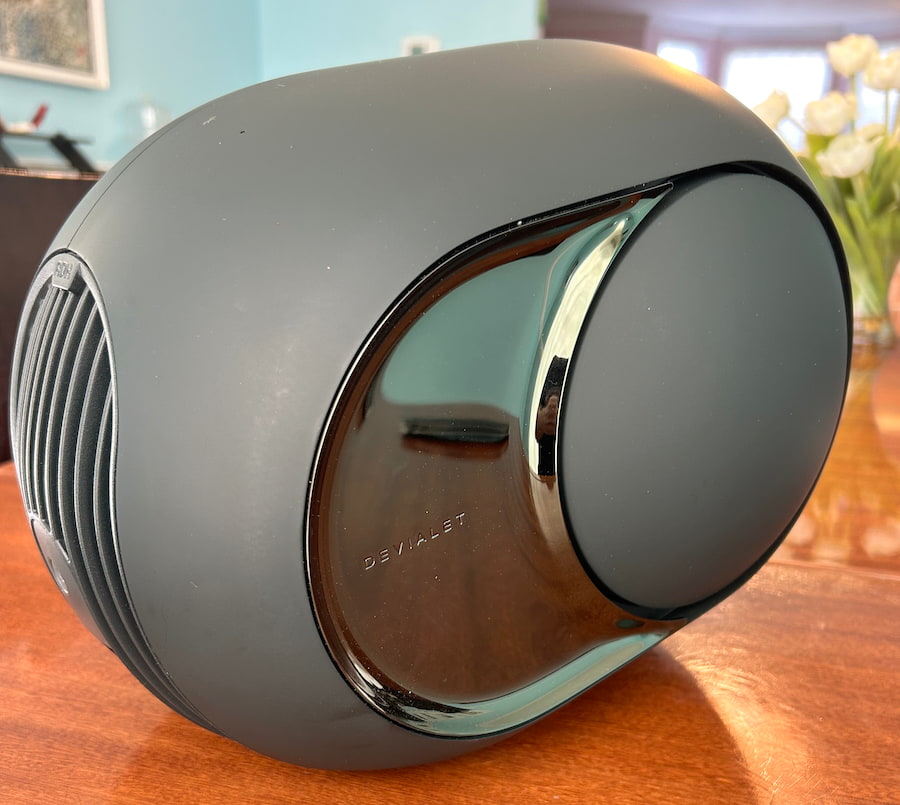
The build quality, however, is excellent. The finish work is clean, the fit is tight, and the overall product looks like nothing else in the category—whether you find that thrilling or slightly ridiculous is between you and your interior designer.
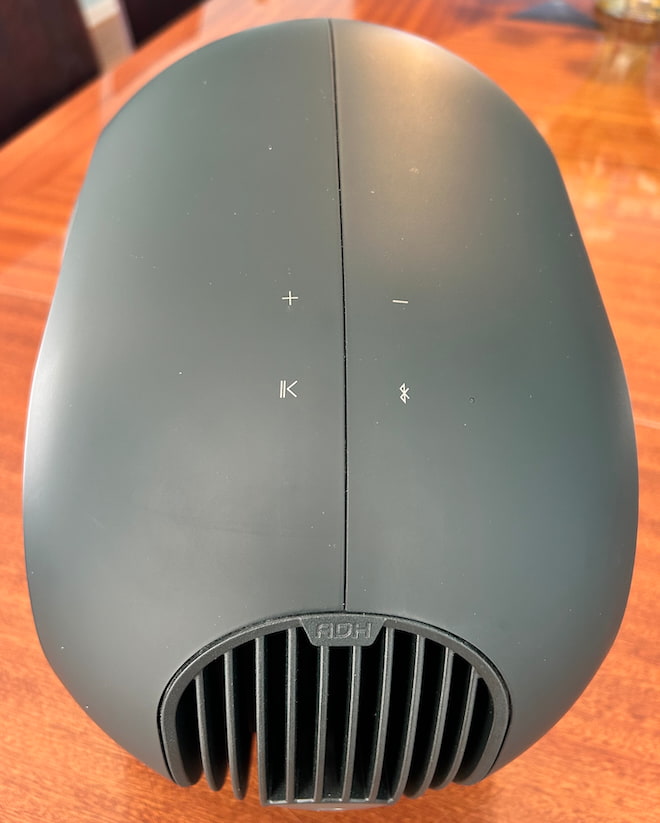
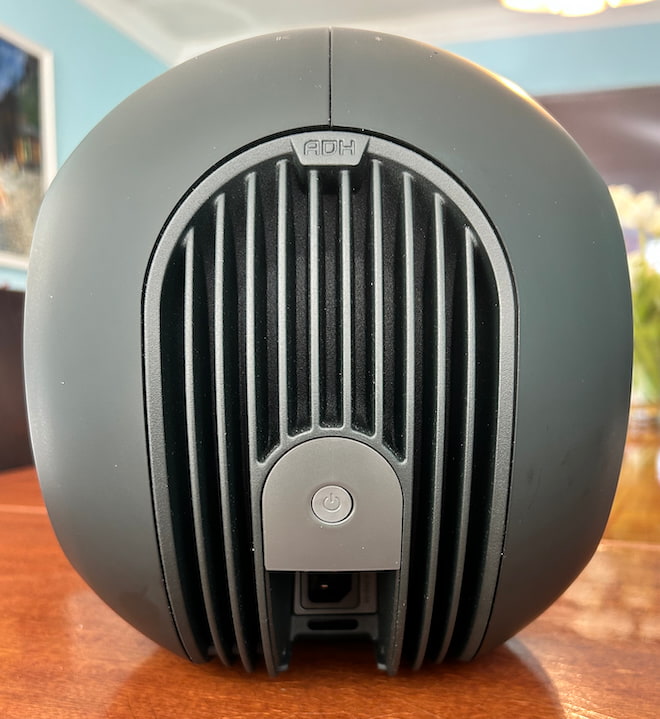
Setup is refreshingly simple, because Devialet doesn’t give you a spaghetti bowl of inputs. You’ve got power, and you’ve got Ethernet to hardwire them for stability. That’s basically it. The top-mounted interface uses four touch controls, and day to day operation is mostly app-driven. If you’re the type who wants a wireless speaker that behaves like an appliance, this is closer to that than many “audiophile” lifestyle products that still manage to be fussy.
So the Devialet Phantom Ultimate 108 dB is less about ticking spec-sheet boxes and more about how it behaves in real rooms. In the Deep Forest finish, it actually comes across as more restrained than you might expect—especially by Devialet standards. The dark green and black accents read as deliberate rather than flashy, and in lower light it can feel surprisingly understated for a product with this much output on tap.
It’s also worth stressing that these are sold as individual speakers, not pairs, and setup matters. Even running a single unit, I had no trouble filling multiple spaces: my living room at 20 x× 13 x 9 feet, a den at 16 x 13 x 9 feet, and even a former basement office here in New Jersey measuring 33 x 13 x 8 feet. In all three, the Phantom Ultimate delivered real scale—solid low-end weight, strong presence, and more volume than anyone would reasonably need. Your ears will give up long before the speaker does.
In larger, open-concept spaces, that sense of scale becomes even more obvious. Depending on the music and how hard you push it, the Phantom Ultimate can sound genuinely large and authoritative in a way most wireless speakers simply cannot manage. That ability to impose itself when asked—without falling apart or sounding strained—is still rare in this category, and it’s where the Phantom Ultimate 108 dB quietly separates itself from the pack.
Devialet Phantom Ultimate Accessories: Essentials, Options, and Real-World Proof
Devialet includes a two-year manufacturer warranty with all of its products, covering defects in materials, workmanship, and design. Coverage can be extended by an additional three years through Devialet Care for $120. The process is entirely digital; purchase the plan, receive an activation code by email, and you’re done. Clean, efficient, and very much on brand.
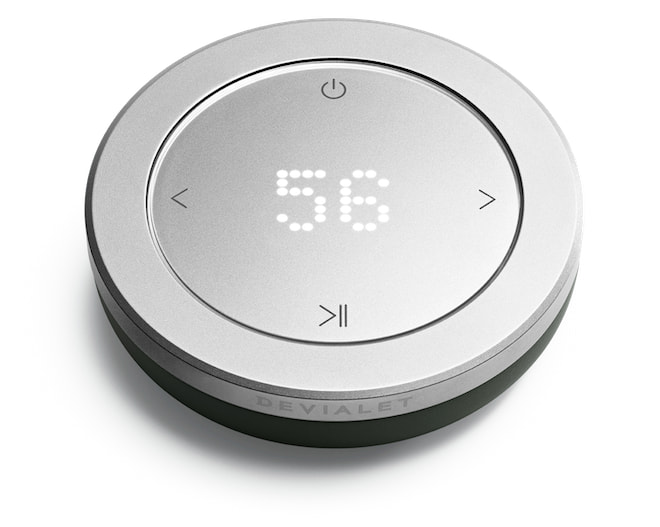
For control, there’s the Phantom Ultimate Remote priced at $199. One remote can operate a single speaker or a stereo pair, and multiple remotes automatically synchronize if you’re using more than one. It’s responsive, intuitive, and a welcome alternative to reaching for the app every time you want to adjust volume or switch content.
Placement matters with the Phantom Ultimate, and Devialet treats it that way. The Treepod Stand at $349 is available in Iconic White, Deep Forest, and Light Pearl. It measures 424 × 345 × 370 mm (16.7 × 13.6 × 14.6 inches) and positions the speaker precisely 345 mm (13.6 inches) above ground level. That height is intentional, placing the speaker where Devialet believes it performs best, while the solid construction keeps everything stable.
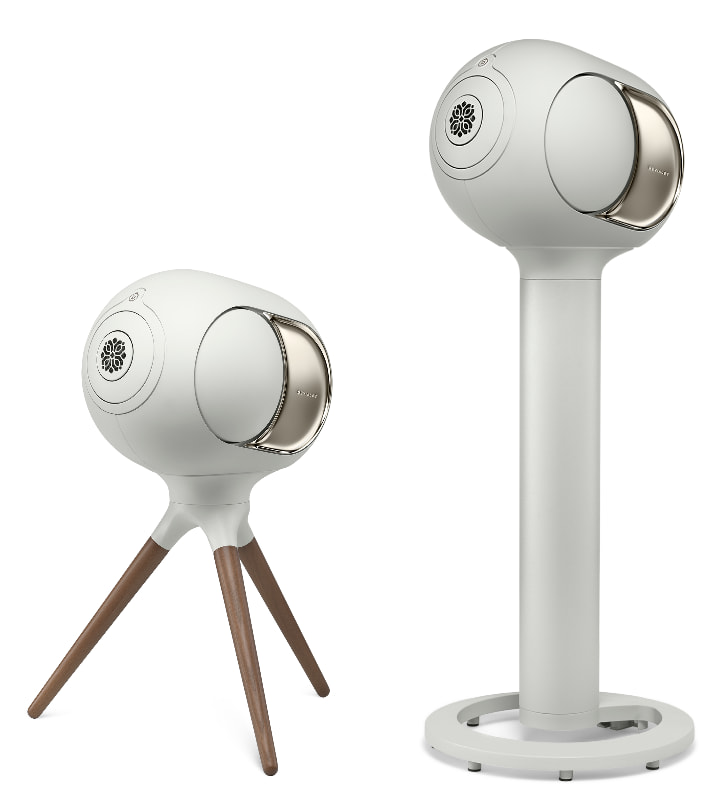
The Tree Smart Stand, priced at $399, offers a more vertical, furniture-like presentation. Measuring 340 × 660 mm (13.4 × 26.0 inches), it’s also available in Iconic White, Deep Forest, and Light Pearl. Compared to the Treepod, it’s less about flexibility and more about committing to a specific visual and spatial statement in the room.
For wall mounting, the Gecko Wall Mount costs $299 and is designed to securely support the Phantom Ultimate 108 dB while maintaining proper acoustic orientation. It’s adjustable, relatively easy to install, and offered in Light Pearl, Deep Forest, and Opéra de Paris finishes so the speaker doesn’t look like an afterthought once it’s off the floor.
I’ve seen the Gecko used effectively outside of a home setting as well; specifically at George Bush Intercontinental Airport in Houston. After spending a few days at the first Focal Powered by Naim location in the land of the trash-can beaters, I ended up in a restaurant near the terminal where a trio of Phantoms were mounted above the bar. Even with constant foot traffic, terminal noise, and a packed room, the sound was easy to follow and never got lost in the chaos.
None of these accessories are strictly required, but together they reinforce a consistent theme: with Devialet, placement is part of the product. How the Phantom Ultimate is supported, positioned, and integrated into a space isn’t an afterthought—it’s baked into the entire overall experience.

Devialet Phantom Ultimate 108 dB Setup: What You Need to Know Before You Hit Play
Yes, the Devialet app is required to set up the Phantom Ultimate during first use. There’s no workaround here. Without completing the initial configuration in the app, the speaker won’t operate—not even over Bluetooth. Think of the app as the ignition key; once setup is complete, day-to-day use is simple, but you can’t skip that first step.
If you’re wondering about stereo pairing, the answer is equally straightforward: you can only pair two speakers of the same model. A Phantom Ultimate 108 dB must be paired with another 108 dB unit, and the same rule applies to the 98 dB version. You can’t mix Phantom I and Phantom Ultimate models in a stereo configuration.
As for placement, Devialet’s recommendations are sensible and worth following, especially given how much output these speakers are capable of. Position the Phantom Ultimate between 45 and 90 cm (18 to 35 inches) off the ground to balance impact and clarity. Leave at least 30 cm (12 inches) between the rear of the speaker and the wall to allow low frequencies to develop properly, and keep the area in front of the speaker clear so sound isn’t obstructed.
Listening distance matters, too. Devialet suggests placing the speaker 1.5 to 2.5 meters (5 to 8.2 feet) from your seating position. In a stereo setup, space the speakers 1.5 to 2.5 meters apart and toe them in 25 to 30 degrees toward the listening position. Done right, this creates a stable, focused soundstage without forcing the speakers to work harder than they need to.
In my own setup, I took a more hardwired approach. I ran CAT6 directly from a new Verizon Fios fibre optic modem, which sits directly below the main floor. From there, I’ve terminated connections in seven rooms throughout the house, each either connected directly to the modem or through an ASUS Mesh WiFi 7 router. In every location I tested, the Phantom Ultimate speakers were seeing at least 700 Mbps of available bandwidth, regardless of where they were placed. Connectivity was never a limiting factor.
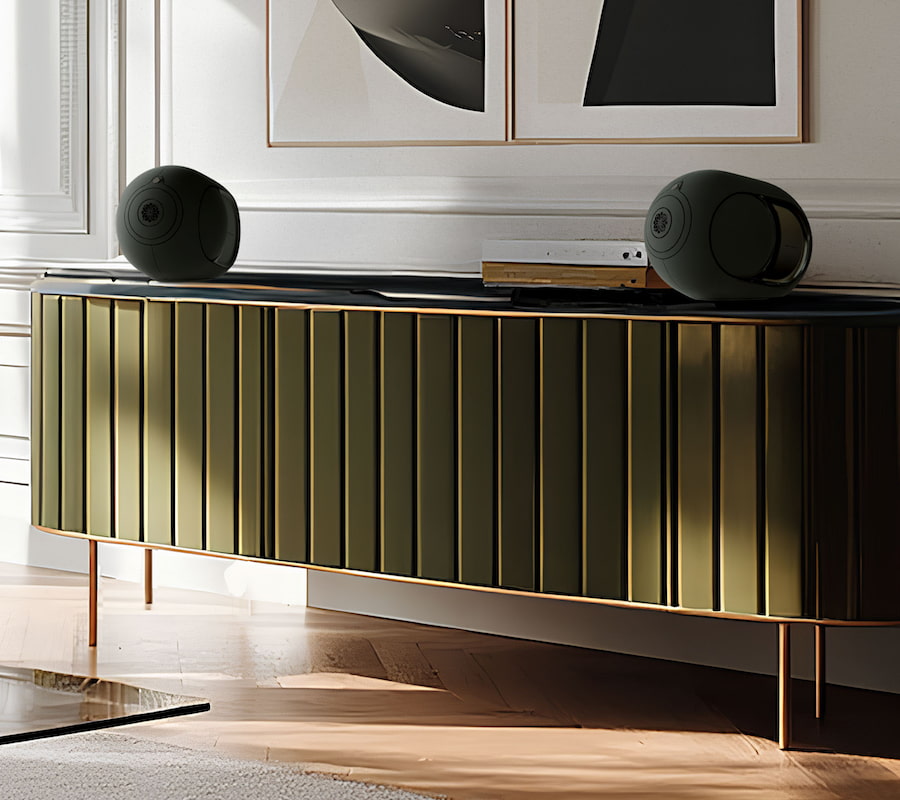
Placement experiments went beyond the official recommendations as well. In one configuration, I set the speakers on our dining room credenza using IsoAcoustics isolation platforms, which raised the center of the driver to approximately 45 inches off the floor. In other setups, the speakers were spaced 6 to 7 feet apart and positioned 2 to 3 feet from the rear wall.
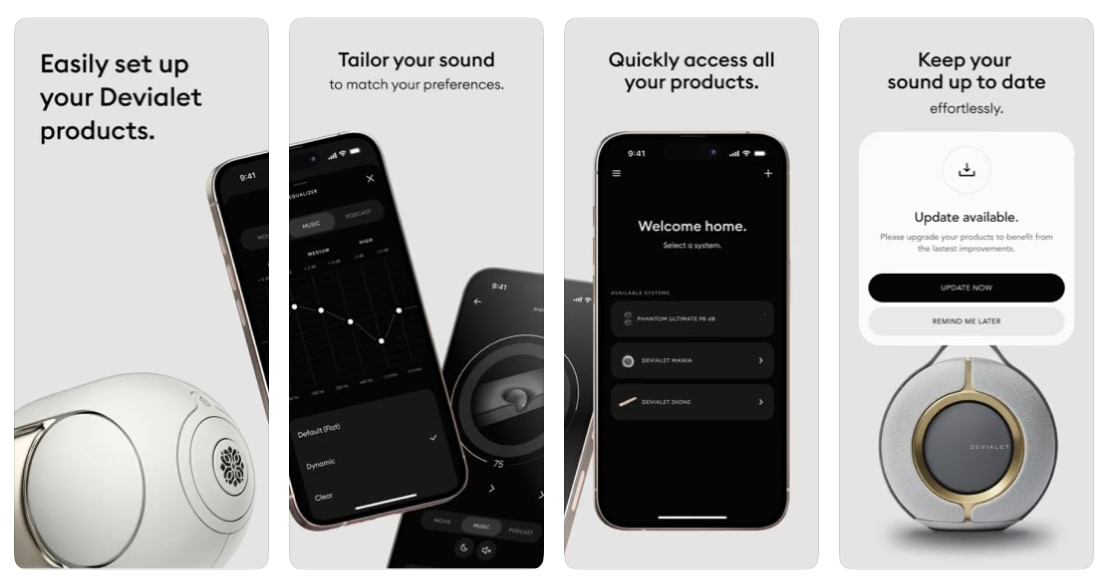
Setup with the Devialet app was relatively easy and mostly uneventful, which is a good thing. The speaker was discovered quickly on the network, and the step-by-step process was clear enough that there was little guesswork involved. Since the app is required for initial setup and the speaker won’t function without it, it’s reassuring that the process doesn’t feel complicated or fragile.
The app version in use during my time with the Phantom Ultimate was 1.25.x, which added full support for the Ultimate platform. That update introduced additional audio settings for the Phantom Ultimate models, including three listening modes, a six-band equalizer, and other advanced controls, along with a revised layout and a smoother setup and stereo-pairing process.
Network discovery was consistent, and firmware updates completed without issues. The expanded Network Status section, which shows Wi-Fi strength and connection quality, was useful for confirming that everything was operating as expected.
Streaming support is handled through integrated protocols rather than forcing you into a closed ecosystem. Bluetooth, AirPlay 2, Spotify Connect, Roon Ready, and UPnP were all available, and switching between services was straightforward. Volume control is precise, whether adjusting a single speaker or managing playback across rooms.
I also tested multi-room playback with one speaker in each room. Synchronization was generally solid, with only a slight delay when starting playback across rooms—small enough that you’d likely miss it unless you were listening for it. Once playing, everything stayed aligned, and the app allows different volume levels in each room, which makes the feature genuinely usable rather than decorative.
Listening Impressions: Attitude Française, Sans le Ridicule
The urge to see what kind of structural damage these could inflict was definitely there right out of the box, but I held back. From past experience with Devialet speakers, I already knew the low-end story—deep bass, serious impact, and plenty of definition were a given. My longer-term takeaway from earlier models, though, was that all that sub-bass and mid-bass muscle sometimes came at the expense of midrange presence. Call it a polite “V” if you want.
Before getting more critical, I let the speakers run for a few hours a day over several days, looping music from an older iPhone 14. Whether burn-in is real is always up for debate, but at the very least, no drivers were harmed in the process—and if there’s any downside to repeated sessions of Shostakovich followed by deadmau5, I haven’t found it yet.
The Phantom Ultimate feels different, and in a way that mattered to me. There’s still weight and authority down low, but it no longer feels like the midrange is being asked to take a step back. That shift shows up quickly with something like Nick Cave’s “Avalanche.” His voice is there, front and center, but it’s the piano and string textures that really benefit—notes have body, tone, and decay, which are essential to how that track works. On better speakers, those elements carry as much emotional weight as the vocal, and here they finally do.
Domestic realities (it’s been a long two years) meant I didn’t push the Phantom Ultimate 108 dB to the kind of levels that would have felt a little irresponsible, but I did get it loud enough to understand what it’s capable of. Even without going full send, there was plenty of mid-bass and lower midrange energy, and that weight carried well beyond the main listening position.
Moving around the room, the soundstage did lose some specificity, but there was no hollowing out of the sound or collapse in scale. The overall presentation stayed intact, with weight and presence remaining consistent even when listening well off-axis.
That translated across all three rooms I used for testing, where the presence was obvious without needing to sit in a carefully defined sweet spot. At one point, I did catch myself wondering whether this was simply too much speaker for the space. That thought disappeared the moment I pulled the volume back to just above conversation level. Everything snapped into focus—timing felt right, dynamics were intact, and the speaker didn’t lose its grip. It’s a reminder that control matters more than brute force, even when a speaker clearly has plenty of it in reserve.
Switching over to Peter Gabriel—“Been Undone” (Dark-Side Mix), “In Your Eyes,” “i/o” (Bright Side Mix), “Games Without Frontiers,” and “Biko”—it became clear that the Phantom Ultimate is very much tuned for listeners who gravitate toward electronic music, synth-driven rock, and rhythm-forward material. The presentation is propulsive and clean, with a lot of detail on tap; some might call it borderline “hi-fi”—and it delivers real slam without smearing bass lines or slowing things down. There’s texture and speed here, and the speaker has no trouble keeping complex mixes organized at higher levels.
Vocals on some of these tracks leaned slightly toward a polished, studio-lit presentation rather than a softer, more natural one, but the trade-off is scale. The Phantom Ultimate sounds big in a way that would make most of the passive speakers I own feel small, especially when it comes to low-end reach and overall presence.
“Biko,” “So Much,” and “In Your Eyes” hit differently for me, and that had less to do with the speaker than the music itself. Those tracks carry their own weight; memories of not being at your best with someone, and the kind of longing that puts you back under a blanket on a beach in Cape Town. We own our successes and our failures. Gabriel just has a way of making both feel uncomfortably close.
deadmau5, Boards of Canada, Talking Heads, and Tangerine Dream were a very different experience through these speakers. The sense of scale, presence, speed, and spaciousness brought out aspects of their music that few other speakers I’ve used over the years have managed to capture as convincingly. Rhythms had drive, layers stayed separated, and the overall presentation felt expansive without losing control.
If I had a larger home office and a dog who wouldn’t spend the entire day staring suspiciously at them—these would be very high on my list.
Listening to McCoy Tyner, Donald Byrd, Coltrane, Wes Montgomery, Miles Davis, Grant Green, and Lee Morgan highlighted both the strengths and the limits of these speakers. Rhythm, snap, and tonal weight are clear positives. The Phantom Ultimate locks into timing well, and it gives piano, bass, and drums real propulsion without sounding slow or bloated.
Texture was there, but it sometimes felt a little constructed—more grey than warm. Compared to my Wharfedale, Q Acoustics, or Triangle speakers, there was less richness in the upper bass and lower midrange. The Devialet brings power, thrust, and precision, but it doesn’t lean into the kind of imperfect coloration that, for me, makes jazz feel more human and less polished.
Horns, to their credit, weren’t bright or edgy, but you can clearly hear the character of an aluminum dome tweeter versus a soft dome. One rolls off sooner and trades sparkle for ease; the other delivers more energy and extension up top. Neither approach is wrong, but which one is more pleasing comes down to taste—and with acoustic jazz, my preference still leans toward warmth over sparkle.
The Bottom Line
The Phantom Ultimate 108 dB is a reminder of what happens when a wireless speaker is engineered like a serious loudspeaker rather than a lifestyle accessory. The technology matters here—ADH New Gen amplification, aggressive DSP control, serious processing power, and drivers that are designed to move air with authority. What it does best is scale, speed, and clarity. Few wireless speakers I’ve heard can project this kind of weight and presence into a room without falling apart, and even fewer maintain control when pushed. As a pair, the Phantom Ultimate delivers a level of output and composure that most wireless systems simply can’t approach.
That said, it’s not perfect. While bass control, dynamics, and timing are excellent, the tonal balance leans toward precision over warmth. Acoustic textures, particularly in jazz—can sound a bit polished compared to the richer, more forgiving voicing of my Wharfedale, Q Acoustics, or Triangle speakers. And while the aluminum dome tweeter brings energy and extension, some listeners may prefer the softer roll-off and natural ease of a traditional soft dome design.
This is a speaker for listeners who want maximum performance with minimal boxes, who value modern streaming, industrial design, and the ability to fill large or open spaces without resorting to separates, subwoofers, or complicated setups. At $3,800 per speaker, it’s unquestionably expensive, and it should be—this isn’t competing with mainstream wireless speakers on price. It’s competing on capability.
Even so, there’s no way around the conclusion: the Phantom Ultimate 108 dB earns an Editors’ Choice Award. In terms of sheer scale, power, speed, and clarity from a wireless speaker system, it’s the most convincing I’ve heard. Everything else I have at home from KEF, Triangle, Audioengine, and Q Acoustics sounds slightly broken by comparison—also far more affordable, and very much playing in a different league.
Where to buy:
Related Reading: