Hisense is expanding its Lifestyle TV push with the new Hisense S6 FollowMe, a mobile, touch-enabled smart display that reflects how screens are actually used in 2026—not fixed to a wall, not tied to one room, and not limited to passive viewing. Designed to roll easily from space to space, the S6 blends touchscreen interaction, smart connectivity, and a clean freestanding design into a more flexible alternative to a traditional television, aimed squarely at households that value adaptability over permanence.
The timing isn’t accidental. Hisense’s move places the S6 FollowMe directly into a fast-growing category now shared with Samsung’s newly announced MovingStyle lifestyle displays and LG’s updated StanbyME 2 portable TV—all betting that modern users want screens that follow daily routines, not dictate them. Whether it’s streaming, video calls, recipe browsing, casual web use, or light smart-home control, the S6 is positioned less as a TV replacement and more as a mobile digital hub that fits into real homes without demanding a redesign.
Hisense S6 FollowMe Signals the Rise of Mobile Smart Displays
The Hisense Lifestyle TV lineup is built around a straightforward idea: screens should adapt to how people actually use them, not lock users into one room or one position. The S6 FollowMe takes that concept a step further by moving beyond fixed televisions altogether. Instead of being anchored to a wall or cabinet, the S6 is designed as a mobile, touch-enabled display that can shift between entertainment, light productivity, and casual interaction as it moves through the home.
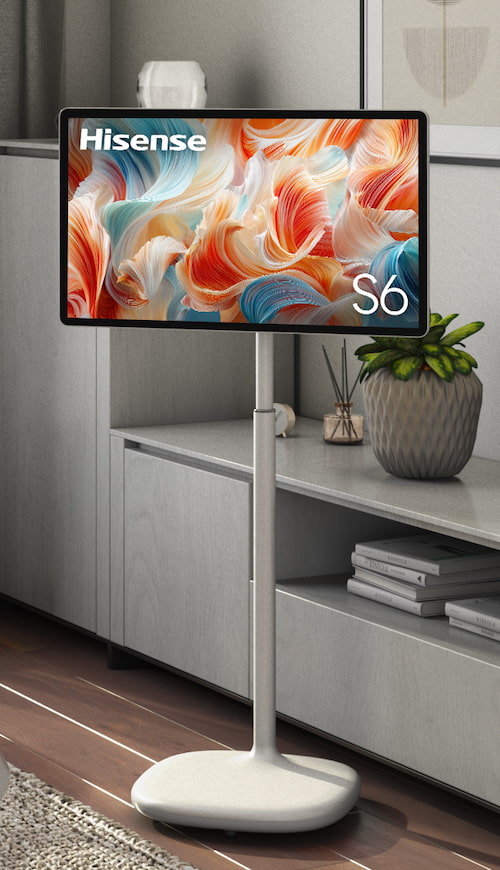
Physically, the S6 is engineered for flexibility rather than permanence. The 32-inch 4K UHD touchscreen is mounted on a wheeled stand that supports tilt, rotation, height adjustment, and smooth movement between rooms. The display can transition from floor height to table height using the included pedestal base or easel-style stand, making it usable from a couch, desk, kitchen counter, or dining table without awkward viewing angles. The emphasis here is practical positioning—putting the screen where it’s needed, at the right height, without rearranging furniture.
Unlike traditional TVs, the S6 is designed for untethered use. A built-in battery rated for up to 10 hours allows it to operate without constant access to a power outlet, reinforcing its role as a portable screen rather than a fixed display. An anti-glare, low-reflection panel helps maintain visibility across different lighting conditions, and Wi-Fi 6 support provides the bandwidth needed for stable streaming, browsing, and smart-home interaction.
On the feature side, Hisense keeps things functional rather than overstuffed. A built-in camera supports video calling, while far-field voice control enables hands-free operation for basic commands and content navigation. Audio is handled by an integrated DTS Virtual:X system, tuned to prioritize clear dialogue and a wider sound presentation without requiring external speakers. It’s not designed to replace a full home-theater setup—but it doesn’t need to. The S6 is positioned as a self-contained, everyday display that prioritizes mobility, touch interaction, and convenience over scale or brute-force performance.
How the Hisense S6 FollowMe Stacks Up Against Samsung MovingStyle and LG StanbyME 2
Samsung’s Movingstyle lineup addresses the growing demand for mobile, flexible displays with two distinct products that target different use cases rather than trying to be all things at once.
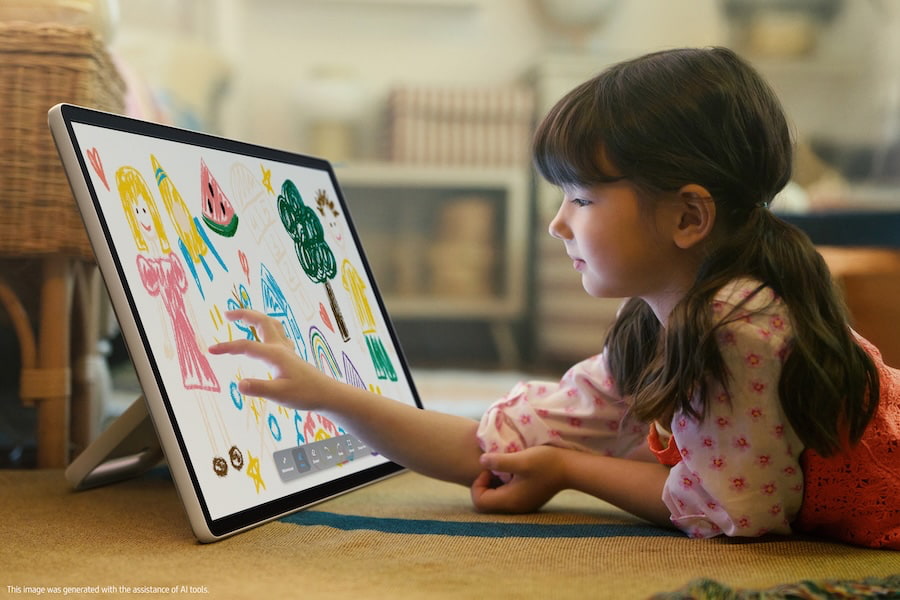
The Movingstyle LSM7F (27-inch) is the more lifestyle-focused option. It features a touchscreen display designed to operate either as a large-format tablet using its integrated kickstand or mounted on a rollable floor stand with concealed wheels for room-to-room mobility. A built-in rechargeable battery provides up to three hours of use without AC power, positioning it for short, untethered sessions rather than all-day portability. Interaction is handled through touch, Bixby voice control, and gesture control when paired with a compatible Galaxy Watch. Core specs include Wi-Fi connectivity, HDR10+ support, Dolby Atmos audio, and a 120Hz Motion Xcelerator refresh rate.
Connectivity options cover USB-C, HDMI, phone mirroring, and Samsung’s Storage Share for streaming content from Galaxy devices. Creative tools such as Sketch Now and access to the Samsung Art Store (subscription required) further reinforce its role as a casual, interactive display rather than a productivity-first monitor. Pricing is $1,199.
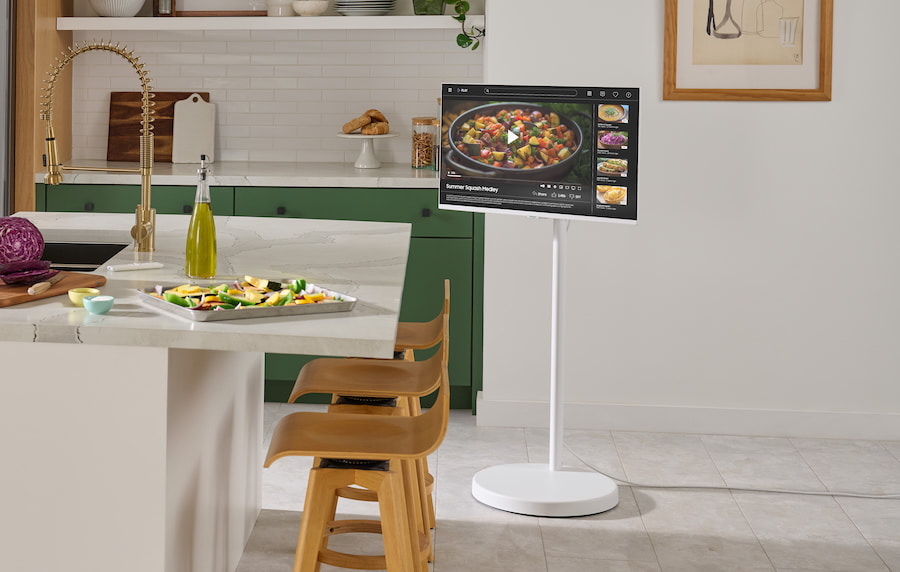
The Movingstyle M7 Series Smart Monitor (32M70F) takes a more conventional approach. It drops the touchscreen and internal battery but gains a larger 32-inch 4K UHD panel and a stronger emphasis on productivity and desktop-style use. Mounted on a rolling stand with hidden urethane wheels, it can still move easily between rooms, but it’s designed to remain plugged in.
Through Samsung’s Workspace feature, the M7 can access productivity tools without a separate PC, while Multi Control enables content sharing across compatible devices. Connectivity includes USB-C, HDMI, and USB-A ports, making it better suited for work, media consumption, and general-purpose use than interactive or touch-driven tasks. The M7 is priced at $699, reflecting its more traditional feature set.
Together, the two Movingstyle models show Samsung splitting the category clearly: the LSM7F prioritizes touch, interaction, and short-term portability, while the M7 Smart Monitor focuses on flexibility within a plug-in, productivity-oriented framework.
LG StanbyME 2: Portability First, TV Second
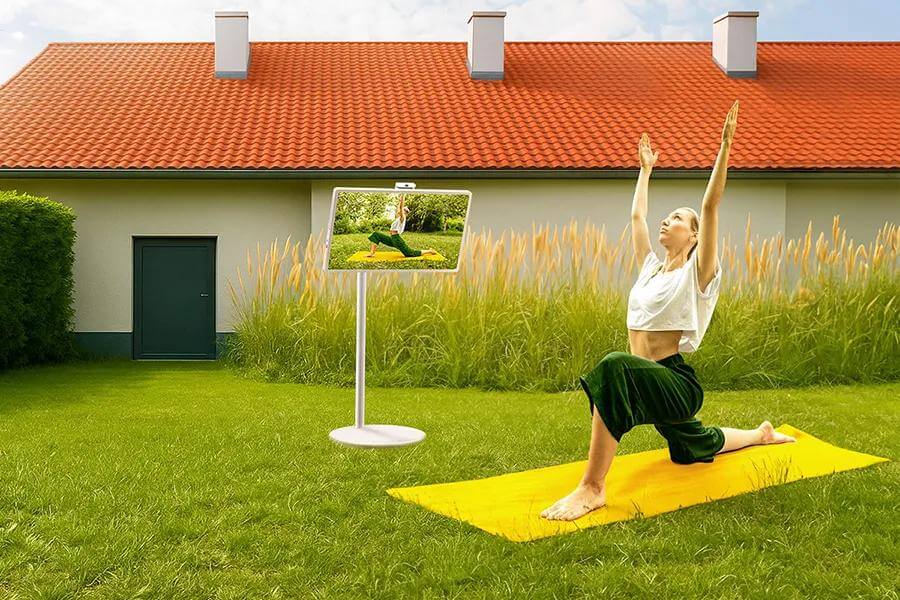
LG’s StanbyME 2 is best understood as a portable smart display that borrows heavily from the TV playbook rather than a traditional television replacement. Built around a 27-inch QHD (2560 × 1440) touchscreen, the StanbyME 2 prioritizes flexibility, detachable use, and wireless operation over screen size or permanent installation.
The defining feature is its detachable design. With a single click, the display separates from its wheeled stand and becomes a fully portable screen with a built-in rechargeable battery rated for up to four hours of video playback. Charging options are notably flexible: users can recharge via the included docking stand, USB-C charger, power bank, or standard AC power. LG also offers an optional strap accessory that allows the screen to be carried or hung, reinforcing its role as a mobile display rather than a fixed appliance.
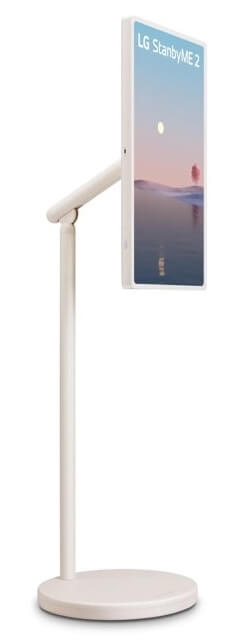
When docked, the StanbyME 2 supports both landscape and portrait orientations, adapting easily to different rooms and use cases. Detached, it can sit on a table or countertop or be wall-mounted, giving it more placement options than most lifestyle displays in this category. That versatility makes it suitable as a secondary screen for kitchens, bedrooms, home offices, or even short trips where a traditional TV would make little sense.
On the smart side, the StanbyME 2 runs LG’s webOS TV platform, providing access to major streaming services, LG Channels, Apple AirPlay, and Google Cast. While it lacks a built-in TV tuner, it covers nearly every other smart-display function users expect in 2026. Picture and sound are handled by LG’s Alpha 8 AI processor, paired with Dolby Vision and Dolby Atmos support. Audio performance is enhanced through orientation-aware EQ presets that adjust sound output depending on whether the screen is used in landscape, portrait, or table mode.
One notable limitation is connectivity. The StanbyME 2 relies on Wi-Fi 5, which feels dated in a market where Wi-Fi 6E and Wi-Fi 7 are increasingly common—even in midrange consumer electronics. For most streaming use cases, this won’t be a deal-breaker, but it does raise questions about long-term future-proofing for a premium-priced lifestyle display.
Priced at $1,199 at Amazon, the LG StanbyME 2 isn’t competing on value or raw performance. Instead, it targets users who prioritize portability, flexible placement, and an integrated smart TV experience in a compact form. Within that narrow but growing category, it remains one of the most fully realized—and distinctive—mobile screen concepts currently available.
Hisense S5 DécoTV Targets Design-Focused, Small-Space Living

Hisense’s S5 DécoTV is a reminder that not every TV needs to be oversized, overcaffeinated, or masquerading as a gaming monitor. At $299.99, this 32-inch QLED model fills a very different—and very deliberate—corner of the lifestyle TV category, one focused on design, simplicity, and sensible performance rather than mobility or technical one-upmanship.
Unlike mobile displays such as FollowMe-style screens or detachable portable TVs, the S5 DécoTV is built for fixed placement in smaller, lived-in spaces. Hisense is clearly targeting bedrooms, kitchens, dining rooms, and multipurpose areas where a massive wall-mounted panel feels intrusive and unnecessary. Finished in Morandi white and paired with a fluid central stand and integrated cable management, the DécoTV leans into furniture-first design. It’s meant to blend into a room visually when not in use, not dominate it.
Performance-wise, the S5 DécoTV stays in its lane. It uses Hi-QLED Color, still relatively rare at the 32-inch size, paired with Full HD (1920×1080) resolution. That combination delivers better color saturation and clarity than the budget LED panels that dominate this segment, without pretending to be a home-theater display. Sound is handled by DTS Virtual:X, which helps widen the perceived soundstage beyond what you’d expect from a compact cabinet.
HDR support is present but clearly secondary. The TV supports HDR10 and HLG, though Hisense has not disclosed peak brightness figures—a strong indicator that HDR here is about compatibility, not dynamic range fireworks. Connectivity is straightforward and practical: three HDMI inputs and a USB port cover Blu-ray and DVD players, cable boxes, and USB media. Press & Ask Alexa is built in for voice control, search, and basic smart-home interaction.
Just as important is what the S5 DécoTV doesn’t try to do. There’s no local dimming, no anti-glare coating, no gaming-focused features like ALLM or VRR, no motion-smoothing tricks, and no analog audio outputs. The absence of Ethernet—odd for a stationary TV—is another clear cost-saving choice. None of this feels accidental. Hisense has drawn a very intentional line to keep the price at $299.99 at Amazon.
Within the broader lifestyle TV category, the S5 DécoTV fills a different need than mobile or portable screens. It’s not about movement, batteries, or touch interaction—it’s about offering a compact, good-looking TV that delivers solid picture quality and modern smart features without excess.
The Bottom Line

With the Hisense S6 FollowMe, what we know so far is deliberately limited—and that’s not a knock, it’s just the reality of an early CES reveal. We know it’s coming to the U.S. on May 1, 2026, that it’s a mobile, touch-enabled display with a built-in battery and camera, and that it’s clearly designed to live with you rather than sit in one place. What we don’t yet know; pricing, final hardware configuration, and real-world performance, will ultimately determine whether it feels like a smart evolution or a niche indulgence.
Zooming out, the S6 FollowMe also highlights how the TV market is splintering into three distinct directions. At the top end, traditional TVs continue to chase absolute image quality, with larger screens, higher brightness, better local dimming, and premium panels aimed squarely at home-theater enthusiasts. Alongside that is the growing lifestyle segment—design-forward TVs meant to blend into a room, display art or photography, and coexist with furniture rather than dominate it. And now there’s a third category emerging: mobile TVs, which blur the line between television, tablet, and smart display by adding touchscreens, cameras, batteries, and full internet access.
The catch? Price. With very few exceptions, these newer lifestyle and mobile concepts are not inexpensive. Asking north of $1,000 for a 27- or 32-inch screen is a hard sell in a world where big-box retailers routinely offer 55- and 65-inch 4K TVs for less. Whether consumers embrace this new class of mobile, interactive TVs will depend less on novelty and more on whether brands like Hisense can convincingly explain—and justify—why flexibility and design now cost more than sheer screen size.
Related Reading:
- More News From CES 2026
- Samsung Unveils Movingstyle Lifestyle Displays—Because Stationary Screens Are So Last Decade
- The LG StanbyME 2 Portable TV Wants To Be By Your Side
- Hisense Shrinks the Screen: S5 DecoTV Targets Style-First, Space-Starved Buyers