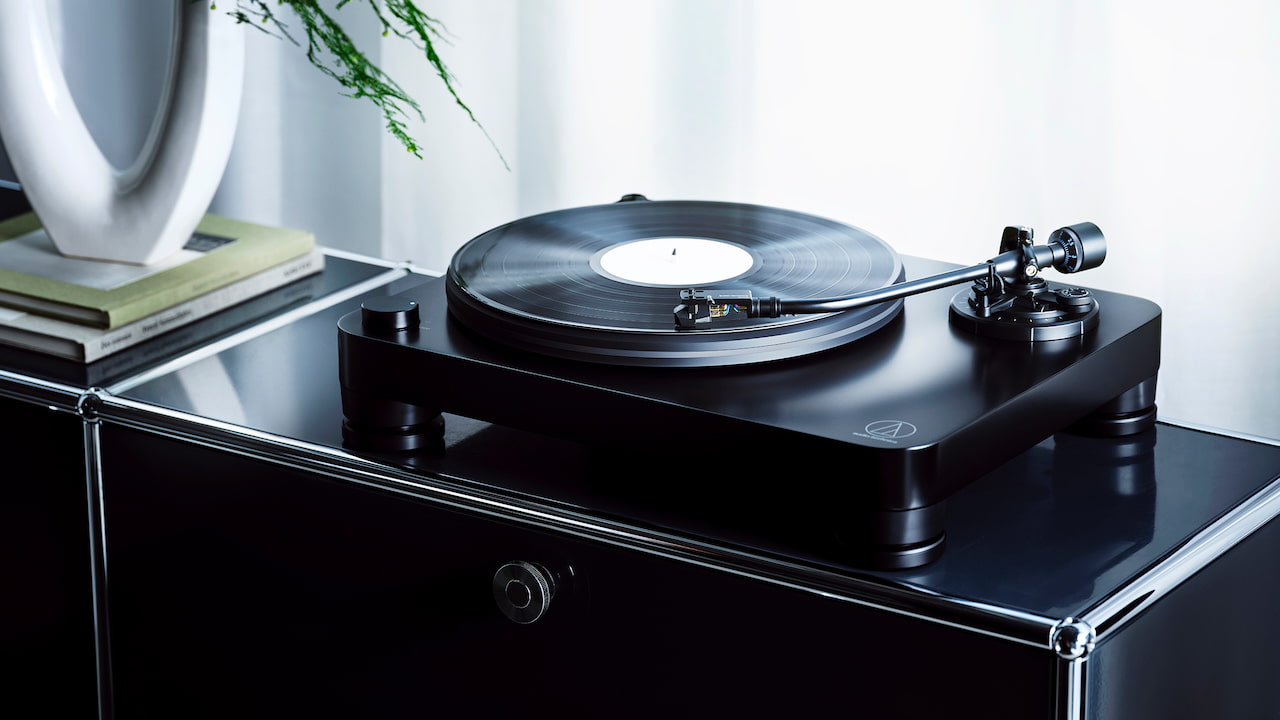
Audio-Technica is widening the lane—and doing it deliberately. The new AT-LP7X arrives as a fully manual belt-drive turntable priced at $999, designed with careful attention to chassis geometry, platter-to-spindle alignment, and tonearm positioning to deliver stable, low-distortion tracking. The J-shaped aluminum tonearm uses a dual-axis gimbal with precision ball bearings, underscoring that this isn’t another lifestyle deck dressed up for Instagram—it’s a mechanically serious table aimed at listeners who actually sit down and listen.
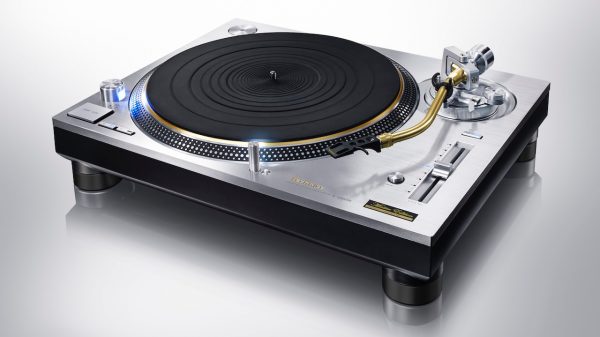
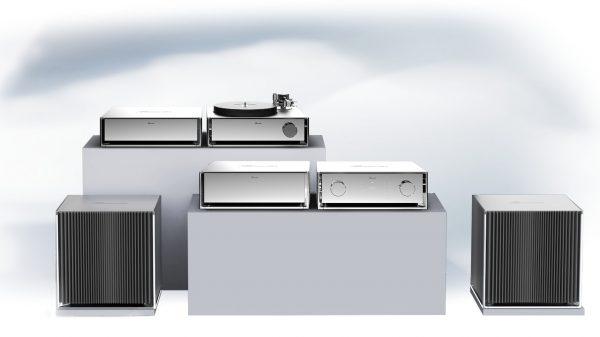
What makes the AT-LP7X more interesting is where it sits in Audio-Technica’s lineup right now. Yes, the brand still moves a massive amount of product below $400—that’s the volume game, and they play it well. But the past 12 months signal a clear shift upward. Alongside the AT-LP7X, Audio-Technica now fields the $1,299 AT-LP8X (a three-speed, semi-automatic direct-drive model), the $2,000 AT-LPA2, and the decidedly not-for-everyone $9,999 Hotaru.
What this actually shows is Audio-Technica deliberately branching into the next tier of vinyl playback, not abandoning its core business. We’ve seen the same move with the new AT33x cartridge series: products aimed at listeners who already dipped their toes into vinyl and now want something measurably better without jumping straight to boutique pricing.
At $999, the AT-LP7X drops Audio-Technica squarely into a crowded and very competitive lane, going head-to-head with Rega, Pro-Ject, U-Turn Audio, and even Technics. This isn’t about chasing volume—it’s about credibility at the $1,000 level, where buyers already know what wow and flutter mean, care about tonearm geometry, and expect more than a pretty plinth and a factory-mounted cartridge.
Audio-Technica AT-LP7X Targets the $1,000 Turntable Class
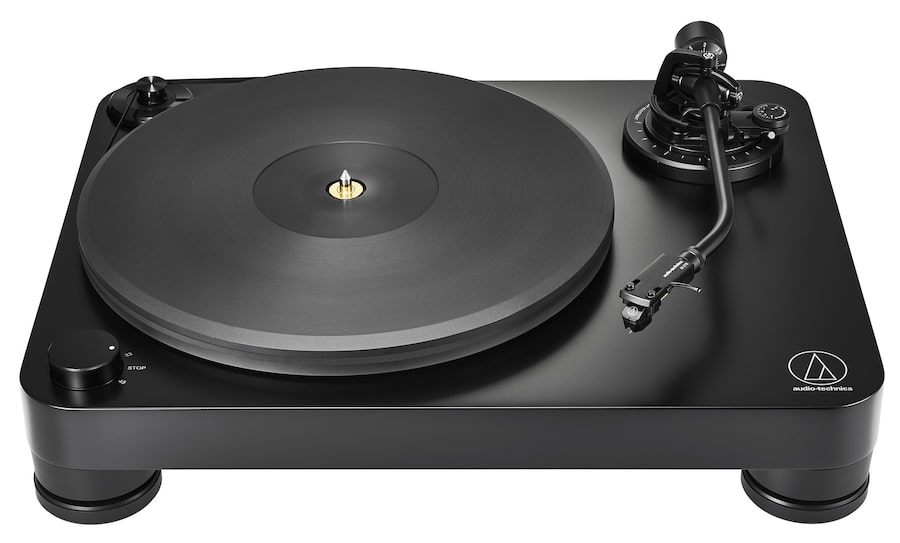
The Audio-Technica AT-LP7X is built around a precision-driven approach to speed stability and vibration control rather than feature creep. Its 20 mm acrylic platter is driven by an optical sensor-monitored motor, maintaining consistently accurate rotation at 33-1/3 and 45 RPM. The motor is mounted on vibration-dampening rubber bushings to decouple it from the plinth, reducing the transmission of mechanical noise before it ever reaches the stylus.
Audio-Technica further addresses noise control by using an external switching power supply, keeping AC-to-DC conversion outside the chassis to minimize electrical interference. Spring-based, height-adjustable isolation feetprovide effective protection against external vibration, while the dense MDF plinth helps suppress unwanted resonance. The table is finished in a restrained matte black, keeping the focus on function rather than flash.
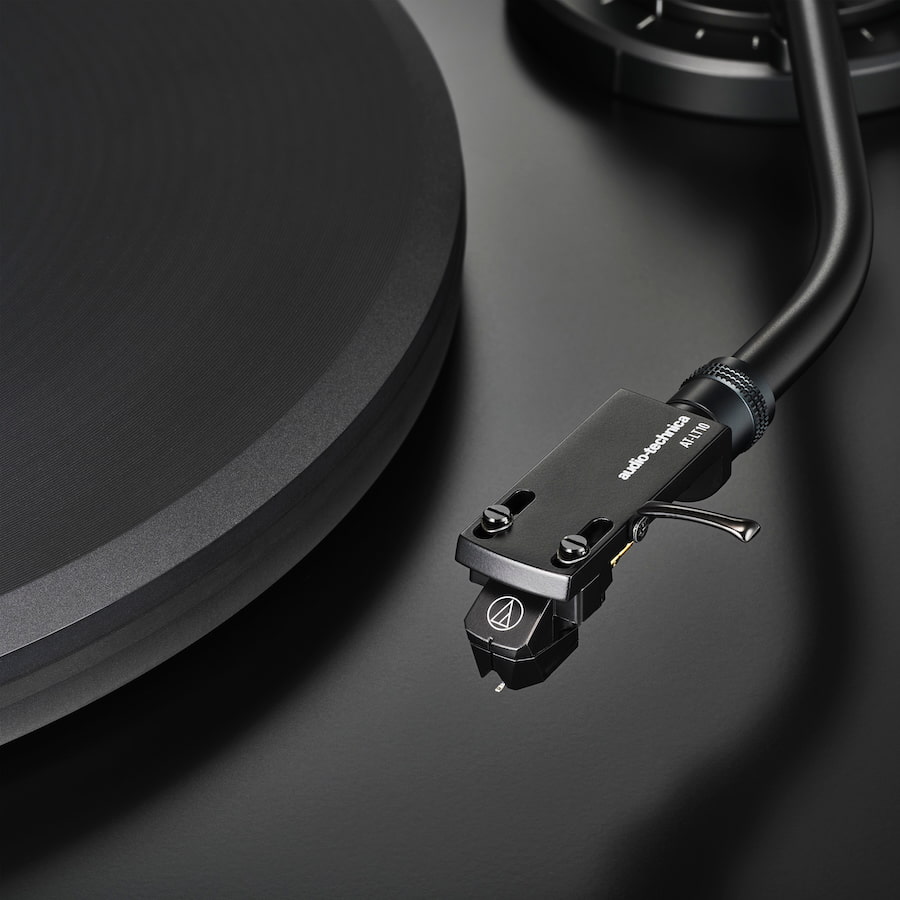
Out of the box, the AT-LP7X is fitted with an AT-LT10 headshell and black AT-VM95E cartridge, featuring a 0.3 × 0.7 mil elliptical stylus chosen for low distortion and solid channel separation.
The AT-LP7X is clearly designed for listeners who want the freedom to experiment with different cartridges rather than being locked into a single factory setup. The tonearm offers VTA (vertical tracking angle) adjustment, and the included 16 g subcounterweight supports a wide range of cartridge and headshell combinations with a combined weight of up to 23.5 g. For heavier configurations, Audio-Technica also offers an optional 32 g subcounterweight, extending compatibility to even more demanding cartridge and headshell pairings.
Flexibility extends beyond the tonearm. The AT-LP7X includes a built-in, switchable phono preamplifier with onboard MM/MC selection, allowing the use of both moving-magnet and moving-coil cartridges without requiring an external phono stage. Together, the adjustable tonearm geometry, interchangeable counterweight system, and MM/MC support make the AT-LP7X a practical and adaptable platform for listeners who want to explore cartridge upgrades over time
Audio-Technica AT-LP7X Specifications:
At its core, the Audio-Technica AT-LP7X uses a DC servo belt-drive motor designed for stable, low-noise operation at 33-1/3 and 45 RPM, paired with a 20 mm acrylic platter that adds rotational mass to help maintain speed consistency. Audio-Technica rates wow and flutter at less than 0.1% (WTD, JIS, 3 kHz), with a signal-to-noise ratio exceeding 60 dB, placing the AT-LP7X solidly in line with expectations for a precision-focused turntable at this price point.
The onboard phono stage is designed to accommodate both cartridge types without external hardware. In MM mode, output is rated at 4.0 mV, while the line-level output increases to 252 mV, allowing direct connection to powered speakers or integrated amplifiers without a phono input. Gain is specified at 36 dB for MM and 56 dB for MC, both RIAA-equalized, keeping system matching straightforward. Total power consumption is modest at 5.5 watts, supplied via an external 12 V DC adapter compatible with global voltage standards.
Physically, the AT-LP7X measures 450 × 352 × 157 mm (18 × 14 × 6.2 inches) (W×D×H) and weighs approximately 7.6 kg (17 lbs), giving it enough mass to support stable playback without becoming difficult to place on standard audio furniture.
The static-balanced J-shaped tonearm has an effective length of 247 mm, 15 mm of overhang, and a maximum tracking error angle of under 2 degrees. Tracking force adjustment ranges from 0.0 to 4.0 grams, and cartridge compatibility varies depending on counterweight configuration, supporting lighter setups without a subcounterweight and heavier combinations when either the included light subcounterweight or optional heavy version is used.
Supplied accessories are practical rather than ornamental, including a dust cover, drive belt, counterweight, light subcounterweight, AT-LT10 headshell pre-mounted with an AT-VM95E cartridge, RCA cables with ground, gloves, and a removable AC adapter. Replacement parts—including styli, headshells, and the model-specific belt—are available separately, reinforcing the AT-LP7X’s positioning as a serviceable, long-term platform rather than a sealed, disposable design.
AT-LP7X vs AT-LP8X: Belt-Drive Precision vs. Direct-Drive Convenience
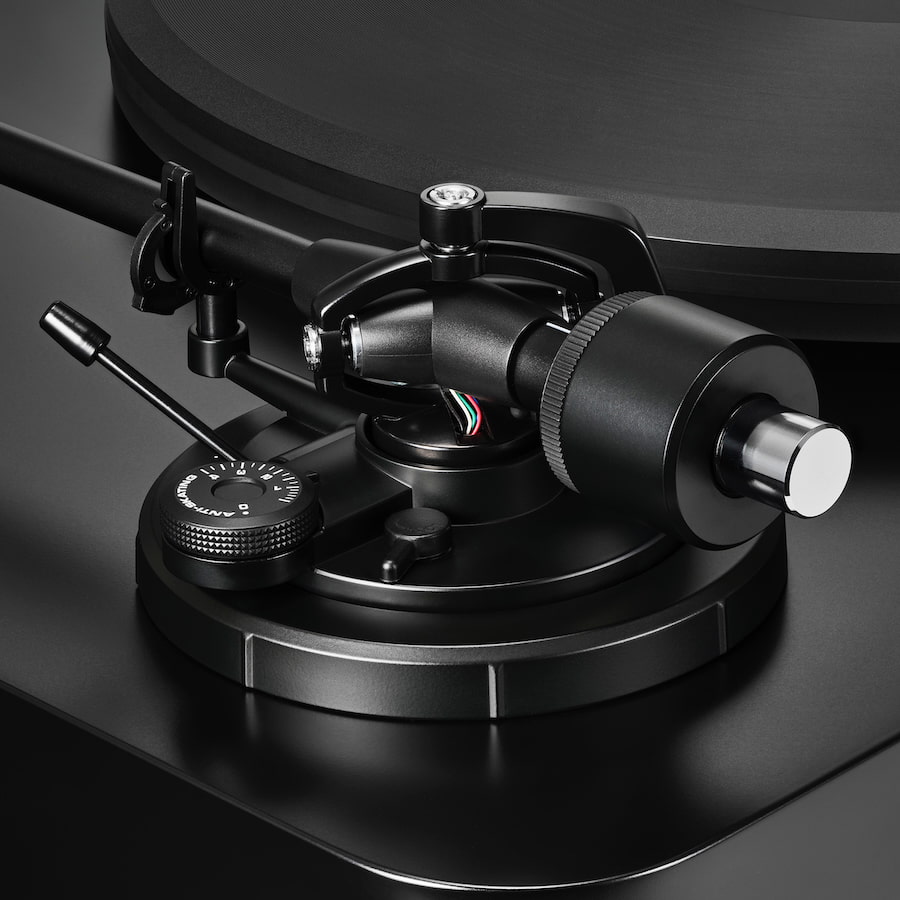
Both the AT-LP7X and AT-LP8X are positioned as serious step-up turntables with adjustable VTA, J-shaped aluminum tonearms, anti-skate and tracking force adjustment, and support for Audio-Technica’s VM95 cartridge ecosystem. Each is built as a platform meant for cartridge experimentation rather than plug-and-play casual use, and both share similar overall footprints on an equipment rack.
What’s different?
The divergence is mechanical and philosophical. The AT-LP7X is a fully manual, belt-drive design with an internal switchable MM/MC phono stage, aimed at listeners who want flexibility without committing to an external phono preamp. The AT-LP8X, now priced at $1,299—up $300 in roughly a year—moves decisively in another direction: direct drive, semi-automatic operation, and three-speed support (33-1/3, 45, and 78 RPM), but no internal phono stage, assuming buyers already own external amplification.
The AT-LP8X’s new low-torque direct-drive DC motor, speed-sensor system, and 25 mm rubber-damped die-cast aluminum platter account for much of its added mass—at 23 lbs, it’s roughly 6 pounds heavier than the AT-LP7X. That weight increase is not cosmetic; it’s tied directly to the platter, motor assembly, and plinth construction, all of which favor speed stability and torque consistency—classic direct-drive advantages.
The Bottom Line
The Audio-Technica AT-LP7X is a deliberate, well-executed step-up turntable aimed at vinyl listeners who want more control, better mechanical fundamentals, and room to grow without crossing into boutique pricing. Its fully manual belt-drive design, solid speed control, adjustable tonearm geometry, and built-in MM/MC phono stage make it a flexible, system-friendly platform at $999. It doesn’t chase automation or mass—it focuses on precision, compatibility, and long-term usability. For listeners ready to move beyond entry-level decks and start experimenting with cartridges and system matching, the AT-LP7X makes a clear, rational case.
For more information: https://www.audio-technica.com/en-us/at-lp7x
Related Reading: