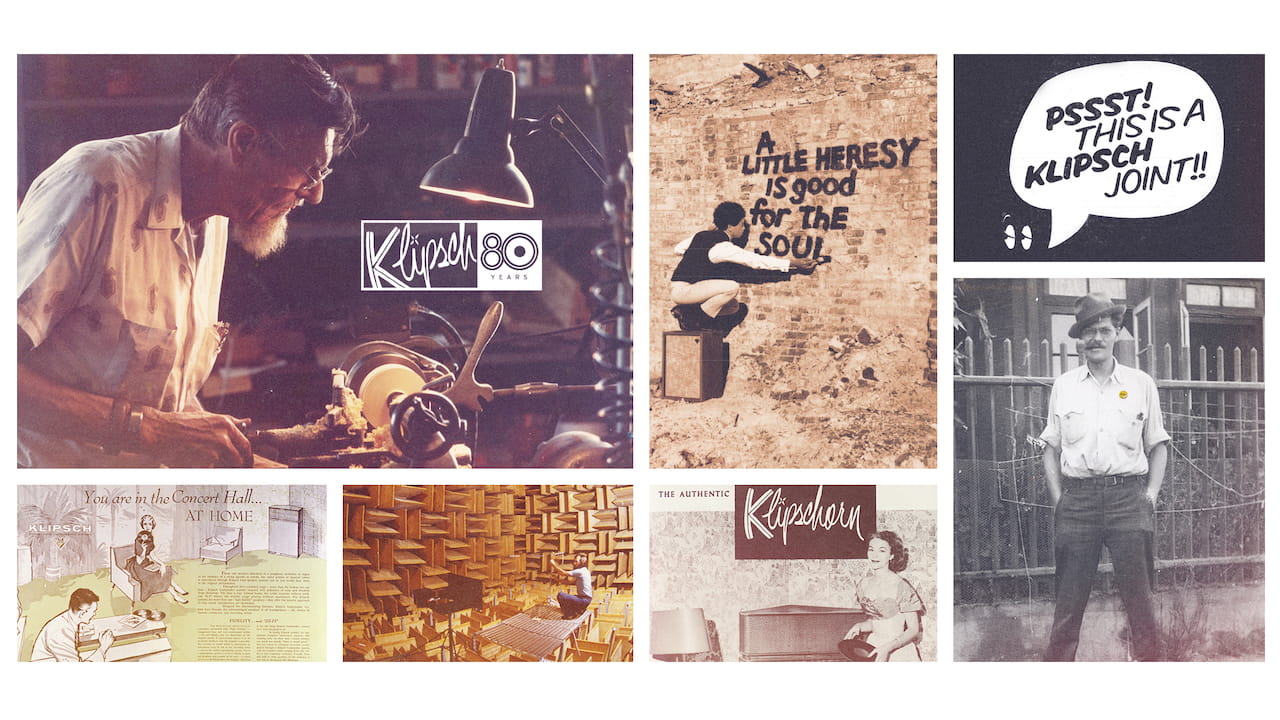
Kicking off a year-long celebration at CES 2026, Klipsch is marking an 80-year milestone that almost no audio brand ever reaches. The new concepts and products on display aren’t trend-chasing prototypes that magically appeared overnight—they’re the latest chapters in a story that began in 1946, built on relentless engineering, horn-loaded thinking, and a stubborn refusal to follow the herd.
Eight decades in, Klipsch isn’t looking backward for nostalgia points; it’s using its history as a launchpad, reminding the industry that longevity like this only happens when innovation, identity, and real-world listening actually matter.
Klipsch: How It All Started & Why It Still Matters 80 Years Later
In 1946, Paul W. Klipsch began building loudspeakers in a tin shed in Hope, Arkansas—not as a hobby, but as a direct challenge to how recorded music was being reproduced at home. His objective was brutally clear: design a loudspeaker that could deliver higher efficiency, lower distortion, and real dynamic scale using sound acoustic principles rather than brute-force power.
What followed wasn’t just a successful product, but a foundational shift in American hi-fi. Klipsch’s work on horn-loaded design, efficiency, and controlled directivity established engineering standards that still underpin modern loudspeaker design. At a time when amplification was scarce and expensive, PWK proved that smarter acoustics—not bigger amps—were the key to lifelike sound. Nearly 80 years later, those ideas remain not just relevant, but essential, which is why Paul W. Klipsch isn’t just part of audio history—he helped write the rulebook.

His patented horn-loaded loudspeaker designs didn’t just gain traction—they became legend, setting Klipsch apart in an industry crowded with good ideas and short memories. That vision transformed Klipsch into one of the most recognizable and enduring brands in audio history, built on efficiency, dynamics, and a refusal to compromise on how music should actually sound in real rooms.
To mark its 80th anniversary, Klipsch isn’t settling for a dinner party and a press release. The company has mapped out a year-long celebration that includes the debut of a limited 80th-anniversary logo, commemorative merchandise, and a slate of new products spanning multiple categories. Limited-edition models are slated to arrive later in 2026, alongside a VIP factory tour event in Hope, Arkansas—bringing the celebration full circle, back to where Paul W. Klipsch first proved that smart engineering could change the sound of American hi-fi forever.

Paul Jacobs, President and CEO, underscored just how central the company’s founder remains to everything Klipsch does today:
“Paul’s legacy, as always, is at the heart of our DNA. I’m beyond proud of the extraordinary innovation our team puts forward year after year to preserve his legacy with products that continue to define and inspire new generations of audio enthusiasts across the world. I can think of no better stage on which to take a bow for 80 years of shaping the audio industry—and the consumer electronics industry at large. We celebrate not only a legend, but the extraordinary passion of the community that has carried this brand forward for eight decades.”
CES holds particular significance for Klipsch, as it was one of Paul W. Klipsch’s last major public appearances—a fitting stage for a man who spent his life challenging convention and pushing the audio industry forward. Long after his passing, his impact continued to resonate across consumer electronics and high-fidelity audio alike.
In recognition of those contributions, Paul W. Klipsch was posthumously inducted into the CTA Hall of Fame as part of the Class of 2004, cementing his status not just as a loudspeaker designer, but as one of the most influential figures in the history of consumer audio.
Watch Vintage Footage of Klipsch Founder, Paul W. Klipsch
The Museum: Preserving the Legacy of Paul W. Klipsch and 80 Years of Innovation
Klipsch continues to honor its humble beginnings while operating on a truly global scale—from its headquarters in Indianapolis, Indiana, to its factory in Hope, Arkansas, and offices around the world. That balance between scale and soul is rare in consumer electronics, and it explains why Klipsch’s identity hasn’t been diluted by growth or time.
Directly across the street from the Hope factory sits the Klipsch Museum of Audio History, a 501(c)(3) nonprofit and one of the very few museums in the world dedicated exclusively to audio. Open to the public, the museum chronicles Paul W. Klipsch’s extraordinary life and work, housing priceless artifacts from the earliest days of hi-fi. Its mission goes well beyond preservation—restoring and maintaining historic audio artifacts, conducting original research, and hosting educational programs that use PWK’s science of sound to spark interest in STEM education for future generations.
Each year, in celebration of PWK’s birthday, the Museum hosts a gathering that began modestly as an appreciation lunch for factory workers. This year’s event—scheduled for March 5-7, 2026—is expected to be the largest yet, marking 80 legendary years of Klipsch. Attendees will have a rare opportunity to tour the factory and walk the hallowed ground where one of audio’s most enduring legacies was born.

Pro Tip: Follow the Museum’s official channels for event details and updates—you won’t get many chances like this to step inside hi-fi history.
The Bottom Line
Few audio companies can credibly claim eight decades of continuous relevance—but Klipsch stands apart even within that rare group. It remains one of the oldest audio manufacturers in the United States and the only brand that can point to the longest-running continuous loudspeaker production in history with the Klipschorn—a product that has survived wars, formats, technologies, trends, and more bad ideas than the industry cares to admit. That kind of longevity isn’t nostalgia; it’s proof that the fundamentals were right from the start.
Klipsch’s 80th anniversary isn’t about looking backward—it’s a reminder that smart engineering, efficiency, and respect for physics age far better than hype cycles and marketing jargon. As Paul W. Klipsch himself put it, “My theories on audio and audio reproduction will be proven wrong only when the laws of physics change.” Eighty years later, physics hasn’t blinked—and neither has Klipsch.
Related Reading:
- Klipsch Has Unveiled the Next Generation Klipschorn AK7 and La Scala AL6 Speakers
- Klipsch Unveils Red Oak Forte IV and Heresy IV, Onkyo Icon Series Brings the Heat at Audio Advice Live 2025
- Klipsch KO-R1 Limited Edition: OJAS Hosts ‘Exclusive’ Listening Sessions at RubenBenjamin Studio in Munich – Leb das Leben, bevor es dich überholt!
- VOXX International Sold To Gentex for $196 Million: Future of Klipsch & Onkyo in Jeopardy?
- More stories from CES 2026