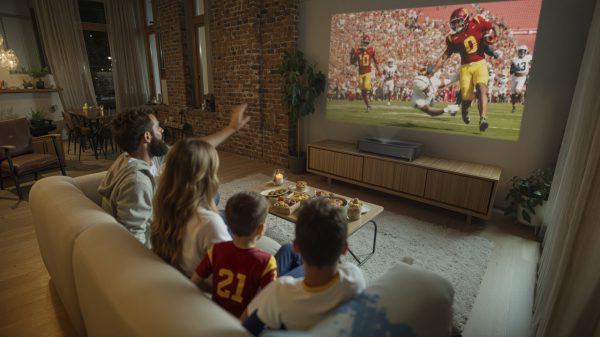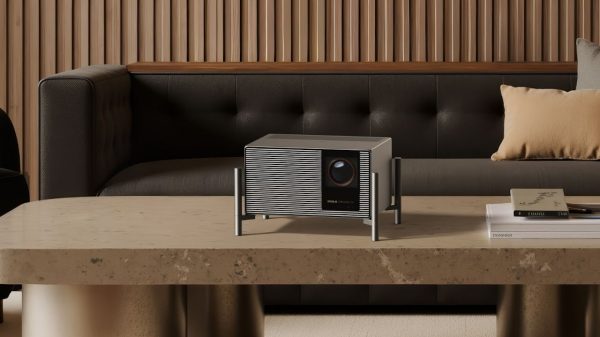
Those looking for a truly cinematic experience at home will probably want to consider something beyond a flat panel TV. While TVs max out at around 100 inches (or up to 116 inches if you have a really big budget), projectors can bring the movie theater experience home for less, with screen sizes up to 150 inches and even larger.
Traditional standard throw or long throw projectors need to be installed well away from the viewing wall, on the ceiling, a table or on the opposite side of your room from the screen, which can make things a bit tricky in terms of running power and HDMI cables. Meanwhile, UST (Ultra Short Throw) projectors can be placed very close to the front viewing wall, making them far easier to install. And with a motorized screen, you can make your giant TV virtually disappear when not in use. But, just like TVs, not all UST Projectors are created equal.

Welcome to the Showdown
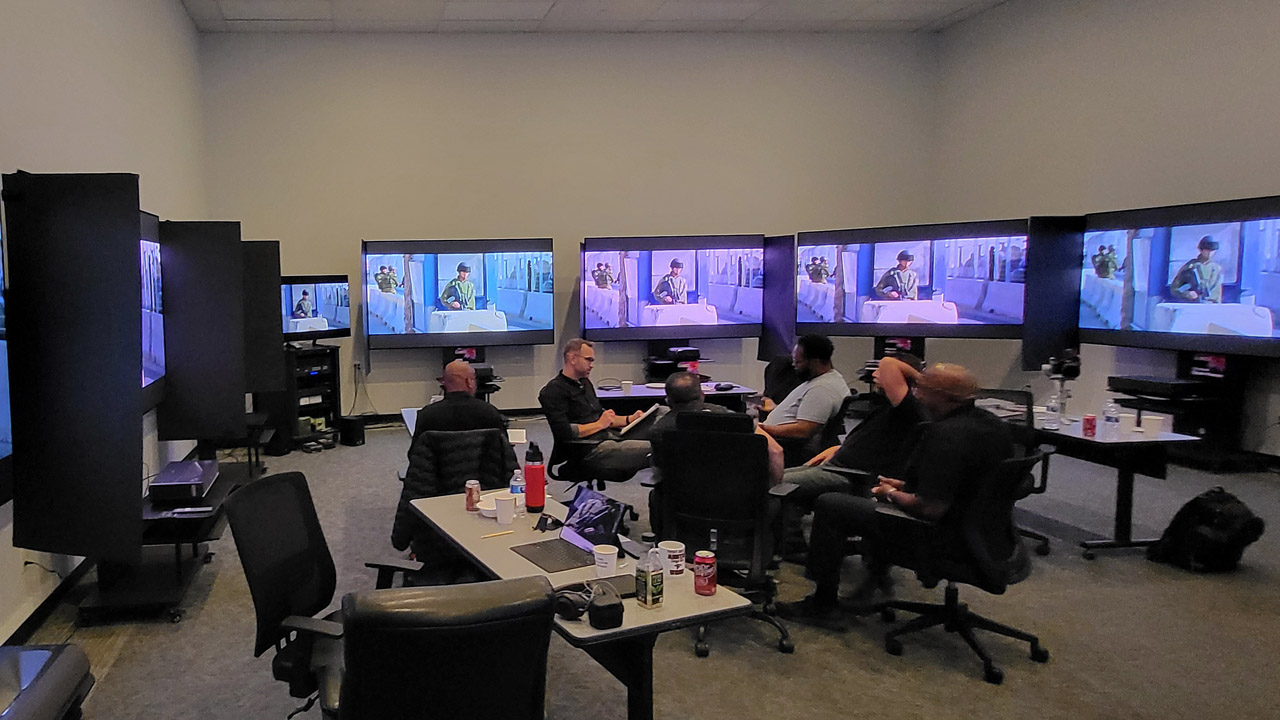
Every year since 2022, projector dealer and distributor ProjectorScreen.com has hosted a UST Projector competition that puts the top performing UST projectors into a single room, and brings in a panel of judges to rate the relative performance of each in order to find the top performing projectors of the year. The event is called the UST Projector Showdown, and this year it was held on Saturday, November 8th, 2025, at ProjectorScreen.com’s new headquarters in Riverdale, NJ.

No Hero Samples Here
Brian Gluck, owner of ProjectorScreen.com, provided not only the venue for the event but also all of the projectors used in the competition, from his store inventory. In Gluck’s words: “We were excited to host the 4th Annual UST Projector Showdown here in our new Headquarters, with Phil Jones from Projector Reviews administrating and leading the event for his second consecutive year. We had another batch of the best UST projectors currently available on the market; no golden samples or beta firmware here – what was in the competition was exactly what a customer would get themselves if they buy one from us or from anywhere else.”
The Contenders
This year’s competitors included eight different UST projector models from six brands, priced from $2,699 to $5,999 (MSRP). Three entrants were repeat contenders from last year’s UST Showdown – the Hisense PX3-Pro, Formovie Theater Premium and XGIMI AURA 2, but with the latest software updates and improvements. The AURA 2 got a nice boost in that it now features the full Google TV operating system, and not the more basic Android TV O/S. The rest of the competitors were brand new models or updated versions of existing models.

Seven of the projectors in this year’s Showdown feature single DLP (Digital Light Processing) imaging chips while one, the Epson QS100, uses three LCD chips, one dedicated to each primary color (red, green and blue). By using dedicated chips for each primary color, the Epson avoids the RBE (rainbow effect) that single-chip DLP projectors exhibit, which some people find particularly bothersome (and some folks barely notice). All eight models used a laser light source but there were some variations there.
Six models in this year’s UST Showdown use a standard Triple Laser light array with individual lasers for red, green and blue primary colors, while the Epson QS100 uses a single laser+phosphor light source and the XGIMI Aura 2 uses a hybrid Dual Light 2.0 Laser+LED light source. The Nexigo Aurora Pro was the only projector in the competition to use the latest ALPD 5.0 light engine. This combines a triple laser lighting system with additional LED elements to extend the color gamut, offer higher efficiency and reduce a visual artifact known as “laser speckle.” Like RBE, laser speckle is something that some (but not all) viewers find annoying.
With these advanced laser and hybrid lighting systems, all of the projectors in this year’s competition are rated for at least 20,000 hours of use with no bulb replacement necessary. That’s roughly 11 years if used for 5 hours per day.

All UST projectors in the competition, other than the Epson, can reproduce a full 4K (3840×2160 pixel) source by using 4-way (dual axis) pixel shifting of the DLP device. The Epson uses a single axis pixel shift system which can reproduce twice the resolution of 1080p HD, but only half full 4K resolution. This did impact the projector’s scores on tests related to sharpness and resolution but the Epson’s extremely high overall brightness (4,500 Lumens) made up for this in bright room viewing conditions.
Models Competing in the 2025 UST Showdown (with MSRP and Rated Lumen Output):
- Epson QS100 3-Chip Laser-Lit LCD Projector – 4,500 Lumens ($4,999)
- Formovie Theater Premium Triple Laser DLP Projector – 2,200 Lumens ($2,799)
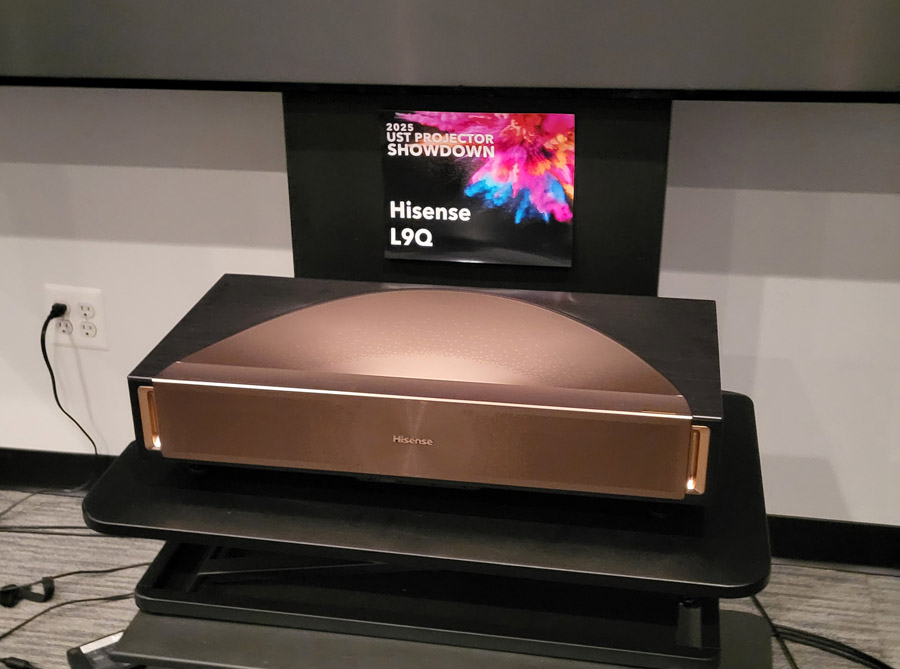
- Hisense L9Q Triple Laser DLP Projector – 5,000 Lumens ($5,999)
- Hisense PT1 Triple Laser DLP Projector – 2,500 Lumens ($2,999)
- Hisense PX3 Pro Triple Laser DLP Projector – 3,000 Lumens ($3,499)
- JMGO O2S Ultra Triple Laser DLP Projector – 3,600 Lumens ($2,999)
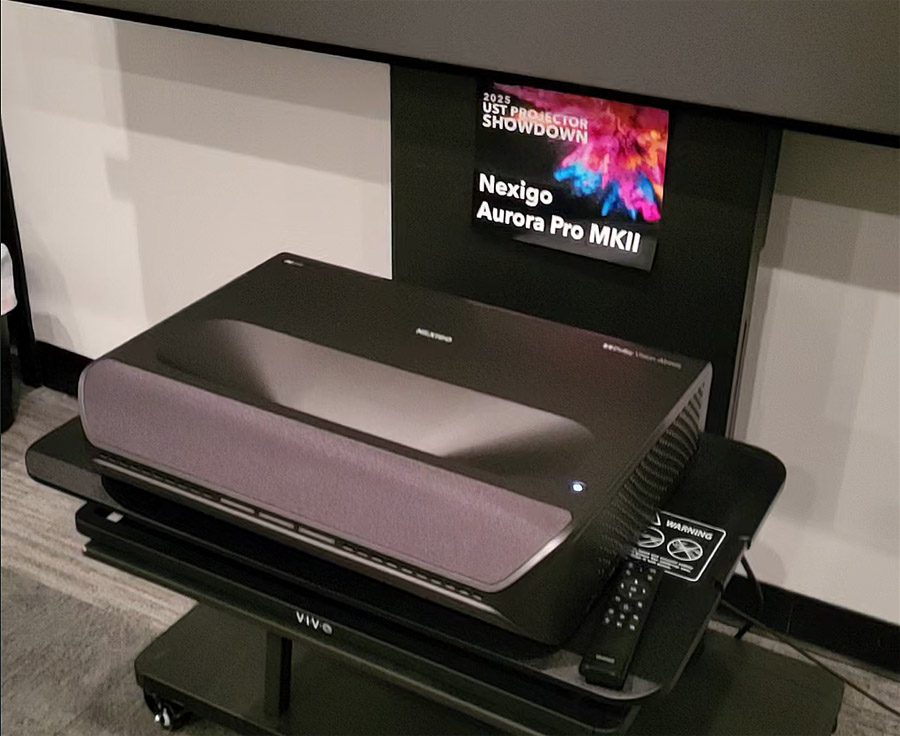
- Nexigo Aurora Pro MKII Hybrid Triple Laser/LED DLP Projector – 2,400 Lumens ($3,499)*
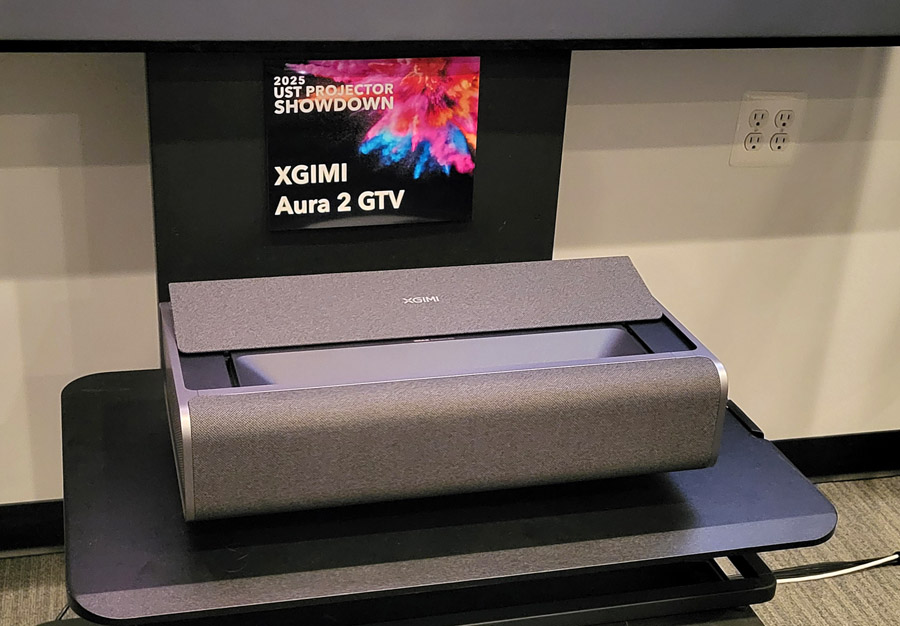
- XGIMI Aura 2 GTV Hybrid Laser/LED DLP Projector – 2,200 Lumens ($2,699)
*While we did evaluate the Nexigo projector at the event, it was later determined that the unit was not on the proper updated firmware for most of the event. So the event organizers chose to withdraw the Aurora Pro Mark II from the formal competition as it was not performing at its best, and there was inadequate time to re-do the evaluation with the projector updated to its current production firmware level. I’ve included some of my general impressions on the Nexigo projector’s strengths below.
Judges for the 2025 UST Projector Showdown
- Chris Boylan – ISF trained calibrator, reviewer and tech journalist. Founder of Big Picture Big Sound and Editor-at-Large for eCoustics
- Andy Grimm – Projector reviewer and contributor to Home Theater Review and Sound and Vision magazine, ISF trained display calibrator
- Chris Majestic – YouTube projector reviewer and influencer, @ChrisMajestic on YouTube
- Chris Mata – YouTube home theater reviewing and influencer, @ThatHomeTheaterDude on YouTube
- Milton Santiago – YouTube content creator and A/V reviewer at EBPMAN Tech Reviews, @ebpman on YouTube
- Kam Valentine – ISF-certified projector calibrator and reviewer for ProjectorReviews.com.

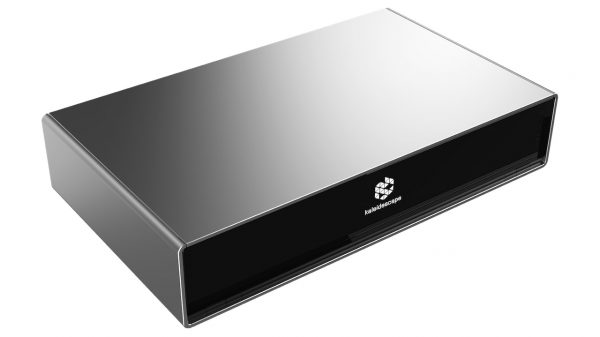
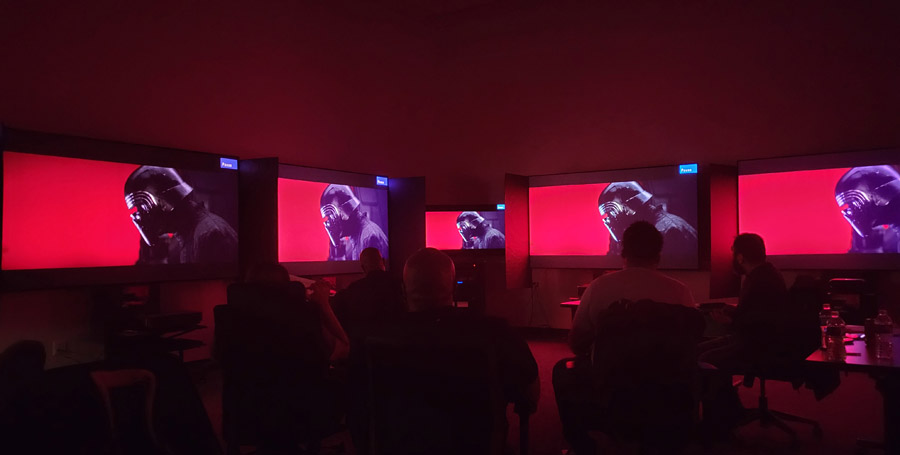
In order to keep a level playing field, all eight projectors were set up with identical 100-inch ALR (Ambient Light Rejecting) projection screens from Spectra Projection and all projectors were fed an identical signal from professional HDMI distribution equipment. For high quality source material, the show organizers used a Kaleidescape Strato V 4K media player, a Panasonic UB9000 4K UHD Blu-ray Player, and a 4K test pattern generator.
In addition to the eight UST projectors, the show organizers included a calibrated QD-OLED TV (Samsung S90F) as a reference. This TV’s exceptionally clean color reproduction and deep inky black levels provided a visual reference as to how a high performance consumer display should look.
To Calibrate or Not to Calibrate?
In any competition like this, the question comes up regarding which settings were used for the various projectors. The show organizers considered professional calibration of each unit, however the question was how representative would this be for most buyers? Few UST projection buyers actually pay extra to have their displays professionally calibrated. So instead, Phil Jones asked for each manufacturer to provide their recommended settings for each unit. These settings are being published by ProjectionScreen.com in their official event coverage.
Owners of these projectors are welcome to try these manufacturer-recommended settings, but keep in mind that sample to sample differences, ambient room lighting conditions and specific screen used will impact your results.
After the main tests were done, the organizers reset each projector to their default factory settings and set each projector in its most accurate out-of-the-box setting for some additional “out of the box” evaluation.
Testing… Testing…
In addition to video clips and stills chosen to highlight specific areas of video performance like shadow detail, color accuracy, motion handling, contrast, detail and overall brightness, we also took a look at content specifically chosen to highlight problematic issues such as color banding, laser speckle and RBE (Rainbow Effect). It was a bit of a torture test for these displays but most were able to rise to the challenge.
And The Winners Are…
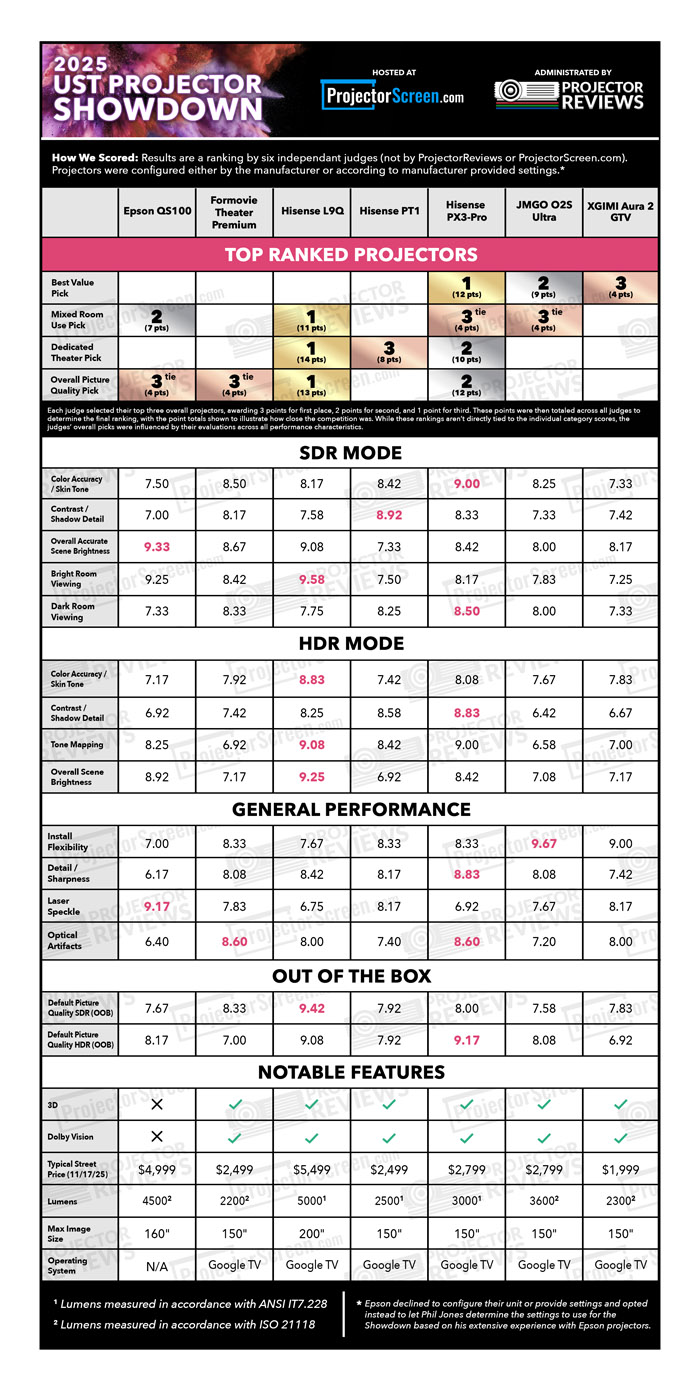
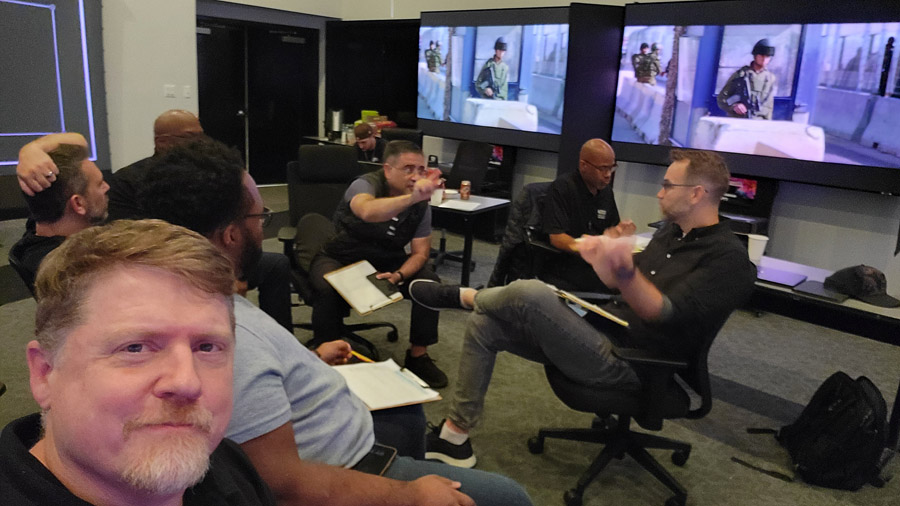
After around nine hours, staring intently at eight screens (with a short break for some fine NJ pizza and wings), we, the judges, submitted our score cards to Phil and Brian for tabulation. The show organizers then compiled the results to create a comprehensive scorecard which allows prospective buyers to see how each projector performed in each category. It also reveals each judge’s individual picks in categories such as “best value,” “best for home theater,” “best for mixed use,” etc.
Without further ado, here are the judges’ overall picks for each category followed by the full official scorecard from the event.
Best Overall Performance (Picture Quality)
- Hisense L9Q
- Hisense PX3 Pro
- TIE: Formovie Theater Premium, Epson QS100
Best Value
- Hisense PX3 Pro
- JMGO O2S Ultra
- XGIMI AURA 2 GTV
Best for Home Theater
- Hisense L9Q
- Hisense PX3 Pro
- Hisense PT1
Best for Mixed Use (Bright Room/Dark Room)
- Hisense L9Q
- Epson QS1000
- TIE: JMGO O2S Ultra, Hisense PX3-Pro
My Viewing Notes and Personal Impressions
This was my third time covering the UST Showdown, first as an audio judge, then as a main event judge. As in previous years, it was a real treat to be able to see these flagship displays doing their thing head to head on some very challenging content. Last year, certain projectors really stood out at both the top and the bottom end of the performance spectrum, but this year, the gap among the top performing and lower performing projectors was much narrower. I could honestly say I could live with any of this year’s contenders as all of them offered unique strengths as well as solid picture performance that could please even a picky videophile like me, at least in certain lighting conditions.

Two of last year’s top performers, the Hisense PX3-Pro and Formovie Theater Premium, were back in the mix this year. But would the latest advancements in both processing and light engine technology leave last year’s models in the dust? It turns out, both projectors were still able to compete effectively, particularly the Hisense.

Looking at my viewing notes and scores, the Hisense L9Q earned my top overall scores in multiple categories and the top overall score for picture quality, which matched the judges’ aggregate score. But its much higher price (twice the cost of the Hisense PT1) kept it from getting my overall pick for best projector. That pick goes to the Hisense PX3-Pro as it represented the best overall performance at its price point ($3,499, discounted to $2,999 for Black Friday). The newest offering from Hisense, the PT1, also put in a really strong showing, and sells for under $3,000 (currently around $2,699 with Black Friday pricing).
The L9Q wasn’t perfect, but it did almost everything well, and some things exceptionally well. Black levels in particular were strong on all three of the Hisense projectors, as indicated by the letterbox bars at the top and bottom of widescreen content. Shadow detail was also excellent, particularly in challenging scenes like the attack on the Gotham City mayor by the Riddler in “The Batman,” where the attacker is just barely visible against the dark background.
But the L9Q really stood out in overall scene brightness, scoring highest of all the DLP projectors in my book, just a shade behind the Epson QS100 LCD projector in peak brightness. If your budget is on the higher end of the scale, and you’ve got the space for it, the Hisense L9Q is a pretty special projector, in a variety of different lighting conditions.
In color accuracy, even without the latest firmware applied, the Nexigo Aurora Pro, MKII was my top pick in the HDR testing, slightly besting the three Hisense and Formovie models. In SDR mode, the Nexigo came in just a bit behind the three Hisense models for color accuracy and was on par with the Formovie Theater Premium, which itself was greatly improved over last year, thanks to firmware updates. Sadly, the Nexigo projector was eliminated from the competition because it was determined not to be on its latest production firmware. I hope to be able to spend some additional time with the Nexigo to see how much better it gets with the latest production firmware.
Hisense’s other new entry this year, the PT1, tied the L9Q for my top scores for color accuracy in SDR mode and actually slightly bested its much more expensive brother for black levels on some content, though it couldn’t match the peak brightness of the L9Q. This peak brightness helped the L9Q to capture bright specular highlights, providing a nice watchable image even in brighter rooms. But the PT1 wasn’t far behind the L9Q, at about half the price. The PT1 gave both the L9Q and the former flagship PX3-Pro a serious run for their money in virtually all categories and actually got my top score for “out of the box” viewing (no special settings applied) in SDR mode (though the L9Q was the overall judges’ pick for that category).

If laser speckle is something that bothers you, three projectors stood out in that regard. The Nexigo Aurora Pro Mk II, with its ALPD 5.0 lighting engine combines triple laser with LED light sources, extending the color gamut and reducing laser speckle significantly. The Epson’s single laser+phosphor and the XGIMI’s Dual Light 2.0 laser+LED light engine also produced very minimal visible speckle. The PT1 also did pretty well avoiding laser speckle, even though it uses a more traditional 3-laser light engine. As for RBE (Rainbow Effect), all of the DLP projectors exhibited this, which was easy to see on black and white test patterns if I moved my head from side to side. As a 3-Chip LCD projector, only the Epson was immune to RBE.

The Epson did display noticeably less detail than the competitive models. Its single axis pixel shifting can only reproduce half the detail from 4K sources. This led to obvious softening in detail in 4K test patterns and clips. Also, its color gamut and color accuracy were notably diminished when compared to the triple laser DLP projectors. This was most noticeable on wide color gamut 4K/HDR program material.
But the Epson really stood out for its bright room performance. When we cranked up the room lights, only the Hisense L9Q and Epson QS100 were capable of producing a pleasing and dynamic image. If you’re going big (150 inches+) and intend to keep the lights on, few projectors can keep up with the Epson QS100. But keep in mind that it is more of a “monitor” than a “Laser TV.” The Epson projector includes no streaming services or Smart TV functions. It doesn’t even include a speaker. It is intended for the CI (Custom Installation) market, where custom integrators are also installing an integrated control system, a dedicated streaming source, and separate components for surround sound.
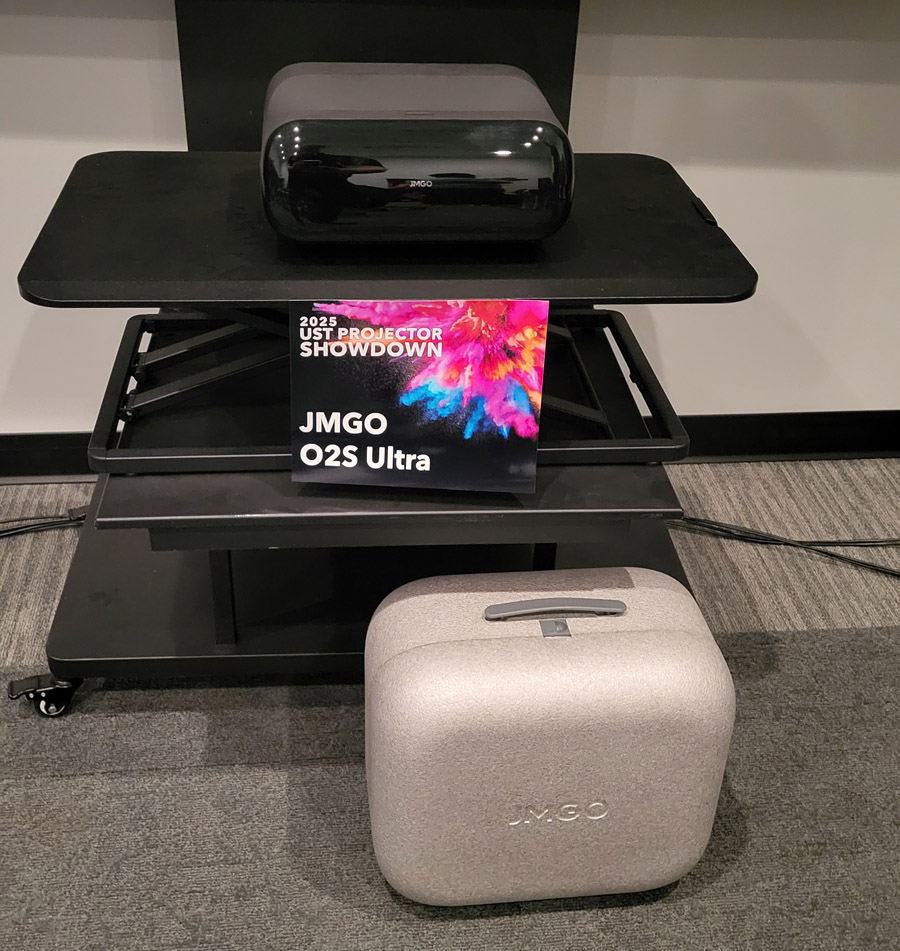
While I haven’t mentioned much about the JMGO O2S Ultra, this little guy was perhaps the most versatile UST projector in the bunch. Its compact form factor, super short throw distance, automatic focus and advanced automatic keystone, geometry and surface correction allow you to literally just place it on the floor or a small table next to any reasonably flat wall, power it up and let the projector worry about creating a sharp geometrically accurate image. It can even work on walls that are not white or grey by adjusting its own color temperature to compensate for a colored wall. It’s the only one in the bunch that comes with its own carrying case so you can bring it virtually anywhere. It does require wall power, however, so don’t take it camping or off-grid, unless you’ve got a high capacity battery along for the ride.
The Bottom Line
While picture quality is, of course, of paramount importance when choosing a TV or projector, it’s not the only thing to consider. Other aspects like features, functionality, styling, ergonomics and (of course) price are also important. While my personal top choice for picture quality was the Hisense L9Q, few can afford to drop $6,000 on a projector. It’s also one of the largest projectors in the bunch which can limit installation options and flexibility.
If you’re working on a more limited budget, the less expensive Hisense PX3 Pro and PT1 are also excellent choices, preserving many of the attributes of the L9Q for roughly half the price. And if you’re looking for a true bargain, the XGIMI Aura 2 is a virtual steal, particularly now that it has the full-fledged Google TV O/S built in. Brian told us the XGIMI Aura 2 will be available for just under $2,000 for Black Friday, making it the cheapest competitor in this year’s batch. At this price, you may even have money left over to add a motorized screen for a truly stealthy home theater that presents itself only when needed and virtually disappears at the touch of a button.
We’d recommend checking out the full results of the 2025 UST Showdown on ProjectorScreen.com’s web site. Here you’ll find the detailed scorecards as well as some additional insight on this year’s competition. Special thanks to Phil Jones for organizing the event, to my fellow judges for keeping things fun (and the conversation stimulating). And a big thanks to Brian Gluck for hosting and inviting us to participate. See you next year!
More Coverage of the 2025 UST Showdown:
ProjectorScreen.com Official 2025 UST Showdown Event Page
Kam Valentine: A Judges’ Perspective on the 2025 UST Showdown (ProjectorReviews.com)
Phil Jones’ 2025 UST Showdown Event Recap and Overview (ProjectorReviews.com)
Judge Chris Majestic’s Take on the 2025 UST Showdown (YouTube)
Related Reading
Top UST Projectors of 2024 Revealed at the UST Projector Showdown