As of 2025, OLED TV technology has evolved into three distinct types: WRGB OLED, Primary Tandem RGB OLED, and QD-OLED. While each offers its own advantages, QD-OLED (Quantum Dot OLED) has quickly become the performance leader—delivering higher brightness, richer colors, and improved viewing angles compared to traditional OLED panels. In this guide, we’ll break down what sets QD-OLED apart, how it differs from the other OLED types, and why it’s become the go-to choice for those chasing the best picture quality in 2025.
Before we get any deeper into how this works, an explanation of quantum dots is definitely in order.

A quantum dot is a nanocrystal with semiconductor properties. When a quantum dot nanocrystal is hit with photons from a light source (in the case of QD-OLED TVs, light from a blue OLED panel) the dot emits the color of a specific bandwidth, which is determined by its size. Larger dots emit light that is skewed toward red. As the dots get smaller, the dots emit light that is skewed toward green. The process of a quantum dot emitting red or green light after being struck by a blue light source is referred to as Quantum Dot Color Conversion (aka QDCC).
OLED stands for Organic Light Emitting Diode. Organic LEDs are self-emitting, meaning that when with provided electric current they produce their own light and color. In OLED TVs, they are used in place of an LED backlight and LCD panel, as they provide the necessary capability to display images without those extra internal components. In a QD-OLED TV, they are used slightly differently as the OLED panel functions both as a backlight for red and green color-sensitive quantum dots, as well as providing the blue color for screen display.

QD-OLED technology combines Quantum Dots with OLED and eliminates the need for an LCD panel to display images. A layer of OLEDs placed on the back of the TV emits blue light. The blue light strikes a layer of quantum dots to produce green and red light, while a portion of the blue light from the OLED layer passes through untouched to the screen. As mentioned, an LCD screen panel is not needed to display images – the blue OLED light and the green and red light Quantum Dot light produce the displayed screen images.
Tip: QD-OLED stands for Quantum Dot with Organic Light Emitting Diode

To compensate for an inherent problem with blue OLED pixel degradation, QD-OLED panels incorporate at least 3 layers of blue OLED pixels. Just with OLED, no LCD panel is needed for the display image. Similar to OLED, QD-OLED technology supports the ability to display absolute black in addition to more precise color than OLED.
What QD-OLED TV Tech Is


Samsung & QD-OLED
When it comes to brands, Samsung Electronics is the world’s largest TV maker both in manufacturing and sales. Their TV lineup is dominated by LCD-based choices, which is a competing technology to OLED. Although Samsung has been selling OLED TVs since 2012, the panels themselves were actually made by their competitor, LG Electronics’ sister company LG Display. Even today nearly all OLED TVs available use LG’s OLED technology, including Panasonic, VIZIO, Philips, and even some models from Sony and Samsung.
Things changed in 2022, when Samsung Display sold its LCD panel production business to TCL’s CSoT, and began production of a new OLED technology using quantum dots, called QD-OLED TVs.
Tip: Samsung Display sometimes refers to QD-OLED TV tech as QD Display Tech.
Bonus Tip: QLED ≠ QD-OLED. The term “QLED” refers to LCD-based TV technology and is neither OLED or QD-OLED. So a QLED TV is not an OLED TV.
QD-OLED as a Transitional Technology?
QD-OLED has been very well received since its release in early 2022, but there is a catch. It may only be a short-term advancement to stay ahead of both OLED and LCD-based TV competition.
Looking forward, to eliminate any possible issues with using blue OLED panels, Samsung is looking into Quantum Dot Nanorod LEDs (similar to micro LEDs) as a replacement. In this scenario, instead of using an organic Blue-OLED backing layer, Non-organic Quantum Nano Emitting Diodes would be used to produce the necessary blue light source – with quantum dots doing the green and red color conversion as they do in QD-OLED. The working moniker for this solution is QNED (not to be confused with LG’s LCD-based QNED miniLED TVs).

The advantage of Samsung’s proposed version of “QNED” over QD-OLED is that nanorods are inorganic which provides a longer-lasting stable blue light source. However, this solution has yet to come to market.
Tip: One thing that is confusing is that Samsung is marketing QD-OLED sets as OLED TVs, rather than QD-OLED or QD Display TVs.
Pricing & Availability
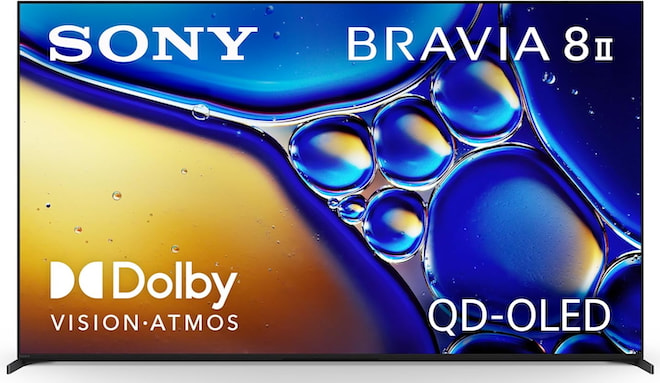
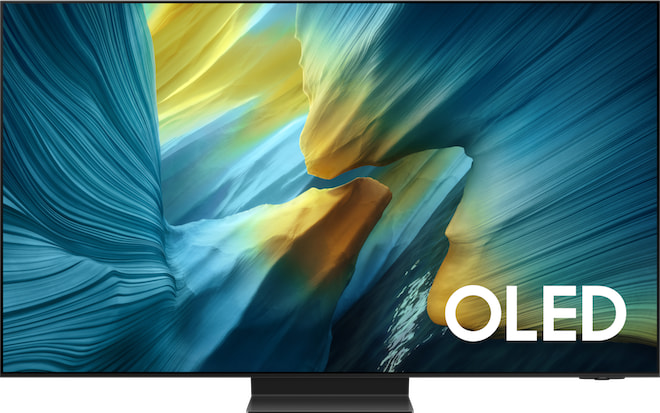
As of 2025, Samsung and Sony are the only two TV makers selling QD-OLED TVs, which are only available in 55-inch, 65-inch and 77-inch diagonal screen sizes.
- Samsung S95F (55″, 65″, 77″ only) at Crutchfield | Amazon
- Samsung S90F (55″, 65″ 77″ only) at Crutchfield | Amazon
- Samsung S85F (55″, 65″ only) at Crutchfield | Amazon
- Sony Bravia 8 II (55″, 65″) at Crutchfield | Amazon
- Sony Bravia A95L (77″, 2023 carryover model) at Crutchfield | Amazon
Tip: Samsung makes smaller and larger models within the same series, so it can be confusing which OLED technology is used. The secret is in the super long model number. If it ends in FXZA, then it uses a QD-OLED panel. If it ends in EXZA, then it uses a WOLED (aka WRGB) panel.
The Bottom Line
QD-OLED TVs are the most expensive TVs (per screen size) in 2025, and have been deemed “closest to reference” by expert judges at the annual Value Electronics TV shootout since first entering the market in 2022. Over that time each generation Sony QD-OLED TVs have swept the competition, with the latest Sony Bravia 8 II taking the “2025 King of TV” crown, followed by the Samsung S95F QD-OLED TV just .03 points behind.
Other than price, the main drawbacks to choosing a QD-OLED TV are realizing screen sizes currently max out at 77-inches in diagonal, while advancements in MiniLED and Micro RGB technology can produce brighter output and potentially more colors. But that’s a debate for another story. In any case, if you want a 55-, 65-, or 77-inch TV in 2025, then QD-OLED TVs are the best-of-the-best.
For more on Quantum Dot technology solutions for TVs, refer to our article: WTF are Quantum Dots?
Related Reading
- Not All OLED TVs Are the Same: Key Differences That Impact Your Viewing Experience
- Sony Bravia 8 II QD-OLED TV Wins “King of TV” at 2025 Value Electronics Shootout
- Podcast: 2025 TV Shootout Results Analyzed With B The Installer
- Podcast: Best TVs of 2025 with Caleb Denison of CalebRated
- Buying A New TV: Everything You Need To Know
- How Far Should You Sit From Your TV?