

Table of contents
Introduction
“Bookshelf speakers” is still the label everyone uses, but let’s be honest, these are small speakers that do their best work on proper stands. Yes, you can park them on a shelf or a credenza, but if accuracy, imaging, and tonal balance matter, stands are non-negotiable. Traditionally, this has been a passive speaker category, but that line is getting blurrier by the year as manufacturers increasingly pivot toward compact wireless and all-in-one designs. The result is fewer traditional refreshes and more emphasis on lifestyle friendly, powered alternatives. If wireless matters more than swapping amplifiers, our Editors’ Choice wireless speaker list is where you should be looking.
That shift is impossible to ignore. Brands are clearly investing more R&D into wireless ecosystems than updating classic passive bookshelf designs, which explains why some long running favorites are sticking around longer than expected. Wharfedale’s newly announced Diamond 12i Series is one of the few notable exceptions, and we already have those slated for review in 2026. As we look ahead, we are watching closely to see what KEF, ELAC, PSB, Klipsch, Monitor Audio, Triangle, and Chesky Audio bring to the category next year, because the future of the “bookshelf” speaker is clearly being rewritten in real time.
Best Bookshelf Speakers of 2025
Vera-Fi Vanguard Scout ($299)
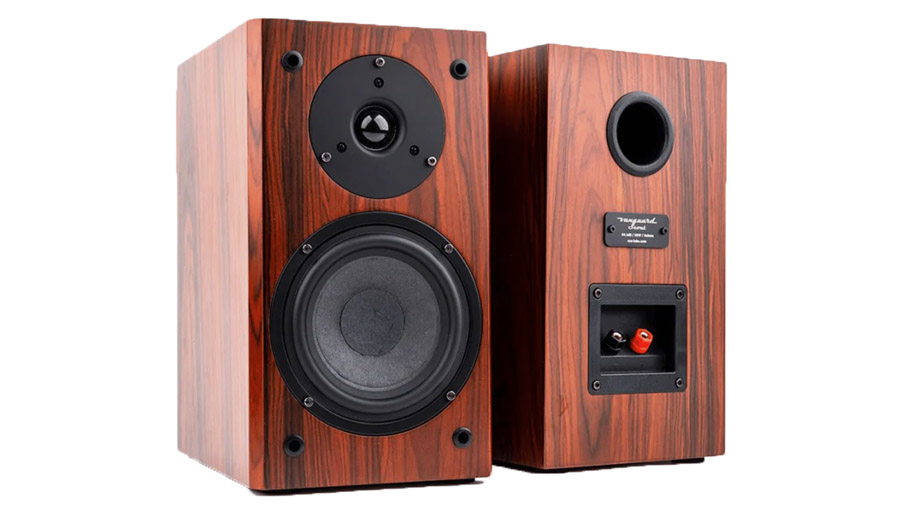
Anyone hunting for genuinely affordable speakers that don’t sound like a budget compromise will find a lot to appreciate in the Vera-Fi Vanguard Scout. They deliver natural, believable tone with both instruments and vocals, lock imaging in place, and avoid the glare and fatigue that plague much of the sub-$500 crowd. Male and female voices, in particular, have a realism that suggests the designers prioritized musicality over fireworks. The trade-off is physics: with 84.5 dB sensitivity, they simply don’t have the dynamic headroom of hotter, more efficient designs, and large-scale material exposes that ceiling. Still, at $299/pair, nothing we’ve heard under $500 matches their overall balance and “just listen” ease.
Built around a two-way bass-reflex architecture with a 5.25-inch treated paper cone woofer, 1-inch silk dome tweeter, and an asymmetric crossover using custom parts, the Scout feels more premium than its price hints at. The real rosewood veneer cabinet with a satin finish, rear-firing port, and 5-way binding posts signal that corners weren’t cut where it counts. Measuring 12″ x 6.75″ x 9.5″ and weighing 12 pounds each, they’re compact but substantial, with a clean removable fabric grille. The limitations remain: low sensitivity restricts maximum SPL and dynamic swing, the soundstage doesn’t break past the speaker boundaries, and some banana plugs don’t seat perfectly in the posts. But taken as a whole, the Vanguard Scout is one of the most thoughtfully executed, musically satisfying loudspeakers available anywhere near this price.
Go to full review | $299/pair at Vera-Fi Audio
Q Acoustics 3020c ($499)

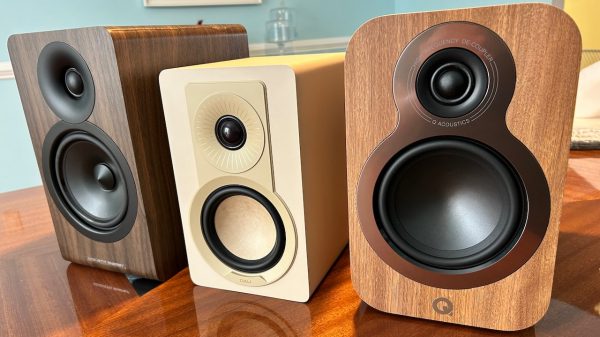
The Q Acoustics 3020c is the rare bookshelf speaker that delivers real engineering upgrades without drifting into “hi-fi for accountants only” pricing. Q raided the tech pantry from the 5000 and Concept lines, dropping in the C3 Continuous Curved Cone for cleaner, more accurate driver behavior and P2P bracing to kill cabinet resonance before it muddies the midrange. Add improved driver isolation and you get a speaker that sounds bigger, cleaner, and more confident than its footprint suggests. The 120mm woofer and 22mm tweeter cover 60 Hz to 30 kHz with an 87 dB sensitivity and a nominal 6-ohm load that dips to 3.3 ohms when it wants to keep your amp honest. It’s happiest with 30-100 watts behind it, plays well with everything from budget NAD to Cambridge high-rollers, and unlike its predecessors is less temperamental about wall proximity thanks to tighter, more controlled bass. Tariffs pushed the price to $549, but the clarity, imaging, and overall refinement still make this one of the strongest compact standmounts in its class.
Physically, the 3020c is compact but substantial at 254 x 155 x 251 mm (10.9 x 6.9 x 11.1 inches) and 5.5 kg (12 lbs), landing easily on a credenza or a solid pair of 24-inch stands. The finish options—Pin Oak, Claro Rosewood, Satin Black, Satin White—avoid fashion trends while looking premium enough for any room. They’re not full-range, and listeners craving real low-end heft will find the larger 3030i or 5020 more satisfying. The tonal balance leans clean rather than rich, rear-port placement still deserves some care, and they don’t have the dynamic punch of Q’s bigger siblings. But pair them smartly and you get clear, detailed sound, excellent imaging, improved bass control over earlier generations, and build quality that feels far more expensive—proof that a well-engineered compact can still deliver genuinely grown-up performance.
Go to full review | $499/pair at Amazon
DALI KUPID ($600)
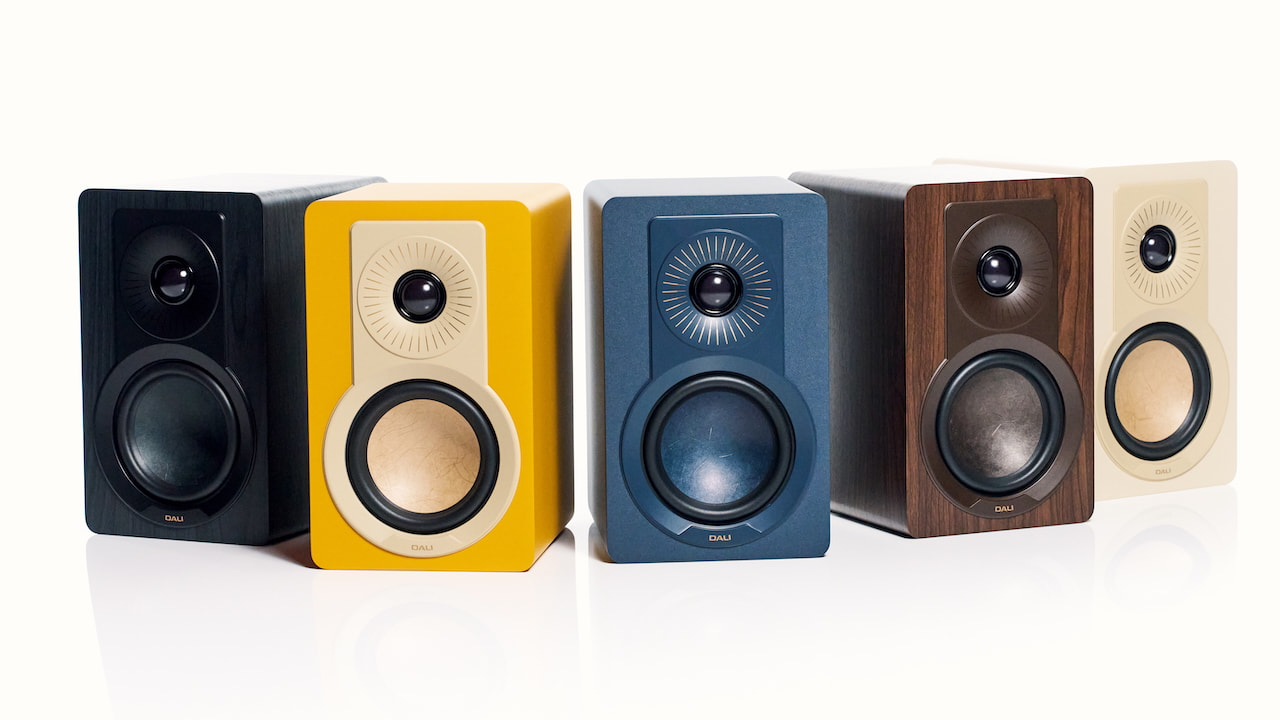
DALI’s KUPID strips their high-end philosophy down to something small, affordable, and unapologetically practical. Everything critical—drivers, cabinets, crossovers, even the screws—comes out of DALI’s own production chain, which matters more here than any fantasy of Danish craftspeople carving baffles by hand. The compact cabinet behaves well near walls, the textured magnetic grilles keep things tidy, and the five color options finally acknowledge that not everyone decorates like a Copenhagen dentist’s office. Inside, the 4.5-inch paper/wood-fibre midbass driver and 26mm soft dome tweeter work through a precisely voiced 2,100 Hz crossover, delivering clean integration, solid bass for the size, and a midrange that lands with clarity rather than politeness. The dual-flare port is tuned to avoid the usual small-box bad habits—no wheezing, no bloat—just controlled output down to its rated 63 Hz.
On the listening side, the KUPID is energetic, articulate, and surprisingly confident without pretending to be something larger. The midrange is present and honest, the treble behaves, and the bass does what it can without resorting to theatrics. Sensitivity is low at 83 dB, so they appreciate real amplification, but they’re flexible: wall-mount them, shelf them, whatever your room allows. Build quality feels more “smart budget” than luxury, but the sound easily justifies the ask. Paired with a WiiM Amp Ultra or a NAD C 316BEE V2 fronted by a WiiM Pro Plus and a better DAC, you get a compact system that simply works—clear, engaging, and free of the usual marketing mythology.
Learn more | $600/pair at Amazon | Crutchfield
Wharfedale Super Denton ($1,499)

Wharfedale has sold a small nation’s worth of Linton Heritage and Super Linton loudspeakers, and I’m still waiting for my engraved invitation to the celebration—typical. While everyone else waxes poetic about those big retro wardrobes masquerading as speakers, the real jewel quietly sits off to the side: the Super Denton. Born in 1971 and still the weird kid in the Heritage family, it’s smaller, denser, and far more serious about texture, coherence, and midrange truth than its crowd-pleasing siblings. At 14.2″ x 9.7″ x 10.8″ and a stout 21 pounds each, these aren’t bookshelf props; they’re “don’t even think about putting us in an IKEA cubby” monitors. The twin rear ports need at least a foot of breathing room—18 to 24 inches if you want to unlock their best work. They’ll function on a high credenza with IsoAcoustics pucks, but proper stands are the correct answer. The 2-inch soft-dome midrange and offset 1-inch dome tweeter are classic Wharfedale moves that pay off with refined treble, fluid mids, and imaging that snaps into place when you set them up correctly. Rated at 87 dB sensitivity with a nominal 6-ohm load (dipping to ~3.4 ohms), they are not for weak-kneed amplifiers; Wharfedale’s “25 to 120 watts” range isn’t a polite suggestion but a firm handshake agreement.
Stick with the walnut finish—it gives them the gravitas they deserve and prevents them from looking like something rescued from a freshman dorm room. The binding posts are slightly shallow, but they’re built with a level of fit, finish, and visual weight that feels far more expensive than the ticket price. And once you get the amplification right, these things sing. Vocals in particular have a realism and emotional pull that’s hard to deny; they’re old-school in soul but unmistakably modern in refinement, speed, and composure. Set them about six feet apart with the midrange domes inward and toe them toward your seat. Do that, pour your drink of choice—Glenrothes, rooibos tea, whatever keeps your existential dread at bay—and enjoy. As Baldrick might say, they’re the cunning plan Wharfedale fans didn’t know they needed: a wonderfully executed, deeply musical speaker that rewards you for treating it properly.
ATC SCM20ASL ($10,999)
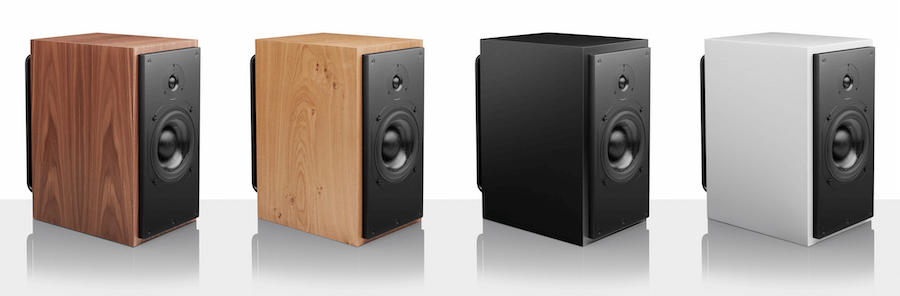
ATC’s SCM20ASL is the point where the usual “active vs passive” debate quietly dies. For around ten grand, there isn’t another active stand-mount that matches this level of coherence, imaging precision, and tonal honesty. Housed in a compact 20-liter cabinet and offered in multiple finishes, the SCM20ASL is built around ATC’s own 150mm Super Linear mid/bass driver—complete with a 75mm voice coil and long-gap motor that keeps distortion astonishingly low through the entire midband. Above it sits the 25mm S-Spec soft dome tweeter, driven by a 2.1-Tesla motor and dual-suspension system that extends cleanly past 20kHz without turning brittle. Each driver gets its own dedicated Class A/B MOSFET amp module—200W to the mid/bass, 50W to the tweeter—so the system behaves like a studio tool rather than a hi-fi vanity project. A line-level 2nd-order Linkwitz-Riley crossover and all-pass phase correction lock the drivers together, giving the SCM20ASL its trademark imaging and that “nothing calling attention to itself” tonal balance.
Around back, balanced XLR is mandatory, and ATC gives you real tuning tools—input sensitivity trim to match your preamp or source, plus a low-frequency shelf for minor room compensation. But the heart of the appeal is the experience: a level of resolution, dynamic control, and neutrality that makes most passive speaker/amp combos in this price range feel like guesswork. The SCM20ASL doesn’t hype, sweeten, or dramatize; it simply delivers clarity, authority, and holographic placement that’s hard to un-hear once you’ve lived with it. If there’s a passive setup near $11K that clearly outperforms it, it’s probably wearing an ATC badge anyway.
Learn more | $10,999/pair [Locate Dealer]
The Bottom Line
This group could not be more diverse if it tried. The Vera-Fi Vanguard Caldera Scout is about tone, clarity, and modern minimalism, built for listeners who want precision without excess. The Q Acoustics 3020c plays the value card brilliantly, offering an easygoing, balanced sound that works in real rooms with real gear. DALI’s KUPID leans lifestyle forward in both looks and voicing, delivering energy and punch in a compact, design-driven package. The Wharfedale Super Denton is the oddball in the best way possible, dense, rich, and unapologetically British, with tone and texture that reward long listening sessions.
And then there are the ATC SCM20ASL, which don’t just sit apart, they operate in a different league. Yes, they are active and require a proper preamp and quality sources, but the payoff is impossible to ignore. These are brutally coherent, exceptionally detailed, and startlingly present, with a sense of control and force that most passive stand-mounts simply cannot match. Different designs, different philosophies, and wildly different sonic personalities, but each one earns its place depending on what you value most in how your music looks, feels, and hits.
Related Reading:
- Best Wireless Speakers
- Best Floorstanding Speakers
- Capital Audiofest 2025: Best in Show
- Latest Editors’ Choice Awards
























Anton
December 18, 2025 at 11:46 am
The DALI pick has me confused. They are butt ugly and feel like “DALI opened a factory in China” cheap.
Are they even worth $600? The Vera-Fi look so much nicer.
ATC is true high end audio. Not cheap.
Ian White
December 18, 2025 at 2:49 pm
Anton,
They are not “butt” ugly. The photos don’t do the little details justice. More detailed review to follow. They are $600 and the little details reflect that. They do make the drivers in Denmark, but these were definitely assembled overseas.
IW
Zander
December 21, 2025 at 2:30 pm
I appreciate the detailed approach and thoughtful selection.
I’ve been tempted by the Q Acoustics but ultimately went with the Triangle Borea BRO4’s (found them for just over $450). Curious if you considered the BR04’s as part of the assessment?
Ian White
December 21, 2025 at 3:31 pm
Zander,
We’ve not had a chance to hear those yet. I own a pair of BR03 BT and love them. Q1 2026 review likely.
IW
Jim
December 21, 2025 at 10:05 pm
Loved your Cap Audio Fest coverage by the way but this category has a strange price skew. Maybe another at the 3-8k point. I’m waiting on the GR Research monitor and floorstander just about to be released in this price range.
Ian White
December 22, 2025 at 1:34 am
Jim,
So here’s the thing. Unless manufacturers send us products in specific price categories to review, we can’t comment on it. I recognise the gap but it’s based on real-world listening experience. We review over 200 products a year and publish an additional 800+ feature and news stories. Only so many hours in the day.
IW
Michael Larsen
February 9, 2026 at 10:27 am
Dali Kupid cost what is equal to $411 for a pair in Denmark
$600 for a pair is way to high
Ian White
February 9, 2026 at 11:22 am
Michael,
We are painfully aware of that reality. It’s the reality of the situation right now.
IW