Table of contents
The Case for Audio/Video Receivers (AVRs)
While soundbars have evolved over the years and can provide a convenient solution to better TV sound, nothing beats a good Audio/Video Receiver (AVR) or A/V separates with a discrete set of surround sound speakers for a truly immersive and cinematic surround sound experience at home. Buyers of modern audio/video receivers get more of everything: more inputs, more features, more flexibility and usually better sound to boot. It will like take you a bit more time (and a roll of speaker wire) to set up, compared to a soundbar, but the benefits make this extra effort worthwhile.
Also known as a “home theater receiver,” or “surround sound receiver,” the AV receiver has undergone a bit of a renaissance in the last decade, thanks, in part, to a global pandemic and quarantine that had people investing in home audio and video gear when going out to movies, plays, restaurants and concerts wasn’t an option. We have seen a constant flow of new models from the top brands, if not annually, then at least every 2-3 years.
Acquisitions have shaken up the market lately. VOXX International, owners of the Onkyo, Integra and Pioneer brands, was acquired by Gentex earlier this year. An unfortunate consequence of that deal was the exit of Pioneer from the receiver market in North America, but with Onkyo’s history and prominence in the market, we expect that the new parent company will continue to invest in and support that brand, and its CI (Custom Installation) sub-brand Integra.
2025 also saw the acquisition of Sound United, parent of Denon, Marantz and Bowers and Wilkins, by Samsung as an expansion of its Harman International audio business. So far, the company seems to be letting each business unit do its own thing, but there could be some consolidation or benefits of technology sharing with Harman’s other receiver/amplifier brands such as JBL and Arcam. Time will tell.
All of the A/V receiver models we’re recommending here (except the compact Anthem model) support video displays up to 8K in resolution and include at least six HDMI 2.1 inputs and HDCP 2.3 on-board for compatibility with the latest source components including next generation gaming consoles, 4K/8K media players and Ultra HD 4K Blu-ray Disc players. The Anthem MRX SLM supports sources up to 4K Resolution (60 Hz) with an HDMI 2.0A HDMI port with ARC/eARC. The Anthem MRX Slim is also the only “receiver” on the list which lacks an FM tuner.
Also, all of our “Editors’ Choice” award-winning receivers can decode DTS:X and Dolby Atmos immersive surround. All but the Anthem model support discrete immersive surround with real height speakers for the most immersive and enveloping surround sound experience. The minimum requirement for that is seven channels of on-board amplification for a 5.1.2-channel DTS:X or Dolby Atmos speaker system.
Please note that we do not currently have a “budget” pick (under $500) as previous recommendations in that category have gone up in price significantly. If you can still find Denon’s AVR-X1700H from 2021 for under $500, we’d say pick that up in a heartbeat as it includes full Dolby Atmos and DTS:X support with discrete height channels and it’s a strong performer for audio and video. But most places are selling that now for $600 or more.
All of our Editor Choice picks for 2025 were either released in 2025 or are still current in the manufacturers’ lineups and still available for purchase in late 2025.
The Best A/V Receivers of 2025
Best AVR Under $700: Onkyo TX-NR7100 ($699)
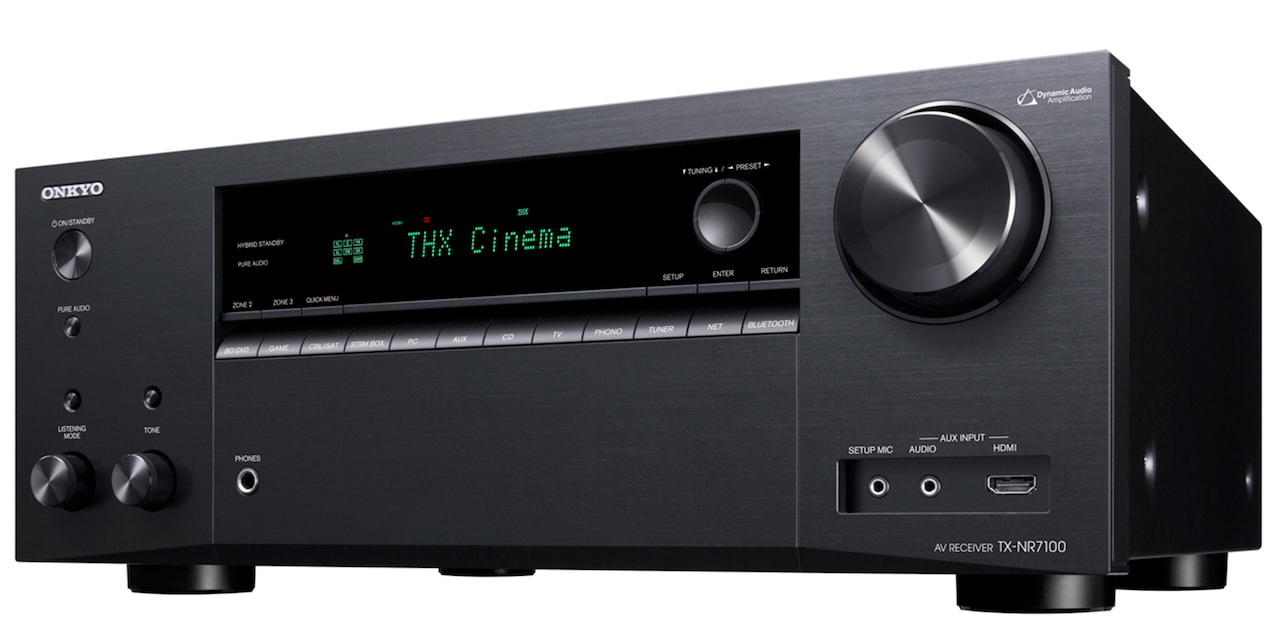
First released in 2021 with a list price of $1299, the Onkyo TX-NR7100 AVR is still technically a current product and is relevant today with support for a full 9-channel system (7.1.2 or 5.1.4), Dolby Atmos, DTS:X, IMAX Enhanced certification, plenty of power and even DIRAC Live room optimization built-in. And, unlike many competitive models which have seen drastic increases in price, the NR7100 street price has dropped to just under $700, making this an exceptional bargain.
The NR7100 includes nice extras like a turntable input and is “Works with Sonos” ready, which means you can turn your living room or home theater system into a fully functional Sonos room or zone, with full remote and app system control, by adding on a Sonos port. The 7100 even received THX Select certification, meaning it meets the demanding audio and video performance standards of that organization.
The user menus may not be as sexy as the newer models, and also the lack of pre-amp outputs means you won’t be able to add channels in the future. Also, while there are two subwoofer outputs, these are not independently controlled which limits your ability to optimize bass for even response throughout a room. However, at its current street price under $700, the Onkyo TX-NR7100 offers exceptional features and performance for the price.
Pros
- Outstanding value at current street price
- Supports 5.1.4 or 7.1.2 channel systems right out of the box
- Works with Sonos certified
- DTS:X, Dolby Atmos, IMAX Enhanced and THX Select certified
- DIRAC Live room correction on board at no additional cost
Cons
- No multi-channel preamp outputs or options to upgrade channel count
- Single subwoofer output limits bass optimization options
- No support for Sony 360 Reality Audio
MSRP: $1,299 $699 – available at Amazon
Best AVR Under $1000: Onkyo TX-RZ30 ($999)
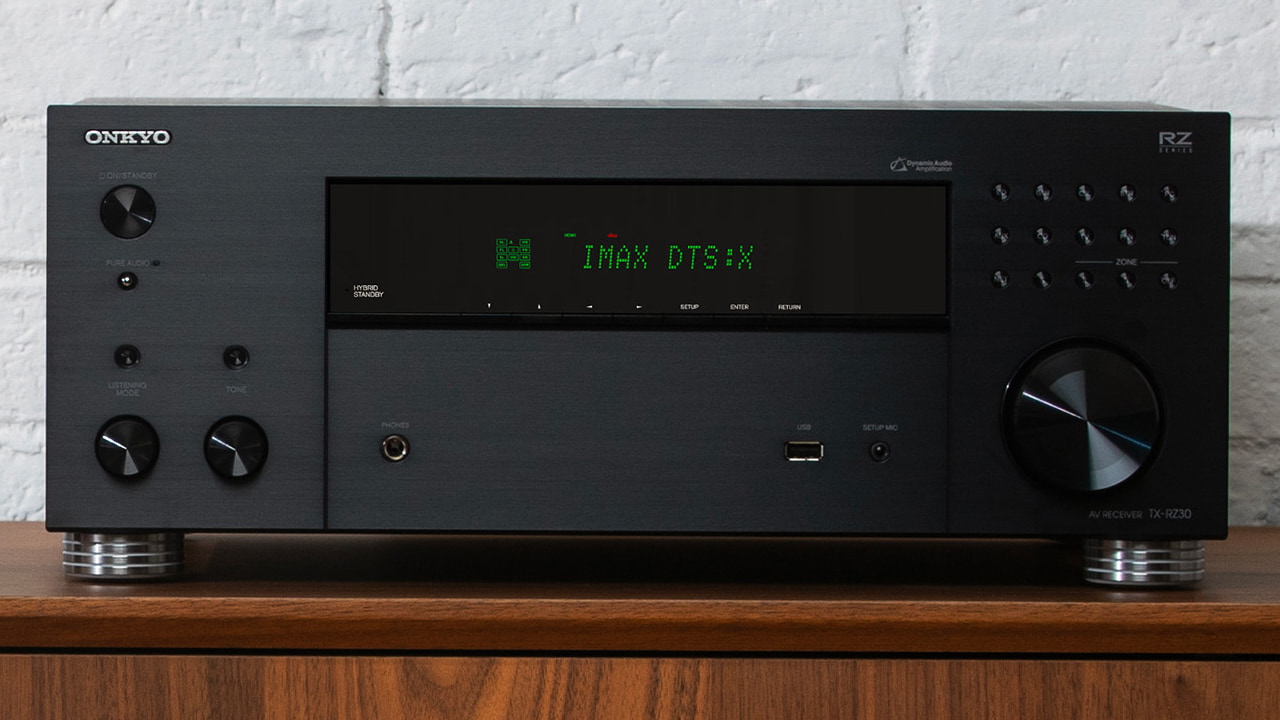
While the Onkyo brand has changed hands a couple of times in the last five years, the company continues to release powerful feature-packed AV receivers which are well-suited to medium to large home theater audio systems. At a current street price of under $1,000, the Onkyo TX-RZ30 hits the sweet spot for price and performance for a full-featured 9.2-channel AVR. It’s similar in many ways to our “under $700” pick above (the TX-NR7100), but offers important advantages such as updated hardware and software, dual independently controlled subwoofer outputs and a full set of preamp outputs.
The RZ30 is rated for 100 Watts/Channel (2 channels driven) with nine on-board amplifiers. It can be configured for a 5.2.4-channel or 7.2.2-channel system, or you can do a 5.2.2-channel system and use the other on-board amps for a second room or zone. Unlike our upgrade choice (Denon AVR-X3800H), the RZ30 can’t be upgraded to an eleven channel system by adding an amplifier, however, the unit does offer pre-amp outputs for each of its nine speaker channels in case you want to beef up the sound of any or all channels with external power amplifiers. External amps can also be used to power the receiver’s Zone 2 and Zone 3 outputs.
What we love about the RZ30 is that it has DIRAC Live room correction on-board at no additional cost and can be updated to DIRAC Bass Control (at a fee) to take full advantage of its dual subwoofer outputs. In our smallish home theater, we were able to get DIRAC Live setup with three measurement points in less than 1/2 hour. The DIRAC optimization is a bit more sensitive to noise and level settings than its competitor, Audyssey, and this required me to exit and restart the calibration a few times. But, with a little effort, I was able to get excellent results from DIRAC Live. For me, it clarified the imaging and sound placement to the point that I kept looking around the room for where sounds were coming from and even thought my neighbor might have been knocking on the walls to keep it down (but they weren’t, it was just an illusion).
If the RZ30 is lacking in any area, it’s in using is as a stereo amp for inefficient bookshelf speakers. Paired with the Chesky Audio LC1s or KEF LS50s, the RZ30 wasn’t quite as transparent and dynamic as some other receivers and amplifiers we tested, though admittedly I did not try optimizing the sound with DIRAC during these listening sessions. With DIRAC optimization applied in a home theater setting, the RZ30 produced stellar, dynamic sound for both multi channel music and movies in Dolby Atmos and DTS:X sound.
The RZ30 is also one of the most affordable AVRs to support dual independently adjustable subwoofer outputs. Most AVRs with two sub outputs actually just split the output signal to both subs without individual control. By allowing independent control, the RZ30 can work with DIRAC Bass Control to optimize the bass response in multiple listening positions. DIRAC Bass Control requires purchase of a separate license (currently $299).
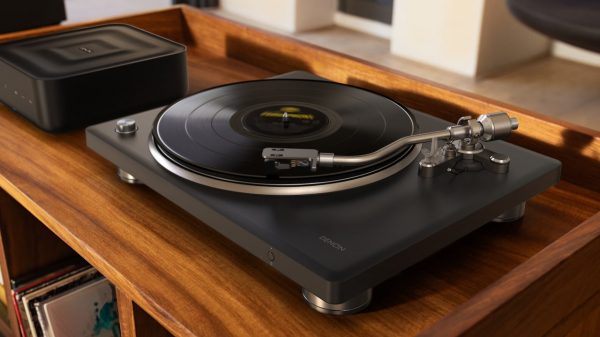
Unlike most entry-level receivers, and even some high-end ones, the RZ30 still includes both component and composite video inputs. So if you’re still rocking a VCR or a LaserDisc Player, you’ll be happy to have a connection for those. There’s also a built-in phono preamp so you can plug in your vintage (or not so vintage) turntable.
Overall, the Onkyo TX-RZ30 is a flexible and capable performer, offering plenty of power and control, a plethora of inputs and built-in best in class room correction in an affordable package.
Pros
- Supports up to 5.4.4 or 7.4.2 channel systems
- Can be used as AV preamp with outputs for nine speaker channels
- 2 independently adjustable subwoofer outputs enable optimized in-room bass response with DIRAC Bass Control (requires additional purchase)
- Dolby Atmos, DTS:X, THX Select Certified and IMAX Enhanced sound
- Supports DIRAC Live room correction at no additional cost
- Solid, dynamic audio performance for multi-channel music and movies
- Works with Sonos certified
Cons
- Channel output is fixed (cannot be upgraded with external amp)
- Bland remote control without backlighting
- Not the best match for inefficient stereo bookshelf speakers (without optimization)
- DIRAC set-up is a little finicky
- No support for Sony 360 Reality Audio
- Front panel is a bit busy, with tiny poorly labeled input buttons
MSRP: $999 – available at Amazon | Crutchfield | Learn more
Best Compact AVR: Anthem MRX SLM ($1,299)
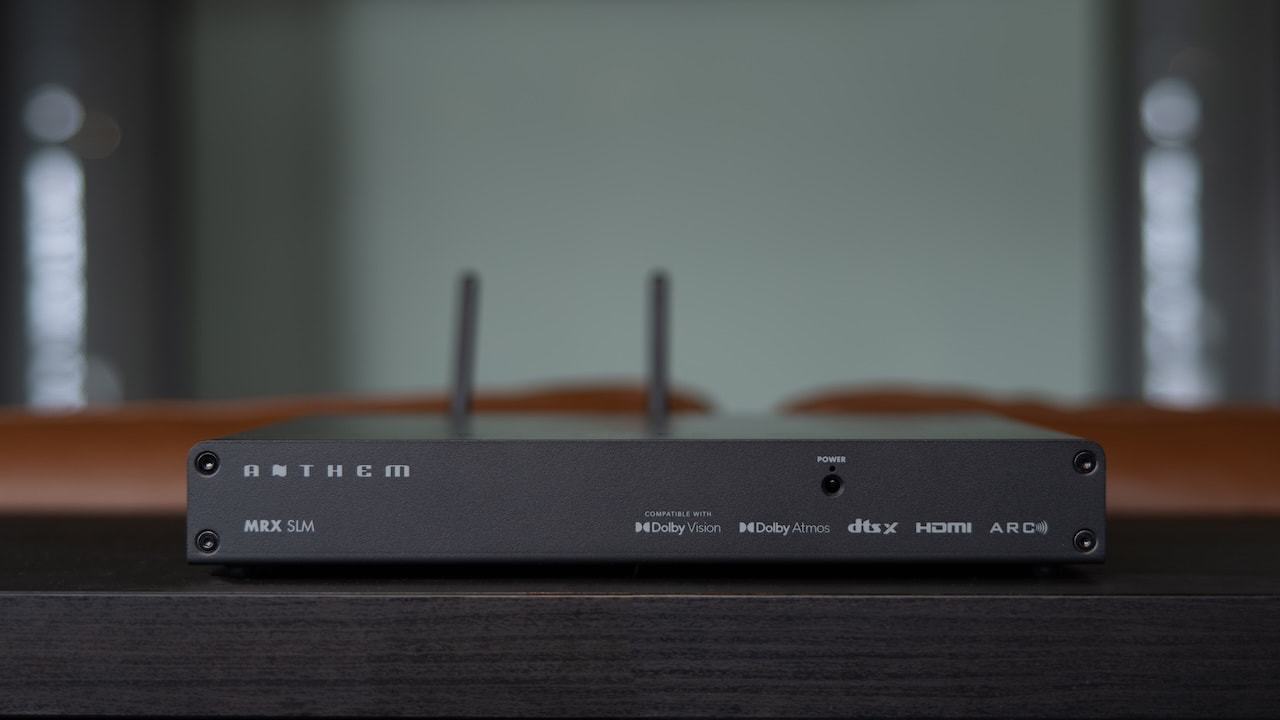
Sometimes size matters. In a CI (Custom Install) environment, many customers want their audio components to be heard, but not seen. In those cases, the large black box of a traditional AVR can be hard to hide. At roughly 12x12x3 inches, the Anthem MRX SLM is a purpose-built, ultra-slim AVR designed for spaces and rooms where a full-size receiver simply won’t fit. Yet it still delivers the clean, neutral sound and stability Anthem is known for. Our Editor in Chief, Ian White, appreciated its build quality, features and sound quality, while our resident CI guy, John Sciacca loved how easy it was to install in or on a wall and out of visible view for his clients.
The Anthem receiver’s Class D amplifier is more refined than the form factor suggests and its on-board ARC Genesis optimization software brings real room-correction authority to in-wall and in-ceiling setups where placement can’t be optimized. Also, the MRX SLM’s HDMI/eARC behaves properly without the handshake headaches that plague many compact receivers. Connectivity stays modern with AirPlay, Chromecast, Spotify Connect, and Bluetooth, while its single HDMI input is offset for many users by its reliable eARC handling. The MRX SLM tucks neatly behind a TV, slips into a cabinet, or mounts directly in a wall, making it ideal for bedrooms, dens, condos, guest suites, offices, and any installation where electronics need to stay invisible and predictable.
Integration is where the MRX SLM really flexes. Phoenix-style connectors streamline CI wiring, and support for Savant, Crestron, Control4, URC, RTI, and ELAN makes it a frictionless fit for professional installs. The Anthem app and web interface make setup and daily use straightforward, and the lightweight chassis even makes it practical for multi-home or multi-room enthusiasts who want consistent performance everywhere. The trade-offs are clear—limited power, only one HDMI 2.0B input, a basic remote, no discrete height channel outputs, and no intention of driving massive floor-standers at reference levels—but within its intended context, the MRX SLM lands squarely in the sweet spot: a compact, high-performance AVR that stays out of sight while behaving like a real Anthem where it counts.
Pros
- Ultra-slim design fits behind TVs, in cabinets, or directly into a wall
- Clean, neutral Class D amplification without the lean edge some Class D designs exhibit
- ARC Genesis included with calibrated mic for meaningful room correction
- Rock-solid eARC performance with no handshake issues
- Full modern streaming suite: AirPlay, Chromecast, Spotify Connect, Bluetooth
- Phoenix-style connector simplifies CI installs
- Strong integration support (Savant, Crestron, Control4, URC, RTI, ELAN)
- Easy to manage through the Anthem app and web interface
- Lightweight—actually travel-friendly if you’re running multi-home setups
- Ideal match for in-wall/in-ceiling or modest floorstanding systems
Cons
- Limited power reserves compared to full-size AVRs
- No option for discrete height channels
- Only one HDMI input (though eARC mitigates this for many users)
- Basic plastic remote—functional but forgettable
- Not intended for large rooms or highly demanding speakers
- Requires time and patience to get the most from ARC Genesis
- Phoenix connector means thick audiophile cables are a no-go
MSRP: $1,299 – available at Crutchfield | Read our review
Best AVR Under $2,000: Denon AVR-X3800H ($1,699)
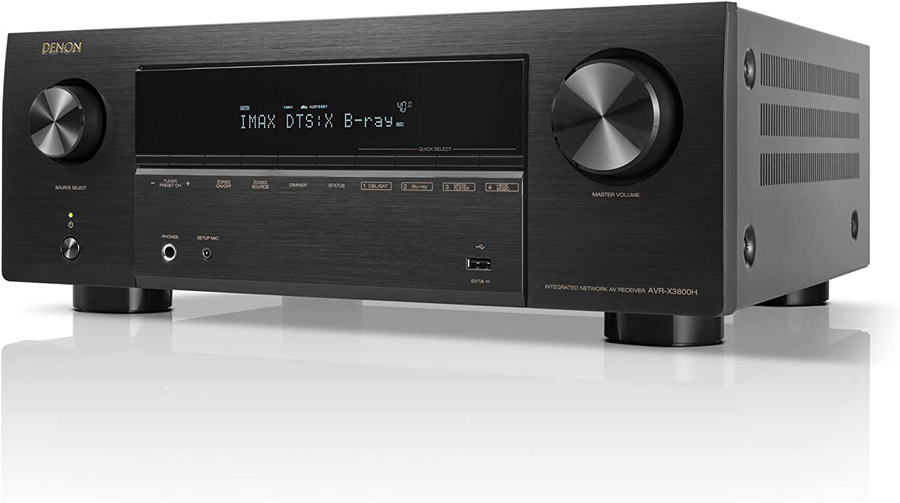
First released in 2022, but still a current model, Denon’s AVR-X3800H receiver offers nine channels of on-board amplification with a power rating of 105 Watts/channel (2 channels driven). But unlike many competitive products, the Denon AVR-X3800H can be upgraded to an eleven channel speaker system by simply adding a two-channel power amp. The X3800H can even act as a full preamp/processor with all eleven channels output to external power amplifiers if you really need to fill a large space with sound or just want to upgrade the on-board amps.
The AVR-X3800H includes the latest features and technology for future compatibility and covers all the bases for audio and video format support. I’ve been using it in my reference home theater system for over three years now, and have found it to offer excellent sound quality and reliability as well as fairly simple intuitive operation.
The 3800H features Audyssey’s advanced MultEQ XT32 calibration software on board as well as an optional upgrade for Dirac room correction, including DIRAC Live, DIRAC Bass Control and, as of 2025, DIRACT ART (Active Room Treatment). But unlike most other A/V receivers on the market today, the Denon AVR-X3800H supports connection of up to four subwoofers, with independent controls for each. This means you can install two, three or even four subwoofers in your listening room and adjust them so they complement each other instead of working against each other. This can allow you to get truly uniform deep bass response anywhere in your room. This is particularly effective when you use DIRAC Bass Control to measure and adjust your system.
We should mention that DIRAC use requires an additional software purchase which currently ranges from $259 to $799 depending on options selected.
The AVR-X3800H also has Denon’s HEOS whole home music and streaming platform on-board so it will easily integrate in a multi-room speaker system along with other HEOS devices. Install the HEOS app on your Apple or Android phone, link it up with the receiver, add your music streaming apps and you’re ready to rock.
For immersive surround, the 3800 supports pretty much every 3D audio format known to man (and woman): Dolby Atmos, DTS:X, IMAX:Enhanced, Auro 3D, 360 Reality Audio and MPEG H. For legacy stereo and surround sound content, the receiver includes Dolby Surround, DTS Neural:X and Auro-Matic processing to enhance the immersiveness of the sound. If you’re into 3D audio, in virtually any format, on virtually any streaming service, the Denon AVR-X3800H has got you covered. And the receiver has only gotten better since launch with Dirac’s most advanced ART room correction made available in 2025 as an optional software update.
In summary, the Denon AVR-X3800H offers all the audio and video performance and features an audiophile or home theater hobbyist could want and its support of virtually every audio codec and format as well as frequent firmware updates will ensure that it stays relevant for years to come. Highly recommended.
Pros
- Supports up to 5.4.4 or 7.4.2 channel systems, expandable to 7.4.4 or 9.4.2 channel with additional two channel amp
- Can be used as AV preamp with outputs for all eleven channels
- 4 independently adjustable subwoofer outputs enable optimized in-room bass response
- Decodes Dolby Atmos, DTS:X, AURO-3D, MPEG-H and Sony 360 Reality Audio Immersive Surround
- Supports DIRAC Live, DIRAC Bass Control and DIRAC ART (requires additional software purchase)
- Solid and musical audio performance in both two-channel stereo and multi-channel listening modes
- HEOS whole home music streaming platform built-in
Cons
- Even the basic DIRAC Live option requires additional purchase
- Relatively expensive, particularly when you add DIRAC license fees
- Bland remote with backlighting on just 2 buttons
MSRP: $1,699 – available at Amazon | Crutchfield | Learn more
Most Versatile AVR: Sony STR-AZ7000ES ($4,199)
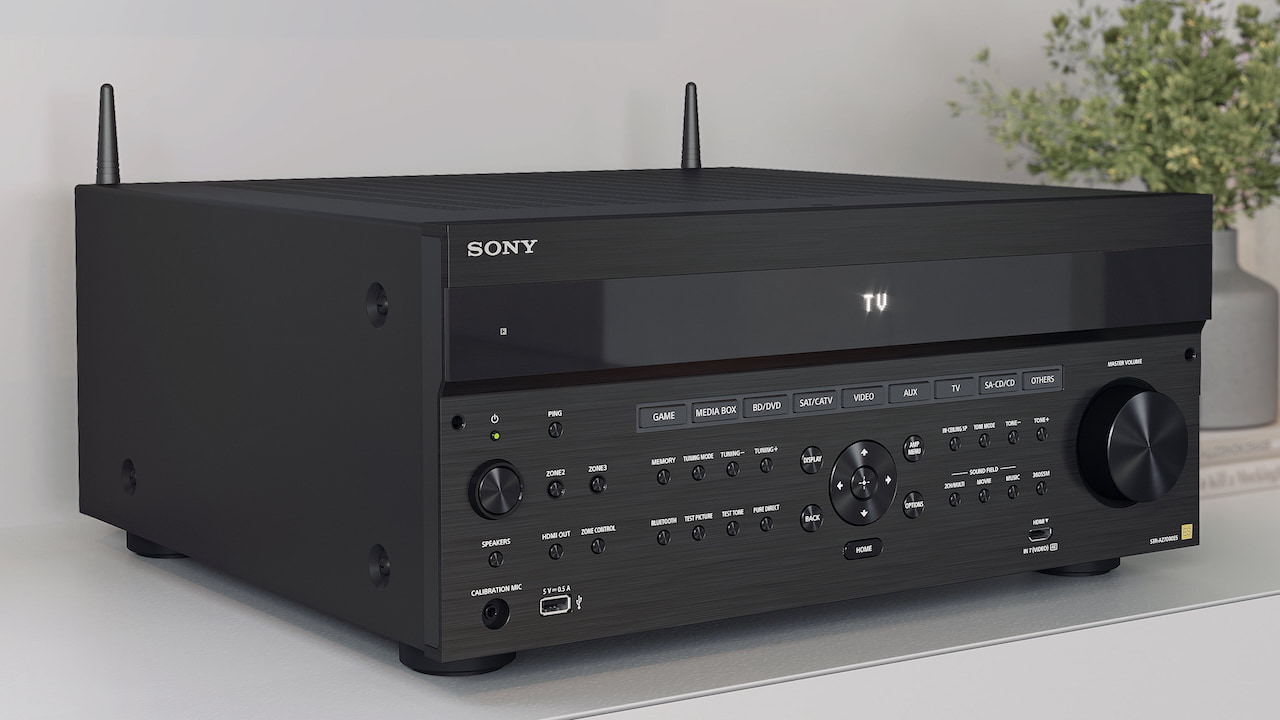
Sony got back into the A/V receiver game in 2023 after several years absent with four new AVRs in the company’s high-end ES line. I reviewed the entry-level STR-AZ1000ES at the time and found a lot to like. More recently, our contributor and YouTube video host Ealan Osborne reviewed Sony’s flagship AVR, the STR-AZ7000ES and found it exceptionally capable in a number of ways. It has some unique features exclusive to the Sony ES series and can be especially useful when paired with Sony TVs.
Like many of Sony’s soundbars, the AZ7000ES supports Acoustic Center Sync (using a compatible Sony TV for the center channel). It also supports dual center speakers (using a center channel speaker above and below the TV to create a phantom center coming directly out of the TV), in-ceiling mode, which acoustically “lowers” the source of the sound so it doesn’t sound like it’s coming out of the ceiling, and the option to use compatible Sony wireless speakers (RS3S and RS5) for surrounds so you won’t have to run speaker wires to the back of your room.
Ealan’s testing revealed Sony’s extra features do make a noticeable difference when it comes to feeling truly immersed in music and movies. He also found that Sony 360 Spatial Sound Mapping does an especially good job of locking in height effects, creating an enveloping bubble of immersive sound that’s often not possible without adding more speakers.
Ultimately we’d highly recommend the Sony STR-AZ7000ES for larger home theater layouts, or when working with a Sony TV, or where center channel placement or overall speaker placement is challenging. This model’s unique features help bring truly immersive sound to virtually any space, and it exceeded our expectations.
Pros
- 13-channels of amplification enable 9.2.4 or 7.2.6-channel speaker layouts
- Dual center and Acoustic Center Sync features help lock dialog to screen
- 360 Spatial Sound Mapping can compensate for non-ideal speaker placement
- Works with Sonos integration (requires Sonos port)
- Wireless rear speaker option
- Preamp-out for all channels (RCA only)
- Zone 2 & 3 option
- Extra features can be exploited when used with Sony TVs
Cons
- Expensive
- No XLR outputs
- Doesn’t support 4 subwoofers
- No option for DIRAC
MSRP: $4,199 – available at Amazon | Crutchfield | Watch review on YouTube
Best Cost-No-Object AVR: Denon AVR-A1H ($7,199)

According to Brian Mitchell, founder of eCoustics.com, Denon’s flagship A/V receiver, the AVR-A1H, is the one to buy when you don’t want to second guess your decision. It gets “dangerously close to separates” and is designed to fill even the largest home theater with clean immersive surround sound. With 15 channels of amplification built-in (150 watts with 2 channels driven), it’s the ideal all-in-one option for those who intend to use all 15 channels in a 9.4.6 channel system. It can even be upgraded to 17 channels by adding an external stereo amplifier.
With the A1H’s four independent subwoofer outputs and the addition in 2025 of DIRAC ART (Active Room Treatment) support, its configuration possibilities are taken to the next level to ensure your home theater system is perfectly tuned to your room. Ultimately, that means the best sound from every seat. We should note that DIRAC use requires an additional purchase (currently $259 – $799, depending on options).
The Denon AVR-A1H is for the home theater enthusiast who demands the very best, without the extra complexity and costs of adding separate components. Its build quality includes the finest internal componentry Denon has put in an A/V receiver to date, including a power transformer that itself weighs more alone than many mid-level AVRs.
In short, the AVR-A1H has plenty of power when a movie soundtrack demands it without any audible strain, as well as the finesse required to capture every whisper. Tack on built-in HEOS for the convenience of multi-room and multi-zone audio control from your phone, and you’ll be spending your time immersed in music and movies, rather than wondering what you’re missing from a less capable receiver.
Pros
- Supports Dolby Atmos, DTS:X Pro, Auro 3D, Sony 360 Reality Audio, MPEG-H and IMAX Enhanced sound
- Beefiest amps and highest grade components Denon has ever put in an AVR
- 4 independent subwoofer outputs for optimized in-room bass response
- 17.4-channel RCA or XLR preamp outputs
- DIRAC Live, Bass Control and ART available as options (additional software purchase required)
- 10 x 32-bit DACs for multi-channel high resolution audio support
- Built-in HEOS enables whole home music
Cons
- Expensive
- Best performance requires additional purchase of DIRAC license
- Heavy and large
- Requires some ventilation
MSRP: $7,199 – available at Amazon | Crutchfield | Learn more
The Bottom Line
Ten years ago, with the proliferation of soundbars, some were saying that the age of Audio/Video receivers was over. But today, a healthy selection of quality AVRs at multiple performance levels and price points confirms that we are indeed still living in the golden age of home theater sound.
Related Reading: