ONIX was born in the seaside town of Brighton more than 40 years ago, long before portable hi-fi became a global arms race. The brand has since been acquired by a Chinese parent company and relaunched internationally in 2023, but its engineering roots haven’t been erased. Since 2003, ONIX has worked closely with Shanling, tapping into that expertise to help develop its current generation of products.
Its first swing at the dongle DAC category, the Alpha Xi1, was solid but largely overlooked in a market dominated by entrenched players like iFi, Astell&Kern, and Questyle. The Beta Xi2 makes it clear ONIX understood the assignment: don’t blend in. By introducing a dedicated tube output in a pocket-sized DAC/amp—something you almost never see at this scale—the Beta Xi2 aims to compete on character, power, and sheer audacity rather than price alone. At $349, it doesn’t get a free pass. It has to earn its place among the best.
Specifications & Technology
On the conversion side, ONIX plays it smart and conservative, opting for a dual Cirrus Logic CS43198 DAC configuration. It’s a proven chip and still a very good one, delivering strong measured performance with up to 128 dB dynamic range and signal-to-noise ratio, 107 dB channel separation, and THD+N around 0.0008% under optimal conditions. In practical terms, the DAC stage stays out of the way, doing exactly what it should without adding noise, grain, or unwanted character.
Amplification is where the Beta Xi2 separates itself from the pack. ONIX has built in two fully independent amplification paths that can be switched on the fly. Solid-state mode uses a pair of OPA1662 op-amps supported by four BUF634A buffers, a serious and well-regarded combination that delivers clean output and plenty of current for demanding headphones.
Tube mode is the wildcard. Engaging it brings two JAN6418 subminiature vacuum tubes into the signal path, instantly changing the Xi2’s behavior. This isn’t a cosmetic feature or DSP trick; the tubes introduce a clearly different sonic presentation compared to solid-state mode. How that shift plays out subjectively is something best judged in listening, but from a design standpoint, squeezing real tubes into a dongle DAC remains rare—and it’s the defining technical statement of the Beta Xi2.
Design & Build Quality
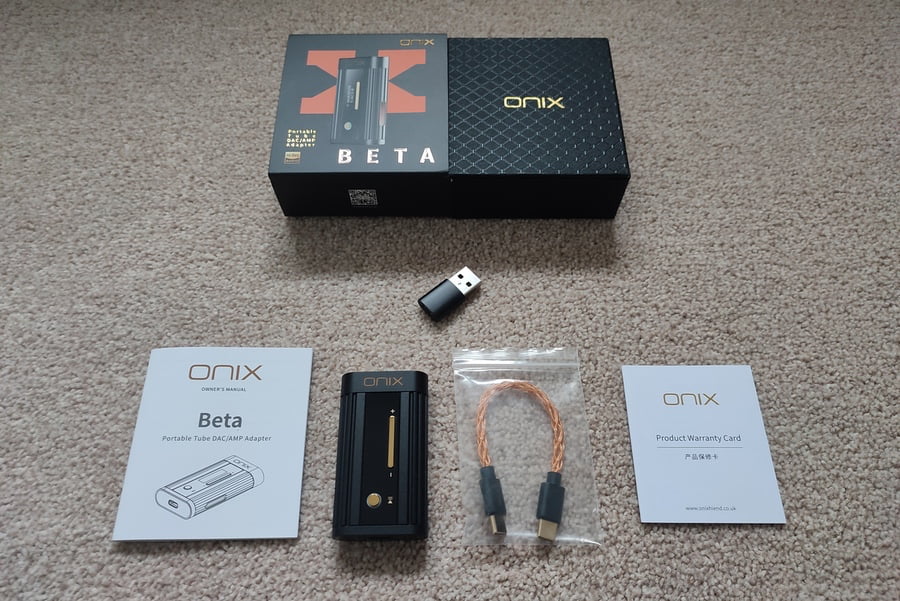
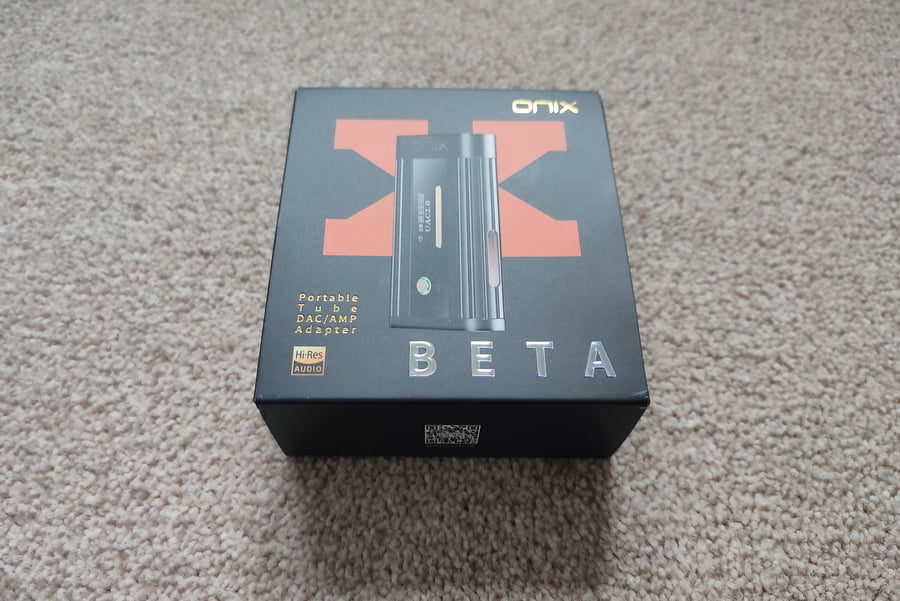
Sliding off the outer cardboard sleeve reveals a clean, understated black presentation box, with magnets securing the top flap. Open it and you’re greeted by the Beta Xi2 itself alongside a USB-C to USB-A adapter. Beneath that sit a USB-C to USB-C cable, a user manual, and a warranty card. It’s a restrained, no-nonsense accessory lineup with nothing missing and nothing included just for padding.
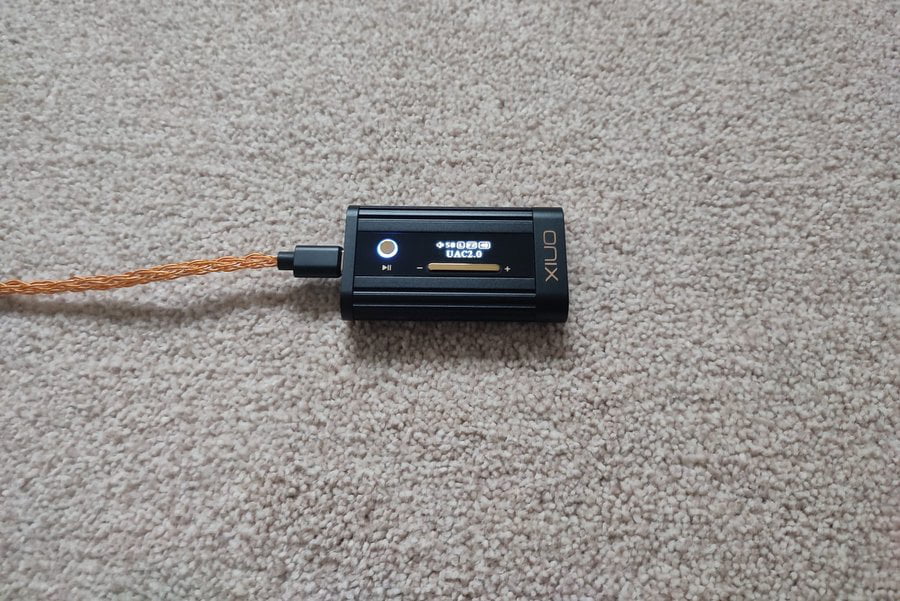
That said, the ONIX OL1 cable deserves special mention. It’s an 8-strand, hand-woven silver-plated oxygen-free copper cable, and it’s far better than the generic afterthoughts usually bundled with dongle DACs. Including a cable of this quality is genuinely rare in this category and feels like a conscious design decision rather than a cost-cutting compromise.
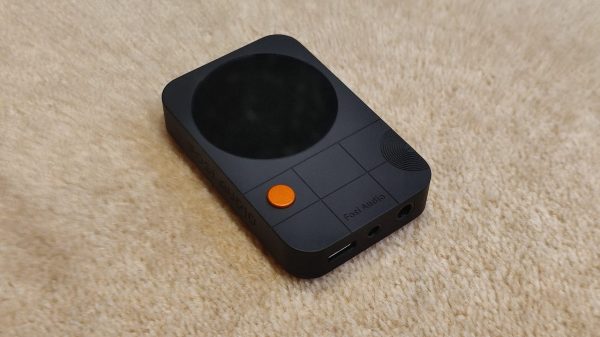
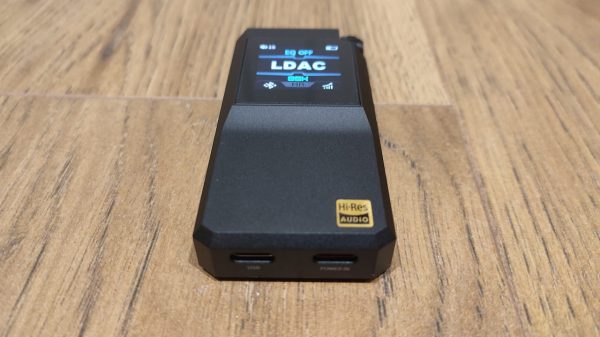
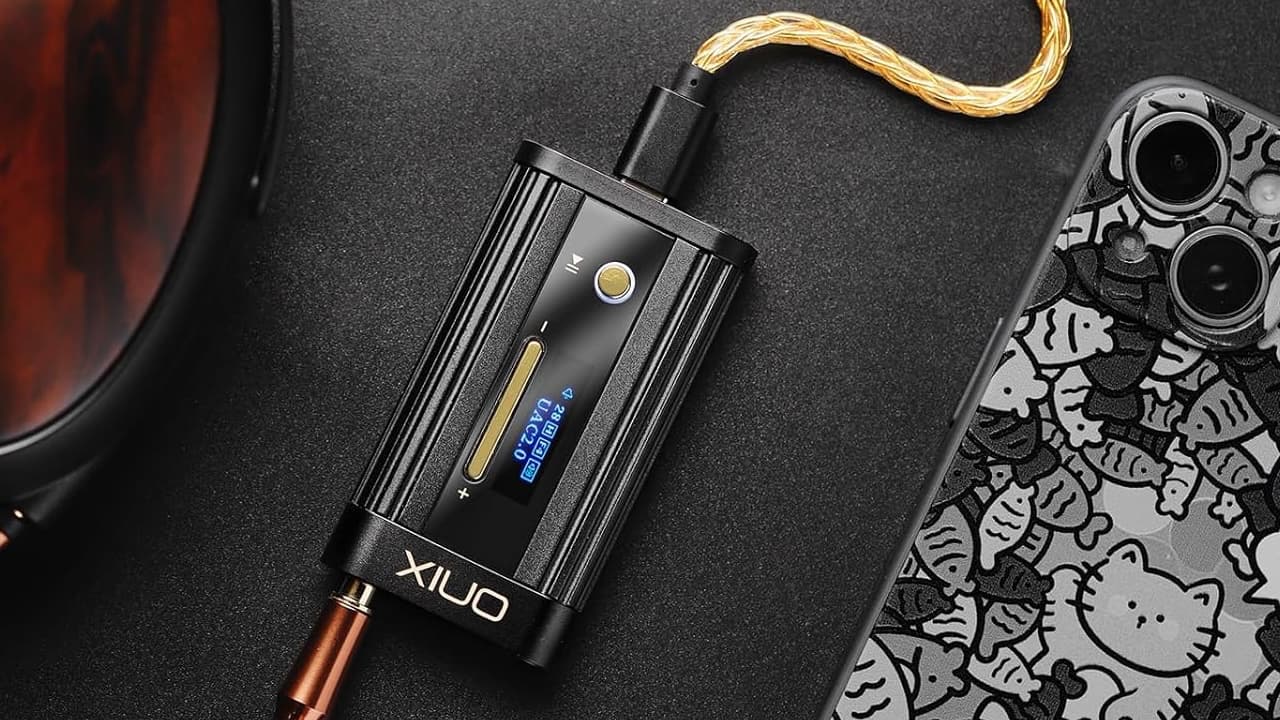
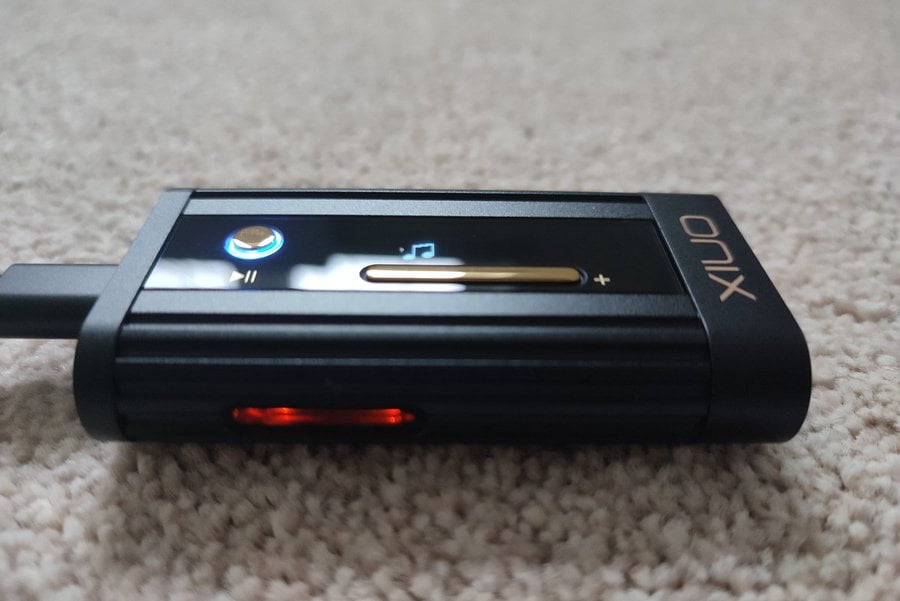
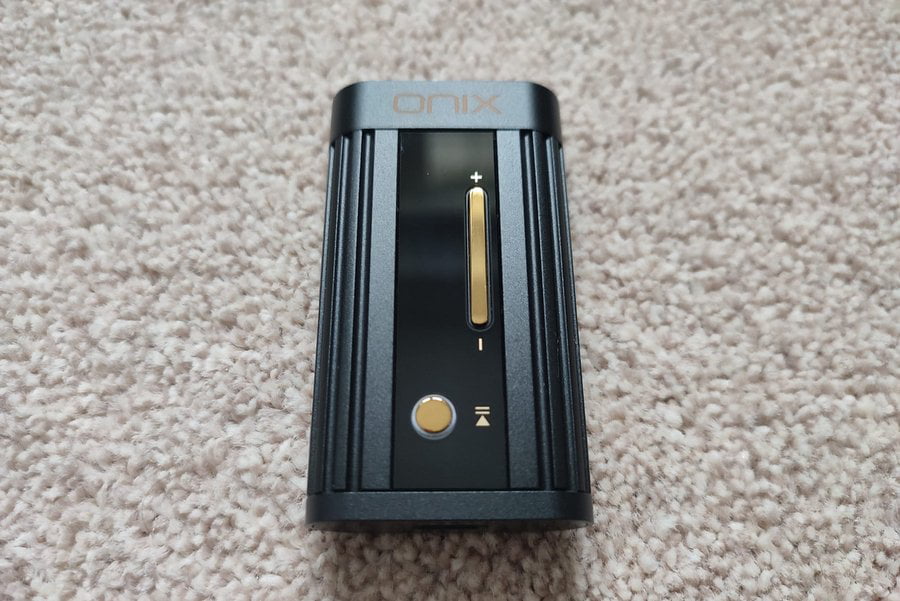
Turning to the device itself, the front is dominated by a 0.87-inch display that provides genuinely useful information at a glance, including the UAC mode, volume level, gain setting, filter selection, and sampling rate. Surrounding the screen are a small number of physical controls: a volume rocker and a play/pause button. The latter is ringed by an LED that changes color depending on the incoming sample rate, offering quick visual confirmation of what’s being fed into the DAC.
Visually, the Beta Xi2 leans into a black-and-gold aesthetic that feels appropriately premium without tipping into excess. Small windows on each side of the chassis reveal the glowing tubes, a subtle but effective reminder of what makes this dongle different from the usual solid-state crowd. The enclosure is aluminum, giving the unit reassuring heft and a sense of durability that suggests it could survive everyday drops without issue.
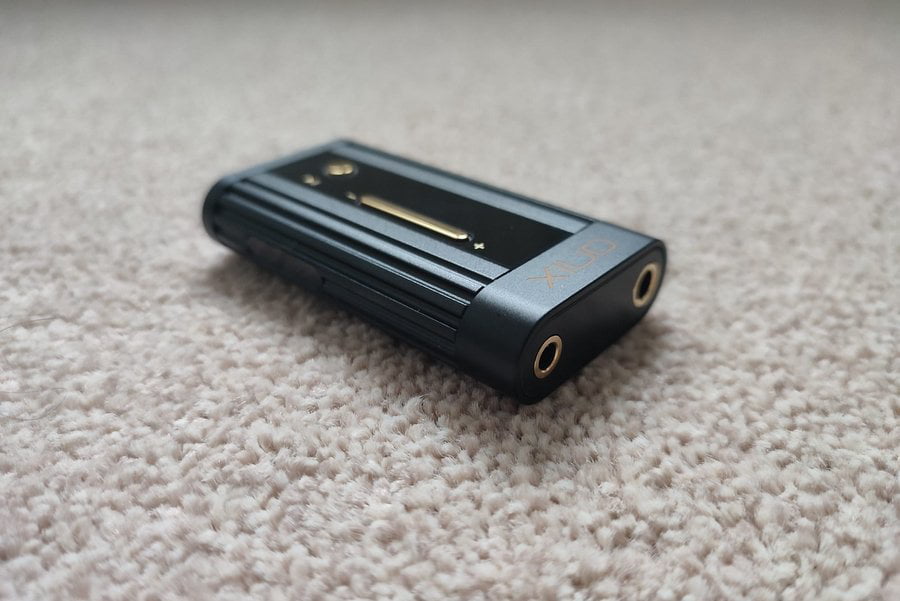
Connectivity is deliberately simple. One side houses the headphone outputs, consisting of a 3.5 mm single-ended jack and a 4.4 mm balanced Pentaconn output. The opposite side is reserved for a single USB-C port handling both power and data. No clutter, no gimmicks, just the essentials done properly.
Listening & Headphone Synergy
Before getting into listening impressions, it’s worth addressing the companion app that’s meant to be used alongside the Beta Xi2. It’s called Eddict Player, and it allows you to adjust most of the device’s settings without relying on the physical buttons. Volume, gain, filters, and even control behavior can all be handled in-app, and you can reassign the volume rocker to skip tracks instead. That flexibility is genuinely useful. What’s less welcome is the absence of an equalizer, which feels like a missed opportunity given that a growing number of competing dongle DACs now offer at least basic EQ functionality.
The Beta Xi2 includes five selectable digital filters, each claimed to subtly alter the sound. In practice, most of them are difficult to distinguish from one another. The notable exception is the non-oversampling (NOS) option, which audibly smooths the leading and trailing edges of notes, lending the presentation a slightly rounder and less etched character.
One area where the Xi2 quietly impresses is tube behavior in real-world use. Tube microphonics are impressively well controlled, even with the dongle plugged in and used close to a desktop PC. That suggests careful mechanical design rather than luck. ONIX and Shanling appear to have invested serious effort into a dedicated tube suspension system, and the result is a tube implementation that behaves far more like a mature design than a novelty feature squeezed into a tiny chassis.
So how does it sound? With the Beta Xi2, that’s not a one-line answer, because you’re effectively getting two distinct sonic personalities depending on whether tube mode is engaged.
With tube mode enabled, the presentation is largely neutral but gently seasoned with warmth and a sense of musical ease. The tonal balance of your headphones doesn’t really change, but the way notes start and fade absolutely does. Attacks are slightly softened, decays feel more natural, and voices and instruments take on a more lifelike flow that many solid-state dongle DACs struggle to replicate. This is not OTL-level syrup or romantic excess, but that’s the point. You get the benefits of tube behavior without the fragility, heat, and compromises that come with a full-size tube amplifier.
Soundstage depth is a strong suit here. It isn’t especially wide, but it is layered and convincingly three-dimensional. Holographic is an overused word, but it fits. Bass gains a touch of softness that flatters genres like jazz and R&B ballads, without any sense of roll-off or loss of extension. The midrange carries real weight and presence while staying clean, and vocals in particular sound convincingly human. The clarity of Jamilah Barry’s voice on “:Woman’s Touch” by Yussef Dayes is a standout example. Treble remains open and detailed, but never sharp or fatiguing, even during longer sessions.
That said, not everyone wants rounded edges and relaxed transients. If you prefer a crisper, more immediate sound with tighter attack, switching off tube mode hands control back to the solid-state amplification. The op-amp path is clean, fast, and authoritative, giving the Xi2 a more traditional high-end dongle DAC presentation at the flick of a switch.
Solid-state mode is arguably just as impressive, only in a more matter-of-fact way. Compared to tube mode, bass tightens up noticeably and gains extra texture while still sounding natural rather than overdamped. The soundstage loses a bit of that holographic depth, but imaging precision remains razor sharp. TOOL’s Chocolate Chip Trip is a perfect stress test here, and the Beta Xi2 handles it with ease, keeping every percussive hit and electronic flourish clearly separated even during the densest passages.
Power is another area where the Beta Xi2 refuses to play small. With up to 550 mW into 32 ohms from the balanced output, it has enough drive for the vast majority of headphones you’re likely to pair with a dongle DAC. Even in tube mode, it performed confidently with planar magnetic designs like the HiFiMAN HE1000 Unveiled and the Sendy Audio Egret, helped by the fact that this is not an OTL-style tube design.
Where the Beta Xi2 really shines, though, is with brighter or more treble-focused headphones. Pairings like my Beyerdynamic DT880 Edition 600 ohm benefit from the Xi2’s ability to smooth out upper-frequency peaks without dulling detail. The result is a more balanced presentation that lets the strengths of the headphone come through. The DT880, in particular, shows just how much bass extension and soundstage it can deliver for its relatively modest price when driven properly.
The Bottom Line
The ONIX Beta Xi2 is not trying to be a bargain-bin dongle DAC, and that’s obvious the moment you use it. What it delivers instead is a rare combination of genuine tube amplification, excellent build quality, and enough real-world power to handle almost any headphone short of the most brutal planars. The dual-mode design actually matters here: tube mode adds depth, realism, and a natural sense of flow, while solid-state mode tightens things up with speed and precision. Neither feels like a gimmick.
The downsides are equally clear. At $349, it’s expensive for a dongle DAC, and the lack of an onboard EQ in the companion app feels behind the curve at this price. Soundstage width won’t wow stage-heads, and those chasing maximum transient bite may prefer the solid-state-only competition.
Value, then, depends on priorities. If you want the cleanest measurements per dollar, this isn’t it. If you want character, flexibility, and a genuinely different listening experience in a pocket-sized device, the Beta Xi2 earns its asking price. This is for listeners who own good headphones, understand what tubes bring to the table, and want that flavor without committing to a fragile desktop rig. For everyone else, cheaper options exist—but none quite do what this does.
Pros:
- Premium tubes in a dongle DAC with equally as impressive tech specs
- Understated yet luxurious black-and-gold, all-metal design
- Astonishingly high-end USB-C cable included
- Neutral sound with a hint of tube warmth
- Two sound profiles in one
Cons:
- Definitely expensive, but still good value
- No in-built EQ on the unit or the accompanying app
Where to buy:
Related Reading:
- Best Dongle DACs: Editors’ Choice
- Questyle M18i Review: The Dongle DAC That Refuses To Be One?
- Campfire Audio Relay Review: Compact Dongle DAC Delivers Big Power and Sound
- iFi GO blu Air Review: A Pocket-Sized Bluetooth Dongle DAC That Punches Headphones Into Shape