
As part of its global 80th Anniversary celebration, JBL has announced the L100 Classic 80, a strictly limited special edition of one of the most recognizable loudspeakers in audio history. This is not a new model, not a redesign, and not an acoustic experiment. It is a commemorative edition of JBL’s modern L100 platform, created to honor eight decades of engineering, cultural relevance, and a speaker that helped define what high-performance home audio looked like in the first place.
Let’s get something out of the way immediately: the JBL L100 Classic 80 is acoustically and sonically identical to the L100 Classic MKII currently in production. Same drivers. Same crossover. Same cabinet volume. Same tuning. The only L100 Classic that differs sonically is the relaunched original 2018 version, which was replaced by the MKII in 2023. Every version since—the MKII, the Black Edition, the 75th Anniversary, and now the Classic 80—shares the same acoustic package. What changes here is the cosmetic execution and collectability, not the sound.
That matters, because JBL isn’t trying to reinvent an icon. They’re preserving it.

Originally introduced in the 1970s, the JBL L100 became one of the most commercially successful and visually recognizable loudspeakers the brand ever produced. It wasn’t subtle, it wasn’t polite, and it didn’t apologize for sounding big, dynamic, and alive. The L100 became synonymous with the rise of serious home stereo systems and remains a reference point for JBL’s identity to this day.
“The JBL L100 is more than a loudspeaker. It’s a symbol of JBL’s role in shaping how people experience music at home,” said Jim Garrett, Senior Director of Product Strategy and Planning, HARMAN Luxury Audio. “The JBL L100 Classic 80 honors that legacy while reflecting the engineering standards and listening expectations of today. It’s a celebration of where we’ve been and how far we’ve come.”
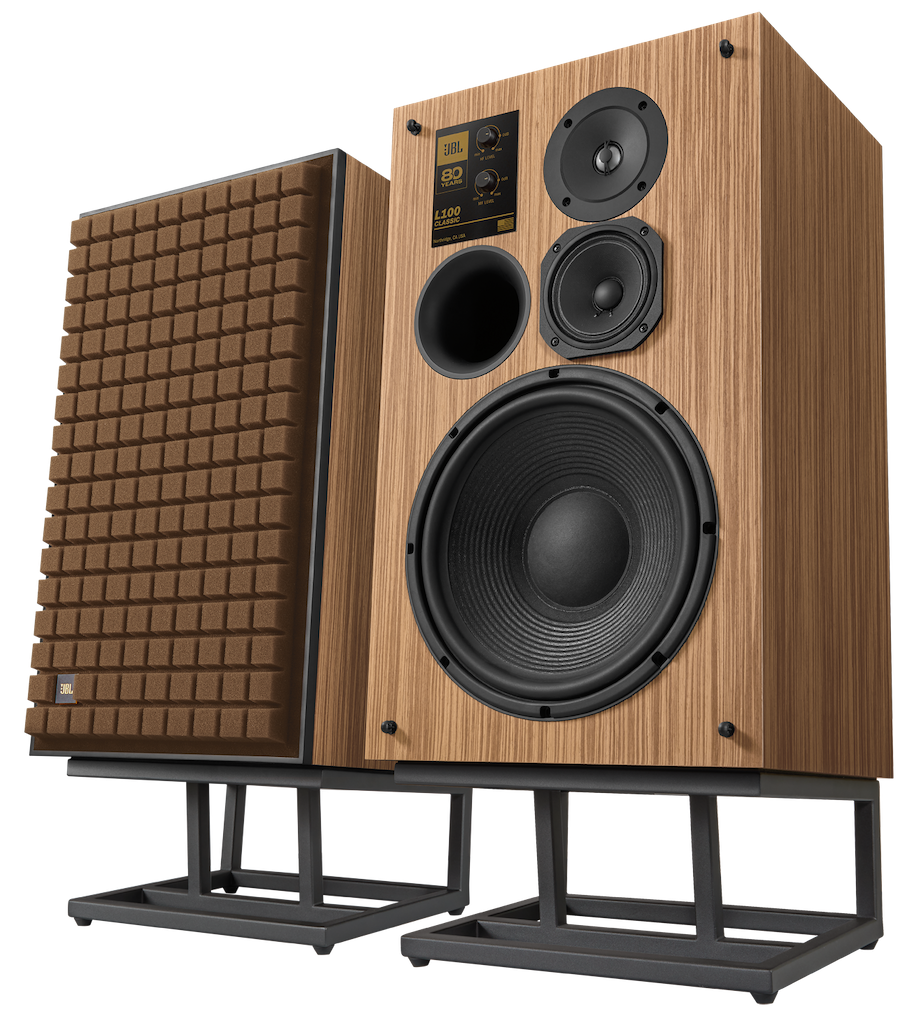
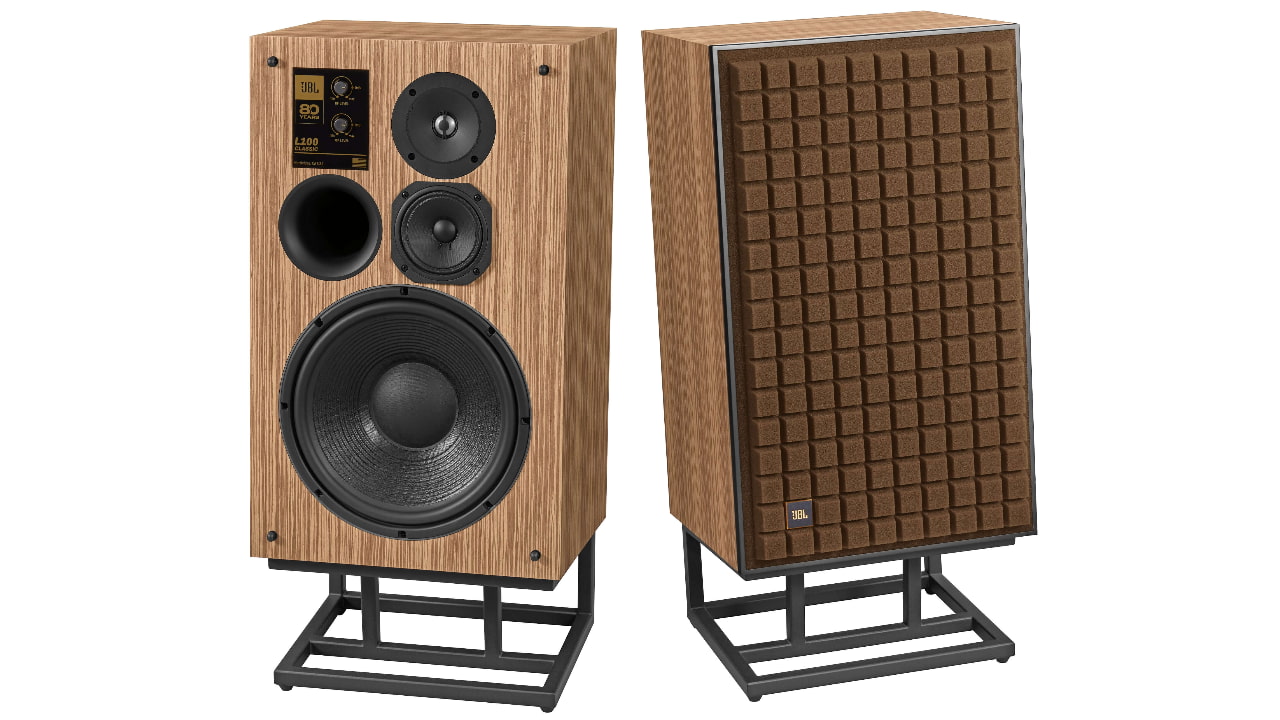
Visually, the JBL L100 Classic 80 Anniversary Edition leans hard into heritage. It’s finished exclusively in California oak veneer, paired with a vintage-inspired brown Quadrex foam grille and accented by a gold-and-black JBL logo. A black satin baffle frame and anniversary badging on both the front and rear further distinguish it from the standard MKII. The 12-inch woofer features a black cone, chosen purely for visual cohesion with the overall package—it is the same woofer used in the white-cone L100 Classic MKII.
Under the hood, nothing changes—and that’s the point. The L100 Classic 80 remains a three-way, front-ported bookshelf loudspeaker built around a cast-frame 12-inch pure pulp cone woofer, a 5.25-inch polymer-coated midrange, and a 1-inch titanium dome tweeter paired with JBL’s acoustic lens waveguide. Front-panel mid- and high-frequency level controls allow fine tuning, preserving the lively, adjustable character that made the L100 famous.

What truly separates the L100 Classic 80 Anniversary Edition from every other modern L100 variant is availability—and finality.
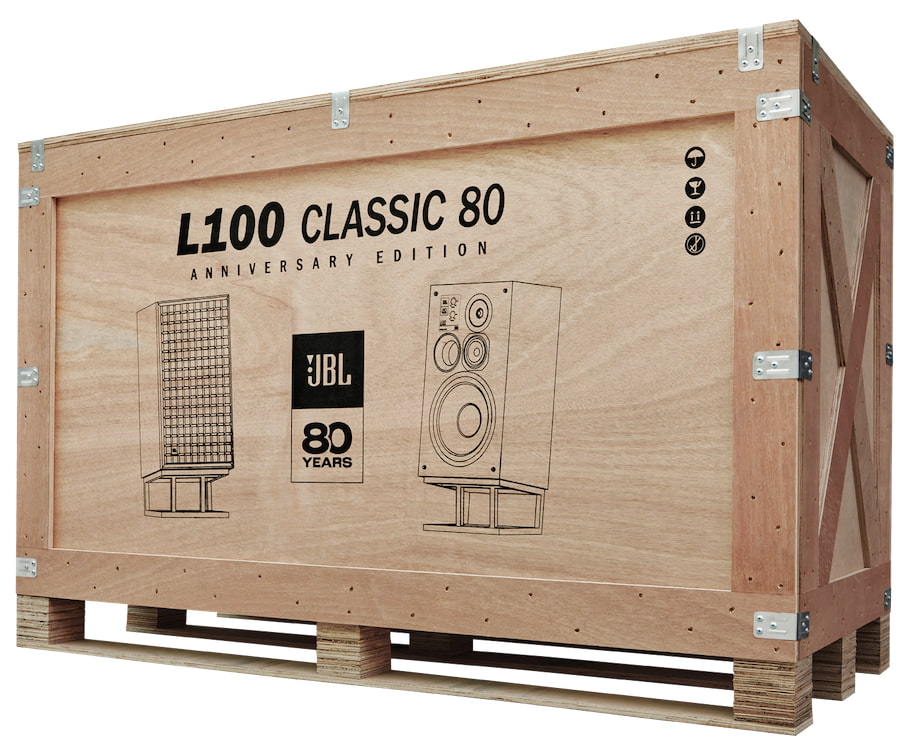
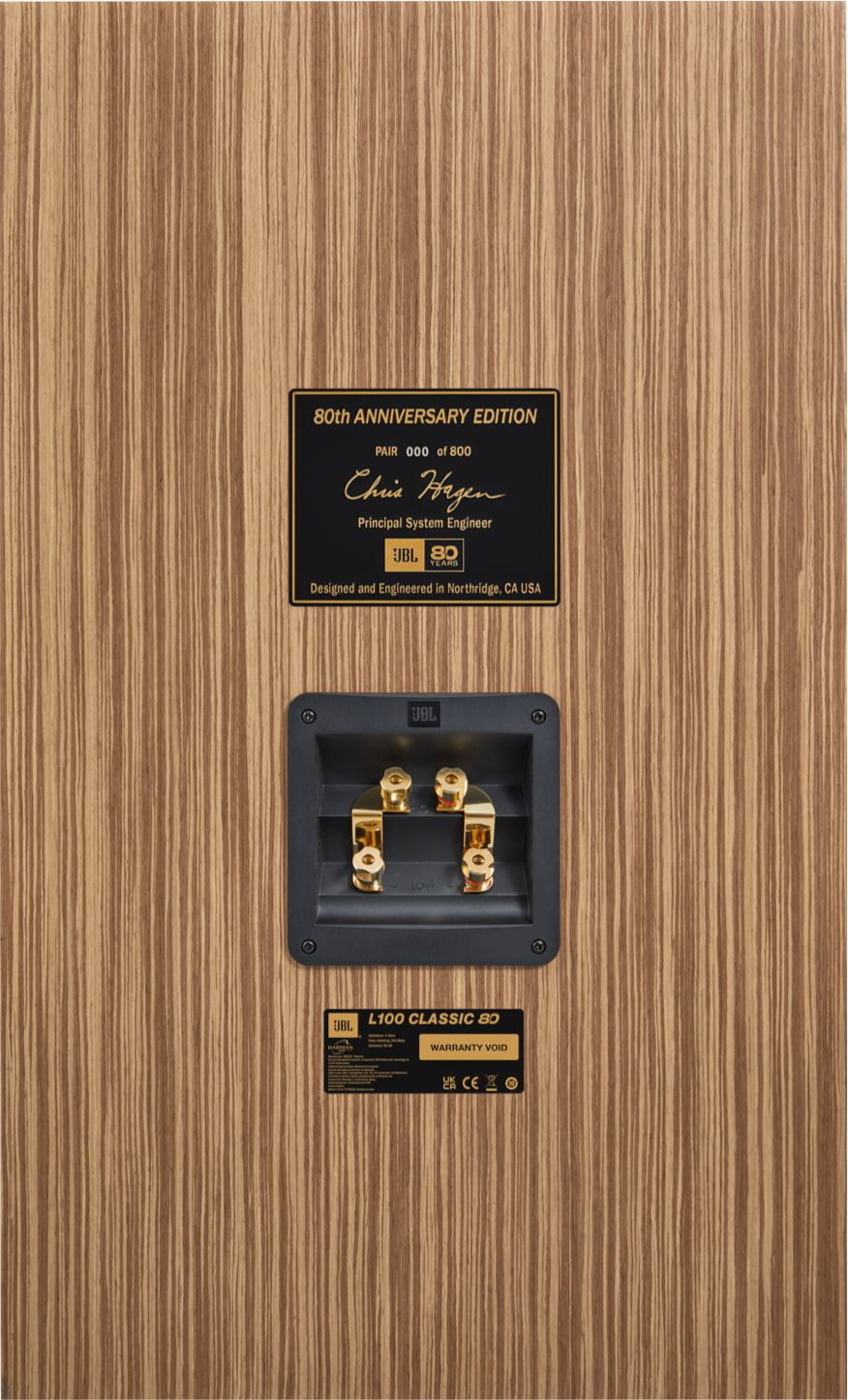
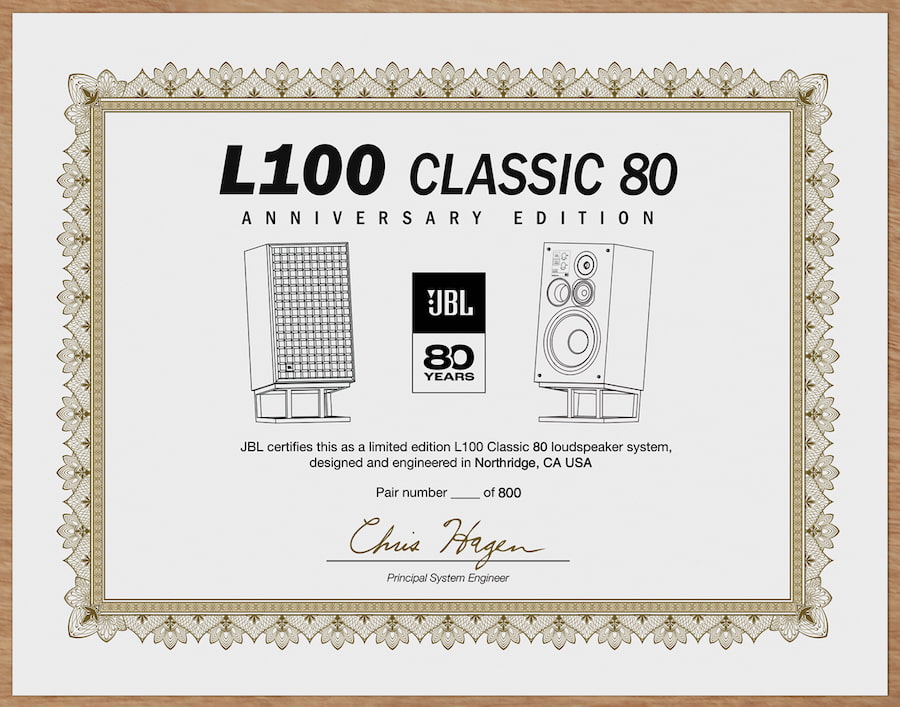
Production is capped at 800 matched pairs worldwide. That’s it. Each pair includes JS-150 speaker stands, ships in a custom wooden crate, and features an individually numbered commemorative plaque signed by principal system engineer Chris Hagen. This is a one-and-done release, with no follow-up runs planned.
For context, every previous special L100 edition has already vanished:
- The 75th Anniversary Edition (2021 model) was limited to 750 pairs and sold out in 2021
- The Black Edition (2022 model) ended production in late 2024
- The L100 Classic (2018 model) was discontinued when the MKII arrived in 2023
That leaves just two L100 options going forward: the standard L100 Classic MKII, available in walnut with multiple grille colors, and the L100 Classic 80, which exists solely to mark JBL’s 80th year—and then disappear.
The Modern Reference Behind the L100 Classic 80 Anniversary Edition
At a glance, the L100 Classic 80 looks like it time-traveled straight out of the 1970s—and that’s intentional. Its physical dimensions (25 x 16 x 15 inches) have barely changed across more than five decades of L100 history. Weight is also in the same neighborhood: just under 60 pounds per speaker, compared to roughly 55 pounds for the original. This has always been a substantial loudspeaker, just not one that fits neatly into modern categories. It’s too large to be a true bookshelf design and too compact to qualify as a traditional floorstander.
Back in the day, L100s were often parked directly on the floor, flanking a stereo cabinet and sitting only a few feet apart. Today, they’re more commonly placed on low stands—about 7 inches off the floor, tilted slightly rearward, with 8 to 10 feet between them. Same speaker, different era, better placement.
The L100 Classic 80 remains a three-way design built around a 12-inch woofer, a 5.25-inch midrange driver, and a 1-inch tweeter. The midrange sits next to a 5-inch front-firing bass port, and the cabinet retains the classic look: black front and rear panels with walnut veneer on the sides, top, and bottom. Visually, it checks every L100 box.
Internally, it’s a completely different animal.
The cabinet is significantly stiffer than earlier versions, using inch-thick front and rear panels, ¾-inch side panels, and substantial internal bracing. JBL also developed a custom internal damping material with higher absorption than standard Dacron fill, helping control internal reflections and cabinet resonances.
The crossover network has been thoroughly updated as well. Heavier-gauge wiring, larger capacitors, and a mix of iron-core and air-core inductors are used, with crossover points set at 450 Hz and 3.5 kHz. The midrange operates across that entire span using second-order filters, while the tweeter employs a third-order high-pass. This approach keeps vocal fundamentals and presence squarely in the midrange driver’s wheelhouse, rather than splitting them awkwardly between drivers, which helps avoid phase issues and preserves clarity.
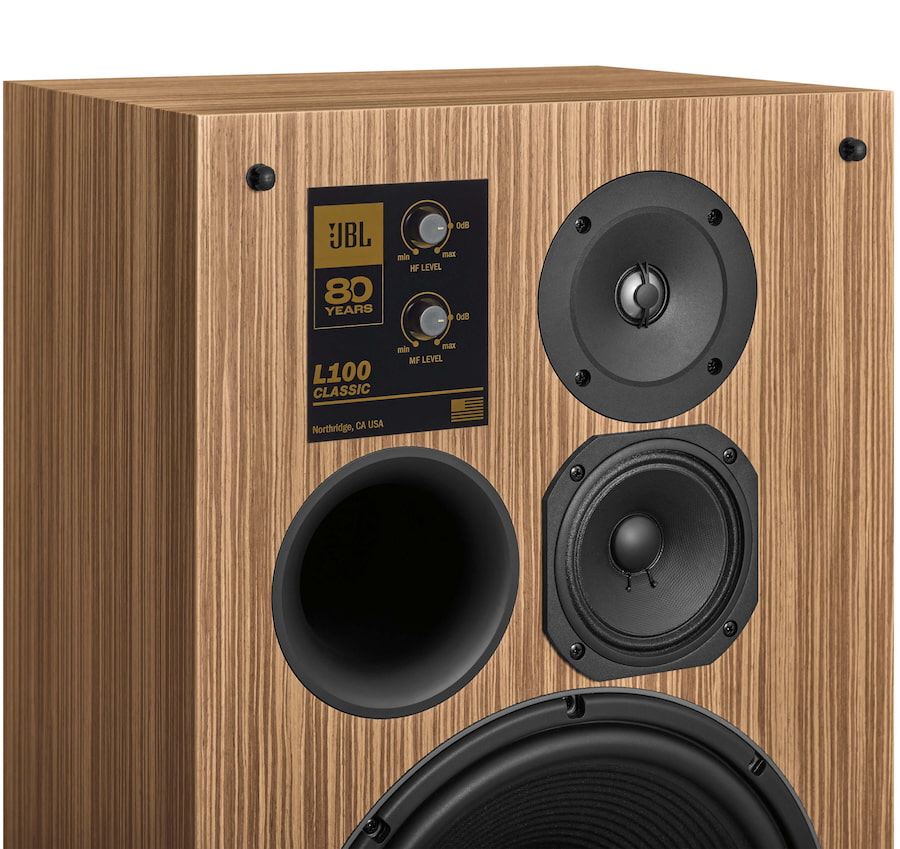
On the front panel, the L100 Classic 80 retains one of its most distinctive features: adjustable midrange and treble attenuators. These controls don’t boost anything—they only reduce output. While the center position is marked as “neutral,” there’s meaningful range available to dial things back. In practice, it’s possible to cut the 600 Hz to 2 kHz region by nearly 10 dB with the midrange control, and similarly reduce energy above roughly 5.5 kHz with the treble attenuator. It’s a practical tool for room matching, not a tone control gimmick.
Driver-wise, the tweeter is JBL’s JT025Ti-4, a 1-inch titanium dome mounted in a shallow waveguide with an acoustic lens. This same tweeter appears in the L52 and L82 models, but what sets it apart is the use of a large ferrite magnet rather than the neodymium magnets common today. Ferrite acts as a better heat sink, allowing the tweeter to operate at lower temperatures and reducing distortion caused by thermal compression at higher output levels.
The midrange and woofer, however, are unique to the L100 Classic MKII and Classic 80.
The midrange is the 105H-1, a 5.25-inch polymer-coated pure pulp cone driver designed as a sealed unit. Unlike the open-back midrange used in the smaller L52, this sealed design prevents cabinet air pressure from interfering with the driver’s motion, which helps maintain consistency and control through the critical vocal range.
Bass duties are handled by the JW300PW-8, a 12-inch pure pulp cone woofer with a cast aluminum frame and a substantial 3-inch voice coil. Its magnet assembly measures 7 inches in diameter and over an inch thick, allowing for significant excursion. That magnet structure alone accounts for nearly a third of the speaker’s total weight, with the woofer tipping the scales at close to 22 pounds by itself.
On paper, the L100 Classic MKI is rated at 40 Hz to 40 kHz (-6 dB), with a sensitivity of 90 dB (2.83V/1m) and a nominal 4-ohm impedance. Those numbers tell you what you need to know: this is a speaker that plays loud without being fussy, rewards solid amplification, and delivers scale in a way that smaller modern designs simply can’t fake.

Specifications
| Speaker Type | 12-inch (300mm) 3-way Bookshelf Loudspeaker |
| Low Frequency Driver | 12-inch (300mm) cast-frame Pure Pulp cone woofer with Dual Spider (JW300SW-8) |
| Mid Frequency Driver | 5.25-inch (130mm) Polymer-coated Pure Pulp cone (JM125PC-8) |
| High Frequency Driver | 1-inch (25 mm) Titanium dome tweeter mated to acoustic lens and waveguide (JT025Ti2-4) |
| Recommended Amplifier Power | 25-200 Watts RMS |
| Impedance | 4 ohms |
| Sensitivity (2.83V/1m) | 90dB |
| Frequency Response | 40Hz-40kHz (-6dB) |
| Crossover Frequencies | 450Hz, 3.5kHz |
| Dimensions With Grille (HxWxD) | 25.3-inch x 15.4-inch x 14.4-inch |
| Controls | Attenuators for MF and HF level control |
| Connector Type | Dual sets of Gold-plated Binding Posts |
| Product Weight | 63 lbs (28.6 kg) each |
The Bottom Line
The JBL L100 Classic MKII and Classic 80 Anniversary Edition are not subtle, not trendy, and not pretending to be something it isn’t. It’s a big, physical loudspeaker with modern engineering underneath a very deliberate old-school attitude. Same proven acoustic platform used across every recent L100 variant, built solid, tuned right, and unapologetically dynamic.
This is for listeners who actually turn the volume knob, have the space to let a speaker breathe, and don’t need their gear to vanish into the décor. If you want scale, punch, and the ability to dial the sound to your room, the L100 delivers. If you’re chasing minimalist boxes, ruler-flat graphs, or lifestyle cred, keep scrolling.
Where to buy
- JBL L100 Classic 80 – $7,499/pair
- JBL L100 Classic MKII – $5,279.90/pair at Audio Advice
Note: All other L100 Classic models have been discontinued. A set of Quadrex foam grilles are included, but can also be purchased separately in different colors for $394.95/pair at Crutchfield. The companion JS-150 or JS-120 speaker stands are not included, but are available for $364.95/pair at Crutchfield.
Related Reading:




Thomas Voth
January 30, 2026 at 1:59 am
In my early teens I went to the local Stereo retailers and stood standing starring at these beautiful speakers and only dreamt of owning them. At the time they were $273.00 ea. I actually contacted JBL company and attempted to buy just the grille covers to put on my homemade replicas of these awesome beasts. I ended up buying Bose 901 series II speakers from my local shop -Lafayette Electronics in Pacific Beach California. Seeing this brings back so many good memories!! WOW.
I have a huge smile!! Might just test my marriage and pull some funds from my IRA. lol.
Ian White
January 30, 2026 at 11:35 pm
Thomas,
I would act fast. The will be sold out for sure by the end of the year.
IW
Paul Clairmont
February 24, 2026 at 12:17 am
I preordered the Classic 80 Anniversary Edition as I’m a collector and the limited run appealed to me along with the new brown grills. I’m thrilled to add these speakers to my home audio set up!!
Ian White
February 24, 2026 at 8:33 pm
Paul,
Excited to see what you think. They look really nice.
IW