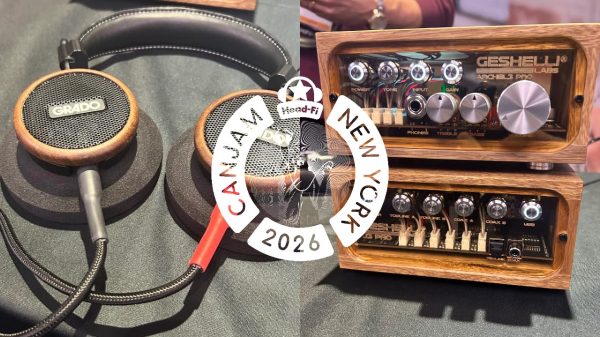
Grado didn’t exactly drop this out of nowhere. When we spoke with the team at CanJam NYC 2026, there were enough hints to read between the lines, but nobody was about to say it out loud. Loose lips and all that. So we kept it quiet. Nobody wanted to end up in the East River. Now it’s official.
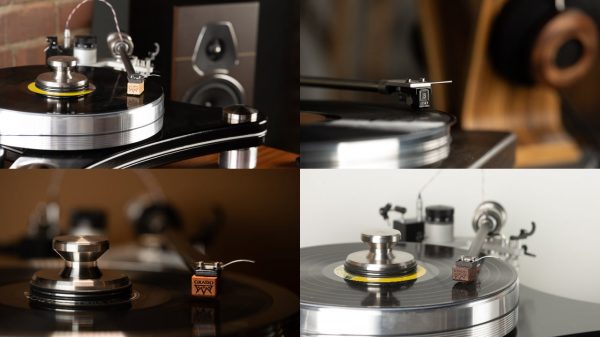
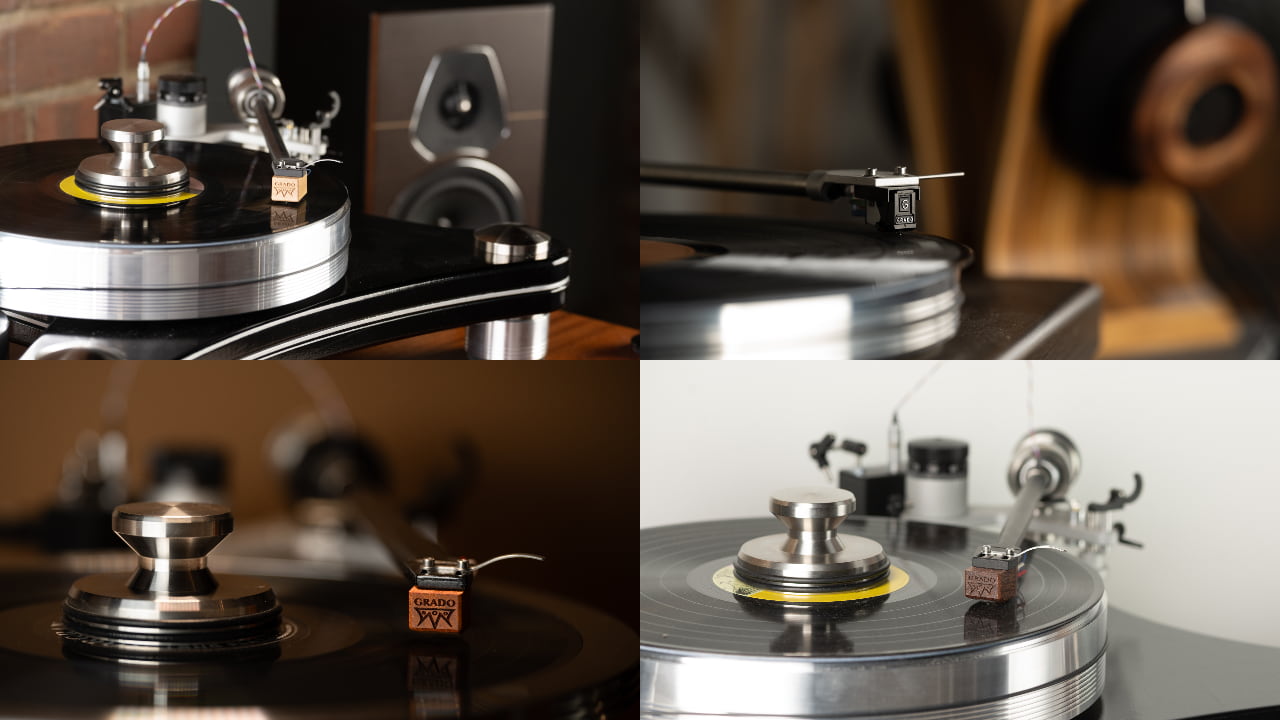
Grado Labs is rolling out an updated phono cartridge lineup across its Lineage, Timbre, and Prestige Series, built around targeted refinements to the stylus assembly, coil composition, and housing geometry. No reinvention, no marketing circus, just a clear effort to improve how these cartridges track, resolve detail, and behave in real-world setups.
The timing isn’t accidental. Vinyl’s resurgence has been very good to Grado’s cartridge business, but it’s also brought a flood of competition from legacy brands tightening their game to newer players looking to grab market share. Standing still isn’t an option when Ortofon, Audio-Technica, Denon, Hana, and Dynavector keep rolling out new cartridge models with every product cycle.
That’s what makes this update matter. They’re going back to the core elements that define cartridge performance and refining them across the board—better materials, tighter tolerances, and more consistency from model to model.
And let’s be clear—John Grado and Rich Grado didn’t build this brand by coasting. This is what staying relevant looks like when you’ve been doing it since 1953.
In other words, the vinyl boom may have kept the lights on, but this is Grado making sure nobody else walks in and starts rearranging the furniture.
What’s Actually Changed: Stylus, Coils, and Housing Get Real Upgrades
The stylus assembly has been refined across the lineup, with diamond profiles and cantilever materials more carefully matched to each specific model. That matters. You’re not getting a one-size-fits-all approach anymore. Some models step up to nude Shibata diamonds, which offer better groove contact and improved tracking compared to the elliptical profiles used throughout much of the previous generation—but not every cartridge gets that upgrade, and Grado isn’t pretending otherwise.
Coils have been updated across the board with OCC copper, with purity levels scaled depending on the model. The goal is pretty straightforward: cleaner signal transmission, better channel balance, and fewer inconsistencies from unit to unit.
On the mechanical side, the wood-bodied cartridges see revised housing geometry. This isn’t just cosmetic. The updated shapes are designed to improve stability during playback and make setup less of a headache—something anyone who has wrestled with cartridge alignment will appreciate.
Lineage Series: Grado’s Top Shelf, No Apologies
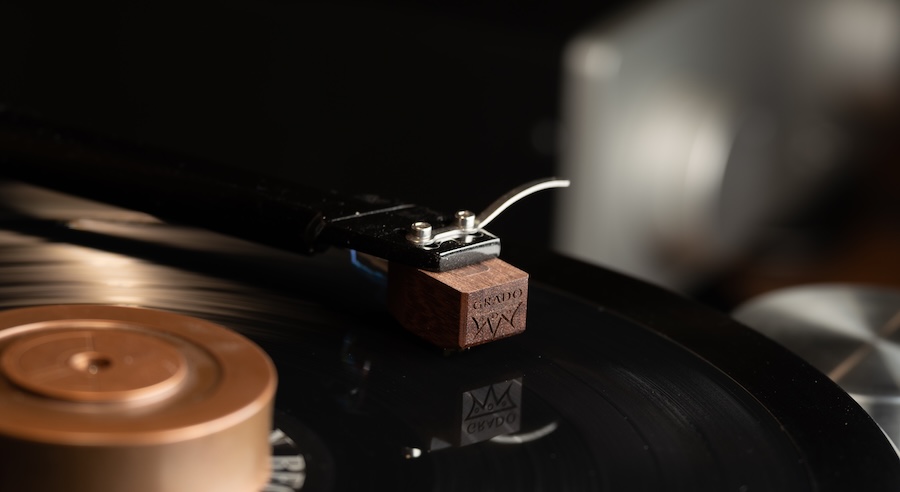
The Lineage Series sits at the top of Grado’s cartridge lineup and uses the company’s low-output moving iron, flux-bridger architecture across all three models. All three get Brazilian Ebony wood bodies, nude Shibata styli, and stereo/mono options, but the cantilever material, frequency range, resistance, and weight are not identical across the range. That’s where the pecking order starts to show.
Grado Epoch4 — $9,995
The Epoch4 is the flagship. It uses a Brazilian Ebony wood body, sapphire cantilever with Shibata diamond, 1.0mV output at 5 CMV (45 degrees), 5 Hz to 75 kHz controlled frequency response, average 35 dB channel separation from 10-30 kHz, 10-47k ohm input load, 8mH inductance, 95 ohms resistance, 10.5 gram cartridge weight, 1.6-1.9 gram tracking force, and 20 μm/mN compliance. Grado also says the internal signal path uses ultra-high purity OCC copper with gold plating, and that the cartridge undergoes cryogenic treatment during component prep and final assembly.
Grado Aeon4 — $4,995
The Aeon4 keeps the Brazilian Ebony body and sapphire/Shibata combo, with the same 1.0mV output, 10-47k ohm input load, 8mH inductance, 10.5 gram weight, 1.6-1.9 gram tracking force, and 20 μm/mN compliance. Where it differs from the Epoch4 is the controlled frequency response, which is listed at 5 Hz to 70 kHz, and resistance, which drops to 74 ohms. Grado specifies ultra-high purity 7N OCC copper here. In other words, still serious, just not wearing the full tux.
Grado Statement4 — $3,500
The Statement4 is the entry point into the Lineage family, but it is not a stripped-down tourist model. It uses a Brazilian Ebony wood body and swaps to a machined boron cantilever with Shibata diamond. Specs include 1.0mV output at 5 CMV (45 degrees), 5 Hz to 65 kHz controlled frequency response, average 35 dB channel separation from 10-30 kHz, 10-47k ohm input load, 8mH inductance, 74 ohms resistance, 10 gram cartridge weight, 1.6-1.9 gram tracking force, and 20 μm/mN compliance. Like the Aeon4, it uses ultra-high purity 7N OCC copper and cryogenic treatment.
Timbre Series: Where Grado Dials It In for the Real World
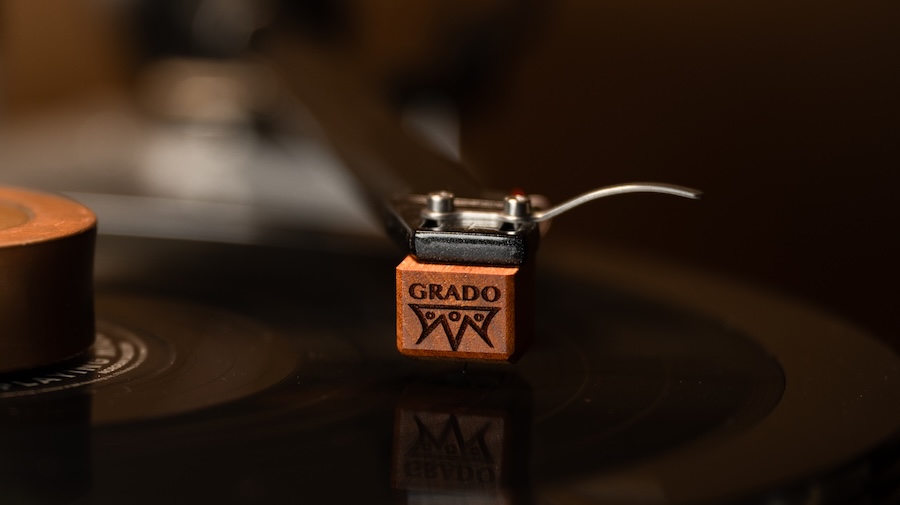
The Timbre Series is where Grado Labs hits the balance point—high-end analog performance without drifting into Lineage-level pricing. This is the middle of the lineup, but it’s not a compromise. It’s a deliberate tuning exercise.
Across the range, Grado sticks with elliptical diamond styli and its moving iron, flux-bridger design. The emphasis here isn’t on any single upgrade—it’s on how everything works together. Stylus profile, cantilever material, coil composition, and housing are treated as a system, not a checklist. The result is a presentation that leans into tonal balance, coherence, and musical flow rather than hyper-detail for its own sake.
Material choices define the hierarchy. The Reference3 and Master3 use American Osage wood bodies with boron cantilevers for greater control and resolution, while the Sonata3 and Platinum3 move to Mediterranean Olive wood paired with aluminum cantilevers. The Opus3, built from American Maple, rounds things out with a simpler aluminum cantilever configuration. Same core design philosophy throughout, just scaled in execution.
Grado Reference4 — $1,500
The Reference4 sits at the top of the Timbre Series. It uses an American Osage wood body, machined boron cantilever with Shibata diamond, 4.0mV high output or 1.0mV low output at 5 CMV (45 degrees), 10 Hz to 60 kHz controlled frequency response, average 30 dB channel separation from 10-30 kHz, 10k-47k ohm input load, 55mH inductance in high output and 6mH in low output, 660 ohms resistance in high output and 70 ohms in low output, 9.6 gram cartridge weight, 1.6-1.9 gram tracking force, and 20 μm/mN compliance. Grado also specifies ultra high purity 6N OCC copper in the internal signal path, along with cryogenic treatment and internal damping.
Grado Master4 — $1,000
The Master4 uses an American Osage wood body, machined boron cantilever with elliptical diamond, 4.0mV high output or 1.0mV low output at 5 CMV (45 degrees), 10 Hz to 60 kHz controlled frequency response, average 30 dB channel separation from 10-30 kHz, 10k-47k ohm input load, 55mH inductance in high output and 6mH in low output, 660 ohms resistance in high output and 70 ohms in low output, 9.6 gram cartridge weight, 1.6-1.9 gram tracking force, and 20 μm/mN compliance. It is offered in high output, low output, and mono versions.
Grado Sonata4 — $600
The Sonata4 uses a Mediterranean Olive wood body, special aluminum cantilever with elliptical diamond, 4.0mV high output or 1.0mV low output at 5 CMV (45 degrees), 10 Hz to 60 kHz controlled frequency response, average 30 dB channel separation from 10-30 kHz, 10k-47k ohm input load, 55mH inductance in high output and 6mH in low output, 660 ohms resistance in high output and 70 ohms in low output, 9.4 gram cartridge weight, 1.6-1.9 gram tracking force, and 20 μm/mN compliance. It is also offered in high output, low output, and mono versions.
Grado Platinum4 — $400
The Platinum4 uses a Mediterranean Olive wood body, aluminum cantilever with elliptical diamond, 4.0mV high output or 1.0mV low output at 5 CMV (45 degrees), 10 Hz to 60 kHz controlled frequency response, average 30 dB channel separation from 10-30 kHz, 10k-47k ohm input load, 55mH inductance in high output and 6mH in low output, 660 ohms resistance in high output and 70 ohms in low output, 9.4 gram cartridge weight, 1.6-1.9 gram tracking force, and 20 μm/mN compliance. It is available in high output, low output, and mono versions.
Grado Opus4 — $300
The Opus4 is the entry point into the Timbre Series. It uses an American Maple wood body, aluminum cantilever with elliptical diamond, 4.0mV high output or 1.0mV low output at 5 CMV (45 degrees), 10 Hz to 60 kHz controlled frequency response, average 30 dB channel separation from 10-30 kHz, 10k-47k ohm input load, 55mH inductance in high output and 6mH in low output, 660 ohms resistance in high output and 70 ohms in low output, 8.3 gram cartridge weight, 1.6-1.9 gram tracking force, and 20 μm/mN compliance. Grado says the internal signal path uses ultra high purity 5N OCC copper, with cryogenic treatment and internal damping as part of the build process.
Prestige Series: Where Grado Keeps It Simple and Affordable
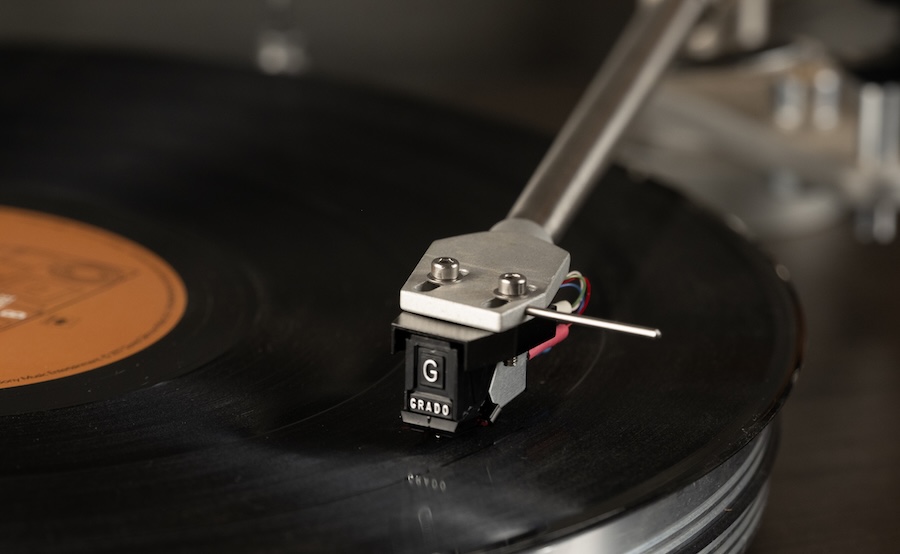
The Prestige Series is the foundation of what Grado Labs has been doing for decades and it hasn’t survived this long by accident. This is the entry point into the lineup, but it’s built on a design that’s been refined over more than fifty years, not reinvented every product cycle. Those paying attention will notice that the lineup has been trimmed down.
Across the range, Grado sticks with elliptical diamond styli, aluminum cantilevers, and its moving iron, flux-bridger design. The goal here isn’t to chase ultimate resolution—it’s consistency. Strong tracking, a balanced tonal presentation, and performance that doesn’t drift over time. These are cartridges designed to work, not impress on spec sheets.
One of the biggest advantages in the Prestige Series is the user-replaceable stylus system. When the stylus wears out, you don’t toss the cartridge, you swap the stylus and keep going. It’s practical, cost-effective, and a big part of why these have remained popular with both newcomers and long-time vinyl listeners.
No exotic wood bodies here, no sapphire cantilevers, just a straightforward design that prioritizes reliability and ease of use without abandoning the Grado house sound.
Grado Prestige Gold4 — $260
The Prestige Gold4 sits at the top of the current Prestige Series. It uses a four piece OTL cantilever with a Grado specific elliptical diamond stylus mounted on a brass bushing, 4 mV output at 5 CMV (45 degrees), 10 Hz to 55 kHz frequency response, average 25 dB channel separation from 10-30 kHz, 10k-47k ohm input load, 50 mH inductance, 660 ohms DC resistance, 6 gram cartridge weight, 1.6-1.9 gram tracking force, and 20 um/mN compliance. Grado also says the Gold4 uses a machined turned generator for lower distortion and greater transparency, along with ultra high purity copper wire and its twin magnet / Flux-Bridger moving iron design.
Grado Prestige Red4 — $190
The Prestige Red4 uses a bonded elliptical diamond mounted to an aluminum cantilever, 4 mV output at 5 CMV (45 degrees), 10 Hz to 55 kHz frequency response, average 25 dB channel separation from 10-30 kHz, 10k-47k ohm input load, 50 mH inductance, 660 ohms DC resistance, 6 gram cartridge weight, 1.6-1.9 gram tracking force, and 20 um/mN compliance. Grado describes it as a high output moving iron cartridge and notes that the stylus assembly is user-replaceable, with Prestige Series styli interchangeable across models.
Grado Prestige Green4 — $140
The Prestige Green4 uses a bonded elliptical diamond mounted to an aluminum cantilever, 4 mV output at 5 CMV (45 degrees), 10 Hz to 55 kHz frequency response, average 25 dB channel separation from 10-30 kHz, 10k-47k ohm input load, 50 mH inductance, 660 ohms DC resistance, 6 gram cartridge weight, 1.6-1.9 gram tracking force, and 20 um/mN compliance. Grado also describes it as a high output moving iron cartridge with a user-replaceable stylus assembly, available in both standard mount and P-mount versions.
Trade-In Program: Grado’s Answer to Cartridge Burnout
Grado takes a different approach to long-term ownership, and it’s one that actually makes sense if you’ve been around analog long enough to know how this usually goes.
For its wood-bodied models, Grado Labs offers a cartridge trade-in program that lets you send back your existing cartridge; no matter how worn, and apply it toward a new one at a reduced cost. No drama, no “must be in mint condition” nonsense.
The idea is simple: keep people in the ecosystem without forcing them to start from scratch every time their stylus wears down or their system evolves. Instead of treating cartridges as disposable, Grado treats them like part of a longer-term upgrade path.
That flexibility cuts both ways. You can move up the range if you’re chasing more performance, or step sideways or even downward if your system changes or priorities shift. Either way, you’re getting a current production model with the latest refinements baked in. You won’t get that from Denon, Hana, or Clearaudio.
The Bottom Line
Grado didn’t reinvent anything—they refined the parts that actually matter. Across Lineage, Timbre, and Prestige, the updates focus on improved stylus assemblies, higher-purity OCC copper coils, and revised housing geometry, all aimed at better tracking, consistency, and easier setup.
On paper, the lineup is clearly tiered: Lineage pushes materials and resolution at the top, Timbre balances performance and design choices in the middle, and Prestige continues as the accessible, user-friendly foundation with its replaceable stylus system. Each range sticks to the same moving iron DNA, just executed at different levels.
Who should pay attention? Anyone with a vinyl setup who hasn’t looked at Grado in a while—and especially those watching how established brands respond to a more competitive cartridge market.
Reviews land in May and June.
For more information: gradolabs.com
Related Reading:
- Grado Labs Prestige Red3 Phono Cartridge: Review
- Grado Labs Timbre Opus3 Phono Cartridge: Review
- The Best Phono Cartridge Below $500: Grado, Goldring And Sumiko
- Best Phono Cartridges: Editors’ Choice 2025