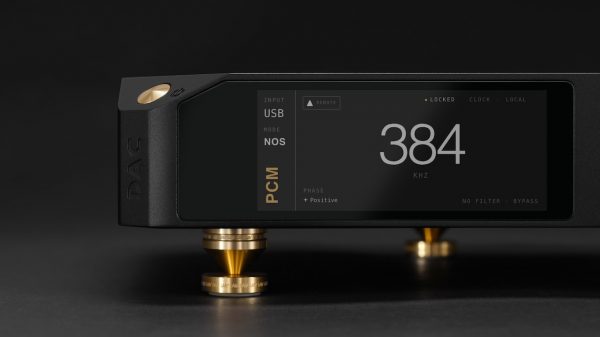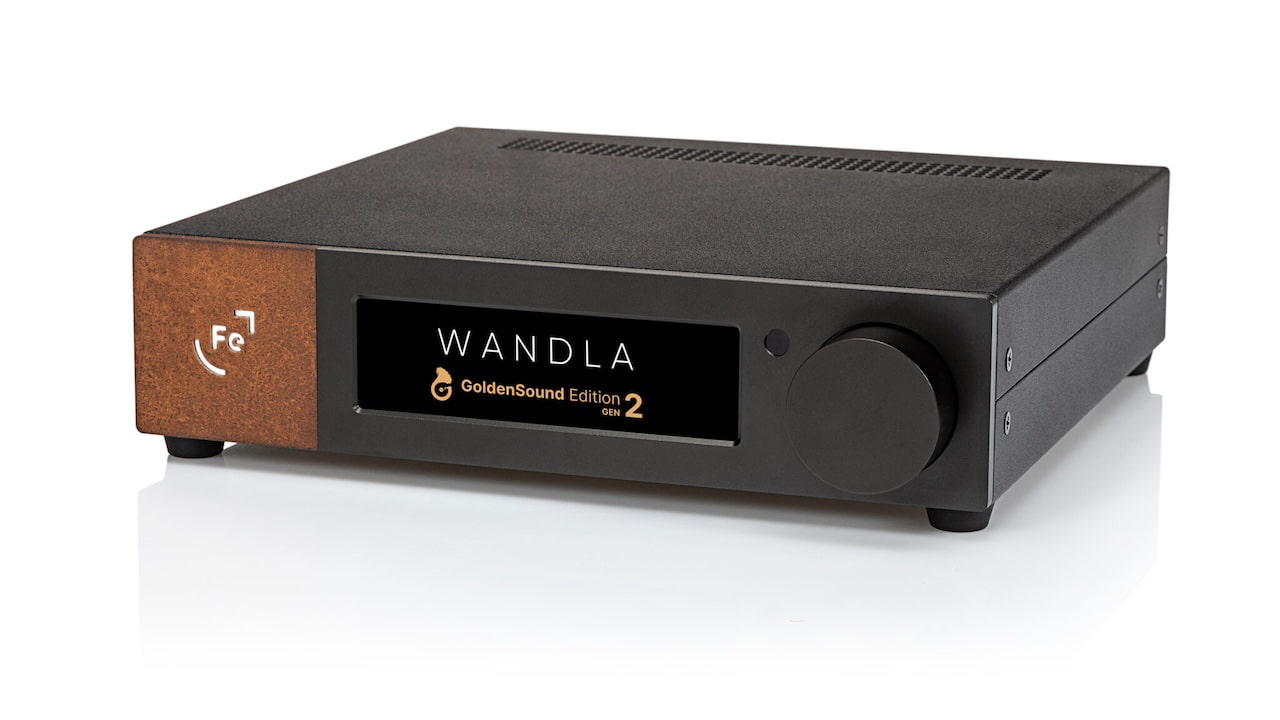
Ferrum Audio arrives at CanJam NYC 2026 with a new iteration of one of its most talked about digital components: the WANDLA GoldenSound Edition Gen 2 DAC/Preamp. Building on the original WANDLA platform and the first GoldenSound Edition, the new model refines the design with updated processing features while retaining the core architecture that helped put Ferrum on the map with serious headphone and personal audio enthusiasts.
Can the Polish manufacturer stand out in a very crowded high end DAC category dominated by Chord Electronics, RME, TEAC, and Schiit Audio? Recent performance suggests the answer may very well be yes.
Since emerging as an independent brand in 2022, Ferrum Audio has quickly become one of the most recognizable names in high end personal audio to come out of Poland. The company made a particularly strong impression at CanJam NYC 2022, where its early products drew attention for combining advanced digital engineering with a modular ecosystem designed to work seamlessly with its power supply and headphone amplification lineup. The WANDLA platform continues that trajectory.
At its core, all WANDLA models share the same fundamental architecture:
- SERCE Module: Ferrum’s proprietary DSP engine designed for high performance digital signal processing and system control.
- DAC Chipset: ESS Sabre ES9038PRO, one of the most widely respected DAC chips used in high end digital playback.
- Hi-Res Audio Support: Native decoding of DSD512 and PCM up to 32-bit/768kHz.
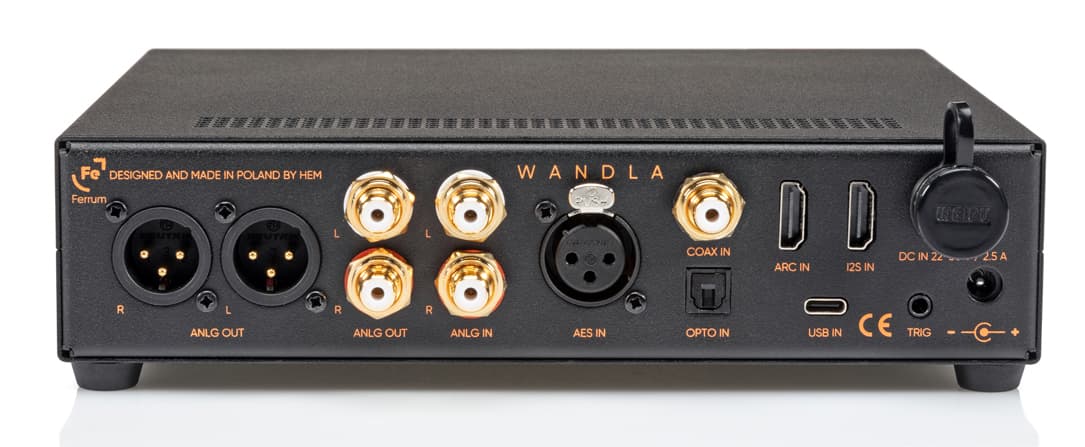
- Connectivity: A wide range of digital and analog connections including HDMI ARC, I2S, USB, coaxial and optical inputs, alongside both balanced XLR and unbalanced RCA outputs.
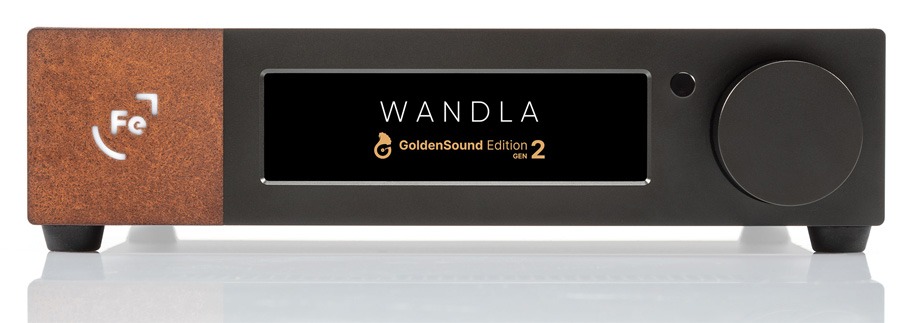
However, the Gen 2 takes things a step further with significant upgrades to three key capabilities within Ferrum’s Sweet Spot Tuning platform: Impact+, Tube Mode, and Spatial Enhancement.
Sweet Spot Tuning
Sweet Spot Tuning is designed to give listeners greater control over the sound while preserving the precision, transparency, and musicality that define the WANDLA platform. The goal is straightforward: help listeners find their personal sweet spot.
Whether adding weight and authority in the low frequencies, introducing the warmth associated with classic valve designs, or expanding the sense of space within a recording, the WANDLA GoldenSound Edition Gen 2 offers a wider range of customization while maintaining the performance expected from a high-end digital to analog converter.
Impact+
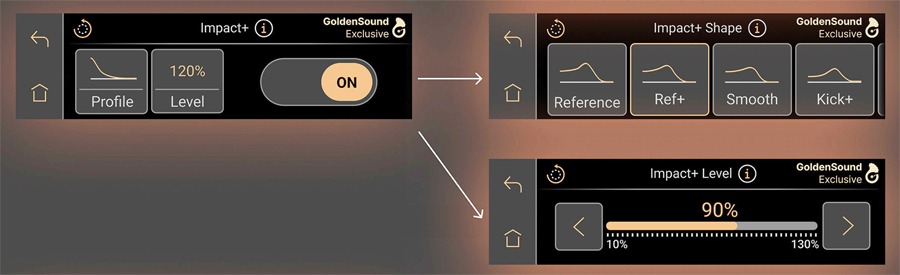
Impact+ is Ferrum’s advanced low frequency enhancement system. In the original GoldenSound Edition, Impact+ used a carefully tuned bass shelf combined with an additional peak to deliver a more realistic and powerful low end presentation.
With the GoldenSound Edition Gen 2, the system has been expanded to include seven selectable sound profiles, allowing listeners to tailor bass response and overall tonal balance to their preferences or specific headphones and systems. The available profiles include:
- Reference
- Ref+ Smooth
- Kick+
- DD Comp
- DD Comp+
- Sub Bass
Each of the new profiles is designed to deliver a distinct combination of bass shaping and dynamic response, allowing the sound to be tailored to different headphones and speaker systems.
Rather than relying on a single fixed enhancement, listeners can select the profile that best suits their system and then adjust the overall Impact+ level from 10% to 130%. This makes it possible to fine tune the balance between subtle reinforcement and more pronounced low end impact.
All processing is handled internally with 64-bit precision, ensuring that these adjustments remain smooth, controlled, and faithful to the original recording. With Impact+ and Ferrum’s Sweet Spot Tuning, low frequency performance becomes something listeners can shape with far greater precision.
Tube Mode

In the previous GoldenSound Edition, Tube Mode introduced the musical sweetness associated with second harmonic distortion, subtly enriching the sound in a way reminiscent of classic valve (tube) amplification.
Building on that concept, Tube Mode in the GoldenSound Edition Gen 2 has been expanded to allow users to match the WANDLA’s sonic character to the tonal signatures of specific tube types. Rather than simply adding a harmonic component, the updated Tube Mode now models the sound characteristics of five classic valve designs: EL34, KT88, 300B, 2A3, and 7062.
Listeners can also adjust the strength of each Tube Mode profile with a variable range from 10% to 200%, making it possible to apply anything from a subtle hint of warmth to a more pronounced tube-like character.
With Tube Mode and Ferrum’s Sweet Spot Tuning, the WANDLA GoldenSound Edition Gen 2 provides a flexible way to experience classic valve tonality within a modern digital platform, giving listeners the kind of tonal shaping options often used in recording studios when shaping the final sound of a performance.
Spatial Enhancement
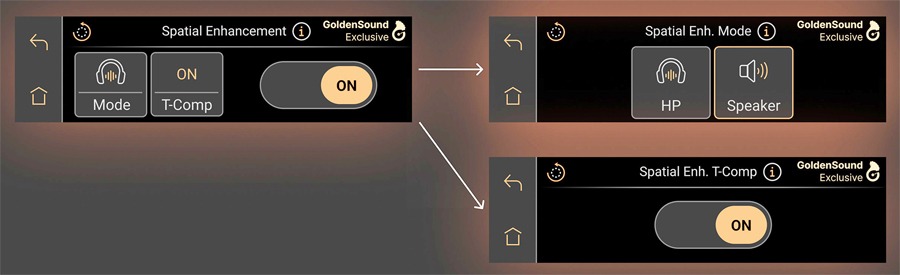
The next upgraded feature is Spatial Enhancement, Ferrum’s technology designed to expand the soundstage and improve the three dimensional presentation of music.
Originally, Ferrum’s implementation of Spatial Enhancement offered two dedicated modes, one optimized for loudspeakers and another for headphones. With the GoldenSound Edition Gen 2, Ferrum introduces a new spatial audio refinement called Transient Compensation, or T Comp, which fine tunes the spatial processing algorithm to better manage high frequency transients.
The result is a more convincing sense of depth and instrument placement, creating a clearer three dimensional soundstage without the imaging shifts often associated with traditional crossfeed systems.
Users can independently toggle the spatial processing, select the appropriate output mode for headphones or loudspeakers, and engage T Comp to further refine the spatial presentation.
The Complete WANDLA Experience
Alongside these new capabilities, the WANDLA GoldenSound Edition Gen 2 retains the features that helped establish the original platform’s reputation. These include the SERCE DSP module, WANDLA’s fully balanced architecture, proprietary amplification stage, optimized digital inputs, carefully tuned digital to analog conversion, and Dynamic Digital Filtering.
Ease of operation remains central to the design thanks to the intuitive touchscreen interface, while Ferrum Streaming Control Technology ensures seamless integration into modern digital audio systems.
When paired with Ferrum’s HYPSOS power supply, WANDLA also benefits from 4TSD voltage sensing capabilities, further optimising performance.
WANDLA Specifications Comparison
| WANDLA GoldenSound Edition Gen 2 (2026) | WANDLA GoldenSound Edition (2024) | WANDLA DAC/Preamp (2023) | |
| Product Type | DAC/PREAMP | DAC/PREAMP | DAC/PREAMP |
| Price | $3,295 | $3,295 | $2,795 |
| DAC Chip | ESS Sabre ES9038PRO | ESS Sabre ES9038PRO | ESS Sabre ES9038PRO |
| DAC resolution | 768 kHz / 32-bit, DSD512 | 768 kHz / 32-bit, DSD 512 | 32-bit/768k, DSD256 |
| Digital inputs | USB Type-C (up to PCM 768 kHz / 32-bit, DSD512, DoP256) I2S (up to PCM 768 kHz / 32-bit, DSD512, DoP256), PS Audio compatible ARC (up to PCM 192 kHz / 24-bit), TV input with CEC AES (up to PCM 192 kHz / 24-bit, DoP64) Coaxial S/PDIF (up to PCM 192 kHz / 24-bit, DoP64) Optical S/PDIF (up to PCM 96 kHz / 24-bit*) | •USB Type-C (up to PCM 768 kHz / 32 bit, DSD 512, DoP 256) I2S (up to PCM 768 kHz / 32 bit, DSD 512, DoP 256), PS Audio® compatible ARC (up to PCM 192 kHz / 24 bit), TV input with CEC AES (up to PCM 192 kHz / 24 bit, DoP 64) Coaxial S/PDIF (up to PCM 192 kHz / 24 bit, DoP 64) Optical S/PDIF (up to PCM 96 kHz / 24 bit*) *may work up to PCM 192 kHz and DoP 64 – depending of customer’s optical cable and transmitter | USB (up to PCM 768 kHz/32-bit, DSD 512, DoP 256) I2S (up to PCM 768 kHz/32-bit, DSD 512, DoP 256), PS Audio® compatible •ARC (up to PCM 192 kHz/24-bit), TV input with CEC AES/EBU (up to PCM 192 kHz/24-bit, DoP 64) Coaxial S/PDIF (up to PCM 192 kHz/24-bit, DoP 64) Optical S/PDIF (up to PCM 96 kHz/24-bit guaranteed; should work up to PCM 192 kHz/24-bit and DoP 64 – depends of user’s optical cable and transmitter) |
| Analog Inputs | RCA | RCA | RCA |
| Analog input Vmax | 9.5 VRMS (2-3.5 VRMS recommended) | 9.5 VRMS (2-3.5 VRMS recommended) | 9.5V RMS (2-3.5V RMS recommended) |
| Analog Input Impedance | 47 kΩ | 47 kΩ | 47 kΩ |
| Line Outputs | Balanced XLR, Unbalanced RCA | Balanced XLR, Unbalanced RCA | Balanced XLR, Unbalanced RCA |
| MQA Support | Not Indicated | Not Indicated | Decoder and Renderer on all digital inputs |
| Volume Control | Analog with bypass option / digital for DAC operation only | Analog with bypass option / digital for DAC operation only | Analog with Bypass Option, Digital for DAC operation only |
| Output level | PRO: 8 VRMS balanced, 4 VRMS unbalanced (@ 0 dBFS / 1 kHz sine) Red Book: 3.5 VRMS balanced, 1.75 VRMS unbalanced | PRO: 8 VRMS balanced, 4 VRMS unbalanced (@ 0 dBFS / 1 kHz sine) Red Book: 3.5 VRMS balanced, 1.75 VRMS unbalanced | 4.65V RMS unbalanced at 0 dBFS, 1kHz Sine Wave – 9.3V RMS Balanced. |
| Frequency Response | 10 Hz – 200 kHz +/- 0.1 dB (analog inputs) | 10 Hz – 200 kHz +/- 0.1 dB (analog inputs) | 10Hz to 200kHz +/- 0.1dB (analog inputs) |
| DAC THD | -121 dB (0.00009 %) | -121 dB (0.00009 %) | -121 dB (0,00009%) |
| DAC THD+N | -118 dB unweighted | -115 dB unweighted | -115 dB unweighted |
| Analog Input THD | -123 dB @ 2 VRMS | -123 dB @ 2 VRMS | -123 dB @ 2 VRMS output level |
| Dynamic Range (A-weighted) | Analog 127 dB Digital 119 dB | Analog 127 dB Digital 119 dB | Analog 127 dB Digital 122 dB |
| Crosstalk | -120 dB at 1 kHz, better than -100 dB for 20 Hz – 20 kHz | -120 dB at 1 kHz, better than -100 dB for 20 Hz – 20 kHz | -120dB for 1kHz better than -100dB for 20Hz to 20kHz |
| Output Impedance | 22 Ω unbalanced 44 Ω balanced | 22 Ω unbalanced 44 Ω balanced | 22 Ω unbalanced 44 Ω balanced |
| Power Consumption | 10 W idle, 15 W max | 10 W idle, 15 W max | 0 watts idle/15 watts max |
| Power inputs (22-30 VDC) | 5.5/2.5 mm DC connector, centre positiveProprietary Ferrum Power Link (FPL) 4-pin DC connector | 5.5/2.5 mm DC connector, center positive proprietary Ferrum Power Link (FPL) 4-pin DC connector | 22-30 VDC proprietary FPL 4-pin DC connector (FPL) 5.5/2.5 mm DC connector centre positive |
| Power Adapter | 100-240 VAC to 24 VDC | 100-240 VAC to 24 VDC | 100-240 VAC to 24 VDC |
| Remote control | Included | Included | |
| Dimensions | 21.7 x 20.6 x 5 cm 8.6″ x 8.1″ x 2.0″ | 21.7 x 20.6 x 5 cm 8.6″ x 8.1″ x 2.0″ | 21.7 x 20.6 x 5 cm 8.6″ x 8.1″ x 2.0″ |
| Weight | 1.8 kg / 3.97 lb | 1.8 kg / 3.97 lb | 1.8 kg / 3.97 lb |
The Bottom Line
Ferrum Audio continues to make serious waves in the DAC and preamp category with the WANDLA series, and the GoldenSound Edition Gen 2 pushes that momentum even further. By expanding its Sweet Spot Tuning platform with deeper control over bass response, spatial presentation, and tube inspired harmonic shaping, Ferrum is giving listeners tools that are rarely seen in a modern digital component.
For headphone listeners and two channel enthusiasts building a high performance digital front end, the WANDLA Gen 2 offers a flexible control center that can feed external amplification, powered speakers, or a dedicated headphone chain. To get the most out of it with headphones, however, Ferrum clearly intends it to be paired with the Ferrum OOR Headphone Amplifier, which completes the company’s reference signal path.
It is not inexpensive, but for listeners looking for a highly configurable DAC and preamp platform designed to integrate into serious personal audio systems, the WANDLA GoldenSound Edition Gen 2 looks like a compelling option.
Price & Availability
The WANDLA GoldenSound Edition Gen 2 is priced at $3,295 (£3295 / €3295) through Ferrum and Authorized Dealers.
Current WANDLA owners can upgrade their unit by purchasing the GoldenSound Edition Gen 2 Converting Plugin for $595 (€595).
Related Reading: