
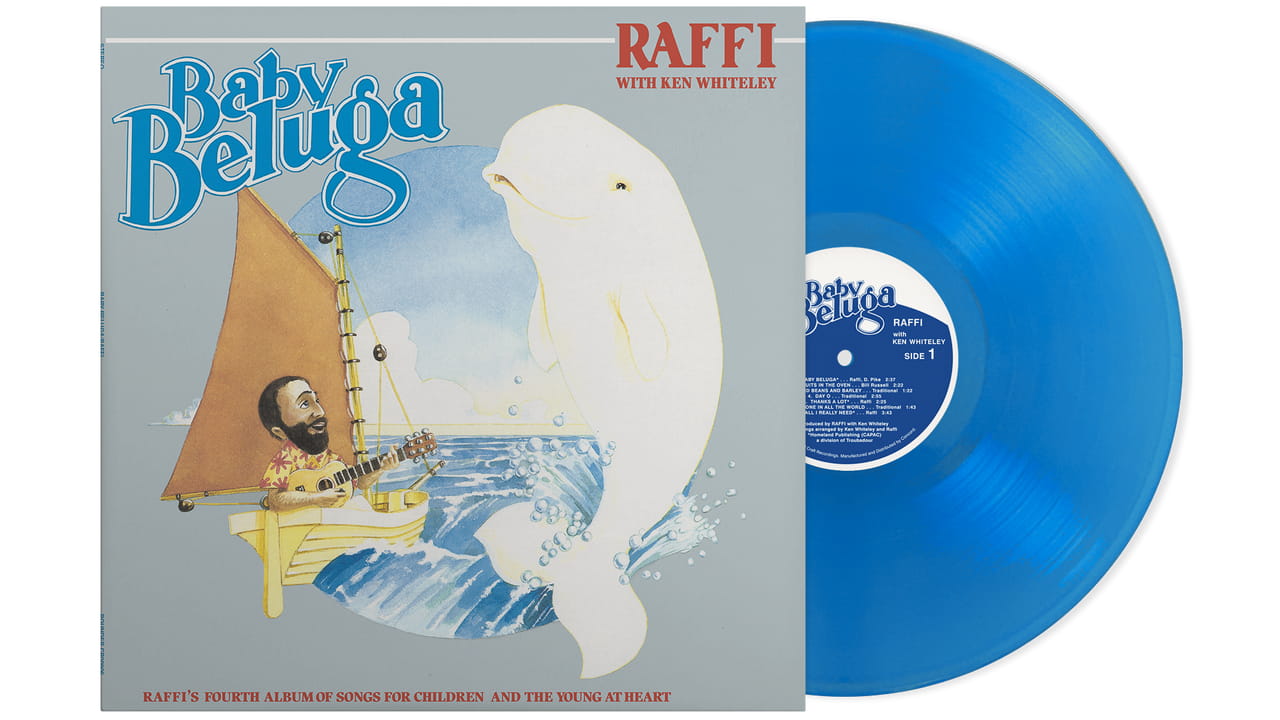
Raffi Cavoukian may be a global figure now—an Armenian-Canadian singer and author once described by The Washington Post as “the most popular children’s singer in the English-speaking world”—but for a lot of us who grew up in Canada, he was simply the soundtrack of childhood. Born in Cairo to Armenian parents who fled the genocide and eventually settling in Toronto in 1958, Raffi built a career that stretched far beyond Baby Beluga: music producer, author, entrepreneur, and founder of the Raffi Foundation for Child Honouring.
So when Craft Recordings offered to send me their new edition of Baby Beluga, I didn’t hesitate. This one hits close to home. Raffi actually played at my elementary school in Toronto when I was ten, and my mother still has my original pressing buried somewhere in storage—wedged between Oklahoma, The Jazz Singer, Saturday Night Fever, a small mountain of smooth jazz, and a lone Edith Piaf record.
Like a lot of Canadians my age, this album isn’t just nostalgia. It’s a time capsule. And getting the chance to revisit it with fresh ears felt like opening a door I hadn’t walked through in decades.
Raffi’s children’s records were never overproduced spectacles; most leaned on exactly what made him effective in the first place—simple folk arrangements built around his voice and guitar. In the early years he pulled in a rotating cast of Toronto folk talent, including Ken Whiteley, The Honolulu Heartbreakers, and, yes, a young Bruce Cockburn before Canada officially claimed him as one of its national treasures; although I’ve never really jumped on that rocket launcher to absolutely nowhere.
As Raffi’s catalog grew, so did his palette. He folded in global sounds long before “world music” became a marketing term, with tracks like “Sambalele” on More Singable Songs (1977) and “Anansi” on The Corner Grocery Store (1979).
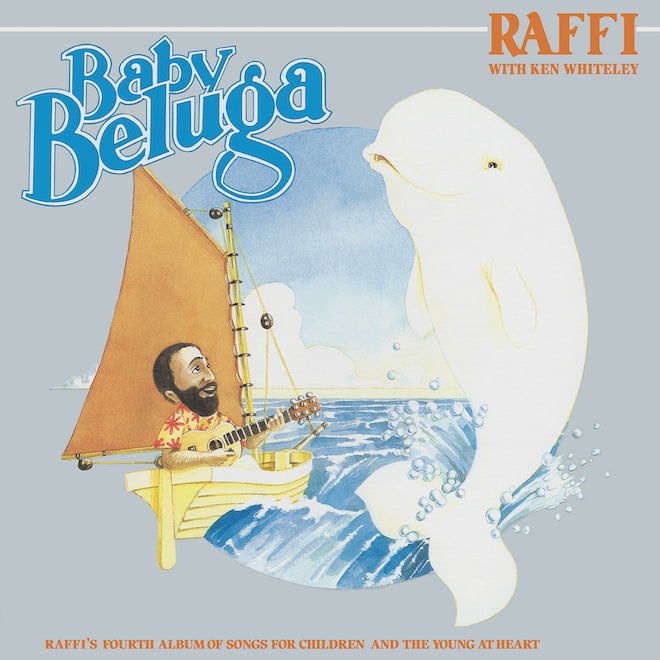
By then he was already racking up staples—“Bananaphone,” “All I Really Need,” “Down by the Bay”—the kind of songs that imprinted on an entire generation. And in 1979 he wrote the one that would follow him for the rest of his career: “Baby Beluga,” inspired by a real beluga named Kavna at the Vancouver Aquarium. Sometimes the biggest hits really do start with a whale.
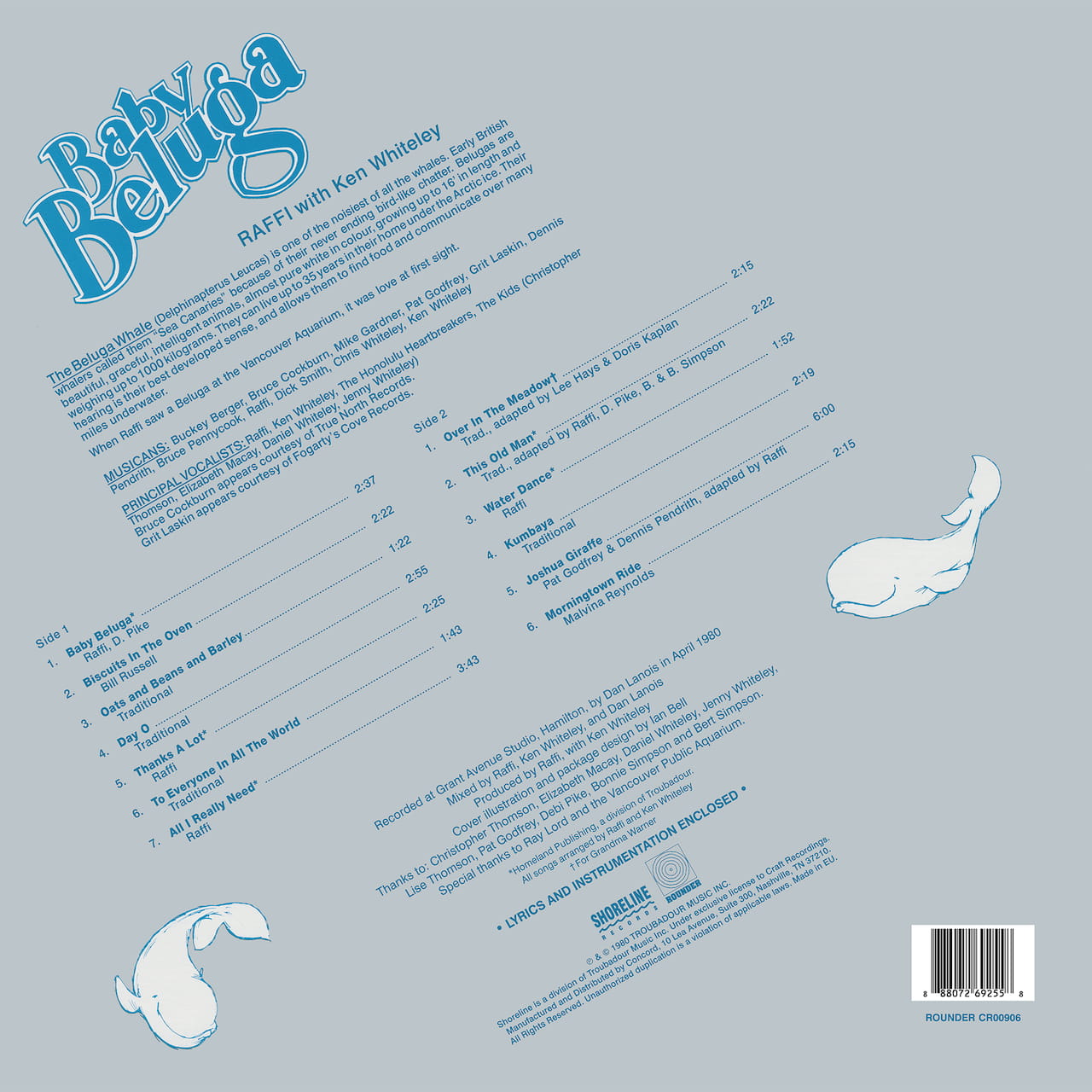
Baby Beluga wasn’t born in some high-gloss Los Angeles complex. It was recorded in 1980 at Grant Avenue Studio in Hamilton, the converted Edwardian house where a young Daniel Lanois was quietly building the foundation for a career that would later include Brian Eno, U2, and Emmylou Harris. Before he was producing global rock landmarks, he was behind the board for Raffi—helping capture the warmth, ease, and clarity that helped these songs stick.
Craft’s new This Blue eco-friendly LP edition marks the album’s 45th anniversary, and they’ve clearly aimed it at the generations who grew up on this record and are now raising kids of their own. Pressed on non-toxic, fully recyclable material, the release brings back staples like “Day O,” “Thanks A Lot,” and of course the title track “Baby Beluga.” It’s a smart choice for an artist whose catalog has moved more than 15 million albums worldwide and who remains, by any sane metric, the most influential Canadian children’s musician of the past half-century.
My kids—who would rather blast Tyler, the Creator, MF Doom, or whatever other pop and rap phenom is melting TikTok at the moment—actually gave their old man a break over Thanksgiving. In between Stranger Things episodes, they let me put on Baby Beluga. I could see the look: fine, Dad, we’ll humor you for one song. But hearing these tracks again for the first time in 45 years hit harder than I expected.
Suddenly I was back at USDS in Toronto’s Cedarvale neighborhood, right on Bathurst Street, in the Jewish hood where we learned how to do pretty much everything without helicopter parents or glowing screens telling us what to think. The 1970s and 1980s weren’t perfect, but they were better. I knew all my neighbors. I lived in the pizzerias and bakeries. The candy store and the Jewish delis were basically extensions of my living room. This record pulled all of that back in an instant, right down to the smell of fresh blueberry buns and the feeling of being a kid in a city that still felt like a community.
This reissue is a must-own for anyone from the 416—or really any Canadian community that remembers when the country felt like a very different place. And the timing is almost ironic. Raffi was always the guy preaching acceptance, the bridge-builder who lived in both Syria and Israel long before the region became the shorthand for endless division. He grew up around the kind of cultural complexity most of us only read about later, and he hated seeing people pulled apart by it.
I have no idea what he thinks about the current situation in the Middle East, and honestly I’m not sure I want to. Social media has turned every artist into a pundit, and sometimes it’s better not to know where childhood heroes land when the world fractures. The Raffi I remember—the man who walked into my school in Toronto and played for a room full of Jewish kids with Han Solo haircuts, ponytails, and Lacoste polos—was simply there to make us happy. No politics, no agenda, just music that made the room feel lighter. And that’s the version of Raffi this record brings back.
Where to buy:
Related Reading:
- Review: One Flew Over The Cuckoo’s Nest 50th Anniversary Vinyl Reissue — So Good, Nurse Ratched Would Have It Shock-Treated Before Visiting Hours
- Where To Find Independent Record Stores Spotify Can’t Kill: Your 2025 Guide
- Crate & Case: Dolly Parton, Talking Heads, Cedric Burnside, Judy Garland And Eric Dolphy From The Used Records And CDs Bins
- One Flew Over The Cuckoo’s Nest 50th Anniversary Vinyl Reissue Lands From Varèse Sarabande & Craft Recordings — Strictly Nurse Ratched Approved
























Anton
November 29, 2025 at 11:34 pm
Now that’s an artist whose name I’ve not read about in 40 years. He’s still alive?
The blue colored vinyl sounds good?
Ian White
November 30, 2025 at 11:24 am
Anton,
He is still alive. Doing mostly charity work these days. I have not listened to my original copy since 1982 so I really can’t compare them, but I will say that the reissue sounds very clean and present. Something I will pass down to my own children and grandkids.
IW