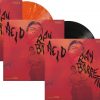
Craft Recordings continues to build momentum behind one of the most successful jazz reissue campaigns of the modern vinyl era. The label has announced three new additions to its widely praised Original Jazz Classics series: The Young Lions (self-titled), Lee Morgan’s Introducing Lee Morgan, and Bobby Timmons’ This Here Is Bobby Timmons.
Arriving April 24, the trio of releases digs back into the fertile late-1950s jazz scene with albums recorded between 1957 and 1960. The set captures Morgan at the very beginning of a career that would later reshape hard bop, documents a rare all-star studio meeting from The Young Lions collective, and spotlights Timmons’ first album as a bandleader after helping define the soulful hard-bop piano sound of the era.
The new titles continue the winning formula that has made Craft’s revival of the Original Jazz Classics imprint such a hit with collectors and audiophiles. Each release features lacquers cut directly from the original analog tapes (AAA) by mastering engineer Kevin Gray at Cohearent Audio, pressed on 180-gram vinyl at Record Technology Inc. (RTI), and packaged in period-correct tip-on jackets that faithfully replicate the original artwork.
All three titles are available for pre-order now and will also arrive on April 24 across digital platforms in 192kHz/24-bit hi-res audio. The OJC revival has already become one of the most consistently praised reissue programs in jazz today and we’ve covered most of the series so far, which you can explore here.
The Young Lions – The Young Lions
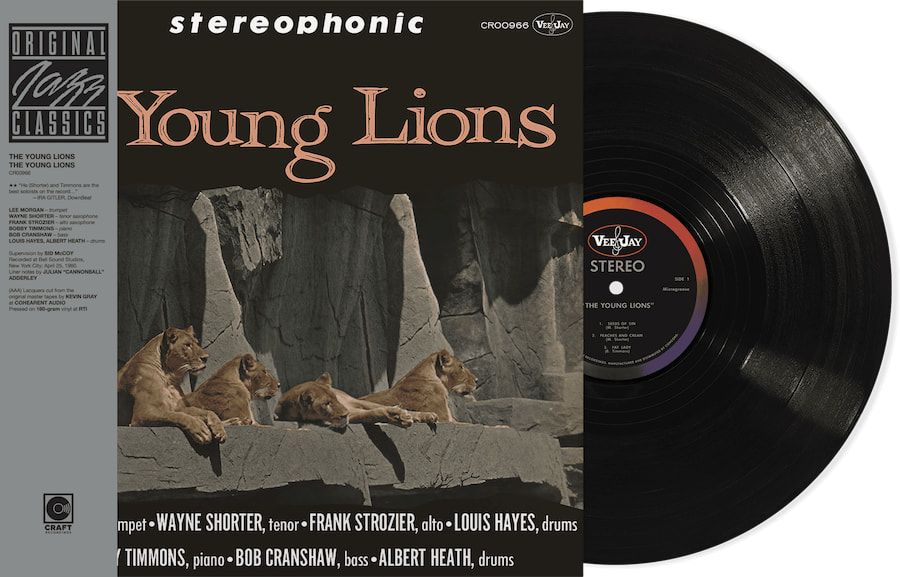
In 1960, tenor saxophonist Wayne Shorter, alto saxophonist Frank Strozier, trumpeter Lee Morgan, pianist Bobby Timmons, and bassist Bob Cranshaw joined forces, supported by alternating drummers Louis Hayes and Albert Heath to record a one-off session that quietly captured a turning point in modern jazz. The resulting album, The Young Lions, brought together a group of rising stars determined to bridge the widening divide between traditional hard bop and the increasingly exploratory avant-garde that was beginning to reshape the genre.
The collaboration proved fleeting, but the music left a mark. Named after Irwin Shaw’s wartime novel, the group embodied a moment when jazz stood with one foot planted in the blues-drenched language of the 1950s and the other stepping toward the freer, more experimental sounds of the decade to come. Decades later, a new generation led by Wynton Marsalis would inherit the “Young Lions” label, but this earlier incarnation captured the spirit first.
The original liner notes by soul-jazz icon Cannonball Adderley set the tone, opening with the biting line, “We are living the era of the glorification of mediocrity,” before celebrating the group’s refusal to play it safe. Much of the album’s most memorable material comes from Shorter, whose compositions “Seeds of Sin” and “Scourn’” serve as confident sonic torchbearers for the band’s fluid, swinging approach—music rooted in bop tradition but already looking beyond it.
(Available April 24, 2026)
Lee Morgan – Introducing Lee Morgan

It’s almost absurd to consider that trumpeter Lee Morgan was only 18 years old when Introducing Lee Morgan arrived in 1957. Already a prodigy on the Philadelphia scene, Morgan had absorbed the language of bebop and hard bop with frightening speed, helped along by a trumpet reportedly gifted to him by his hero Dizzy Gillespie, complete with the tilted bell that became part of his visual signature.
Morgan’s tone on this debut bears the unmistakable influence of the late Clifford Brown; bright, confident, and full of youthful fire but the session remains grounded thanks to the steady presence of tenor saxophonist Hank Mobley and his quintet backing the young trumpeter. The result is a straight-ahead hard bop showcase that lets Morgan stretch his legs across a range of moods, from the blistering drive of “Hank’s Shout” to the more reflective reading of “P.S., I Love You.”
Even at this early stage, the album hinted at the trajectory of one of jazz’s most important trumpet voices. Morgan would go on to record a string of landmark sessions including The Sidewinder, Search for the New Land, and Cornbread that pushed hard bop toward funkier rhythms and more exploratory territory. That career arc makes Introducing Lee Morgan all the more fascinating: the sound of a teenager already playing like a veteran, laying the groundwork for a run of recordings that would define the next decade of modern jazz before his life was tragically cut short at just 33.
(Available April 24, 2026)
Bobby Timmons This Here Is Bobby Timmons
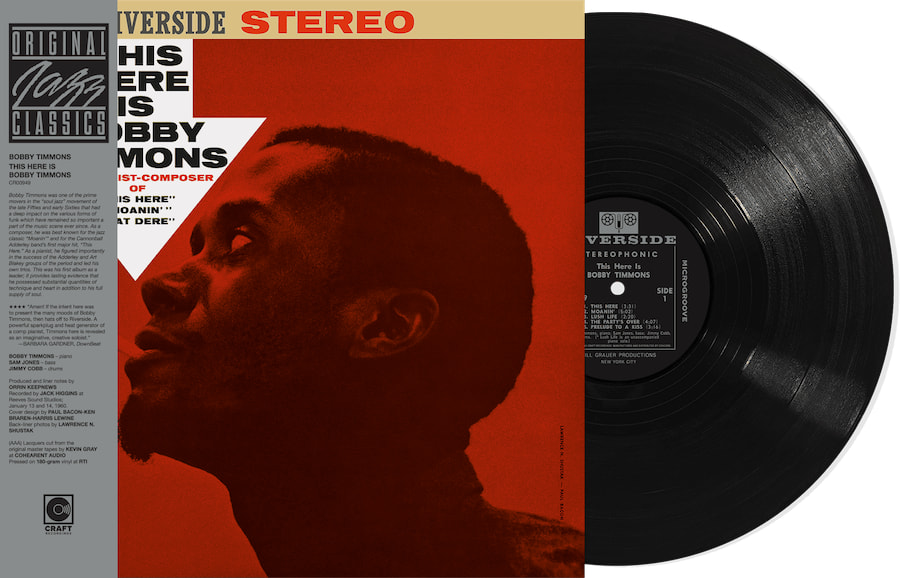
When Bobby Timmons stepped into the studio in 1960 to record This Here Is Bobby Timmons, he was already one of the defining pianists of the hard bop era. Timmons had built his reputation with Art Blakey’s Jazz Messengers and the Cannonball Adderley Quintet, where his writing and playing helped shape a more soulful, groove driven direction in modern jazz. This first album under his own name feels like a statement of purpose, with Timmons stepping out front to show just how deep his musical roots ran.
Those roots came from the church. Raised in Philadelphia where his father was a minister, Timmons grew up surrounded by gospel music, and that influence flows through the entire record. You hear it immediately in the infectious title track, while the relaxed swing of “Dat Dere” reveals the same gospel touch in a lighter, playful groove.
Timmons had already written one of the most recognizable compositions in modern jazz. “Moanin’,” first recorded by Blakey and the Jazz Messengers, became an instant classic and was later inducted into the GRAMMY Hall of Fame. The tune gained a second life when Jon Hendricks added lyrics, with vocalists including Sarah Vaughan helping turn it into a standard. Along with “Dat Dere” and the title track “This Here,” those songs helped establish Timmons as one of the architects of soul jazz, a pianist whose church rooted groove could swing hard while speaking directly to the listener.
(Available April 24, 2026)
Related Reading:
- Craft Recordings Kicks Off 2026 With Landmark Original Jazz Classics Reissues From Vince Guaraldi, Thelonious Monk, And Wes Montgomery
- Bill Evans Trio Moon Beams: Craft Recordings Revives The Classic With Kevin Gray-Mastered 180-Gram OJC Vinyl
- Review: Yusef Lateef’s 1957 Jazz Mood — Craft Recordings Revives His Rare Savoy Debut In The Acclaimed OJC Vinyl Series
- Hank Mobley’s Jazz Message #2 Review: Craft Recordings Delivers A Standout In The 2025 OJC Reissue Finale