
Quad’s recent resurgence isn’t an accident—and it didn’t start with the Quad 3. The real turning point was the smart, respectful reimagining of the 303 power amp and 33 preamp, which proved that Quad could mine its own history without turning into a museum piece. Quad is best known today for its loudspeakers, which is both true and slightly beside the point. Yes, the company still builds some of the most underrated dynamic and electrostatic speakers on the market—but that reputation has conveniently distracted people from the fact that Quad’s electronics are just as accomplished.
This isn’t a speaker brand moonlighting in amps and preamps; it’s a hi-fi manufacturer quietly making serious, well-engineered electronics while everyone else is busy chasing touchscreens and firmware updates.
The Quad 3 Integrated Amplifier builds directly on that momentum: a 65-watt-per-channel Class A/B design using Quad’s Complementary Feedback topology to keep distortion low, linearity intact, and heat where it belongs—outside the listening experience.
The result is an amplifier that feels unapologetically British in its restraint, modern in its versatility, and refreshingly sensible in its pricing. Quad isn’t dabbling anymore. They’re making serious electronics again—and doing it properly.
21st-Century Quad With A Retro Soul?
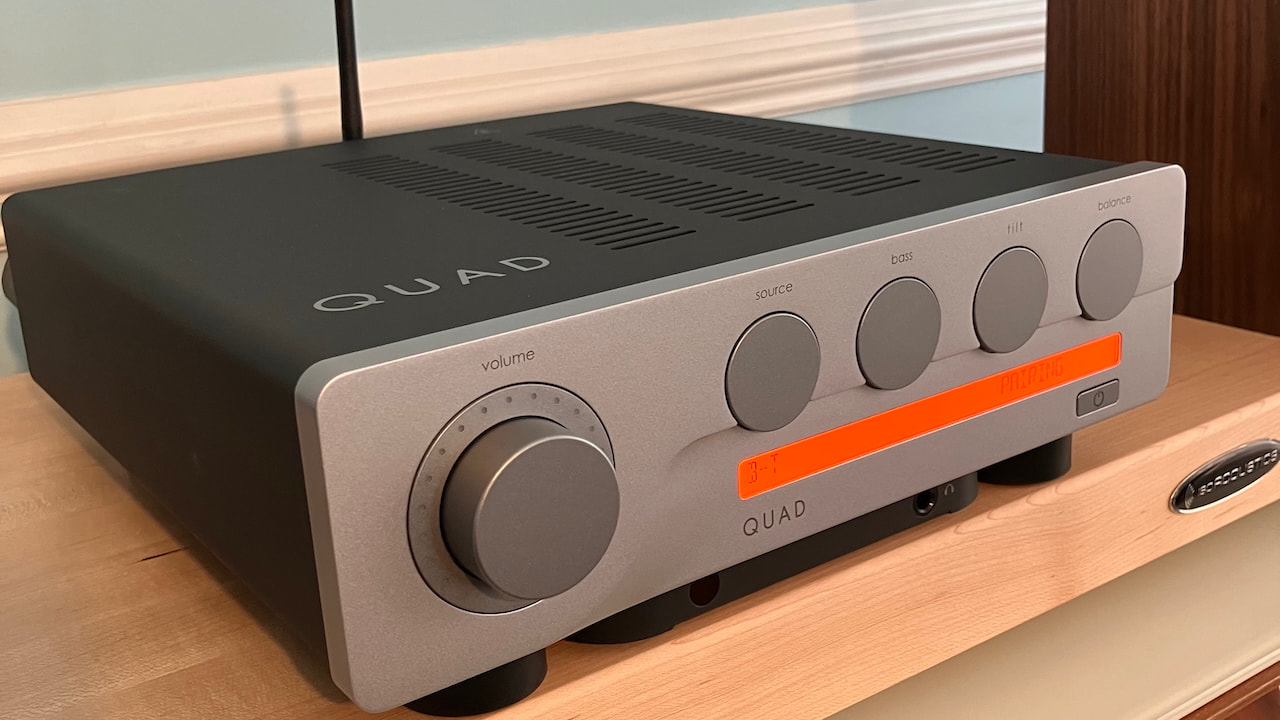
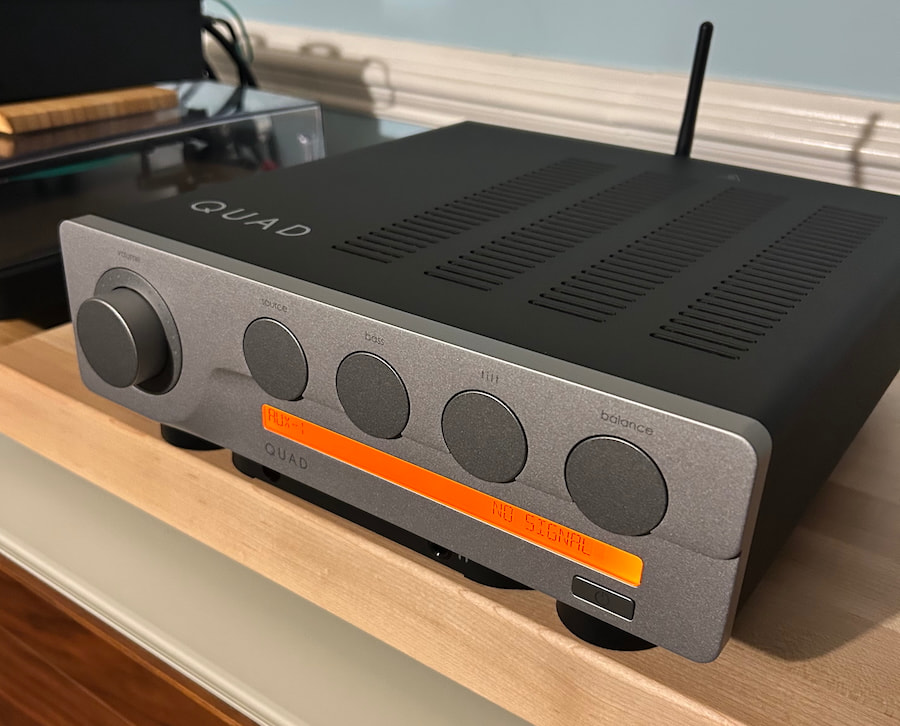
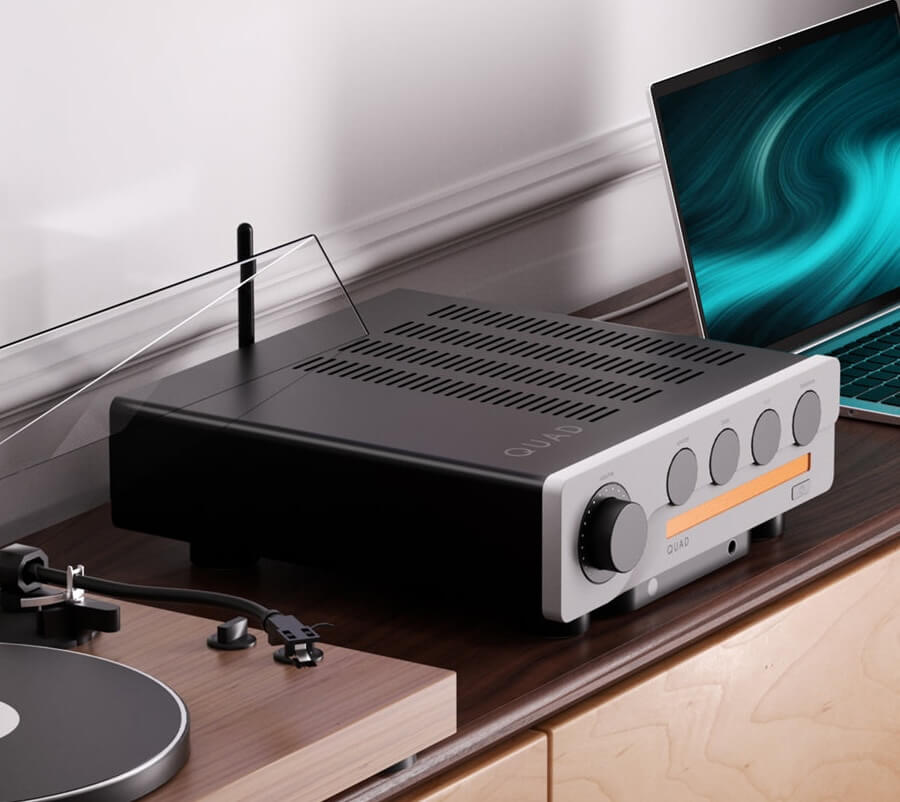
The industrial design sticks closely to Quad’s DNA, but with a much-needed update. It’s still smooth, solid, and built like it plans to outlive you, yet the casework has evolved from “granddad taupe” to a far more civilized matte silver. The iconic orange strip remains, now LED-backlit and doing double duty by discreetly housing a modern LCD display. The white buttons are gone, everything glows orange, and somehow it all works without turning the amp into a retro cosplay act.
The control layout will look instantly familiar to longtime Quad fans—volume on the left, three flush rotary controls on the right—but what those knobs actually do has been dragged firmly into the present. The Quad 3 clearly carries the design language and DNA of the reborn 33/303, yet it stands confidently on its own as a fully integrated amplifier: vintage lines, modern internals, and no apologies for refusing to chase trends.
The Quad 22’s design DNA is all over the Quad 3, especially in the fascia detailing and that neat row of tactile rotary encoders that feel like they were engineered by adults, not UX interns. Those dials handle volume, source selection, bass, balance, and Quad’s wonderfully stubborn Tilt control—an old idea that still makes more sense than half the tone-shaping nonsense being sold today.
Bass adjustment is sensibly limited to ±3dB, which is exactly as far as it needs to go. It’s enough to rein in a boomy room or give a skinny recording a bit more backbone without turning the low end into porridge. But the real party trick remains the Tilt control. Instead of fiddling separately with treble and bass, Tilt shifts the entire tonal balance around a 700Hz pivot point. One direction warms things up, the other cools them down, all in tidy 1dB steps. It’s elegant, effective, and blissfully free of graphic EQs, menu diving, or weird remote button sequences.
Despite its relatively compact footprint—300 x 101 x 332 mm (W x H x D), or roughly 11.8 x 4.0 x 13.1 inches—the Quad 3 weighs a reassuring 8 kg (about 17.6 pounds), which tells you everything you need to know about the casework and power supply.
The Quad 3 is solidly built and almost aggressively quiet. Apart from a single, polite click when it wakes from standby, there’s nothing—no hum through the speakers, no hiss at idle, no mechanical nonsense. After 100+ hours of listening, the Class A/B design never got remotely warm, which feels almost suspicious in a world where “runs hot” is often marketed as a feature. Apparently, Quad didn’t get the memo that thermal anxiety is supposed to equal sonic credibility.
The power amplifier section is rated at +29dB of gain, delivering 65 watts per channel into 8 ohms and 100 watts per channel into 4 ohms, both at under 1% THD.
The Quad 3 behaved like an amplifier designed by engineers rather than a branding department—competent, controlled, and staring at the usual audiophile theatrics as one might regard a man in a shiny waistcoat insisting that warmth, soul, and virtue can be measured by how uncomfortably hot a box becomes—with the expression of someone patiently deciding whether to explain the error or simply let nature take its course.
Properly Connected: Everything You Need, Nothing You Don’t
Quad didn’t overthink the Quad 3’s connectivity—and that’s a compliment. It covers modern digital, proper analog, and real-world system integration without turning the back panel into a logic puzzle.
On the analog input side, you get two RCA line inputs (Aux) plus a dedicated moving-magnet phono input. The phono stage is a proper, low-noise MM design with 47 dB gain, 47kΩ / 100pF loading, and 3.6 mVrms input sensitivity (at Volume = 0 dB).
In plain English: it’s set up the way a normal MM cartridge expects, and it doesn’t come with weird “audiophile” surprises. The line inputs run 10kΩ input impedance, with 800 mVrms sensitivity (Line, Volume = 0 dB), and the preamp section is +0 dB on the line stage.
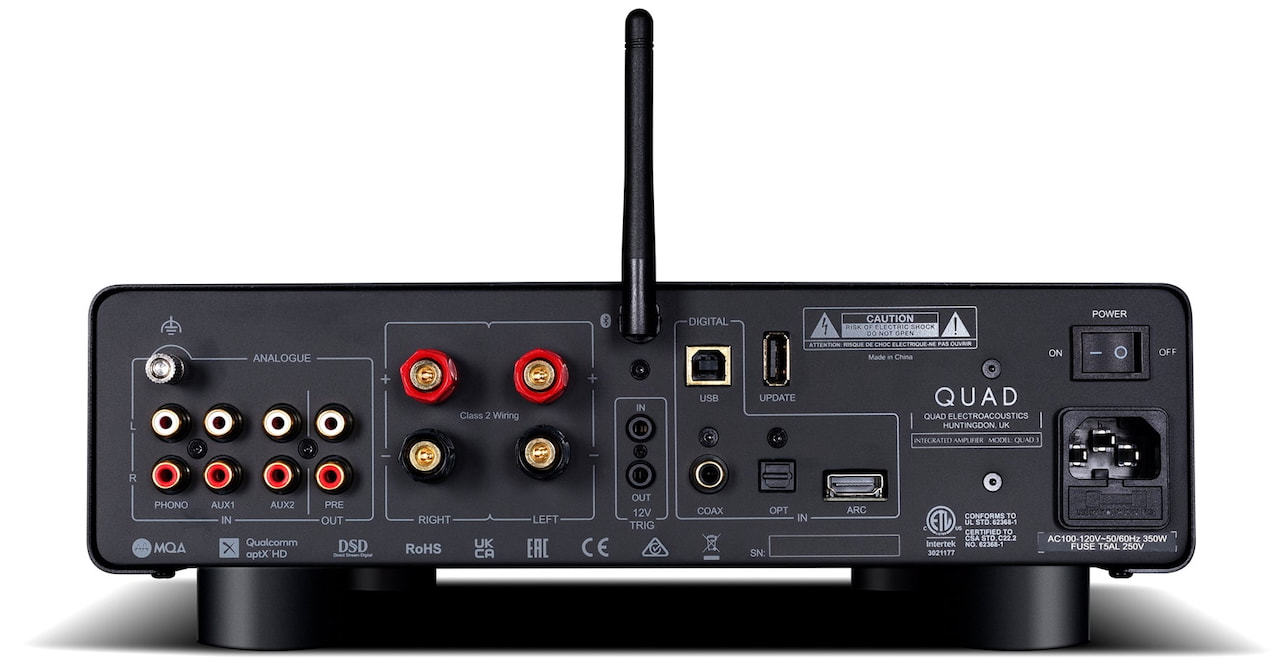
Digital is equally well covered. You get 1x coaxial SPDIF and 1x optical SPDIF, both supporting 44.1kHz to 192kHz PCM, and Quad also supports full MQA decoding via PC USB, coax, and optical. The USB-B (PC USB) input is the heavy hitter: 44.1kHz to 768kHz PCM plus DSD64 / DSD128 / DSD256 / DSD512. So yes, it’ll take your hi-res library seriously—whether or not you should be feeding it 768kHz is between you and your therapist.
For TV integration, the Quad 3 includes HDMI ARC, making it easy to fold into a living-room setup without extra boxes or cable gymnastics. Wireless duties are handled by Bluetooth 5.1 with aptX and aptX HD. Bluetooth isn’t why you buy this amplifier—and Quad clearly knows that—but it’s implemented competently. It played nicely with my rotating cast of iPhones (using the latest Questyle and iFi Bluetooth dongles) as well as a borrowed Samsung smartphone, without hiccups or drama. Support for aptX Lossless or LDAC would have been welcome and feel like logical next steps, but they’re simply not part of the Quad 3’s brief.
Outputs are straightforward and flexible: a preamp output (useful for adding a power amp or integrating a sub that wants line-level), a stereo speaker output via binding posts, and a 6.35mm headphone output powered by a dedicated current-feedback headphone amplifier (read: not some sad resistor off the speaker taps).
A 12V trigger is also included for system integration, allowing the Quad 3 to wake up or shut down in sync with other components like the new Quad 3CDT that was just announced last week and is available.
The Quad 3 Plays Well With Others…Mostly
One of the genuine advantages of working with MoFi Distribution is the sheer breadth of the brands they represent. Not all of it aligns with my idea of sensible high-end audio, but there isn’t a single weak link in the lineup. Wharfedale, Castle, Leak, Quad, MoFi Electronics, and now Thorens are the standouts, and you should expect a steady run of coverage on all of them through 2026—with some of that already live.
I’ve been a Wharfedale customer for over 20 years, still own an original Quad Vena, and currently live with three restored Thorens turntables. So yes, there’s history here, and I’m not pretending otherwise. Being able to spend time with one of the first Quad 3 units was genuinely appreciated.
MoFi’s Lionel Goodfield and I go back nearly 28 years, which tends to make things easier when it’s time to get the ball rolling on a review like this. There’s no song and dance, no awkward introductions, and no need to explain where either of us is coming from—we’ve already had those conversations, repeatedly, and usually over food.

Yes, there’s the unavoidable Toronto–Montreal rivalry, but it’s a friendly one, sharpened by an intense, mutual appreciation for Montreal deli, proper bagels, and the undeniable gravitational pull of South Florida. That shared history and shared snobbery about what constitutes decent food meant the Quad 3 discussion moved quickly from “should we?” to “when can you start?” Long relationships have their advantages, and in this case, it made access straightforward and expectations clear.
On paper, the Quad 3’s power ratings made it an obvious match for speakers I actually live with: Q Acoustics 5040, 3020c, Acoustic Energy AE100 MKII, and my long-serving Wharfedale Diamond 10.1s. The Magnepans, meanwhile, took one look at the spec sheet and sulked in the corner like the Maple Leafs denied their preferred early tee time after yet another first-round playoff exit. No surprises there.
Complicating matters—in a good way—was the fact that we were already lining up reviews of the IsoTek power line conditioner, the Wharfedale Super Denton, and the final pairs of Diamond 12.3s before they were officially replaced. So everything landed at once. Rather than pretending otherwise, I used all of it. Repeatedly. Different rooms, different pairings, different moods.
And thanks to an unplanned stretch of forced downtime—two months of stress tests, endoscopies, colonoscopies, round one of stomach surgery (round two lands on the 30th), and a bout of flu picked up in the hospital because of course you always get sick in the hospital—I had more time than usual to listen, re-listen, and actually think.
No rushing. No box-checking. Just long sessions at home, speakers rotating in and out, and the Quad 3 left to show what it could do when excuses and distractions were removed. Sometimes the worst timing turns out to be useful.

Listening
Right out of the gate, I started with the Quad 3 over Bluetooth aptX HD, streaming Sia’s “Unstoppable,” “Cheap Thrills,” and “Breathe Me” via Qobuz—not exactly the audiophile confession booth, but a useful reality check. And nobody is going to accuse the Quad 3 of sounding anemic or thin. Ever.
Neutral? Not even remotely, and Quad isn’t pretending otherwise. There’s weight, density, and a sense of physicality that shows up immediately, even over Bluetooth. Paired with the Wharfedale Super Denton, things leaned confidently to the warm and full side. The Super Denton delivers far more bass than its compact cabinet has any right to, and it brings that low-end authority without asking permission.
It’s not neutral either—but together, the combination sounded deliberate rather than accidental, more “rounded” than “studio monitor honesty,” which, frankly, felt like the point.
Switching over to the WiiM Ultra—using both its analog outputs and then its digital output into the Quad 3’s DAC—there was an immediate and fairly obvious shift. Through the Quad’s internal DAC, clarity was very good and never soft-focused, but it didn’t quite dig out as much fine detail as the WiiM Ultra running on its own. That said, the comparison wasn’t a loss so much as a change in priorities.
The Quad 3’s internal voicing nudges everything to the darker side of neutral, pulling the presentation back from edge definition and leaning into weight and density instead. It’s a conscious tonal choice rather than a technical shortcoming, and depending on the speakers and the recording, it can be either welcome restraint or mild subtraction. The Quad isn’t chasing hyper-resolution; it’s shaping the music in a way that favors solidity and flow over spotlighting every last detail.
Regardless of source—CDs, vinyl, or streaming—and regardless of what I threw at it, the Quad 3 / Wharfedale Super Denton pairing behaved consistently. Nick Cave, Boards of Canada, The Cure, Talking Heads, Lee Morgan, Sonny Rollins, Thad Jones, Miles, Kraftwerk—same story every time. That’s a compliment and a criticism, depending on your priorities.
The upside is coherence. The downside is that my lone, repeatable gripe never went away. There’s a bit of looseness in the sub-bass, and the upper midrange isn’t quite as clear or resolved as it was with some of the other amp and speaker combinations I rotated through. It’s not muddy, and it’s not wrong, but it does sound slightly relaxed where others were more precise. If you’re chasing forensic clarity or iron-fisted low-end control, this pairing may not be your religion. If you’re after flow, body, and a presentation that doesn’t interrogate every recording like a hostile witness, you’ll probably shrug and keep listening.
If you’re a serious fan of female vocals—especially well-recorded pop, soul, jazz, and blues—this Quad 3 / Super Denton combination plays directly to that strength. Sarah Vaughan, Amy Winehouse, Carole King, Sia, Seinabo Sey, Natalie Bergman, Gabi Hartmann, Emmylou Harris—all came through with real presence and an easy sense of soul that never felt hyped or pushed.
Tone is spot on, pacing is confident without dragging, and the top end never hardens, even when the recordings lean hot or forward. Voices stay anchored and dimensional, not spotlighted or etched, which makes long listening sessions feel effortless. It’s the kind of presentation that flatters vocals without turning them into caricatures—and once you lock into that, it’s very easy to stop swapping tracks and just let albums run.

Quad 3 with Q Acoustics 5040 & 3020c: West End Polish Meets East End Attitude
Did these combinations offer a better balance of strengths? Absolutely. The Q Acoustics 5040 have been my daily drivers since the day they arrived, and that alone says plenty. Speakers rotate through here with alarming regularity; the 5040s have stubbornly refused to leave. Everything I value about them—openness, detail, top-end extension, speed, pacing, and imaging—is front and center. That upper-end reach, in particular, was never a strong suit of the old 3030i and 3050i, which are now enjoying a quieter life doing home-theater duty in Vero Beach.
That same list of strengths, however, cuts both ways. Pair the 5040s with the wrong amplifier—especially something overly neutral and hyper-precise—and the whole presentation tips into what I call the “Topping curse”: clean, analytical, and about as soulful as a tax audit. Everything is technically correct, and none of it makes you care.
Enter the Quad 3, which effectively responds with a raised eyebrow and a “hold my pint.” The bass filled out, the midband gained body, and the overall balance shifted from forensic to something that didn’t feel like it was waiting to be graded. Vocals weren’t hurled into your lap like a soused barmaid from Torquay looking for a good time, but they were fuller, more dimensional, and confidently positioned in front of the speakers.
The Quad didn’t dull the Q Acoustics’ strengths—it civilized them, restoring proportion and flow while quietly identifying their more excitable tendencies as a cunning plan, confiscating them for everyone’s safety, and filing them somewhere they can do no further harm.
One can’t help wishing the same firm confiscation of bad ideas were applied to certain politicians after their more catastrophically misjudged public responses, when silence, proportion, and basic human decency would have been the wiser course over the weekend.

Quad 3 with Acoustic Energy AE100 MKII & Diamond 12.3: And Now for Something Completely Different
Did I prefer the Quad 3 with the now-discontinued Wharfedale Diamond 12.3 (full Audiophile System Builder column coming soon)? In several respects, yes. It was simply a better match. The 12.3s sound bigger, throw a more precise image, and deliver bass that’s a bit quicker on its feet. You either buy into the Wharfedale house sound or you don’t—but no one is ever going to accuse Wharfedale of throwing decades of hard-won engineering out with the bathwater. What they do instead is refine: better resolution, more clarity, improved detail and speed, without tearing up the rulebook for the sake of novelty.
The Acoustic Energy AE100 MKII, meanwhile, remains criminally underrated. It’s punchy, slightly warm through the midrange, with a lively, open top end that makes it a genuinely fun listen across most genres. No, it’s not going to survive Metallica at unhealthy levels—physics still applies—but within the obvious limitations of a compact bookshelf, it punches well above what people expect. It’s a speaker that remembers music is supposed to be enjoyable, not a stress test.
What makes the Quad 3 work so well in all of these pairings is restraint in the right places. It accentuates the positives without dragging a spotlight over every wart. Some listeners want brutal, unforgiving accuracy. Others want coloration so heavy it redraws the lines entirely. The Quad 3 lands somewhere far more sensible. Cue Nick Cave’s haunting cover of Leonard Cohen’s “Avalanche”: tonal weight in the piano, real force behind that gravel-coated voice, and a sense of emotional gravity that feels earned rather than imposed.
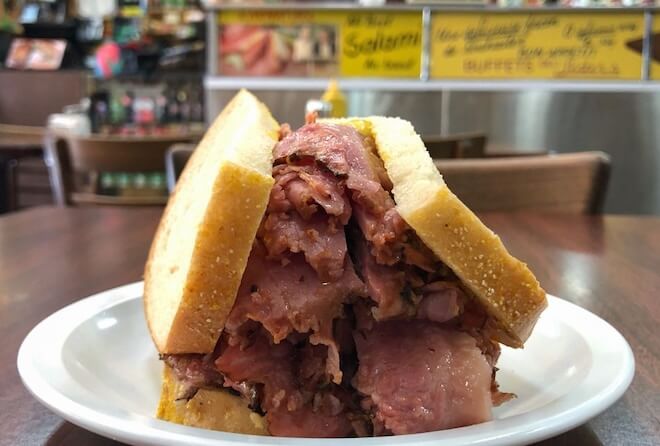
It sounded less like a demonstration and more like an invitation—as if Leonard, Nick, and I were about to meet at Lester’s Deli for a proper sandwich, on fresh rye, with mustard that actually means something. Not the cheap stuff.
The Bottom Line
The Quad 3 Integrated Amplifier gets the fundamentals right—and then stays out of its own way. What it does well is immediately obvious: tonal weight, midrange density, and a sense of proportion that makes long listening sessions easy and engaging. It pairs particularly well with speakers that lean lean, fast, or overly explicit, adding body and coherence without smothering detail. Vocals—especially female vocals and well-recorded jazz, soul, and singer-songwriter material—are a clear strength, and the amp’s quiet operation, stability, and consistent behavior across sources speak to conservative, competent engineering.
What it does great is system building. The Quad 3 is forgiving without being sloppy, expressive without being soft, and it manages to flatter a wide range of loudspeakers without imposing a single, rigid personality. The inclusion of HDMI ARC, a proper MM phono stage, a current-feedback headphone amp, and deep USB support (up to PCM 768kHz / DSD512) makes it unusually versatile for an amplifier that still feels resolutely old-school in its priorities.
The so-so? Absolute resolution and sub-bass grip aren’t class-leading, and listeners chasing forensic detail, ultra-tight low-end control, or studio-monitor neutrality may find it a touch too relaxed. Bluetooth is competently implemented but stops short of aptX Lossless or LDAC, and while full MQA decoding is included, some will question its long-term relevance.
What’s missing is largely what Quad chose not to chase: no streaming platform built in, no room correction, no DSP tone shaping beyond the elegant Tilt control, and no balanced inputs. None of that feels accidental—it feels deliberate.
So who is this amp for? Listeners who value tone, flow, and emotional weight over spec-sheet theatrics. System builders who want flexibility without feature bloat. And anyone tired of amplifiers that confuse aggression with insight.
At $1,895, the Quad 3 isn’t cheap—but it is sensible, thoughtfully engineered, and musically convincing. Is it worth the asking price? Without question. It was one of the easiest Editors’ Choice decisions I’ve made in years, precisely because it knows what it is—and refuses to pretend to be anything else.
Pros:
- Excellent tonal weight and midrange density; voices sound natural and unforced
- Quiet, stable Class A/B design that never runs hot or draws attention to itself
- Pairs exceptionally well with leaner, faster, or more revealing loudspeakers
- Thoughtful system-building features: HDMI ARC, MM phono stage, headphone amp, pre-out, 12V trigger
- Strong digital support via USB (up to 768kHz PCM / DSD512) and full MQA decoding
- Tilt control is genuinely useful and more musical than conventional tone controls
- Solid industrial design that respects Quad’s heritage without looking dated
- Sensibly priced for the performance and versatility on offer
Cons:
- Not a hyper-neutral or ultra-analytical amplifier; detail-chasers may want more edge
- Sub-bass grip is good but not class-leading with demanding speakers
- Bluetooth stops at aptX / aptX HD (no aptX Lossless or LDAC)
- No built-in streaming platform or room correction
- No balanced XLR inputs
For more information: quad-hifi.co.uk
Related Reading:
- Best Integrated Amplifiers: Editors’ Choice
- Quad Unveils Platina Integrated Amplifier: Exhaustive Redesign, Class A/B Power, Zero Nostalgia
- Quad 3CDT Arrives As The Quad 3’S Quiet, Disc-Spinning Sibling: A No-Drama CD Transport For Quad’s New Integrated










Anton
December 18, 2025 at 11:44 am
I was on the fence about the industrial design, but you’ve moved me into the “maybe I need to demo this” mode.
And +2 for the subtle Blackadder references. The U.K. is not the same place anymore. Amazed you can say anything against the government without being tossed in the drink.
Ian White
December 18, 2025 at 2:50 pm
Anton,
Is any place the same place anymore? England is just run by idiots. Like we are any better? Glad you caught the “cunning” part. In regard to the amplifier, it is indeed a very special piece. I highly recommend it.
IW
Mike Cornell
December 18, 2025 at 2:16 pm
As a longtime Quad owner (34/405), I’m really intrigued by this integrated. I feel it will perfectly ’integrate’ into our family room and be simple enough for the family to use while also giving me what I want….great sound, accessible tone controls as only Quad knows how to do them and a great aesthetic as well. If our living situation gets to the point where I can’t have a separate music system/room (condo or apartment living, for example), I could live with it as my one and only as well. Nice to see it pairs well with the Q’s, as I feel they would be a good fit for the above situations, as long as they don’t need to be pulled out too far from the front wall. Great review, Ian!
Ian White
December 18, 2025 at 2:48 pm
Mike,
Apppreciate the kind words. The best part is that I read the price wrong because it was part of a list of other Quad products. It’s only $1,800…not $2,800.
It’s a lovely piece of kit. Trying to convince someone to let me buy it. I like it that much.
IW
Mike Cornell
December 18, 2025 at 3:10 pm
A shade under $2700 CAD, so a bit more of an “ouch” but doable given the build quality and projected longevity!
Ian White
December 18, 2025 at 3:28 pm
Mike,
Canadian consumers always get screwed. Dollar sucks.
IW
Mike C.
December 20, 2025 at 10:22 pm
I’m probably carrying a prejudice towards this amp as I remember how a friend’s original 33/303 sounded back in the day compared to my Threshold 400a/SL10. I recall a very warm sound but with flabby(ish) bass. I do however like the design and form factor of the new version and plan to check it out in the flesh in the near future. Who knows…
PS – Fairmount is my favorite place for bagels in Montreal but St-Viateur is a close second. As for smoked meat, Lesters is good but my favorite is from a less famous deli in Laval (north of Montreal).
Mike
Ian White
December 20, 2025 at 10:31 pm
Mike,
It’s more modern sounding than the original 33/303 but I would agree that the bass could have more definition.
St. Viateur is great depending on the hour. Fairmount feels more like family to me. Georges is the only one that far north that comes to mind. I’m a Lester’s/Schwartz’s/Snowdon guy.
IW
Mike C.
December 21, 2025 at 12:00 am
The smoked meat place is Deli 440 in the Marché 440. An under the radar place you probably won’t find on ”best smoked meat” lists but I was born and raised in Montreal, haven’t been to Snowdon in ages but have eaten at Lester’s and Schwartz’s many times and to me their smoked meat edges out both those places. Their steak & pepperoni subs are pretty decent as well.
Rich
January 24, 2026 at 12:07 am
Hi Ian, fantastic review, thank you! I have the 5040s too and am REALLY interested in the Quad 3… been thinking for ages about which amp to upgrade to from my old Rotel RA-05. I’m using a WiiM Ultra and have a medium size room – kitchen and living room open space… not huge – 8x5m and I don’t listen to music at deafening levels. I do like to give it a little nudge when the missus is out but my Rotel is 40W and I NEVER go past 50% volume. I’m pretty sure the power of the Quad 3 is ample but wonder what you think? Also, do you use a sub? I’m thinking of adding a WiiM Sub Pro to my WiiM Ultra… just to beef up the base a little, but maybe it’s overkill with the Quad 3?!
Thanks so much!
Rich
Ian White
January 25, 2026 at 12:21 pm
Hi Rich,
Apppreciate the kind words. So the Quad 3 is an excellent match for the 5040 in terms of tonal balance, resolution, and the top end. It’s somewhat soft in the sub bass. You definitely feel the impact, but it’s not as defined as it could be. Soundstage is very wide (not as deep) and the imaging is quite solid. It’s more than enough power in my 16′ x 13′ x 9′ listening space where they are set-up. I have multiple subwoofers at home, but don’t use one at this point with the 5040. The WiiM Ultra is a very good match with the Quad 3. Tightens everything up. Very transparent presentation. I do run the Ultra straight into the Quad 3 and with a selection of DACs.
IW
Wayne Hatton
January 26, 2026 at 2:39 am
Ian: Would the Quad 3 be compatible with my Harbeth P3ESR bookshelf speakers? Wayne
Ian White
January 26, 2026 at 11:31 am
Wayne,
It truly depends on the tonal balance of the Harbeth (which I happen to think are wonderful sounding speakers) and how loudly you listen. The Quad 3’s one deficiency would be in the sub-bass when it comes to control and overall definition. There is certainly impact there, but the amplifier colors slightly outside the lines in that range. Not the firmest.
The Harbeth are wonderful at imaging and I think the Quad 3 would play along nicely here. It’s greatest strength is texture, flow, and overall tonal balance. It’s not a good choice for darker or thicker sounding speakers.
IW
Wayne Hatton
January 28, 2026 at 7:16 pm
Thank you Ian for your reply. I was mainly concerned with the ability of the Quad 3 to fully supply enough wattage to play the Harbeths properly. I’m 74, so I do not listen to music loudly played. I mainly play LP’s with my Linn LP-12, mostly jazz, blues, Dylan. They were formerly being powered with a Quad 405 and Quad 44. I also have constraints with the space available in my entertainment center. The Quad 3 suits that condition perfectly. Can you recommend any other Integrated amplifier that may be suitable to my needs and compliment the Harbeths that I absolutely adore. Wayne
Ian White
January 29, 2026 at 12:59 am
Wayne,
A few questions. Budget? MC or MM cartridge? Very few integrated amplifiers today offer both MM/MC phono stages (some are not very good) and I don’t want to recommend something that won’t be in your budget range and allow you to use the LP-12.
IW
Wayne Hatton
January 30, 2026 at 1:23 am
Ian: My LP-12 is fitted with an Ittok II arm, and I have a Clearaudio Virtuoso Wood MM cartridge on it. My budget for a new integrated amplifier is “ballpark” up to about $3500. I also have a large CD collection and will need a new CD player or transport. My LP collection contains predominantly English/European pressings and the CD’s are mostly Japanese SHM. I also have and use on occasion a Revox A-77 Dolby reel to reel recorder, and a Nakamichi 700 Tri Tracer cassette recorder. Older stuff I know, but well cared for and cherished. Quad is supposed to offer a new CD player later this year to match the Quad 3 amp., correct? Anyway, advice on a new integrated amplifier and CD player is appreciated. Thank you, Wayne Hatton
Ian White
January 30, 2026 at 11:39 pm
Wayne,
Very nice analog rig. We’ve already covered the new Quad CD Transport and it’s available now unless something changed. You can read about it here. QUAD 3CDT
I still think the Quad/Harbeth would be a good combination. I have a review coming next week of the Advance Paris A10 Classic Integrated which is also rather superb and a lot more powerful. And it has a tube section. Solid phono stage.
IW
Wayne Hatton
February 1, 2026 at 12:00 am
Thanks Ian. I always liked Quad. I was just told recently to look into the Exposure 2510 Integrated Amplifier. Have you heard anything about it? Wayne
Ian White
February 5, 2026 at 3:45 am
Wayne,
I know the Exposure but have not listened to the most recent versions in over a year. Very high quality but also a tad spartan from a features perspective. It’s very good equipment and also hard to find in America. Trade shows are the only opportunity for most people here to experience it.
IW
Ruben
May 10, 2026 at 9:48 pm
Hello everyone.
I own a Rega Planae 3 50th anniversary and i am searching for an amp and speakers that can combine well with the Rega. Yesterday i went to an hi-fi shop and the dealer suggested my the Quad 3 amp and the Sonus Faber Lumina 3. Any thoughts about that combination? I was looking for the Rotel A11 Tribute and the Dali Sonik 5 speakers but the dealer said i won’t get the juice of the rega with “my” combination.
Thanks
Ian White
May 11, 2026 at 10:55 pm
Ruben,
Depends on the tonal balance and presentation of the Sonus faber. Which cartridge are you using on the Rega? The new DALI Sonik are quite nice and would work well with the Quad if it has the typical DALI presentation — slightly bright and open treble range and more linear sounding midrange.
The Quad is a warm sounding amplifier. From top to bottom.
IW