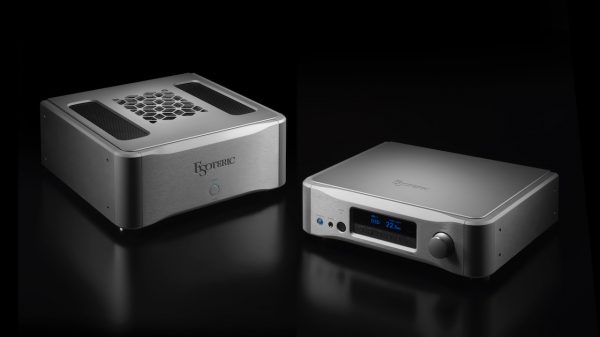
iFi Audio is swinging for the fences with the new iDSD PHANTOM, a flagship home component that rolls a reference-class DAC, ultra-resolution network streamer, and genuinely powerful headphone amplifier into a single chassis. This isn’t a cosmetic refresh of the Pro iDSD; it’s a ground-up rethink with a new streaming engine, higher-precision digital conversion, more output headroom, and finer user control across the board.
At £4,499 / $4,499 USD / €4,695 EUR / $6,999 CAD, the price will raise eyebrows—no getting around that—but in the context of what flagship DACs, streamers, and headphone amps cost when purchased separately, the math isn’t as crazy as it first looks. If iFi delivers on codec support, connectivity, power, and sonics as promised, the PHANTOM could be one of the most talked-about pieces on the CanJam circuit in 2026. Can they pull it off? I wouldn’t bet against them.
What Sets the iFi iDSD Phantom Apart: Streaming, Conversion, and Power at the Flagship Level
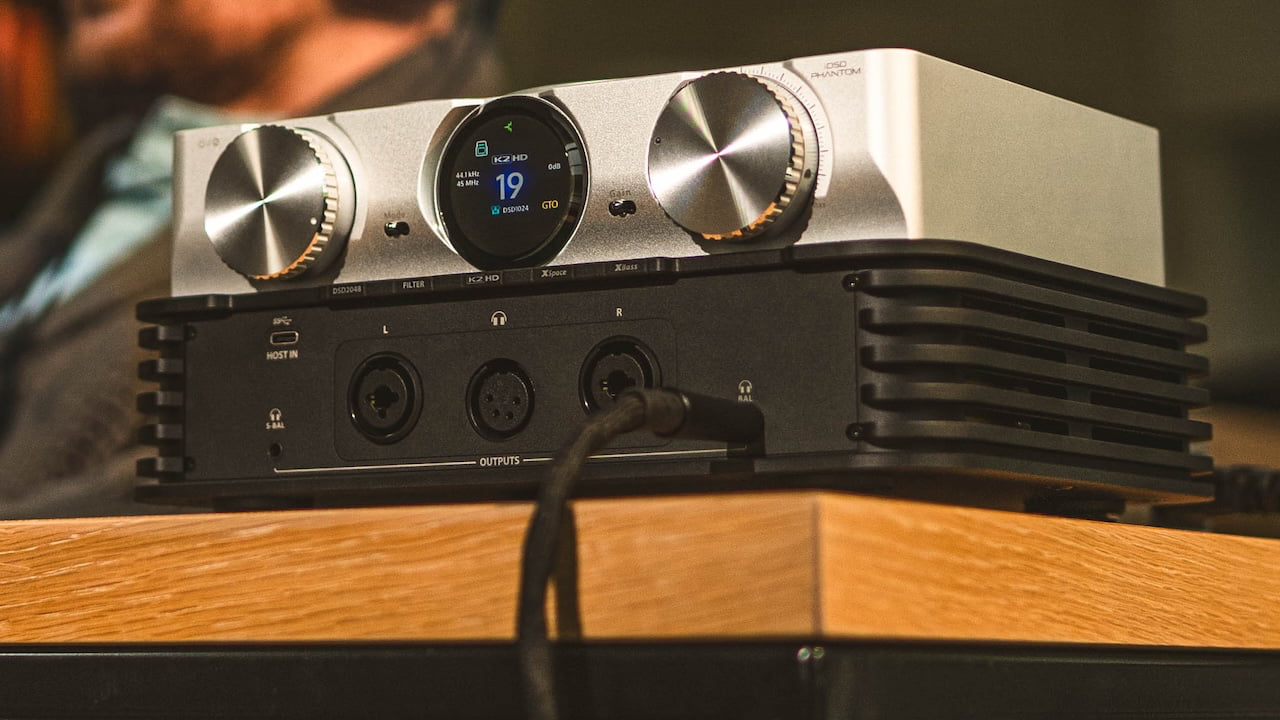
Beneath the PHANTOM’s two-tone industrial design is not a cosmetic refresh, but a wholesale rethink of iFi’s digital and analog architecture. The platform is built around a new streaming engine capable of handling up to 768 kHz PCM and DSD512 from services like Qobuz Connect and TIDAL Connect, paired with a quad Burr-Brown DAC topology focused on low-level linearity rather than spec-sheet theatrics.
On the processing side, iFi’s Chrysopoeia FPGA enables DSD remastering all the way to DSD2048, while K2HD processing is included to recover harmonic structure lost during production and encoding. Output stage flexibility is another key differentiator: users can switch in real time between discrete J-FET solid-state and NOS GE5670 tube stages, effectively offering three distinct amplification topologies in a single chassis.
Power is not an afterthought. The PHANTOM’s pure Class A headphone stage is rated at up to 7,747 mW peak, making it suitable for everything from efficient portables to current-hungry planar magnetics. Add iFi’s fully analogue XBass Pro and XSpace Pro circuits, along with selectable digital filters, and the result is a level of control and system integration that moves the PHANTOM well beyond a conventional DAC/amp—and firmly into reference territory.
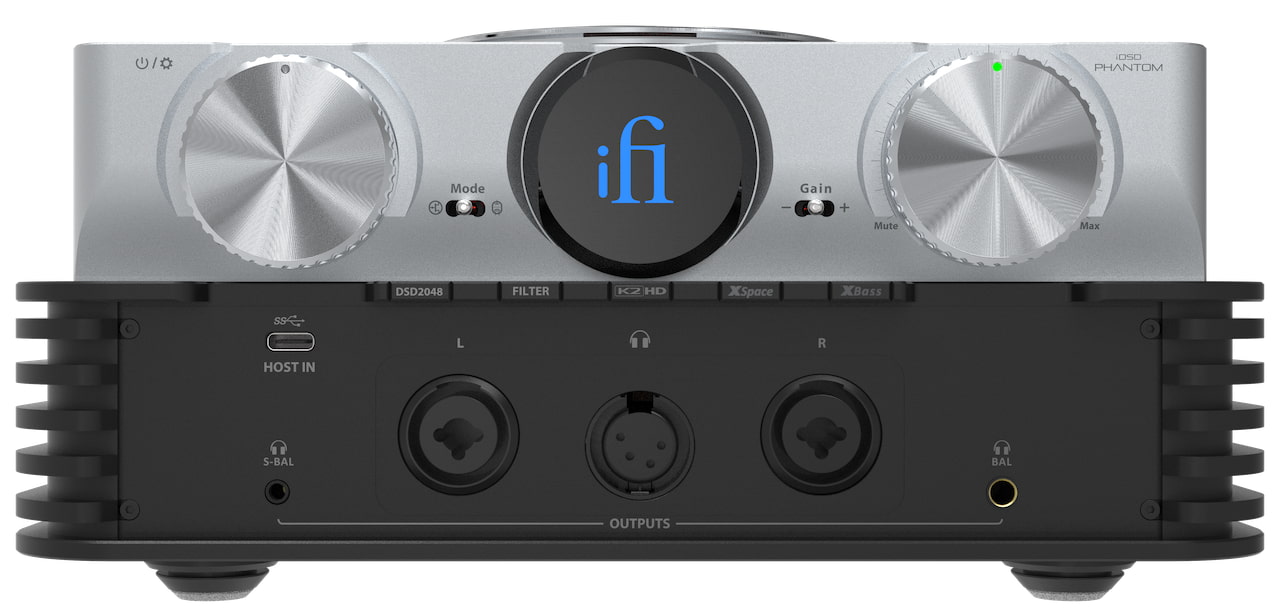
A True All-In-One Centerpiece
The iDSD PHANTOM adds Qobuz Connect to an already broad feature set that includes TIDAL Connect, Spotify Connect, AirPlay 2, and network playback from local libraries. The emphasis here is not just on format support, but on stability, responsiveness, and system control—areas where earlier network audio products often fall short.
Native support extends up to 768 kHz PCM and DSD512, with access to content stored on external USB drives and NAS systems across the home network. In practical terms, the PHANTOM is designed to function as the central digital hub of a serious two-channel or headphone-based system, rather than a bolt-on streamer.
Signal integrity is addressed with galvanic isolation on Ethernet, S/PDIF, and AES/EBU inputs, reducing the potential for noise transfer from connected sources. iFi’s Exclusive Modes further refine operation by disabling non-essential system processes during playback. The updated Nexis control app now supports Wi-Fi pairing and more direct system access, making day-to-day control simpler without sacrificing depth for advanced users.
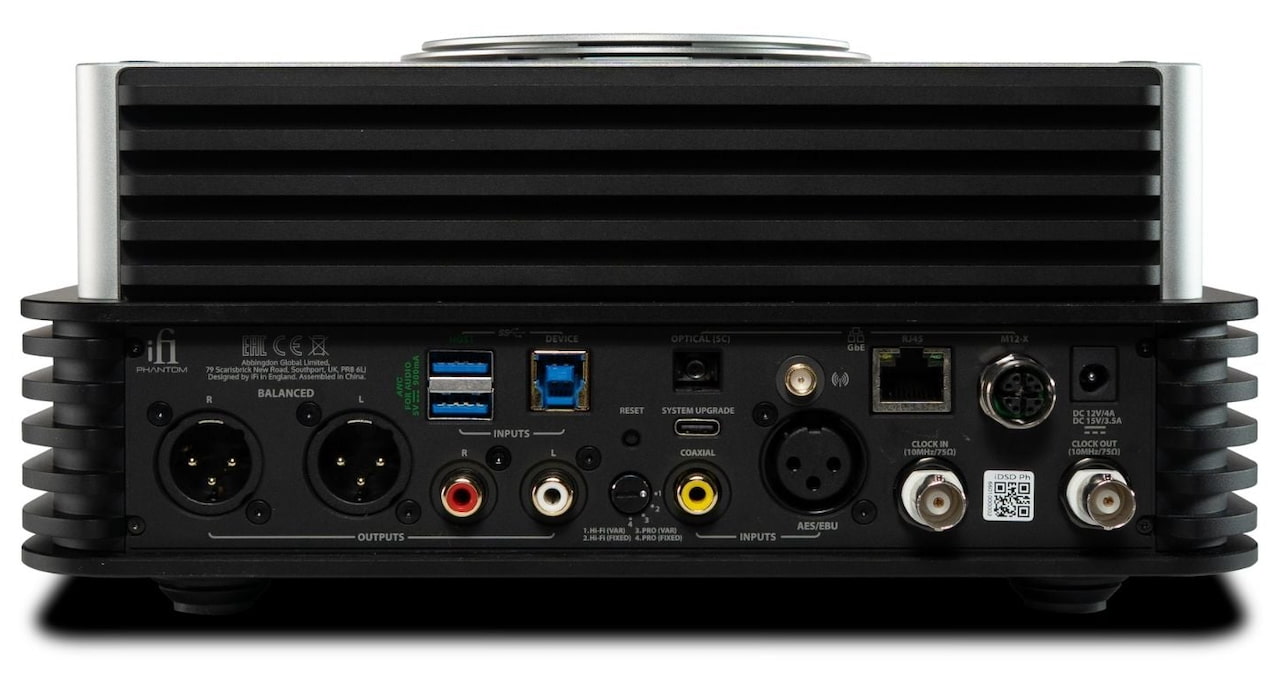
The World Premiere of DSD2048
DSD has long been a core part of iFi’s design philosophy, largely because of its strengths in low-level detail and time-domain behavior. With the PHANTOM, that approach has been taken further, not by adding another spec, but by reworking the entire remastering and conversion path with DSD as a primary format.
The Chrysopoeia FPGA remastering engine now supports conversion up to DSD2048. It applies iFi’s proprietary remastering algorithms and jitter reduction before the signal reaches the DAC stage. From there, DSD is converted directly to analogue using a delta-sigma modulator, with volume handled in the analog domain and no digital filtering applied to the DSD stream.
At the core are four Burr-Brown DSD1793 DACs in a custom interleaved configuration. In Normal mode, DSD passes straight through to the DAC, while PCM is processed via user-selectable digital filters. In Remastered mode, each DAC can operate up to DSD1024, enabling native decoding at DSD512, DSD1024, and, at the top of the range, DSD2048.
It’s also worth keeping the context clear: outside of the audiophile community, DSD is largely irrelevant. Most streaming services do not support it, and most listeners will encounter it only through locally stored files. The typical PHANTOM buyer may own some DSD content, but this is not a mainstream format. In that sense, DSD2048 is less about everyday use and more about offering maximum headroom and conversion precision for those who care about what happens at the very edge of digital audio.
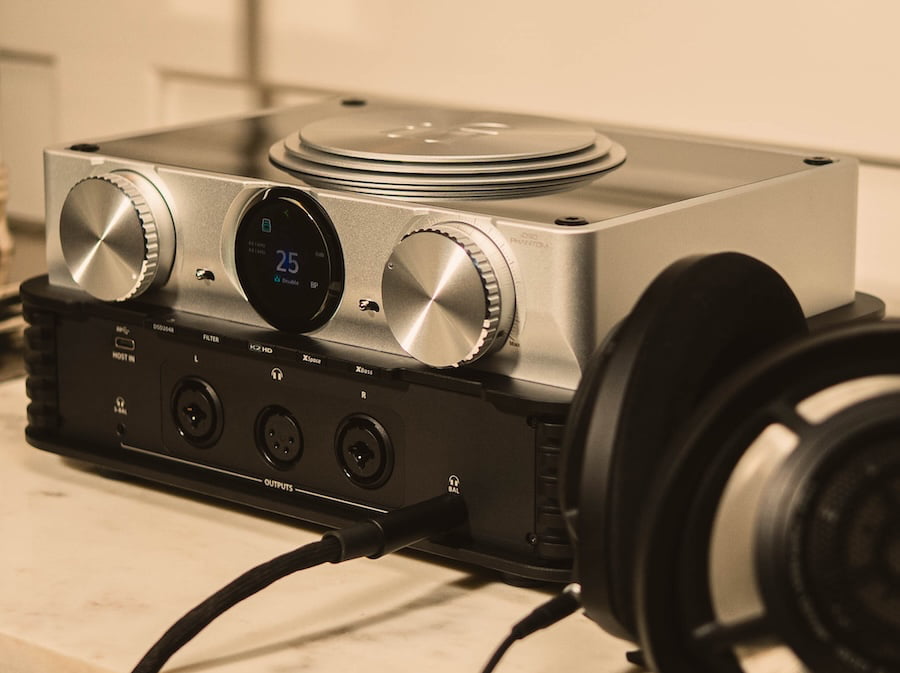
The PHANTOM’s Split Personality Disorder (In the Best Possible Way)
The PHANTOM doesn’t lock you into a single sonic personality. Instead, it offers three real-time, user-selectable output modes built around two completely different amplification topologies: solid state and tube. This isn’t new territory for iFi, but the execution here goes well beyond what the Pro iDSD delivered.
According to iFi, the output stage has been reworked for a significantly higher current capability, with revised voltage and operating points to improve drive and reduce distortion. The NOS GE5670 tube stage has also been carefully retuned to improve linearity and consistency, rather than simply leaning into coloration for effect.
In practice, you can switch between:
- Solid-State: A dual-mono, discrete J-FET stage focused on speed, control, and low distortion.
- Tube: A dual-mono GE5670 valve stage that trades a little precision for a smoother, more relaxed presentation.
- Tube+: A reduced loop-gain variant that increases second-harmonic content for more body and a distinctly vintage tonal balance.
Paired with a quoted 7,747 mW peak Class A headphone output, this flexibility makes the PHANTOM adaptable to almost any IEMs, dynamic or planar headphone on the market. The only real exception is electrostatics, which still live in their own ecosystem and require dedicated energizers. Had iFi solved that problem too, this would be the most unusual DAC/streamer/headphone amplifier ever built. As it stands, it’s already doing more than most competitors are willing to attempt.
Analog Rehab for Digital Music
Digital files don’t always survive the production chain gracefully. The PHANTOM addresses that with K2HD processing developed with JVCKENWOOD, designed to restore harmonic structure and timing cues that are often reduced during encoding and mastering.
Two modes are offered: K2, which maintains the original resolution, and K2HD, which can upsample to 192 kHz/24-bit. The processing is time-domain focused, not simple EQ, and is intended to recover natural overtones rather than add tonal coloration.
This is familiar ground for iFi. Several members of our team use K2HD daily in products like the GO bar Kensei—and I travel with one myself. In the PHANTOM, the same concept is executed at a far more serious, system-level scale.
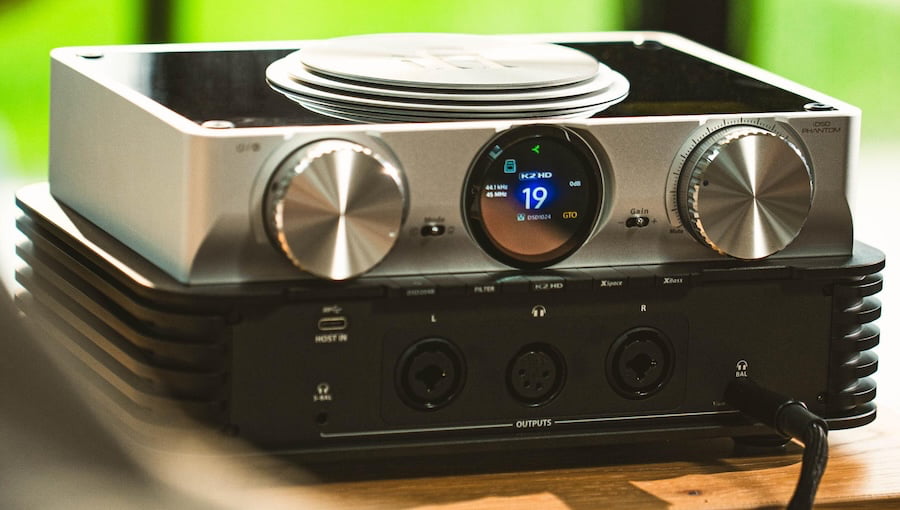
Tone Control for Grown-Ups (No, Not the 1987 Kind)
Open-back headphones are prized for space and air, but they rarely deliver true low-end weight. Even many closed designs leave something on the table. The PHANTOM addresses both ends of that problem with fully analog shaping that’s meant to be useful, not gimmicky.
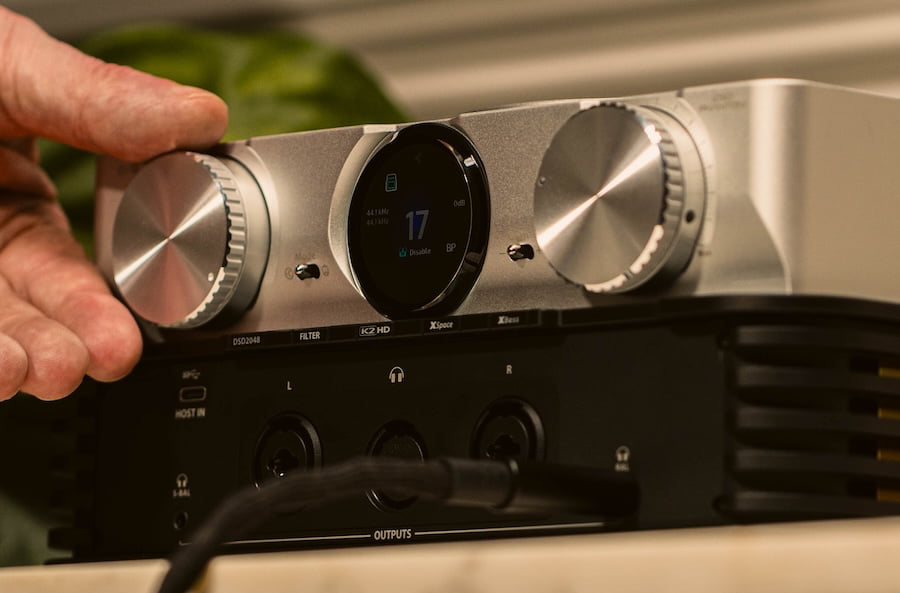
XBass Pro is a variable shelving EQ with 10, 20, and 40 Hz options, designed to restore bass impact without thickening the midrange. It’s particularly effective with open-backs and leaner planars, and the adjustment range makes it practical across a wide range of headphones.
XSpace Pro tackles the other common limitation of headphone listening: scale. Rather than conventional crossfeed, it uses iFi’s own spatial processing, offering 30°, 60°, and 90° presentation options to create a more speaker-like soundstage without smearing detail.
These circuits are integrated into a redesigned feedback architecture to maintain impedance stability, low noise, and consistent performance when engaged.
Once the analog side is set, the PHANTOM also provides selectable digital filters:
- Bit-Perfect / Bit-Perfect+ for unprocessed playback.
- GTO for upsampling to 352.8/384 kHz with minimal post-ringing.
- Transient Aligned for smoother, more controlled presentation.
- Apodising for higher-rate upsampling to 705.6/768 kHz with a softer transient profile.
The Bottom Line
The iFi iDSD PHANTOM isn’t a lifestyle DAC with a headphone jack. It’s a serious, no-compromise headphone-first platform that happens to include one of the most advanced digital front ends iFi has ever built.
What makes it genuinely different is the combination of features you simply don’t find together elsewhere: real-time tube and solid-state output stages, DSD2048 remastering, K2HD processing, a quad Burr-Brown DAC architecture, and a high-power Class A amplifier capable of driving virtually any dynamic or planar headphone or IEM on the market. (Electrostatics remain their own ecosystem and still require dedicated energizers.)
At $4,499 (£4,499 / €4,695 / $6,999 CAD), this is not an impulse buy. But as a single-box solution that replaces a DAC, a streamer, and a reference headphone amplifier, the pricing is far more rational than it first appears.
The PHANTOM is for the listener who lives in headphones, wants real control over voicing and presentation, and refuses to compromise on format support or drive capability. If that sounds like you, iFi has built one of the most distinctive and ambitious headphone components of the year.
Where to buy: $4,499 at iFi Audio
Related Reading:
- iFi GO bar Kensei Review: Can this Dongle DAC Slice Its Way Through the Competition?
- Best Headphone Amplifiers: Editors’ Choice 2025
- iFi iDSD Valkyrie DAC/Headphone Amp Review: Futureproof Powerhouse or Feature Fatigue?