
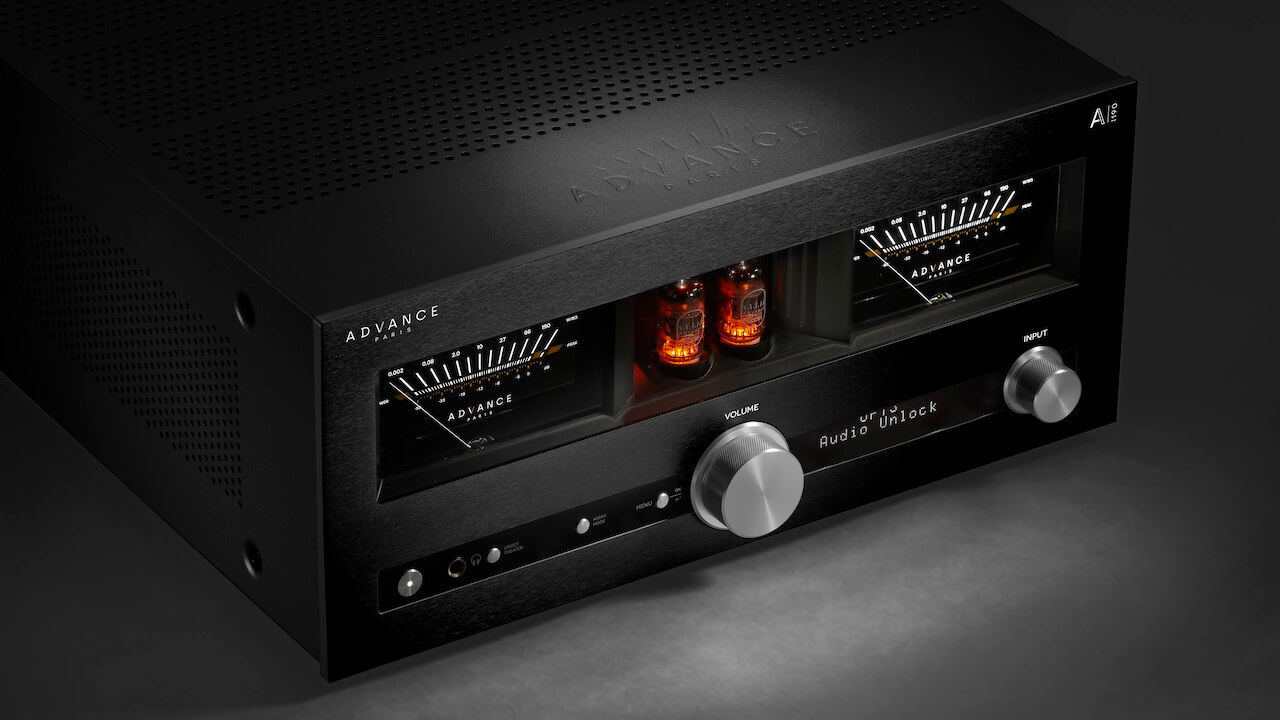
Advance Paris is bringing its new NOVA flagship series to AXPONA 2026, and it feels like the next deliberate step in a push that has already kicked down more than a few doors on this side of the pond. The French brand, which has quietly built momentum in the U.S. and Canada with its retro-leaning aesthetic and feature-rich designs, is officially unveiling a five-product NOVA range built around two integrated amplifiers, a modular streaming cartridge, a bi-directional Bluetooth dongle, and a rotary remote that leans hard into tactile control.
Unlike some of its compatriots; YBA, Devialet, Metronome, and Jadis, that tend to favor either stark minimalism or full blown luxury theatrics, Advance Paris has found a middle ground that actually resonates with North American listeners. NOVA sits at the top of that strategy, combining amplification, streaming, and wireless connectivity into a modular system designed to evolve over time rather than lock users into a single box solution.
A-i130 & A-i190 Integrated Amplifiers
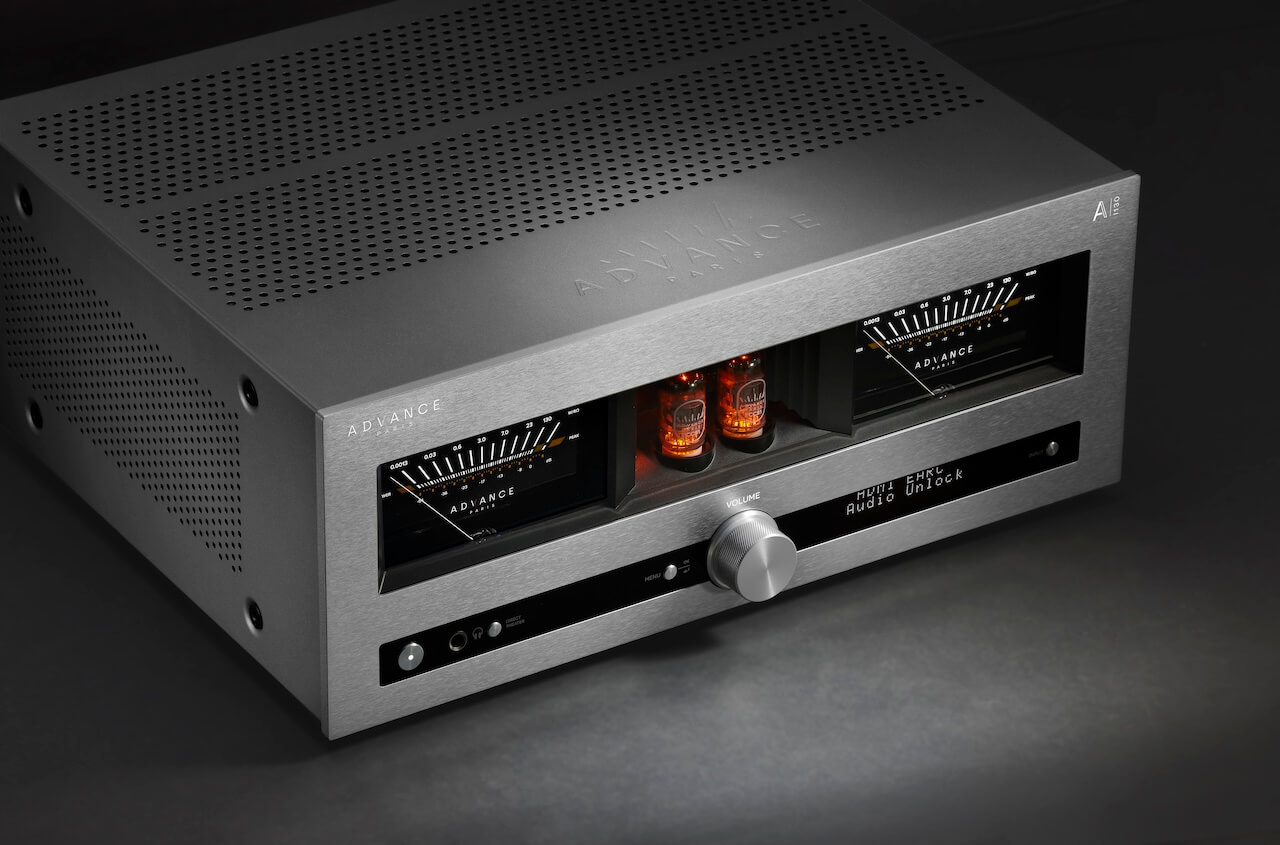
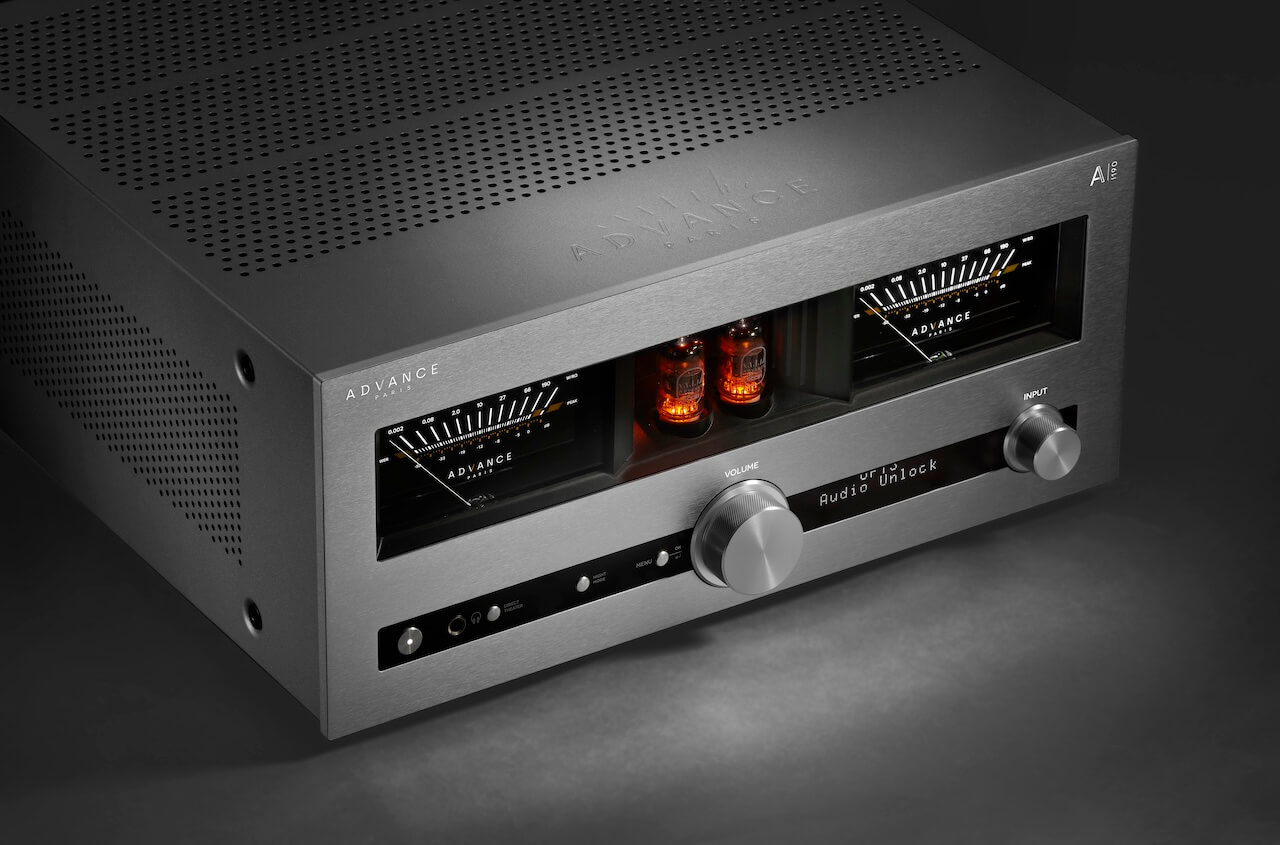
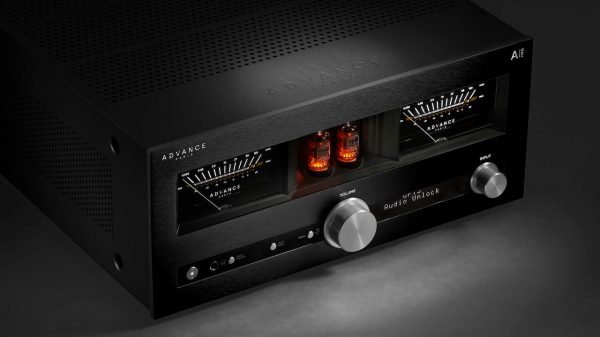
Both the A-i130 and A-i190 are built on the same core idea: this isn’t just an integrated amplifier, it’s the control center for an entire system. Advance Paris is combining hybrid amplification, DSP, DAC, and subwoofer management into one chassis and then letting you expand it later with modular add-ons. That’s the play.
At their core, both models use a hybrid design with an ECC81 tube preamp stage feeding a Class A/B output section. You get some harmonic texture without sacrificing control. On the digital side, both rely on an ESS9017 DAC running in Quad mode, paired with a 4 channel DSP that handles EQ and room correction across left, right, and up to two subwoofers.
Subwoofer integration is taken seriously here. Both support 2.1 or 2.2 configurations with a proper crossover and independent control, which immediately separates them from a lot of integrated amps still pretending subs don’t belong in two channel systems.
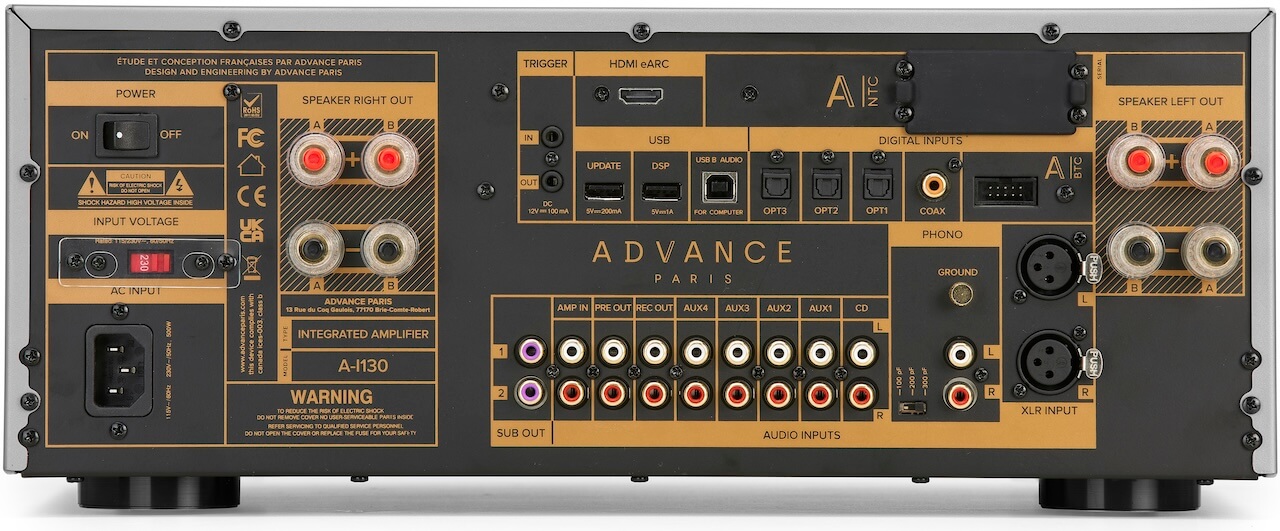
Add HDMI eARC, USB with DSD support, multiple optical and coaxial inputs, five line level RCA inputs, MM phono (with ground), pre-out, record out, dual sub outs, and a 6.35 mm headphone jack, and both units are clearly designed to replace a stack of separates without feeling compromised.
They also share the same expansion path. Both include slots for the optional A NTC streaming cartridge and A BTC Bluetooth module, enabling full streaming or bi-directional wireless audio including headphone transmission. And yes, both support the rotary remote if you want tactile volume control without getting off the couch.
Physically, these are not compact lifestyle boxes.
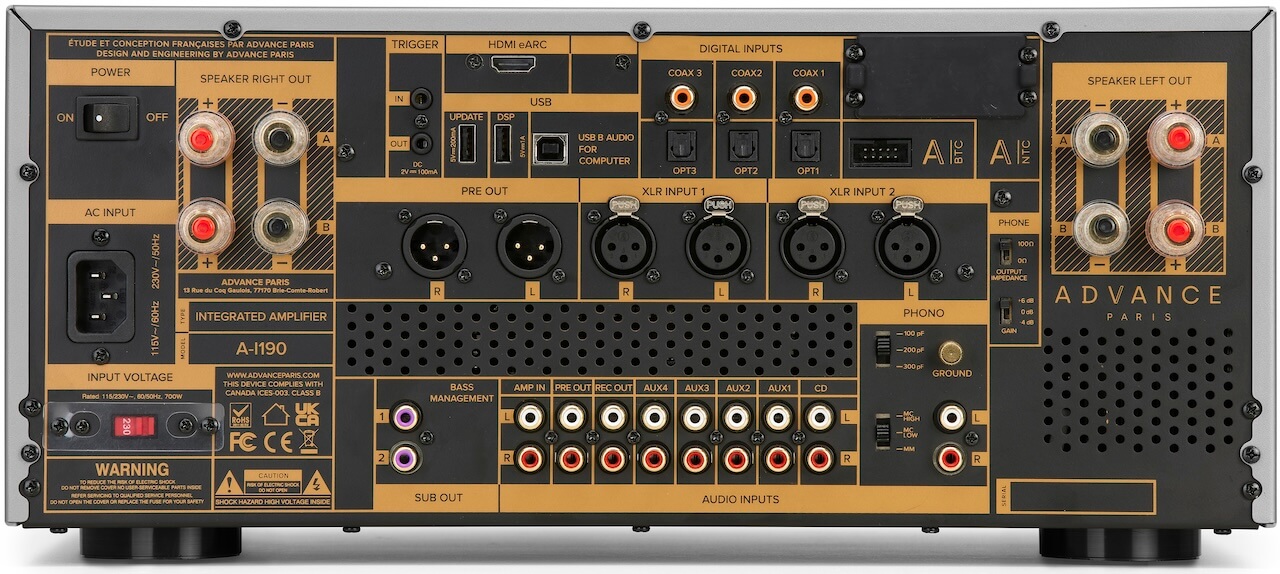
The A-i130 measures 43 x 17.5 x 35.1 cm (16.9 x 6.9 x 13.8 inches) and weighs 13.3 kg (29.3 lbs). Think of it as the Marion Cotillard of the lineup; refined, composed, and quietly in control of the room.
The A-i190 grows in every direction at 43 x 19.2 x 45.4 cm (16.9 x 7.6 x 17.9 inches) and 19 kg (41.9 lbs), which tells you exactly what’s going on inside before you even turn it on. This one is Vincent Cassel; leaner than you expect, hits harder than it should, and absolutely not here to play nice.
Where they diverge is power, architecture, and connectivity.
The A-i130 delivers 130 watts per channel into 8 ohms using a single toroidal transformer. Its connectivity is extensive but entirely single ended on the analog side. You get five RCA line inputs, an MM phono input with grounding terminal, and RCA outputs for pre out, record out, and dual subwoofers. Digital inputs include three optical, three coaxial, USB audio with DSD support, and HDMI eARC for TV integration. There’s also a 6.35 mm headphone output on the front. It’s a complete, modern hub without unnecessary complexity—and for most systems, it’s not leaving anything on the table.
The A-i190 takes that foundation and pushes it into more serious territory. It moves to a dual mono design with two toroidal transformers, effectively isolating each channel and increasing output to 190 watts per channel with greater headroom. Connectivity expands where it actually matters: in addition to the same five RCA line inputs and digital suite (optical, coaxial, USB, HDMI eARC), the A-i190 adds balanced XLR inputs and a balanced XLR pre out alongside the RCA pre out. The phono stage is upgraded to support both MM and MC cartridges, and it retains dual subwoofer outputs and record out. In other words, it’s not just more power—it’s built to integrate into more demanding, higher-end systems without forcing compromises.
A-NTC Streaming Cartridge Turns NOVA into a Real Network Player
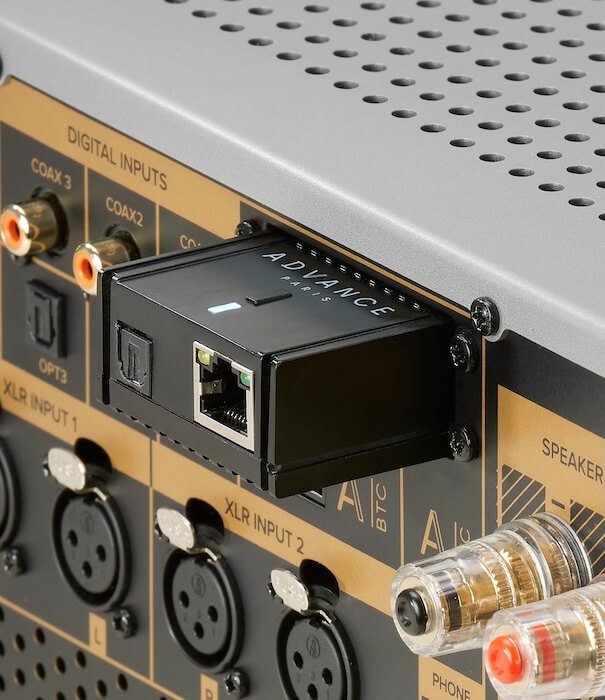
The A-NTC is Advance Paris’ modular answer to streaming, and it’s designed to work two ways without overcomplicating things. On its own, it can function as a standalone streamer via its optical output, adding network playback to any system with a compatible digital input. Install it into the expansion slot on the A-i130 or A-i190, and it disappears into the chassis; no extra cables, no extra box, just a fully integrated streaming amplifier.
It supports the platforms that actually matter: Spotify Connect, TIDAL Connect, Qobuz Connect, AirPlay 2, Chromecast, DLNA, and Roon, with connectivity over Ethernet or Wi-Fi. Output is capped at 24-bit/192 kHz, which covers the vast majority of real world streaming use cases without pretending to chase numbers for marketing.
The key point here is integration. This isn’t another streamer fighting for shelf space, it’s part of the ecosystem. Clean, functional, and exactly what most people will use.
A-BTC Bluetooth Dongle Adds Wireless Flexibility Without Pretending It’s Perfect
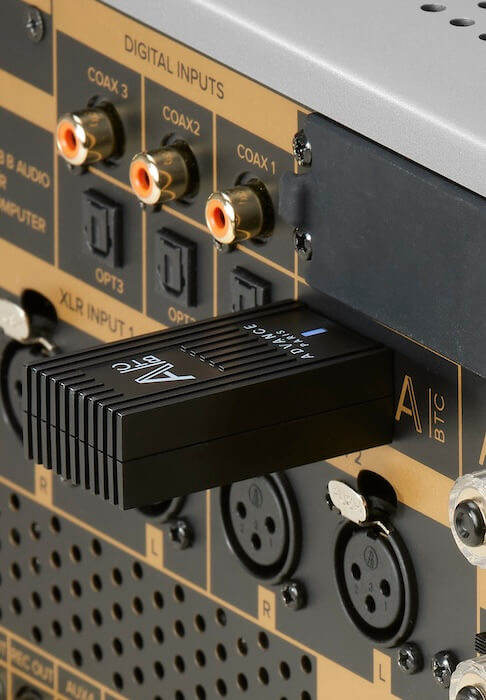
The A-BTC is a bi-directional Bluetooth 5.4 module that uses the same expansion slot, adding both transmit and receive functionality to the NOVA platform. You can stream from your phone to the amplifier or send audio out to a single pair of Bluetooth headphones; useful for late night listening or keeping the peace when the rest of the house is asleep.
Codec support includes aptX HD, aptX Adaptive, aptX Low Latency, and AAC, which gives you solid coverage for both sound quality and low latency video use. Lip sync should be tight with aptX LL, and aptX Adaptive handles variable bitrate conditions more gracefully than older standards.
What it does not include is just as important: there’s no LDAC and no aptX Lossless. That’s going to matter if you’re running newer wireless headphones that rely on those codecs for maximum resolution. In other words, this is a well executed, practical Bluetooth solution, but it’s not chasing the bleeding edge of wireless audio.
A-RTR Rotary Remote Brings Back Tactile Control
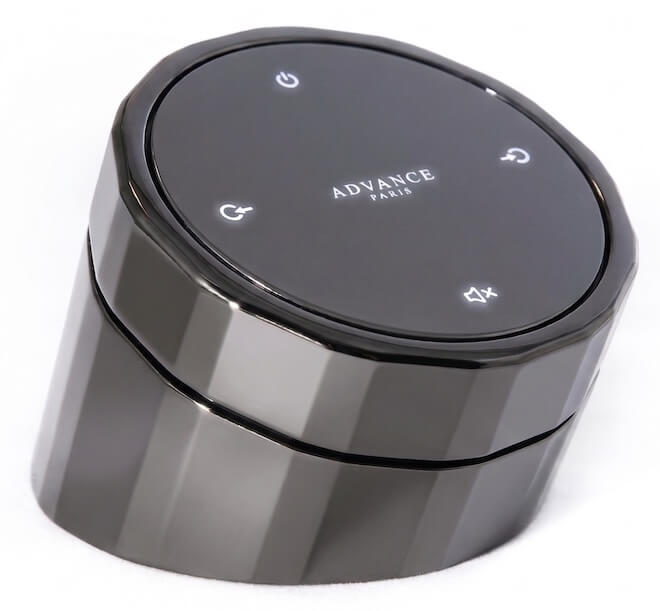
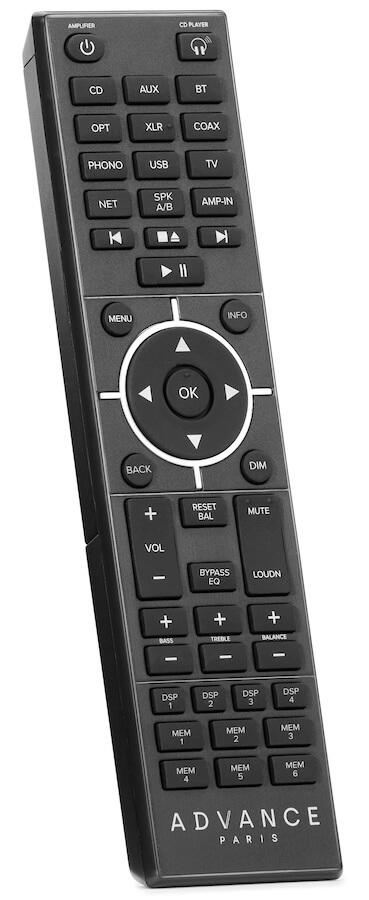
The optional A-RTR rotary remote is exactly what it looks like: a solid, weighty metal control designed to live on your coffee table or listening surface, not get lost between couch cushions. It connects wirelessly to the A-i130 and A-i190 via the A-BTC Bluetooth module, so yes—you need that piece in place for this to work.
Functionally, it keeps things simple. The rotating crown handles volume, while additional controls manage input selection and power. No screen, no app dependency, no nonsense. Just direct control with a physical interface that mirrors the design language of the amplifiers themselves.
This is clearly aimed at listeners who are tired of poking at phones or dealing with plastic remotes that feel like they came free with a toaster. It’s not about adding features, it’s about restoring a more tactile way to interact with the system.
As Cédric Léon, Product Manager at Advance Paris, puts it: “With these new products, we are offering a future proof audio solution that is both powerful and versatile—and really leans into the modern and sleek aesthetic Advance Paris is known for. Whether you’re looking for the best possible sound quality, streaming flexibility, or an amplifier that can adapt to a variety of needs, this new product lineup has it all.”
The Bottom Line
The NOVA range stands out because it combines a hybrid tube front end, Class A/B power, 4-channel DSP with real subwoofer integration, and a modular expansion path that lets you decide how far down the streaming and wireless rabbit hole you want to go. Two slots, two modules, and a clear upgrade path.
The execution matters. Both integrated amplifiers function as serious control centers with proper inputs and outputs, HDMI eARC, and flexible bass management, which is something a lot of competitors still treat like an afterthought. The A-i190, in particular, leans into higher end territory with dual mono architecture and balanced connectivity, making it viable in more ambitious systems.
The modular approach will feel familiar to anyone who has spent time with NAD and its MDC ecosystem, especially in the Master Series. Same idea: don’t lock the user into a fixed feature set that ages out in two years. Let them add what they need. The difference here is that Advance Paris is applying that concept to a more stylistically distinctive platform.
That said, there are tradeoffs. At these prices, a lot of competing integrated streaming amplifiers already include network streaming out of the box. Here, it’s a paid add-on. And while the Bluetooth module is well executed, the lack of LDAC and aptX Lossless means it’s not chasing the highest tier of lossless wireless audio performance.
The A-RTR remote is another interesting play. It’s tactile, heavy, and clearly designed to be part of the experience, but it will look very familiar if you’ve seen what Devialet and MOON by Simaudio have been doing for years. Whether that’s homage or imitation depends on your level of cynicism.
So who is this for? Someone who wants a modern, feature rich integrated amplifier with real system flexibility, but doesn’t want to be locked into an all in one streaming platform that may age poorly. Someone who values tactile control, clean system integration, and the ability to evolve over time.
Related Reading:
- Advance Paris Unveils A8, A10, A12 APEX Integrated Amps & ACD CD Player: French Luxury, With A Wink
- Review: Advance Paris LINK Cables — So French They Probably Judge Your Other Cables Silently
- Advance Paris’ New Wave Of French Hi-Fi Finally Makes It Across The Pond…30 Years Later
- Best Integrated Amplifiers: Editors’ Choice 2025














Gil Poulsen
April 8, 2026 at 2:28 pm
Hey, just FYI, AFAIK Arylic created that ATR Rotary Remote a couple years ago. Looks like Advance Paris maybe bought the rights to it, or they had Arylic make them a branded version?
They call it the BK10 Lifesyle: https://www.arylic.com/products/bk01-smart-remote-control
Ian White
April 8, 2026 at 2:33 pm
Gil,
That’s why I made the comment. It looked very familiar to me. Good to know and thanks for the heads-up.
IW