

Table of contents
Introduction
Digital music streaming owns roughly 85% of the market in 2025, and that grip is only tightening. Spotify finally rolled out Spotify Lossless for Premium users this year—a seismic shift considering its footprint—while Qobuz Connect blasted past 100 hardware partners in under a year, instantly becoming one of the most important features in the hi-fi ecosystem. Between Spotify, Apple Music, Amazon Music HD, TIDAL, Qobuz, and Deezer, every corner of the listening world now has a platform tailored to its tastes. Even classical fans, long ignored, now have Apple Classical (built on its Primephonic acquisition) and Idagio to keep them well-fed.
But streaming’s rise hasn’t been without bruises. TIDAL continues to shrink after layoffs and the slow-motion collapse of the MQA partnership it once championed. Formats like MQA and Sony 360 Reality Audio are now gone from the service, replaced by good old-fashioned FLAC. All of this makes the question clearer than ever: why bother with a dedicated streamer when everyone already has a smartphone in their pocket?
Because a phone simply isn’t built for serious audio. Battery drain, dongle clutter, and mediocre internal DACs limit what your system can do. A proper streamer lifts those bottlenecks—unlocking better clarity, dynamics, and fidelity when paired with capable speakers or headphones. If you care about sound, your phone is the weak link; the streamer is the upgrade.
A network streamer lives or dies by its control app. Bluetooth playback is table stakes, but the real value comes from a well-designed app that lets you browse multiple streaming services, internet radio, and your local music library from a single interface over Wi-Fi or Ethernet. And these apps have grown up fast: many now include advanced tools such as room correction, onboard EQ, and automated system calibration that used to be reserved for AVRs and high-end processors. A great app doesn’t just control your streamer—it elevates your entire system.
Best Music Streamers of 2025
WiiM Pro Plus ($219)

The WiiM Pro Plus expands on the success of the $99 WiiM Mini and $149 WiiM Pro with upgrades that genuinely earn the higher price tag. The shift to an AKM 4493SEQ premium DAC brings support for up to 768kHz PCM and DSD512 with automatic switching, while a TI Burr-Brown PCM1861 ADC enables 192kHz/32-bit digital output—serious hardware for a budget streamer. Its platform compatibility remains one of the strongest in the category: AirPlay 2, Spotify Connect, TIDAL Connect, Qobuz, Amazon Music, Deezer, TuneIn, iHeartRadio, and full Chromecast-enabled app streaming. Add a 10-band graphic EQ, additional digital EQ tools, and the later addition of Roon Ready and parametric EQ via firmware, and you have one of the most complete feature sets under $300.
Extended listening confirms that the Pro Plus isn’t just spec-sheet padding. There’s a clear improvement in midrange resolution, clarity, and timbral accuracy over earlier WiiM units, and the overall presentation feels more refined without losing the brand’s easygoing character. You don’t get a touchscreen, but realistically, nobody wants to operate a streaming device on their knees when the app does everything flawlessly. The only real caveat is the shadow cast by the $329 WiiM Ultra sitting just above it. Still, at $219, the Pro Plus remains one of the strongest price-to-performance propositions in the streaming category.
Go to full review | $219 at Amazon
WiiM Ultra ($329)

The WiiM Ultra Music Streamer delivers an impressive mix of performance and versatility for $329 USD, making it one of the best options under $1,000. It packs serious connectivity — HDMI ARC for your TV, subwoofer output, coaxial and optical digital I/O, analog inputs, and even a built-in MM phono preamp. Inside, an ESS Sabre ES9038Q2M DAC handles up to 32-bit/384kHz PCM, and the sharp 3.5-inch color touchscreen gives it a premium feel that rivals streamers costing far more. The control app is intuitive and supports TIDAL Connect, Spotify Connect, and Alexa, though Apple users may groan at the lack of AirPlay 2.
Sound quality is clean, open, and largely neutral — an easy match for a wide range of amplifiers and active speakers, though some might prefer pairing it with warmer gear to balance the precision. The phono stage is serviceable but not standout, yet at this price, the feature list and sonic clarity are tough to beat. For anyone who wants high-resolution streaming with serious flexibility and usability, the WiiM Ultra is an easy recommendation.
Bluesound Node ICON ($999)

The Bluesound NODE ICON is a serious step up for the brand’s streamer lineup, blending audiophile-grade engineering with luxury-level design. Its Dual-Mono DAC configuration uses two ESS Sabre ES9039Q2M chips for exceptional clarity, dynamic range, and timing precision—further refined by MQA Labs’ QRONO D/A technology. Add THX AAA headphone amplification, a 5-inch full-color display, and balanced XLR outputs, and you’ve got a streamer built for both critical listening and everyday ease of use. Connectivity is equally robust, with HDMI eARC, coaxial, optical, RCA, USB, and even a high-performance ADC for pristine analog-to-digital conversion.
Housed in a sleek aluminum chassis with a glossy black finish, the NODE ICON feels every bit as premium as it sounds. It’s also Dirac Live–ready (license and calibration kit sold separately), allowing users to fine-tune their rooms for optimal playback. Sonically, it delivers a warm yet articulate presentation—less lush than older NODE models, but with greater transparency, stereo separation, and control. Well-built, intuitive, and impressively capable, the NODE ICON sets a new benchmark for Bluesound and anyone chasing high-end performance in a compact, modern package.
Where to buy: $999 at Crutchfield | Amazon
Cambridge Audio EXN100 ($1,799)
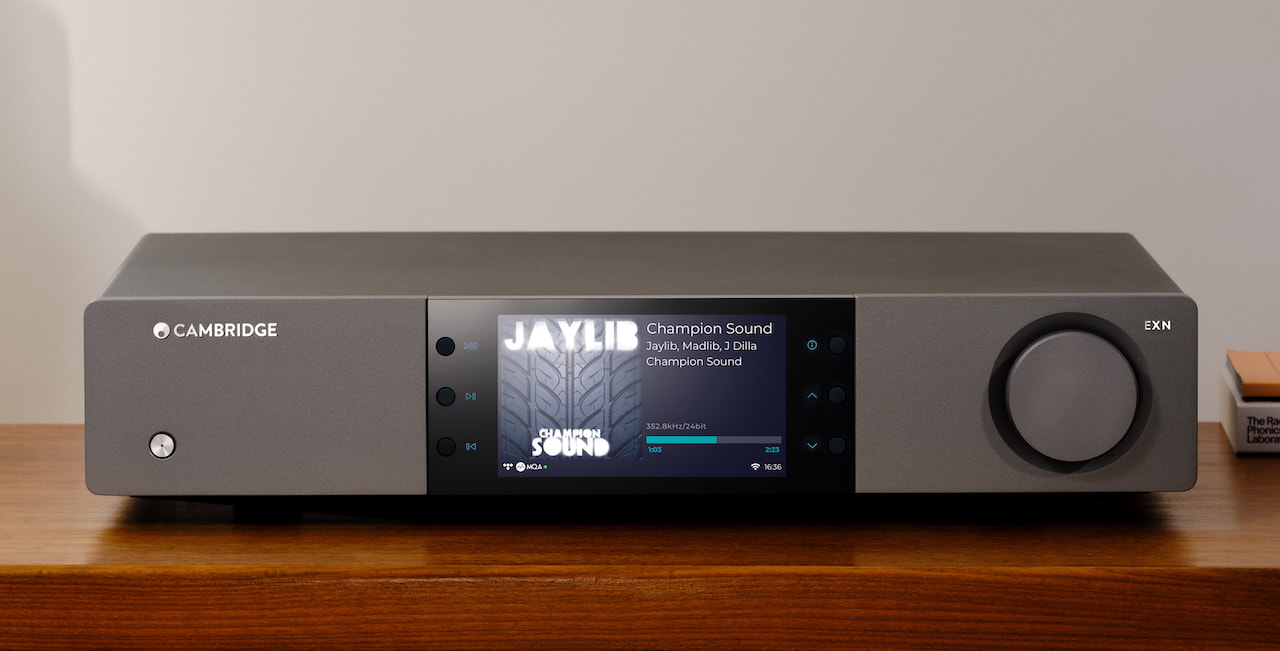
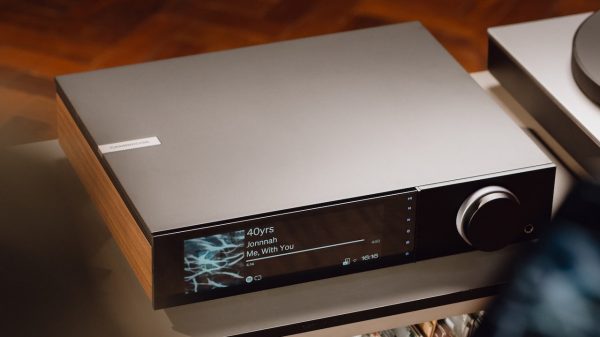
The EXN100 earns its spot on this year’s list because it pushes Cambridge Audio’s network streamer lineup into noticeably bolder, more refined territory. Built on the same fourth-generation StreamMagic platform as the CXN100, the EXN100 adds deeper streaming support, upgraded hardware, and a far more premium physical design. The ESS ES9028Q2M SABRE32 DAC brings wider dynamic range and lower distortion, delivering a presentation that starts to inch closer to the company’s Edge Series rather than simply improving on the CXN100. Add in preamp functionality with both RCA and balanced outputs, full high-resolution support up to 32-bit/768kHz PCM and DSD512, and a broader set of digital inputs, and you have a streamer designed to anchor a serious system—not just complement one.
The question, of course, is whether it’s $500 to $700 “better” than the already excellent CXN100. In terms of build quality, flexibility, and audible performance, the answer leans toward yes. The thicker casework, milled aluminum faceplate, and expanded 5-inch display give it a more sophisticated presence, while HDMI eARC, Chromecast, AirPlay 2, aptX HD Bluetooth, and Roon Ready support make it one of the most versatile streamers in its class. With StreamMagic gaining Amazon Music, Spotify normalization, QPlay, and Qobuz Connect support in 2025, the EXN100 benefits from a rapidly improving ecosystem. The CXN100 remains a superb value at around $1,100, but the EXN100 delivers a bigger, richer, more dynamic sound that justifies the premium for listeners building a system where the streamer is the centerpiece rather than an accessory.
Where to buy: $1,799 $1,599 at Crutchfield | Cambridge Audio
The Bottom Line
The Cambridge Audio EXN100, Bluesound Node ICON, WiiM Ultra, and WiiM Pro Plus paint a clear picture of where streaming is headed in 2025: smarter platforms, better DAC architecture, broader service support, and serious performance at prices that would’ve seemed laughable a decade ago. Cambridge brings the most refined all-rounder with genuine DAC flexibility and a more analytic, high-resolution sound; Bluesound offers a polished ecosystem and tighter multiroom integration; and WiiM continues to swing way above its pay grade with shockingly complete feature sets at budget prices.
But the real story is what comes next. The under-$2,000 streamer category is about to get crowded in 2026, with new challengers arriving from FiiO, Topping, Eversolo, and others who plan to squeeze even more performance out of every dollar. If 2025 set the stage, 2026 may be the year the value wars truly begin.
Related Reading:


























Mike
December 15, 2025 at 6:47 pm
What? No Eversolo? It should be on number one.
Ian White
December 16, 2025 at 1:48 am
Mike,
Why should it be “number one?” My experience so far with their streamers has been only mixed. I found it very dry sounding. Most certainly needs a DAC with some extra padding. I also don’t think their control app is on the same level as the WiiM Control app.
We plan on listening to the T8 in 2026 and we’ll see how it performs.
IW
Mike
December 15, 2025 at 6:49 pm
Eversolo has been around just as long as the WiiM.
Ian White
December 16, 2025 at 1:52 am
Mike,
And? Bluesound has been around longer than both of them combined. Eversolo does some things very well, but my experience so far has been that the WiiM Ultra offers the most potential in terms of getting the best sound quality out of a player below $1,000.
The Innuos and Aavik players are miles ahead of both. Like comparing a BMW M5 or Audio RS8 to a Toyota.
IW
D Clark
December 16, 2025 at 4:38 pm
Volumio Rivo+ with it’s Lineo5 power supply walks off with all the accolades at £1400.00 or there abouts. It’s only problem is it will need a reboot now and again, but when it’s sounds so good at that price nothing comes close.
Admittedly you need a Dac but then most people have one or it’s built into the Amp so it’s not a problem.
Montanero
December 20, 2025 at 10:19 pm
After purchasing a Node Icon to replace an Allo Digione Signature with dedicated power supply; I am impressed, excellent value for dollar and superb sound reproduction and usability. It also integrates easily with a subwoofer and powered speakers.
Ian White
December 20, 2025 at 10:26 pm
Solid choice and good use of your money.
IW